• Quick note - the problem with Youtube videos not embedding on the forum appears to have been fixed, thanks to ZiprHead. If you do still see problems let me know.

Reincarnation as a trivial scientific fact

I don't understand your reasoning. You had claimed that an alleged population decrease of the Giant Panda caused by low fertility is evidence against Giant Panda reincarnation. I answered that if such a population implosion had occurred in recent times, "then this actually would constitute strong evidence against my evolution-by-reincarnation theory".

This conclusion is based on the premise that no closely related species has been growing at the expense of the Giant Panda population in recent times. However, if not even the Red Panda is relatively closely related to the Giant Panda then my argument becomes even more straightforward, and you simply have to provide evidence for your original claim in order to seriously attack the psychon theory.
Oh dear, you once again completely miss the point. The Giant Panda has no natural enemies, plentiful food, and no particularly closely related species. If your psychon theory is true then there is no reason for their numbers to dwindle at all - they should have a high fertility rate. But their numbers have been falling for a long time, and their fertility is still very low. This can, however be explained in evolutionary terms, because the Giant Panda moved from being a carnivore to being a herbivore, but it's gut hasn't yet evolved properly to draw enough energy from its chosen food.

The question of the relatedness between the Giant and the Red Panda is very interesting. Two quotes from Wikipedia:

"For many decades the precise taxonomic classification of the panda was under debate as both the giant panda and the distantly related red panda share characteristics of both bears and raccoons."

"The red panda and the giant panda, although completely different in appearance, share several features. They both live in the same habitat, they both live on a similar bamboo diet and they both share a unique enlarged bone called the pseudo thumb, which allows them to grip the bamboo shoots they eat."

If the conclusion of the paper mentioned by you is correct and both Panda species are only very distantly related from the viewpoint of genetics then this is an interesting case of convergent evolution.
Irrelevant to the topic at hand.

Future research may be able to decide whether animal souls (of a soul-species) can lead to convergent evolution in lineages drifting genetically apart, by alternately incarnating in the different lines. In the concrete case of the Giant and the Red Panda, such an assumption would imply that at least some of the souls of the Red Panda lineage were born in the Giant Panda branch after their separation from a common ancestor, and the other way round.

Such a propensity of their ancestors for incarnating in genetically quite different species could maybe also help to explain the extremely low soul number of the Red Panda (a few thousand), which is a rather small animal with a weight of only 3-6 kg. For comparison: for every Red Panda soul more than one million human souls exist.
And yet the Japanese can't get souls from the incredibly closely genetically related Europeans. Nope, if you're Japanese you have to have a Japanese soul.

Doesn't the mental gymnastics required to hold these two opposed ideas make your brain hurt? :rolleyes:

As a possible scenario the following could have happened: Very difficult conditions, under which only a small number of the strongest and most capable individuals could survive and reproduce, lasted for a long period. Because at the same time the conditions were much better for another related species, the population size of this related species increased in the long run at the expense of the population (of the ancestors) of the Red Panda.
Yep, when the facts don't agree with your idea, make up something convoluted that contradicts your previous position. :nope:

Independently of whether such a scenario is possible or not, it is a logical necessity for evolution-by-reincarnation that after a species has become extinct the souls are born within related species: the closer related such a destination species and the better its living conditions and reproduction, the higher is the probability of being born there; and the more distant this destination species from the extinct one, the more difficult it is for the soul of the extinct species to learn to survive to fertile age in the destination species.
But neither the Red or Giant Panda are extinct, both live with no natural enemies and plentiful food. So where are their souls going?

And why, if a species dwindles in number due to environmental factors do their souls have to go to another species? Your entire argument about demographic saturation is that there's a limit on the number of human souls, but the population is higher than it has ever been and according to you has only just reached (or is near to reaching) saturation. So what were all those human souls doing until now? Were they inhabiting Gorillas and Chimpanzees? Have 3/4 of a billion Chinese souls appeared in the last century at the expense of great ape populations?
 
Last edited:
"The Giant Panda has no natural enemies, plentiful food, and no particularly closely related species. If your psychon theory is true then there is no reason for their numbers to dwindle at all - they should have a high fertility rate."

We agree that the Giant Panda numbers should not decline, not from my point of view, and even less from a Darwinian point of view. Therefore I’ve put into question the reality of the alleged decline in Giant Panda populations and challenged you to provide evidence that it actually happened. Yet there seems to be counterevidence:

"In the 1990s, however, several laws (including gun controls and the removal of resident humans from the reserves) helped the chances of survival for pandas. With these renewed efforts and improved conservation methods, wild pandas have started to increase in numbers in some areas, even though they still are classified as a rare species." (Wikipedia)​

"But their numbers have been falling for a long time, and their fertility is still very low."

When did the Giant Panda numbers fall, and how long?

According to my psychon theory, it is quite plausible that the numbers could have fallen in times when survival conditions were quite adverse (for instance during or after major climate changes in the past), but it is very implausible that the numbers fell after the Giant Panda became a more and more protected species.

"This can, however be explained in evolutionary terms, because the Giant Panda moved from being a carnivore to being a herbivore, but its gut hasn't yet evolved properly to draw enough energy from its chosen food."

Explaining the low fertility of the Giant Panda by its change from being carnivore to herbivore is an excellent example of an ad-hoc-hypothesis, where a simple coincidence is taken for an explanation ("correlation instead of causation").

Or does any halfway plausible mechanism exist which could explain how the Giant Panda's inefficient gut affects its fertility? Without natural enemies, with plentiful food, and even fostered by humans, these animals are far from being undernourished. And their reproduction doesn't seem to consume all too much energy:

  • Copulation time is short, ranging from thirty seconds to five minutes, but the male may mount repeatedly to ensure successful fertilization
If we further take into account

  • The whole gestation period ranges from 83 to 163 days, with 135 days being the average
  • Usually, the female panda gives birth to one or two panda cubs
  • Growth is slow and pandas may not reach sexual maturity until five to seven years of age
  • Giant Pandas can usually live to be 20-30 years old in captivity
then from the low actual fertility rate of the Giant Panda we must conclude that this species does not participate in Darwinian evolution: Rooted in Malthusianism, Darwinism is based on the premise that natural selection chooses the fittest, because otherwise, the earth could not hold the offspring of just a single pair.

According evolution-by-reincarnation however, the low actual fertility rate of the Giant Panda simply means that the Giant Panda population currently has a high saturation value. This implies that (almost) all panda souls are incarnated and that a new panda can only be born if another panda dies.

"And yet the Japanese can't get souls from the incredibly closely genetically related Europeans. Nope, if you're Japanese you have to have a Japanese soul. Doesn't the mental gymnastics required to hold these two opposed ideas make your brain hurt?"

We must be careful to distinguish short-term developments from long-term developments. In the same way as the short-term fixity of species does not hinder species from changing in the long term, a short-term constancy in soul-numbers of species or sub-species does not imply such constancy in the long term.

Let us assume that the probability of a given soul being born outside a given sub-population is very low under normal circumstances. Nevertheless, if environmental or other pressures reduce the size of the sub-population, this probability may increase, and it obviously reaches 100% if the sub-population becomes extinct.

Cheers, Wolfgang
 
Well is it a learning thread or "dur" Lets get it straighter, not every body has a soul. Countrys like India, Africa, are low in soul numbers. New souls are created by spirit guides if they are happy with the couple. soulless people are called useless eaters they live die and thats it. The lucky ones go on, the elite prepare for there next reincarnation. Havn't you had a aunty say " isn't he like great uncle Bill" mybe he is. Family sticks together leap froging down the generations. We know who all our grand kid have in them and the mother side is more important. Ley line are instant travel for our spirits and they gain sustance from the full moon light. Now do you want to here more or talk dribble? Cheers Old Bob.
 
Well is it a learning thread or "dur" Lets get it straighter, not every body has a soul. Countrys like India, Africa, are low in soul numbers. New souls are created by spirit guides if they are happy with the couple. soulless people are called useless eaters they live die and thats it. The lucky ones go on, the elite prepare for there next reincarnation. Havn't you had a aunty say " isn't he like great uncle Bill" mybe he is. Family sticks together leap froging down the generations. We know who all our grand kid have in them and the mother side is more important. Ley line are instant travel for our spirits and they gain sustance from the full moon light. Now do you want to here more or talk dribble? Cheers Old Bob.

I want to "here" less, and "there" more, because the dribble here is starting to puddle.
 
I can't believe this damn thread is still going...

It seems to me that Wolfgang should take the following advice:

 
The baby boom in the United States caused by the many deaths in Europe during World War II is a good example showing that souls "move from country to country".

Why did those souls move from Europe to the US, when Europe was also going through a baby boom?


Many Europeans had moved to the United States, and the high death rate of their relatives in Europe increased their fertility. A quote from your referenced article:

"As is often the case after a major war, the end of World War II brought a baby boom to many countries, notably those in Europe, Asia, North America, and Australasia."

It is old wisdom that wars increase fertility and sometimes even the proportion of male births. However, it is astonishing that the simple explanation of such old wisdom was found only less than 20 years ago (by me).


Where did those spare souls come from, when, despite all the deaths in WWII, the population of Europe significantly increased between 1930 and 1950?


There was no significant population increase between 1930 and 1950 in the Western countries leading the demographic transition. (The case of e.g. Japan is different, see figures). The figures of your source are affected by the fact that "the borders of most countries has changed several times and that the population statistics can therefore refer to either the country within its present or its historical borders."

Fertility between the two world wars became so low in some Western countries that for the first time predictions of population decline became popular. For instance:

"In 1938, in a chapter to Hogben’s Political Arithmetic, Charles produced population projections for England and Wales showing the population falling from 41 million in 1935 to either 29 or 18 million in 2000 (in reality it was to be 52 million)."

The above is a quote from The Western Fertility Decline: Reflections from a Chronological Perspective dealing among others with "the very low fertility in the Depression of the 1930s" in Western countries (Northern, Western, Southern Europe, USA, Canada, Australia, New Zealand).

The actual reason of this low fertility between the two world wars lies in the socioeconomic progress having led to a further substantial mortality decline.

Public Health and Mortality: What Can We Learn from the Past?:

"City life in the nineteenth and early twentieth century was dirty and dangerous. … But, by 1940, the urban mortality penalty had disappeared and life in a city was in many ways healthier than life in the countryside. Between 1902 and 1929, the urban waterborne death rate had fallen by 88%. This paper focuses on this mortality transition in American city life between 1910 and 1930, a change that was only possible because of the expensive investments in city infrastructure."

With demographic saturation, it is easy to answer the three questions raised at the beginning of The Western Fertility Decline: Reflections from a Chronological Perspective.

"What was the nature of very low fertility in the Depression of 1930s?"

The reason of the low fertility in 1930s was the normal demographic transition, in which due to continuously decreasing mortality and increasing life expectancy, a population is converging to saturation. A saturated population has reached its potential maximum and cannot grow further from within, as all or almost all corresponding souls are already incarnated.

"How can we include the 'baby boom' in any theory of demographic transition?"

The baby boom was an exceptional event caused by the deaths and prevented births during World War II. Without this war, a second demographic transition would not have occurred, and fertility rates would not have fallen as low as they have in the second transition, because Western population pyramids would have been more balanced with more persons in old age groups and less persons in fertile age groups.

"Where does the transition go from now?"

Birth numbers will remain close to death numbers (i.e. actual fertility will remain close to direct-replacement fertility), and this will further lead to an increasing fertility due to population-aging and decreasing numbers of fertile-age cohorts.

Cheers, Wolfgang
 
For instance, if a transcription factor in a human cell were fully determined by its electrons, protons and neutrons, then its movement as a whole would only resemble Brownian motion, but the transcription factor would not be able to find its destination on the incredibly long DNA. In order to do that, a transcription factor as a whole must be able to purposefully move (similar to migratory animals), and this implies an effect on the behaviour of its parts.

Nope. The motion is determined by attractive and repulsive forces (those would be the electrons and protons at work). You're anthropomorphising, yet again.


Is this a suggestion that the transcription factor has e.g. positive charge whereas its destination on the DNA has negative charge. An illustration of a transcription factor bound to DNA can be found here.

A quote from the psychon theory in order to get an imagination of the spatial proportions:

How impossible it is that random thermal motions determine the happenings in living cells would become obvious, if one created an enlarged model of the DNA helix with a helix diameter of 50 cm, and if persons had to take over the functions of the many enzymes which are involved in the DNA replication. The whole human DNA (of one single cell), which normally is tightly packed, would be at such an enlargement about 500'000 km long. This model would also show how improbable it is that transcription factors could find a given DNA position, if there were only random motions and if recognition of the position were possible only by direct contact. Because of the enzyme size, this improbability cannot be hidden behind the Heisenberg uncertainty relations.

Also this animation can help to get an imagination of the vast spatial extent of DNA: Molecular Biology's Central Dogma.

Cheers, Wolfgang
 
@Wolfgang

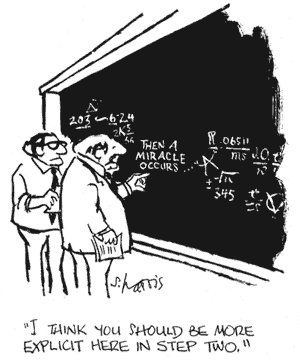
It seems you missed this post:

I can't believe this damn thread is still going...

It seems to me that Wolfgang should take the following advice:

774747e59690e58f2.gif

In case you simply don't understand the relevance, I will now emphasise the significant points:


Using the hitherto unsubstantiated concept of 'souls' to prop up your world-view means that
your so-called theory
is
fundamentally flawed

Get it?
 
Is this a suggestion that the transcription factor has e.g. positive charge whereas its destination on the DNA has negative charge. An illustration of a transcription factor bound to DNA can be found here.

A quote from the psychon theory in order to get an imagination of the spatial proportions:

How impossible it is that random thermal motions determine the happenings in living cells would become obvious, if one created an enlarged model of the DNA helix with a helix diameter of 50 cm, and if persons had to take over the functions of the many enzymes which are involved in the DNA replication. The whole human DNA (of one single cell), which normally is tightly packed, would be at such an enlargement about 500'000 km long. This model would also show how improbable it is that transcription factors could find a given DNA position, if there were only random motions and if recognition of the position were possible only by direct contact. Because of the enzyme size, this improbability cannot be hidden behind the Heisenberg uncertainty relations.

Also this animation can help to get an imagination of the vast spatial extent of DNA: Molecular Biology's Central Dogma.

Cheers, Wolfgang
You're invoking Heisenberg? Are you certain?
 
#165: "In the case of e.g. gravitation (of our planetary system) or Brownian motion, computer simulations can easily be made, because what happens in nature can be well explained by physical laws. In case of life however, simulations based on physical or chemical laws do not exist. Why? Those believing in quantum mechanics sometimes claim that such simulations are possible in principle, but that the needed computing power exceeds all existing computers."

#167: "No, since the laws of QM are probabilistic, not deterministic, no such precise simulation is possible. It would be possible to produce a simulation that gave a probable outcome, but not a certain outcome, as is possible for Newtonian mechanics."

#174: "So you concede that the rather deterministic than probabilistic construction of the bacterial flagellum cannot even in principle by explained by quantum mechanics and similar theories?"

#175: "Nope. I said that it's only possible to produce probabilistic models in QM. That doesn't mean that the actual evolution of the flagellum is impossible."

#182: "The problem we are dealing with is the goal-directed construction of the flagellum by enzymes."

#184: "Anthropomorphism. How do you know that the flagellum was the goal?"

My expression "construction of the bacterial flagellum by enzymes" relates to ontogeny and not to phylogeny. We must clearly distinguish between development of an individual organism (ontogeny) and evolutionary development of a species (phylogeny). So my conclusion remains correct: Goal-directed work of biological molecules defies the probabilistic nature of Quantum Mechanics and similar theories.

In the intransigent antagonism between proponents of neo-Darwinism and proponents of Intelligent-Design (ID), both sides are sure that the other side is wrong or even dishonest. In fact however, both sides are partly right and partly wrong. ID proponents start with reasonable basic probability-considerations suggesting the impossibility of macro-evolution.

Neo-Darwinians start more or less unconsciously with reasonings of this kind: if the laws of matter can transform a fertilized egg without difficulty into a human then such laws must in the long term also be able to transform monkeys into humans. Or: if a special mixture of biological molecules is enough for a bacterial flagellum to emerge, then such a seemingly complex rotary machine is in some respect so simple that also its evolutionary development by selection must be possible.

The common basic error of both neo-Darwinism and ID is the belief that physical and chemical laws as conceived by modern science are enough to explain life. We are told that panpsychism (not to be confused with animism) and vitalism have been refuted by scientific progress. In fact however, the victory of reductionist materialism over panpsychism and vitalism was rather an accidental result (for instance of scientific power politics) than the result of its superiority.

To sum up: Both neo-Darwinians and ID proponents start with the wrong premise of reductionist materialism. But whereas ID proponents conclude in a logical correct way from probability calculations to the impossibility of macro-evolution, neo-Darwinians conclude in a logical correct way from ontogenetic development to the possibility of phylogenetic evolution and further to the defectiveness of ID probability calculations.

Cheers, Wolfgang

Dawkinsism rendered sane: The Selfish Psychon
 
My expression "construction of the bacterial flagellum by enzymes" relates to ontogeny and not to phylogeny. We must clearly distinguish between development of an individual organism (ontogeny) and evolutionary development of a species (phylogeny). So my conclusion remains correct: Goal-directed work of biological molecules defies the probabilistic nature of Quantum Mechanics and similar theories.
And you're still wrong, because QM works on the subatomic scale, not the atomic or molecular scale, and so is irrelevant to the actions of enzymes. And you are still talking about Goal-directed work of biological molecules, which is anthropomorphism. Enzymes blindly do whatever job they do in any situation where they can do it. That's how DNA replication works too. There is no "Goal" as such.

In the intransigent antagonism between proponents of neo-Darwinism and proponents of Intelligent-Design (ID), both sides are sure that the other side is wrong or even dishonest. In fact however, both sides are partly right and partly wrong. ID proponents start with reasonable basic probability-considerations suggesting the impossibility of macro-evolution.
ID proponents' probability-considerations are, indeed, very basic, and not at all reasonable.

And wrong.

Neo-Darwinians start more or less unconsciously with reasonings of this kind: if the laws of matter can transform a fertilized egg without difficulty into a human then such laws must in the long term also be able to transform monkeys into humans.
No, they don't. Development of an embryo into a full adult is not connected in any way to evolution, beyond the fact that it is necessary for evolution, by way of procreation of said adult.

Or: if a special mixture of biological molecules is enough for a bacterial flagellum to emerge, then such a seemingly complex rotary machine is in some respect so simple that also its evolutionary development by selection must be possible.
No, again. You're very good at these strawman arguments, aren't you?

The common basic error of both neo-Darwinism and ID is the belief that physical and chemical laws as conceived by modern science are enough to explain life. We are told that panpsychism (not to be confused with animism) and vitalism have been refuted by scientific progress. In fact however, the victory of reductionist materialism over panpsychism and vitalism was rather an accidental result (for instance of scientific power politics) than the result of its superiority.
The victory over panpsychism was due to there being absolutely no evidence for any such phenomena.

To sum up: Both neo-Darwinians and ID proponents start with the wrong premise of reductionist materialism.
No, ID proponents start with a wrong premise of "God did it".

But whereas ID proponents conclude in a logical correct way from probability calculations to the impossibility of macro-evolution,
No, they don't, they conclude in an illogical way from erroneous probability assertions, much as you do with your 100 dice argument.

neo-Darwinians conclude in a logical correct way from ontogenetic development to the possibility of phylogenetic evolution
Nope, evolution is not drawn from ontogenetic development, but from huge amounts of fossil and genetic evidence, not to mention direct observation of the evolution of viruses, bacteria and insects.

and further to the defectiveness of ID probability calculations.
Which requires nothing more than 2 minutes applying half an unbiased brain, and relies not at all on anything more than an understanding of probability.
 
Goal-directed work of biological molecules defies the probabilistic nature of Quantum Mechanics and similar theories.


"And you're still wrong, because QM works on the subatomic scale, not the atomic or molecular scale, and so is irrelevant to the actions of enzymes."

If we replace "Quantum Mechanics and similar theories" by "the fundamental physical laws of particles respective of matter", then your statement implies that the laws of biochemistry are independent from these fundamental physical laws. So what you say is in fact: Biochemistry cannot be reduced to or explained by physics. We agree on this.

However, the reductionist materialism you adhere to is based on the premise that the laws of biochemistry are fully determined by the underlying laws of physics. How can physical laws on the one hand fully determine the behaviour of enzymes, and on the other hand be "irrelevant"?

"And you are still talking about Goal-directed work of biological molecules, which is anthropomorphism."

Keeping quoting myself:

The reductionist scientific world view as many religious world views is based on the premise that we humans are outside nature. It is admitted that human behaviour depends on objectives, values, intuition and a tendency towards order. However every attempt to admit analogous principles of finality in nature is criticized as anthropomorphism. ()

"Enzymes blindly do whatever job they do in any situation where they can do it."

Bees blindly do whatever job they do in any situation where they can do it. And also you blindly do whatever job you do in any situation where you can do it.

"That's how DNA replication works too."

Look at this animation. I’m sorry, but the belief that general physical laws are able to produce such a complex and coordinated collaboration of so many different participants is more than absurd and grotesque (at least from the Kantian viewpoint of pure-reason judgements).

And take also into consideration (from Wikipedia):

"Some DNA polymerases may also have some proofreading ability, removing nucleotides from the end of a strand in order to remove any mismatched bases. DNA polymerases are generally extremely accurate, making less than one error for every million nucleotides added."

Cheers, Wolfgang
 
If we replace "Quantum Mechanics and similar theories" by "the fundamental physical laws of particles respective of matter", then your statement implies that the laws of biochemistry are independent from these fundamental physical laws. So what you say is in fact: Biochemistry cannot be reduced to or explained by physics. We agree on this.
Wrong.

Biochemistry is just chemistry; chemistry is just physics. The chemical properties of atoms can be - and are - derived from the quantum mechanical properties of those atoms.

What you say cannot be done is in fact routine.

Look at this animation. I’m sorry, but the belief that general physical laws are able to produce such a complex and coordinated collaboration of so many different participants is more than absurd and grotesque (at least from the Kantian viewpoint of pure-reason judgements).
"Absurd" and "grotesque" are not valid objections to a statement of scientific fact. "Wrong" would be valid - but then you have to supply evidence that the statement is, in fact, wrong.
 
If we replace "Quantum Mechanics and similar theories" by "the fundamental physical laws of particles respective of matter", then your statement implies that the laws of biochemistry are independent from these fundamental physical laws. So what you say is in fact: Biochemistry cannot be reduced to or explained by physics. We agree on this.
No we don't, because that isn't what I said. That's the second time you've said that I claimed that. Please stop changing the meaning of what I say to suit your own ends. As PixyMisa pointed out, the properties of atoms can be derived from QM, and are. Chemical interactions can be derived from the properties of atoms. And biochemistry can be derived from the chemical interactions of atoms. So, biochemistry can be derived from QM. But the QM is 3 steps removed from the biochemistry, and is therefore irrelevant for the purposes of your argument.

However, the reductionist materialism you adhere to is based on the premise that the laws of biochemistry are fully determined by the underlying laws of physics. How can physical laws on the one hand fully determine the behaviour of enzymes, and on the other hand be "irrelevant"?
They are irrelevant in the context of your argument, which (as I understand it) is that the apparent "goal-directed" behaviour of enzymes can't be explained by the probabilistic laws of QM. That argument is utterly spurious, because, 1. you have yet to show that the behaviour of enzymes is "goal-directed", and, 2. the behaviour of enzymes is determined by their chemical properties which, although they can be derived from QM, are not themselves quantum mechanical.

Keeping quoting myself:

The reductionist scientific world view as many religious world views is based on the premise that we humans are outside nature. It is admitted that human behaviour depends on objectives, values, intuition and a tendency towards order. However every attempt to admit analogous principles of finality in nature is criticized as anthropomorphism. ()
That's just hilariously funny. A large part of the criticism that scientists receive from the religious community is precisely because science places humans squarely within nature. You're the one trying to provide a supernatural explanation here.

Humans are capable of making decisions or having objectives & values because of the complicated chemical and electrical interactions that occur in our brains. Are you arguing that enzymes have brains?

"Enzymes blindly do whatever job they do in any situation where they can do it."

Bees blindly do whatever job they do in any situation where they can do it. And also you blindly do whatever job you do in any situation where you can do it.
Nope.

Bees often show a preference for particular types of flowers, which displays more than just blind adherence to their task, and my brain allows me to decide what job I do, where I do it, when I do it, and how I do it.

"That's how DNA replication works too."

Look at this animation. I’m sorry, but the belief that general physical laws are able to produce such a complex and coordinated collaboration of so many different participants is more than absurd and grotesque (at least from the Kantian viewpoint of pure-reason judgements).
You do realise that that animation is, um, an animation, don't you? It isn't a film of what actually happens, but a representation (highly simplified) of what happens.

And take also into consideration (from Wikipedia):

"Some DNA polymerases may also have some proofreading ability, removing nucleotides from the end of a strand in order to remove any mismatched bases. DNA polymerases are generally extremely accurate, making less than one error for every million nucleotides added."
Which proves precisely nothing. Sorry, but this doesn't show anything more than the fact that polymerase is a highly complex enzyme, which is capable of more than just one simple task.
 
I'd like to say two things

1. Your psychon 'theory' should be called a hypothesis as it is only a guess and cannot be verified by experiment.

2. Quantum physics does not yield 'probabalistic' results due to the probabilistic nature of the universe. Quantum theory yields probabilistic results because our methods of discovering the properties of the universe are based on limited tools and probability based models. Just because an electron can appear on the other side of an energy potential that it shouldn't have enough energy to penetrate does not mean that it just magically goes poof on one side and pop on the other. There is almost certainly a precise mechanism at work which we have yet to discover (as of the last time I studied quantum physics science hadn't discovered it, or maybe I just didn't get that far in).
 
2. Quantum physics does not yield 'probabalistic' results due to the probabilistic nature of the universe. Quantum theory yields probabilistic results because our methods of discovering the properties of the universe are based on limited tools and probability based models. Just because an electron can appear on the other side of an energy potential that it shouldn't have enough energy to penetrate does not mean that it just magically goes poof on one side and pop on the other. There is almost certainly a precise mechanism at work which we have yet to discover (as of the last time I studied quantum physics science hadn't discovered it, or maybe I just didn't get that far in).
No, the universe really does work like that. What you're talking about is what is known as a hidden variable theory of QM. There is at least one workable hidden variable theory, but the hidden variable is nonlocal, meaning that it predicts that exact same quantum weirdness that conventional quantum mechanics does.

Which is a necessity in any QM theory, because quantum weirdness really happens.

None of which should be taken to imply that anything wogoga has said is in any way correct or even coherent...
 
So what you say is in fact: Biochemistry cannot be reduced to or explained by physics. We agree on this.

No we don't, because that isn't what I said. That's the second time you've said that I claimed that. Please stop changing the meaning of what I say to suit your own ends.


Read again post #211. In #212 you answered:

"QM works on the subatomic scale, not the atomic or molecular scale, and so is irrelevant to the actions of enzymes."

From your statement
  • QM is irrelevant to the actions of enzymes
I deduce
  • QM is irrelevant to at least essential parts of biochemistry
and further:
  • Biochemistry cannot be reduced to or explained by QM

As PixyMisa pointed out, the properties of atoms can be derived from QM, and are. Chemical interactions can be derived from the properties of atoms. And biochemistry can be derived from the chemical interactions of atoms. So, biochemistry can be derived from QM. But the QM is 3 steps removed from the biochemistry, and is therefore irrelevant for the purposes of your argument.


Congratulations on your excellent rhetoric. On the one hand, biochemistry can be derived from QM, and on the other hand, QM is irrelevant for the purposes of my argument. Here once again my original argument

"In the case of e.g. gravitation (of our planetary system) or Brownian motion, computer simulations can easily be made, because what happens in nature can be well explained by physical laws. In case of life however, simulations based on physical or chemical laws do not exist. Why? Those believing in quantum mechanics sometimes claim that such simulations are possible in principle, but that the needed computing power exceeds all existing computers."​

and your objection:

"No, since the laws of QM are probabilistic, not deterministic, no such precise simulation is possible. It would be possible to produce a simulation that gave a probable outcome, but not a certain outcome, as is possible for Newtonian mechanics."

The duplication time of Escherichia coli is 15-20 minutes in the laboratory. So we can predict that one healthy bacterium in an appropriate culture medium will create a second bacterium. Whether we call this duplication a goal or an unavoidable outcome (like the free fall of a stone), whether we call it purposeful or purposeless, is not important. Important however is that the highly complex process progresses in an efficient and quite deterministic way. E.g. before fission, the whole genome of around 4.6 million base pairs must have been doubled.

Even if one accepts the lame excuse that it is much too complicated to actually calculate biochemical behaviour from QM, one nevertheless should request at least an explanation of the principle by which the probabilistic nature of QM could result in the rather deterministic duplication of bacteria. If such an explanation is impossible, and I’m sure it is, then the psychon concept becomes a reasonable hypothesis at least for unprejudiced persons.

Cheers, Wolfgang
 

Back
Top Bottom