• Quick note - the problem with Youtube videos not embedding on the forum appears to have been fixed, thanks to ZiprHead. If you do still see problems let me know.

Physics Response to Flight 77 Trajectory Speculation

Nice job Ryan. I haven't checked your numbers but someone should. It'll be interesting to see if P4T comes back with anything substantial.

 
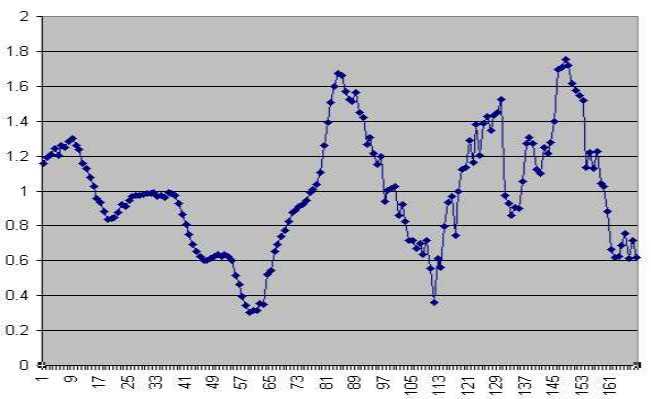
Good work, the final path may be somewhat like A or B since the terrorist had just pulled 1.7 gs in the last few seconds. He looks like he was in a PIO of sorts, and twice in the last 10 second of data on the FDR, the terrorist was up to 1.6 to 1.7 gs after going a low as 0.4 to 0.6 gs. (1.0 g is what we are sitting at)

I'd agree with that -- I'd speculate that the true path is somewhere between Case B and Case C, although really, any of them will do fine.


(I think Ryan is taking x = 0 at impact point, and x increases away from the Pentagon, correct me if I'm wrong)

That's correct. See the diagram. I have the origin at 0 MSL and the wall of the Pentagon, with the aircraft decreasing in x. You can do it any way you like, of course. x0 is the horizontal position of the radio tower, i.e. x0 = 3400 feet, but since it disappears anyway I left it like that.

Also, you can just use the chain rule rather than expanding all those nasty quadratics, but it's pretty simple either way. ;)

And finally, a question:
Is it reasonable to assume the flight path to be a quadratic?
It occurs to me that the aircraft motion would likely not fit a smooth, simple curve.
As a method of showing the feasibility of the required maneuver (which is all you were trying to do), it works for me.
But I'm wondering what your response would be to someone who challenged your work on the basis that it is not likely to represent the exact flight path?
Would you only say that all you were doing was showing it is possible?

See my comments to Anti-sophist below, but in brief, the quadratic assumption is reasonable, if simplified. Certainly the terrorists could have been (and probably were, as beachnut pointed out above) rocking the stick a bit, trying to zero in on their target, but keep in mind that the rate of descent and position are aggregate quantities. Instead of differentiating position to get acceleration, now we're integrating the acceleration to get position, and thus it averages out. The g-loads I computed are in effect the average g-loads expected, and provided you've got some performance left in the aircraft, you can oscillate around it a bit without making any real difference. Case F is pretty close to the limit, so screwing around there might put you into the lawn, but the others -- particularly Case A and B -- are so mild that you could add a couple of bumps with ease.


I just read a response to Mr. Mackey's white paper from Rob Balsamo at the ATS site.......

What a strange remark. You can propose different assumptions, or try to find errors in my mathematics, but I don't see how I can have lied. Ah well. As I said in the OP, I'm not going to engage in any bickering, particularly when it comes from a forum I rarely read.


You've assumed that the fixed coordinate system of the ground is equivalent to the moving coordinate system on the aircraft. This isn't quite true.

A more accurate model would have parameterized both horizontal and vertical velocities with time, held the magnitude of the velocity constant (instead of the horizontal speed) and calculated the vertical acceleration with respect to the aircrafts coordinate frame instead of the fixed coordinate frame.
[...]
In your model, the velocity of the plane is slowing (horizontal speed is constant, vertical goes down). This is an additional source of acceleration that serves simply to make the calculations easier (by reducing the need for parameterization). Your model also incorrectly assigns all of the acceleration to the vertical axis of the aircraft, when in fact some of it would manifest itself as longitudinal acceleration (in this case, very specifically, drag). Unfortunately for the truthers, the simplified model you used actually produces a higher g-force than it would in the slightly more complicated model, thereby producing an even more "worst-case" number for them.

Correct of course, although I trust you understand why I set it up the way I did. As I stated in my assumptions, for small pitch angles this is a small correction; also, I don't know the true speed, nor even whether it's groundspeed or airspeed! The problem is set up to use the "Pilots for 9/11 Truth" numbers, and frankly, they don't lay out their assumptions well at all.

Also, going with a strict parabola is a much simpler thing to compute. In reality, an aircraft trajectory will be closer to a cardioid... Since even this level of computation appears to have gone misunderstood, throwing multivariate calculus at it would be overkill, and unappreciated.

That being said my suspicion is the difference between the two models probably won't show up in the first two decimal places. It might for the most extreme angle.

Your suspicion is correct. Regarding the total speed rather than just the horizontal component, the average rate of descent is (304-33 feet)/4.4 seconds = about 62 feet per second for Case A, and (699-39 feet)/4.4 seconds = 150 feet per second for Case F. We can add this to the horizontal speed in quadrature to find the true speed; so Case A gains 2.5 fps, while Case F gains 14.3 fps, a difference of only 0.3% and 1.8% respectively.

Likewise, the aircraft gains speed as it drops through conservation of energy. If we assume 100% airfoil efficiency -- which is nuts, particularly during a high-g maneuver -- we can find it through (m v12) / 2 + m g h = (m v22) / 2, in which case we find Case A gains 0.3 fps, and Case F gains 13.4 fps.

By comparison, the height at the radio tower varies over 50% between cases... so these errors are negligible. I doubt any of the figures in the problem are known to within 2%. Hence, why not go with a parabolic curve?


Nice job Ryan. I haven't checked your numbers but someone should. It'll be interesting to see if P4T comes back with anything substantial.

Hi Gregory, and thanks. It's an easy thing to verify, so anyone is welcome to do so. You don't even have to solve the Quadratic Equation to work it out, it just takes some organization. Incidentally, I don't want to derail my own thread, but I'd be interested to hear how your progressive collapse paper is faring with the Journal of 9/11 Studies review team.
 
Last edited:
Since even this level of computation appears to have gone misunderstood, throwing multivariate calculus at it would be overkill, and unappreciated.

Not by me!

Yes, yes, agrees all around. My criticisms were largely pedantic ... meant mostly as my message to you that I bothered to read & understand your work.. even if they won't.
 
Also, you can just use the chain rule rather than expanding all those nasty quadratics, but it's pretty simple either way. ;)

I know. But I wanted to make the steps as basic as I could, aside from the basic simplifications. At any rate, quadratics don't bother me. The use of "v" for vertex threw me, however, since I orignally used it for velocity when I worked it out, resulting in some confusion. :boggled:

I figure anybody interested enough to probe further will be willing to look up a derivative on their own, so I didn't explain the process for those.

Good work, though. And thanks for the reply.
 
Hi Gregory, and thanks. It's an easy thing to verify, so anyone is welcome to do so. You don't even have to solve the Quadratic Equation to work it out, it just takes some organization. Incidentally, I don't want to derail my own thread, but I'd be interested to hear how your progressive collapse paper is faring with the Journal of 9/11 Studies review team.

I have seen it suggested that there are G load measurements in the FDR data. Do you know if that is true? Maybe Beachnut can answer?
Based on the suggestion from Dr. Greening regarding adiabatic compression and a suggestion from Dr. Jones that I deal with the Kuttler WTC1 paper, I've asked them to wait until I add those parts. It will probably be a couple of weeks before I am finished because I have alot going on at work.
 
I have seen it suggested that there are G load measurements in the FDR data. Do you know if that is true? Maybe Beachnut can answer?
Yes the g was recorded every 1/8 of second. Here are the last seconds.
gs.jpg

There is data missing at the end of the flight. Not sure how much. The final trend was increasing descent rate, and would most likely be followed again by a pullup of 1.4 to 1.7 gs again.

The p4t 11.2 g pull out is pure never took physics smoking gun.

p4t have no idea what happen on 9/11, they make up new smoking guns as often as they can to keep their web site up to date with false information so the DVD sales continue. Their impossible approach is already pre-debunked by witnesses on 9/11 and DNA evidence. It is hard to believe the p4t group is dumb enough to make this stuff up, but their math/physics failures pretty much makes a case for total ignorance on 9/11 topics. They are just like the rest of 9/11 truth members, short on evidence and willing to lie about it to sell DVDs or push a political agenda.
 
Last edited:
Good one, Mr. Mackey. Alas, just like your previous effort (and Myriad's), you have failed to address that Beachnut is a JREF forum sponsor. At least, that seems to be the only major objection Balsamo has managed to come up with. But he's got his henchmen working on a rebuttal, so it should come any day now. Hopefully some time this year. Or decade. Then Anti-S can post his proposed version and reviewing this will keep PfTers busy til the end of the century.
 
That took me back to 1976 and my 1st year math, Ryan. Odd that although I would not have known how to go about doing it, I could however follow your working it out.

p4t will not have a coherent response since they still cannot understand that their original calc's are badly constructed and make no sense.

In fact, in another thread using p4t's numbers and assumptions I calculated that the aircraft would desend 48.75 feet from pole 1 to the Pentagon in terms that I thought p4t could easily follow. here
If pole 1's top is at 80ASL then 80-48.75=31.25. Although this would mean the aircraft hits short it does require a steady upward acelleration beginning only as the plane passes pole 1.
 
Last edited:
Yes the g was recorded every 1/8 of second. Here are the last seconds.
[qimg]http://www.beachymon.com/photo/gs.jpg[/qimg]
There is data missing at the end of the flight. Not sure how much. The final trend was increasing descent rate, and would most likely be followed again by a pullup of 1.4 to 1.7 gs again.

The p4t 11.2 g pull out is pure never took physics smoking gun.

p4t have no idea what happen on 9/11, they make up new smoking guns as often as they can to keep their web site up to date with false information so the DVD sales continue. Their impossible approach is already pre-debunked by witnesses on 9/11 and DNA evidence. It is hard to believe the p4t group is dumb enough to make this stuff up, but their math/physics failures pretty much makes a case for total ignorance on 9/11 topics. They are just like the rest of 9/11 truth members, short on evidence and willing to lie about it to sell DVDs or push a political agenda.

Thanks Beachnut. Any idea how this relates to Ryans assumption of constant pull up? It looks like they were pulling negative Gs at the point where the data stops. How does this correlate to the position relative to the radio tower?

The graph looks rather eratic. Considering the time scale, would that be due to turbulence?
 
Eyewitnesses

Are there any eyewitnesses supporting this part of the flight path and the maneuver the alleged pilot made before leveling off?
 
Are there any eyewitnesses supporting this part of the flight path and the maneuver the alleged pilot made before leveling off?

Don't you mean "Are there any alleged eyewitnesses allegedly supporting this alleged part of the alleged flight path and the alleged maneuver the alleged pilot allegedly made before allegedly levelling off"? You don't want anyone to think you admit anything specific actually happened.

Dave
 
Don't you mean "Are there any alleged eyewitnesses allegedly supporting this alleged part of the alleged flight path and the alleged maneuver the alleged pilot allegedly made before allegedly levelling off"? You don't want anyone to think you admit anything specific actually happened.

Dave

An alleged yes or no would have sufficed as well as an alleged source to alleged witnesses of this alleged part of the alleged flight path by the alleged pilot of the alleged plane hitting the alleged Pentagon in the alleged city of D.C. within the alleged country of the United States as found on the alleged planet Earth.;)
 
Seriously, I've never seen an eyewitness account placing the flight path either over or around the VDOT antenna. Since neither is impossible, it's of little practical significance.

Dave

ETA: http://911research.wtc7.net/pentagon/evidence/witnesses/bart.html has a fairly comprehensive set of eyewitness statements. None of them mentioned the VDOT antenna directly, so without drawing inferences there probably isn't any way to tell.
 
Last edited:
celestrin said:
But he's got his henchmen working on a rebuttal, so it should come any day now.

Honestly, why does it take days and/or weeks to address what constitutes essentially a high-school level physics problem?

beachnut said:
The p4t 11.2 g pull out is pure never took physics smoking gun.

Har har.
 

Back
Top Bottom