RFC: Bazant and Zhou Simple Analysis refuted

A jack up is a sea going vessel, it has bulkheads and is built to maritime standards. It moves around the field during contracts. Semi subs also move on contract. There are also drill ships in the North Sea.

Exactly what are you claiming to be responsible for? Do you actually go offshore?

Exactly - jack ups, drilling vessels and semi-subs are seagoing vessels that are always surveyed and repaired ashore at a shipyard in a drydock when they are clean and gas free. Easy! Nothing to do with offshore structures that remain in position in the middle of the ocean for years, not clean, not gas free at any time without the possibility to be inspected in peace and quiet ashore.

So you have to do it offshore. Quite a challenge. If you don't do it properly you have accidents like the ones mentioned above.

Study my web site and you will find out what offshore structures I specialise in and what systems I have proposed to make the job safer!

BTW - did you find any errors in my article about the WTC1 collapse?
 
Exactly - jack ups, drilling vessels and semi-subs are seagoing vessels that are always surveyed and repaired ashore at a shipyard in a drydock when they are clean and gas free. Easy! Nothing to do with offshore structures that remain in position in the middle of the ocean for years, not clean, not gas free at any time without the possibility to be inspected in peace and quiet ashore.

So you have to do it offshore. Quite a challenge. If you don't do it properly you have accidents like the ones mentioned above.

Study my web site and you will find out what offshore structures I specialise in and what systems I have proposed to make the job safer!

BTW - did you find any errors in my article about the WTC1 collapse?

You never answered. Do you actually go offshore to fixed oil platforms in the North Sea? If so which platforms have you been to?

I found errors in your paper. Not wanting to be disrespectful, but as your paper is disrespectful, I found it to be junk.
 
Return to topic please

You never answered. Do you actually go offshore to fixed oil platforms in the North Sea? If so which platforms have you been to?

I found errors in your paper. Not wanting to be disrespectful, but as your paper is disrespectful, I found it to be junk.

This thread is not about Heiwa's competence or his paper. Please stay on topic and/or start a new thread.

Some have suggested that yield strength should be used instead of ultimate strength. I provide the following citation regarding yield strength and the portion of the stress-strain curve between yield and ultimate strength from Wikipedia:

In structural engineering, this is a soft failure mode which does not normally cause catastrophic failure unless it accelerates buckling.

Correct me if I'm wrong, but I think most engineering books will be in agreement. I have seen elsewhere that the length of one floor is too short for buckling to be the failure mode so "unless it accelerates buckling" shouldn't be an issue.

Thus, I still think it is correct to use the ultimate strength in the calculation.
 
This thread is not about Heiwa's competence or his paper. Please stay on topic and/or start a new thread..

I think you will find I have told heiwa to stop derailing this thread, that I thought was a promising one. I also told him he should apologise to you for spoiling this thread with his junk claims.
 
This thread is not about Heiwa's competence or his paper. Please stay on topic and/or start a new thread.

Ironically enough, Heiwa said much the same thing about us discussing your analysis in this thread, back around post #100.

Some have suggested that yield strength should be used instead of ultimate strength.

Personally, I think your choice of ultimate strength is appropriate if you're trying to test whether it's inevitable that collapse would have propagated, and hence is consistent with the highly conservative assumptions in the Bazant model. If you're trying to disprove collapse propagation you'd need a much more complex model, and for a convincing disproof I'd want to see that the yield strength wasn't exceeded, because there's such clear evidence that the initial failure was buckling of the perimeter columns due to pull-in.

Dave
 
This thread is not about Heiwa's competence or his paper. Please stay on topic and/or start a new thread.

Some have suggested that yield strength should be used instead of ultimate strength. I provide the following citation regarding yield strength and the portion of the stress-strain curve between yield and ultimate strength from Wikipedia:


Correct me if I'm wrong, but I think most engineering books will be in agreement. I have seen elsewhere that the length of one floor is too short for buckling to be the failure mode so "unless it accelerates buckling" shouldn't be an issue.

Thus, I still think it is correct to use the ultimate strength in the calculation.

First I noted a minor error in the table para. 6 of your paper. Unit for Ultimate strength is N/m² (=Pa and not Pa/m²).

If the theoretical compressive buckling stress for a column exceeds the yield stress, evidently the column will yield before it buckles, i.e. there will be out of plane bending and plastic deformation in the highest stressed fibers, but we still do not know when buckling=collapse occurs. The column section changes - it can collapse or it can re-arrange itself to a more stable configuration. However, instinctively the critical stress is less than the ultitmate strength (or stress) unless the column section itself (its geometry) is extremely solid. Compare a tube pipe with a certain wall thickness with a solid round steel bar. So the answer may be that the critical stress in this case is somewhere between yield and ultimate stress? And it depends on the column section.

Furthermore - this critical stress in the substructure is only experienced when (during) the original (energy) impact occurs. As soon as the impact has passed, we are back to a static condition again in the area under consideration, e.g. just below the initiation zone/impact area.

It could very well be that some columns - or rather some extreme fibers in the columns - are stressed above yield during the impact and either cause the complete column to buckle/collapse or, also possible, the column reconfigure its cross area to withstand buckling/collapse and re-directs the impact energy elsewhere.

The latter effect is easiest understood when watching somebody hitting a nail with a hammer. You may actually knock apart the nail if you try to hit it through a stiff support, e.g. a steel plate - the nail goes into two pieces - or the nail bends and the hammer (the impact energy) slips off the nail head and hits something else. And so on.

Neither Bazant nor NIST understands this.
 
Some maybe Off Topic comments to above (they are Off Shore :-)

Once there was an offshore structure with a big crane fitted on it. For various reasons, including incompetense, the crane suddenly collapsed and fell down and impacted the offshore steel structure below. Luckily the offshore structure acted like a spring and the crane bounced off and disappeared into the water beside the offshore unit. Goodbye crane.

What were the damages to the offshore structure? Well, it was a big buckle in the steel main deck below the crane = the plate was plastically deformed down a fair distance and the stiffeners below were also plastically bent and ... they had fractured in their highest stressed fibers.

Note that they crane didn't punch a hole through the offshore structure and caused global collapse or sinking or whatever! The potential energy of the crane (mass above) simply didn't exceed the strain energy of the structure below.

Your obedient servant later sorted out the matter at minimum cost and highest safety. Obviously the (ir)responsible parties prefer to be anonymous.
 
Last edited:
Your obedient servant later sorted out the matter at minimum cost and highest safety. Obviously the (ir)responsible parties prefer to be anonymous.

But of course.

I remember one time when I was in the SAS and carrying out Royal protection duties........

..... ahhhh but I can't really talk about that.
 
Ironically enough, Heiwa said much the same thing about us discussing your analysis in this thread, back around post #100.

Personally, I think your choice of ultimate strength is appropriate if you're trying to test whether it's inevitable that collapse would have propagated, and hence is consistent with the highly conservative assumptions in the Bazant model. If you're trying to disprove collapse propagation you'd need a much more complex model, and for a convincing disproof I'd want to see that the yield strength wasn't exceeded, because there's such clear evidence that the initial failure was buckling of the perimeter columns due to pull-in.

Dave

I think it was Heiwa's comment that got me thinking about it. Anyway, I've recalculated the stiffness C (still based on the entire lower structure) using:

1/Keff = 1/K1 + 1/K2 + ... + 1/Kn

and I get 6.40 x 10^9 GN/m. I did the same for the top part and got 11.9 GN/m. I was surprised that the top was almost 2x stiffer.

ETA: I agree, disproving collapse propagation would require a more complex model that B & Z's. My point is that the B & Z's model may not prove collapse propagation. I'm working out some new numbers to see if the deflection of the top floor excedes the offset yield point (0.2%). If not, those columns never reach the elastic limit.
 
Last edited:
I think it was Heiwa's comment that got me thinking about it. Anyway, I've recalculated the stiffness C (still based on the entire lower structure) using:

1/Keff = 1/K1 + 1/K2 + ... + 1/Kn

and I get 6.40 x 10^9 GN/m. I did the same for the top part and got 11.9 GN/m. I was surprised that the top was almost 2x stiffer.

It's much shorter =]

Are you planning on posting an updated version of your paper?

edit: are you planning on using the entire lower block or will you use x number of stories based on the elastic wave speed?
 
Last edited:
Dave notes;

because there's such clear evidence that the initial failure was buckling of the perimeter columns due to pull-in.

The perimeter pulling in was witnessed on only the east face of the South Tower.

There is no mention of pulling in for the North Tower perimeter or for the other 3 faces of the South Tower.

The inward pull is seen only along the 81st (?) floor.


There is no evidence for inward pulling anywhere else.


A chief characteristic of the perimeter of all 8 faces is an OUTWARD PEELING during the "collapse".


This can be seen clearly in the rubble distribution. Most all the perimeter pre-fab sections are seen OUTSIDE the footprints of the towers.


Dave, do you have any other evidence of inward pull of the perimeter besides that mentioned above?
 
Last edited:
It's much shorter =]

Are you planning on posting an updated version of your paper?

edit: are you planning on using the entire lower block or will you use x number of stories based on the elastic wave speed?

I'll try to do it based on elastic wave speed if that's kosher. I'm not quite sure how to calculate the time though, because it's based on the max deflection/avg velocity for the deflection period which changes if I adjust the stiffness for fewer floors.
 
If you are spring thinking then the energy is the integral of force over distance, i.e. Int (kx)dx=(1/2)kx^2 . I'm no engineer but to me it looks like it is mainly the distance that determines how much energy can be absorbed. If you are at the maximum distance of elasticy then the amount of energy is only a little bit. If the top section is elastically 'absorbed' then the maximum x is a relevant value. But if it isn't then there is the plastic phase. I've seen a couple of those stress strain diagrams and to me it looks like the latter phase is able to absorb much more energy than the elastic phase for the simple reason that the area under the graph is much bigger. If you want to prove that a top section is absorbed then that phase is also relevant.

Major_Tom

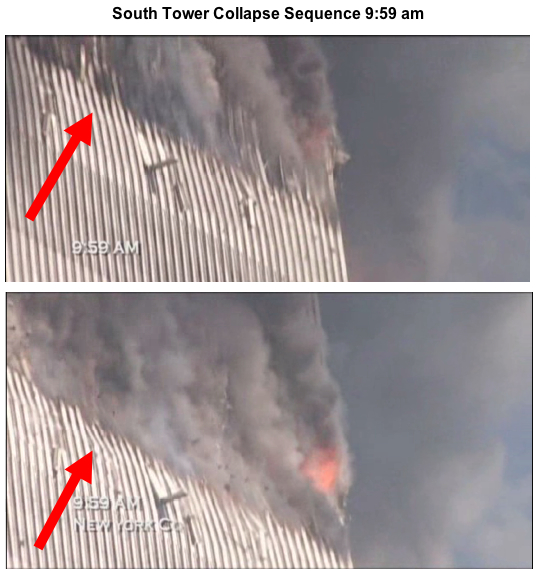
The perimeter pulling is an interesting and hot topic. The last I've seen about it was a posting by a debunker called "Gravy" he posted two pictures, on the first you see more or less intact columns and on the second one a failed column. The time stamp was however the same, this implies that it was a very fast process.
 
I'll try to do it based on elastic wave speed if that's kosher. I'm not quite sure how to calculate the time though, because it's based on the max deflection/avg velocity for the deflection period which changes if I adjust the stiffness for fewer floors.

It can be very iterative. You have to know the right answer to one question before getting the second, but the first question involves the second answer. Welcome to engineering :D

You could assume that the upper block deaccelerates from full velocity to zero velocity (i.e. just barely or not overcoming the lower block) to be conseravtive in favor of collapse prevention without being absurd.
 
The perimeter pulling in was witnessed on only the east face of the South Tower.

There is no mention of pulling in for the North Tower perimeter or for the other 3 faces of the South Tower.

The inward pull is seen only along the 81st (?) floor.

There is no evidence for inward pulling anywhere else.
Major_Tom I suggest that you take a careful look at NIST NCSTAR 1-6 to get a understanding of the collapse initiation as described by NIST. Search for the word bowing. Even on your website you have a picture showing inward bowing on the south face of WTC 1. That picture comes from the NIST reports (Figure 8-106 NIST NCSTAR 1-5A). Are you really sure you are being honest with us now.

A chief characteristic of the perimeter of all 8 faces is an OUTWARD PEELING during the "collapse".

This can be seen clearly in the rubble distribution. Most all the perimeter pre-fab sections are seen OUTSIDE the footprints of the towers.

Yes that is entirely correct. When the upper block of both towers fell they where funneled inside the lower block splitting it open in the process. This is very evident in the videos. It was columns against floors inside the towers, a match the floors never had any chance of winning whatsoever. The exterior columns where pushed out by the falling mass inside the Tower. The load bearing strength of the exterior columns and the interior columns did not matter after the collapse initiation. They could not stand on their own without the support of the floors inside the towers. No need for the totally unsubstantiated thing your website is all about, but that you have been hinting at in your posts all the time.
 
The exterior columns where pushed out by the falling mass inside the Tower. The load bearing strength of the exterior columns and the interior columns did not matter after the collapse initiation. They could not stand on their own without the support of the floors inside the towers. No need for the totally unsubstantiated thing your website is all about, but that you have been hinting at in your posts all the time.
I'm wondering what makes you think that, if this is true, they were standing on their own ? That massive top section was still connected, perimeter columns, trusses, floors, core columns.

Maybe this helps a little bit for you

7wj2zxc.jpg


http://i3.tinypic.com/7wj2zxc.jpg
 
I'm wondering what makes you think that, if this is true, they were standing on their own ? That massive top section was still connected, perimeter columns, trusses, floors, core columns.

Maybe this helps a little bit for you

[qimg]http://i3.tinypic.com/7wj2zxc.jpg[/qimg]

http://i3.tinypic.com/7wj2zxc.jpg
When the collapse initiated all the columns in the initiation area became overloaded, they buckled up and broke off. From then on it was floor against columns inside the tower when the upper block destroyed the floors on its way dawn to the ground. Without the horizontal support of the floor structure the columns could not stand, they would buckle up and collapse. Do I need to remained you of what happened to the remaining core columns that were still standing after the rest of the towers had collapsed?

So even though the columns in the lower part had not been weakened by fire, as the columns in the initiation area, it did not matter.
 
Last edited:
small errors of people inclined to believe 9/11 truth false information.

If you are spring thinking then the energy is the integral of force over distance, i.e. Int (kx)dx=(1/2)kx^2 . I'm no engineer but to me it looks like it is mainly the distance that determines how much energy can be absorbed. If you are at the maximum distance of elasticy then the amount of energy is only a little bit. If the top section is elastically 'absorbed' then the maximum x is a relevant value. But if it isn't then there is the plastic phase. I've seen a couple of those stress strain diagrams and to me it looks like the latter phase is able to absorb much more energy than the elastic phase for the simple reason that the area under the graph is much bigger. If you want to prove that a top section is absorbed then that phase is also relevant.

Major_Tom

The perimeter pulling is an interesting and hot topic. The last I've seen about it was a posting by a debunker called "Gravy" he posted two pictures, on the first you see more or less intact columns and on the second one a failed column. The time stamp was however the same, this implies that it was a very fast process.
879045fd54c927534.jpg

The time is in minutes! This sequence is just as the failure begins. Seconds apart! One minute resolution on time stamp! This is not a test, this is a standard logic, you must have the ability to catch the easy non errors or you are lost! Please stop making simple errors. Your time stamp ideas is a false idea.

Have you even wonders why 9/11 truth can not connect the dots! This is an example. Failure to understand evidence. Both photos are in the same minute! Is this possible, there are 60 seconds in the Minute. Time is relative or something. What did Einstein say?.
 
Last edited:

Back
Top Bottom