How long will it take for computers to simulate the human brain?

There is something that makes us different from animals and machines. Our imagination. That, we can never simulate in machines.

ETA: from imagination stems new knowledge.
First off, humans are also animals. But anyway, how do you know non-human animals do not imagine? And what is it that we have in our brains that makes imagination possible?
 
There is something that makes us different from animals and machines. Our imagination. That, we can never simulate in machines.

ETA: from imagination stems new knowledge.

These are some bold assertions. Please demonstrate that no animal has ever used imagination (and I'll play your game by saying humans are not animals, but I don't believe it for a moment). Please demonstrate that imagination will never (or even for a very long time) be simulated/stimulated in machines. You could even demonstrate that all humans are equally gifted with imagination and the ability to realize their imaginings. Back to my favourite paraphrase:

Will Smith: "Can you create a masterpiece?"
Robot: "Can you?"

ETA: further to everyone who's posted in the interim, please also be precise in your definition of imagination.
 
Last edited:
There is something that makes us different from animals and machines. Our imagination. That, we can never simulate in machines.

ETA: from imagination stems new knowledge.


First, we have established scientifically that whatever imagination is, it is generated and contained in our physical brains. Since our physical brains are physical, by definition we can build a machine that performs the same task. It may be a biological machine, and it might end up just looking like a brain, but it would still be a machine.

Second, you are flat out wrong that new knowledge stems from imagination. It is the exact opposite. New knowledge can only come from environmental observations -- everything else is just recombinations of existing knowledge or inferences.
 
Last edited:
Well, it does not take a lot to make a copy of that painting which is extremely similar to the original. A good 10Megapixel camera?

That's not a copy - it's a image of the original. No-one would confuse that with a painting, let alone a masterpiece.
 
New knowledge can only come from environmental observations -- everything else is just recombinations of existing knowledge or inferences.

Imagination combined with creativity can lead to new knowledge, although one can certainly imagine things without being creative. Artists create new things all the time using their imagination creatively.

I don't think the core issue should be imagination - I view that as a tool. Creativity, the ability to "make a new thing" in the world, on the other hand, is clearly something different and unique to the human animal.

Keep in mind that problem-solving may or may not involve creativity. Abstract thinking, likewise. It doesn't matter if the "new thing in the world" is drawn upon observations, or recombinations of existing knowledge, inferences, etc - it's the fact that it's something new, something that never existed before and is not the result of random associations. :)
 
Last edited:
The nature of simulation is that you abstract and simplify an aspect of reality in a model. For example, your checkbook is a simulation of the money flowing through your bank account, small enough to fit in a pocket. A spreadsheet model of a company's finances are obviously both simplified and viewed from a single aspect of reality. The models of atomic bomb explosions or weather processes which serve in lieu of the real thing are very complex, but less so that the phenomenon itself. In particular, in the latter, the model is "digitized", which moves it a step farther from analog reality and introduces all manner of hypothetical problems papered over by a huge statistical averaging process.

So, you really do have to define what you mean by simulation. What aspect of the mind is being inspected? To what order of accuracy? What approach - are you going to model the abstract flow of ideas, or the molecular chemistry in action and the electrical network, or just stimulus/response (black box, or van Neumann criteria sim)? All of them? Man, I want to see the spec document on that before signing up.

3 billion years of evolution has to account for *some* complexity, you know. That we may be able to duplicate that complexity in a few ten or hundreds of years is a measure of how undirected evolution is as a process.
 
New knowledge can only come from environmental observations -- everything else is just recombinations of existing knowledge or inferences.

Ummmm, that's pretty much a tautology there - all knowledge (except the instinctual, perhaps) is either inductive or deductive.
 
Well, it does not take a lot to make a copy of that painting which is extremely similar to the original. A good 10Megapixel camera?

But the way that a painting reflects statistically pure white light and is then digitized both in space and in depth (colors) is only one aspect of the Mona Lisa. What about it's tactile reality, or the way that the canvas is hung, how it affects the acoustics of the place where it is hung (pity that has to be glassed over), and so on and so on? How do you account for the frame that it is mounted in, visually (don't tell me that doesn't affect the impact of the painting)? How does it appear in ultraviolet? Does it smell different from the copy printed on glossy paper? Whose fingerprints are upon it, and what did they have for dinner the day before? Tell me what a simulation of the Mona Lisa is, and is not.

 
Last edited:
Creativity, the ability to "make a new thing" in the world, on the other hand, is clearly something different and unique to the human animal.

I think the degree of creativity is different, but other animals do create. A quick google search on "chimpanzees" and "creativity", or "animal creativity" found articles about cats who paint, or chimps who come up with their own sign language, or who use tools creatively.
 
I think the degree of creativity is different, but other animals do create. A quick google search on "chimpanzees" and "creativity", or "animal creativity" found articles about cats who paint, or chimps who come up with their own sign language, or who use tools creatively.

I would argue that unless the cats can show some aesthetic sense, they are merely playing; additionally, most art has a purpose beyond "looking pretty". So if their "art" doesn't show some form of meaning... then it's not really art.

As for chimpanzee sign language, the ability to communicate may be a sign of intelligence - but it may also merely an extension of instinct. Many species have shown the ability to communicate by a variety of means, including sound and body language. Doesn't mean they're intelligent.

In any event, intelligence doesn't necessarily denote creativity - merely the ability to problem-solve.
 
Last edited:
Well if you want, you can do the google search I suggested and see for yourself. There's too much out there to summarize.

What do you think human brains have that other animals lack that enables creativity and intelligence?
 
No idea.

However, the evidence that we have something exceptional is all around us, including our ability to think abstractly and communicate on this forum - not to mention have creative ideas, make up humorous comments (no other animal laughs), construct an artificial language (mathematics), ask the question "why" about the world surrounding us, create multiple cultures, develop civilization, put men on the moon, and so forth.
 
Last edited:
Douglas Adams said:
It is an important and popular fact that things are not always what they seem. For instance, on the planet Earth, man had always assumed that he was more intelligent than dolphins because he had achieved so much — the wheel, New York, wars and so on — whilst all the dolphins had ever done was muck about in the water having a good time. But conversely, the dolphins had always believed that they were far more intelligent than man — for precisely the same reasons.
:D
 
I think for one, our brains are bigger, and also we have the physical ability to speak. The things you mention that we can do that other animals can't (communicate on this forum, make up humorous comments (no other animal laughs), construct an artificial language (mathematics), ask the question "why" about the world surrounding us, develop civilization, put men on the moon, and so forth) took us tens of thousands of years to be able to do. Mammals have all shown greater intelligence than other animals. Surely one set of mammals are more intelligent than the others, and they have been the primates. And of the primates, hominids have been the most intelligent.

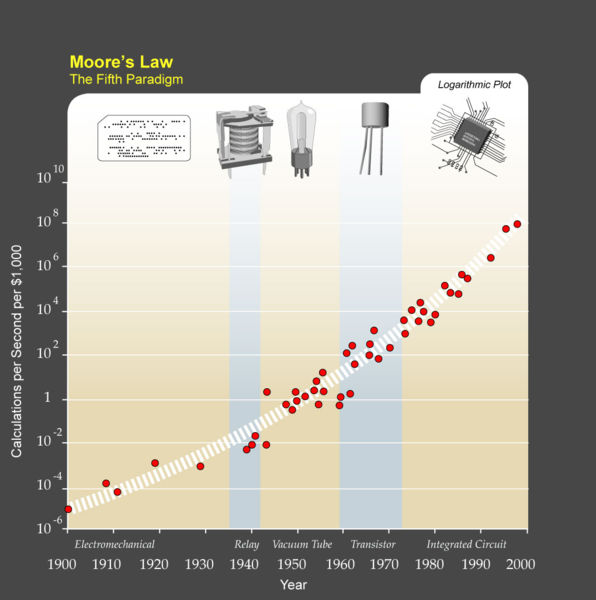
Ray Kurzweil may be a futurist, but he does convincingly show that Moore's law isn't just about microprocessors. It's about the exponentially increasing speed at which information can be encoded. And he lists many paradigm shifts that happen along the way which enable the next series of advancements. Microprocessors were one paradigm shift. See this chart:
596px-PPTMooresLawai.jpg


And this logarithmic chart shows the paradigm shifts that have been happening for the last several billion years:
770px-PPTCanonicalMilestones.jpg


If we look at another species their 'playing' or semi-intelligent and/or instinctual behaviors will seem pretty mundane to us because they are further back on that logarithmic scale. They advance nowhere near as fast as we do. But I believe their intelligence, as limited as it may be, is there.
 
Why do you think this is true? I can't think who to cite, but robots that could distinguish between cylinders and cones and manipulate these blocks were kicking about in the 70's.

I don't think telling bottles from cans is that hard to teach a computer.

I think it still is, unless you place always the same can in the same position, or the same bottle of beer in the same position.
If you change, computers will still have problems
 
That's not a copy - it's a image of the original. No-one would confuse that with a painting, let alone a masterpiece.

But the way that a painting reflects statistically pure white light and is then digitized both in space and in depth (colors) is only one aspect of the Mona Lisa. What about it's tactile reality, or the way that the canvas is hung, how it affects the acoustics of the place where it is hung (pity that has to be glassed over), and so on and so on? How do you account for the frame that it is mounted in, visually (don't tell me that doesn't affect the impact of the painting)? How does it appear in ultraviolet? Does it smell different from the copy printed on glossy paper? Whose fingerprints are upon it, and what did they have for dinner the day before? Tell me what a simulation of the Mona Lisa is, and is not.

Mona Lisa does not operate and work, so, wrong example, maybe
 

Back
Top Bottom