• Quick note - the problem with Youtube videos not embedding on the forum appears to have been fixed, thanks to ZiprHead. If you do still see problems let me know.

I need all debunkers I can get!

Joined
Apr 12, 2007
Messages
837
Location
Sweden
Last edited:
Heiwa is a "no-planer," so keep that in mind. Note that he does not address NIST's findings or calculations at all: he simply ignores them.

I don't have time to get into this in depth, but here are a couple of quick responses to these claims:

It is suggested in NIST report - NISTNCSTAR1-6D that all the wall and core columns buckled in the impact area as they were affected by fire/heat 40-80 minutes later that reduced their strength and caused subsequent overloading.

Even if this phenomenon is not seen on any video of the collapse itself or in the columns of the rubble afterward, let's assume that our vertical cage bars or columns buckled.
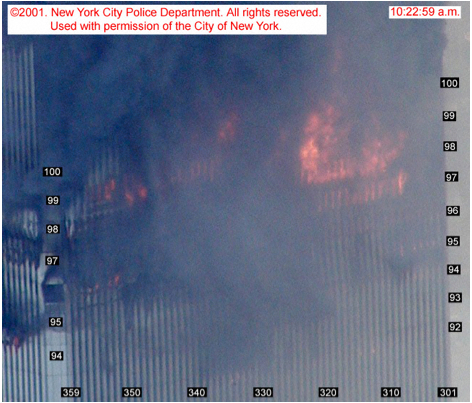
This phenomenon is seen in photographs and on video. See the video of the south tower's east wall buckling inward here, with examples of controlled demolitions that follow: http://video.google.com/videoplay?docid=2873871255585611926#1m10s

The wall bar is obviously fitted in the wall and cooled by external air and can never be heated very much.
Absolute nonsense. How much is a column being cooled by external air when it is surrounded by flame and the floors below are also on fire?

879045fd54c8e5e6c.jpg

8790461136f07c80d.jpg

NCSTAR1-5AFig8-44pg188.jpg

BNCSTAR1-AChap9fi9-1wtc2.jpg
 
I've only looked at the first one briefly, but -

Well, he mixes up some of his terms. For instance, the structural members supporting the concrete floors were steel bar joists, not beams or trusses.

It's good that he notes that 100% of the building's weight is carried down to the ground. I'm not going to bore you by pointing out that this is true in every building ever designed.

I might take issue with his assertion that the "cage" as he puts it has a high level redundancy in that you can remove numerous structural members in any given location without effecting the integrity. Building designers aren't in the habit of adding a whole bunch of needless steel to a building. It adds weight, which may require more structure below. Please don't randomly remove any structural members in my buildings and expect it to be ok.

I don't understand how he's connecting the total mass of the towers (which he says is of little to no imporance!) with the wind loading.

The simplifications and some of the other assumptions he's making seem a bit much. If you're only looking at individual members, it seems like you would be ignoring the part where nearby structure has been damaged or removed by the impact. When this happens, the remaining structure has to carry the load that was previously being carried by those members. However, those loads are now being transferred to the intact members in a manner other than what they were designed for, which is a less-than-optimal condition, so your normal "safety factors" aren't as accurate.

I'm sure that one of our engineers can go into much more depth on this than I can. As I said, I've only looked at it briefly. It is at least a step in the right direction in my opinion that this fellow is trying to use some calculations and at least documenting his assumptions in support of his theory. That's more than we usually get here.
 
The guy wasted all that time on junk, his two pages compared to tens of thousands of real studies on the collapse of the WTC. 99.99 percent of all engineers can look at 9/11 as it happen, with just video, and see impact and fire destroyed the WTC. Robertson, the chief structural engineer on the WTC, confirms that conclusion. This guy is a waste when it comes to 9/11. If you are an engineer, rejoice, this guy is a nut case on 9/11 topics, you can steal his job; if he has one.

Some one may comment on his stuff, but I read it and did not come away with any real factual evidence the WTC would survive an impact and fire on the magnitude of 9/11. It must be embarrassing to be wrong. I doubt he is rational on the subject. He is like Fetzer and knows he is right because he said so.

It may not be a waste to go after this guy with real engineering work. But he is nuts on 9/11. I have not found one engineer I know who did not figure out impact and fire destroyed the WTC towers. Rational engineers would need more evidence to even check out the nut case ideas. This guy has no evidence to support his silly shallow non research paper. The internet is a good place for his paper if you consider how much junk you find on 9/11 when you google it. It fits with the million other lies.

I see no real evidence this guy presents to destroy the impact and fire destroyed the WTC. He makes no case for his conclusions. He waves his hands and declares what happen did not happen. Nut case, on 9/11.
He is wrong on the temperature stuff by a bunch, I mean his rant the 500 C is like room temperature on the steel. He is making an assumption the steel is protected (quick look, sorry, I get ill seeing pure stupid). And he left out impact damage to fire proofing.
 
Last edited:
Ok on a swedish board a member has posted this:
http://www.flashback.info/showpost.php?p=9354836&postcount=7361
http://www.flashback.info/showpost.php?p=9354844&postcount=7362

(instead of copying the whole text, I posted the links...I hope this is ok)

I guess you recognize Heiwa from before :) I'm not a engineer so I wouldnt dare to debunk that. So I need your help. What in his text is wrong?

(Hmm btw are these sort of threads permitted?)

Please remind him for me that water weighs 8 pounds per gallon, and there were huge water tanks in both towers at the mechanical floors and roof levels. Along with associated pumping stations.
 
Please remind him for me that water weighs 8 pounds per gallon, and there were huge water tanks in both towers at the mechanical floors and roof levels. Along with associated pumping stations.

Only in the US, in the UK 1 gallon would weigh 10 pounds.

There are 16 ounces to the US gallon but 20 ounces to the Imperial gallon.

(In the US the saying is, "A pint's a pound the world around", in the UK the saying would be, " A pint of water is a pound and a quarter". Nitpicking I know. :shrug: )

In SI units a litre of water would weigh 1 Kilo (2.204 pounds), 1000 litres would weigh 1 Tonne (2,204 pounds).
 
Well, he mixes up some of his terms. For instance, the structural members supporting the concrete floors were steel bar joists, not beams or trusses.


NIST refers to the floor structural elements as "truss assemblies".

-Gumboot
 
16 oz in the US pound perhaps....not sure if the UK pound is heavier...lol

TAM;)
 
NIST refers to the floor structural elements as "truss assemblies".

-Gumboot

Well, they're not incorrect in using that, per say, since steel bar joists use the same principle as a truss to maximize strength and minimize weight, but that would not be my first choice of term if I was trying to be as concise as possible.

I suppose I'll withdraw that aspect of my complaint since he might have borrowed the term from NIST.
 
His last line says it all:

The mass above - 80% concrete and glass and lose furniture, etc - immediately break up in small pieces and cannot put any big load on the steel structure below.


Mass is mass, it's the pound of lead versus the pound of feathers thing.
 
Reading the original posts (by Heiwa?) it appears that this thread should be about column stress and how it varied in the impact zones and how it varied with time and temperature in the towers, NOT about linguistics, semantics or metric vs. imperious units.
 
TAM:

Thanks!

Well it went, but not well!

The medical profession's selection of pain relievers is not very impressive to say the least, but I already knew that and I digress....

I may not be up to "debating" the topic at hand, ... too exhausted ...., but I can still snipe from the side-lines occasionally.

Happy Solstice!

But how can a day be the shortest day when they are all 24 hours long?
 
The main problem over at Flashback is the lack of any expertize in the area, apart from Heiwa himself. I think that was the intention of the OP - understanding exactly what Heiwa is aiming at, and then what flaws might be present.
 
Heiwa is a "no-planer," so keep that in mind. Note that he does not address NIST's findings or calculations at all: he simply ignores them.

Second statement is absolutely correct (I've seen quite a lot of his arguments at flashback), however I think he dropped the no-plane part in favour of some even crazier idea (sorry, don't remember which one right now, I THINK it was mininukes). He's been practising theory-hopping quite a bit, without ever explaining what made him pick up or drop the different crazy ideas...
 
Second statement is absolutely correct (I've seen quite a lot of his arguments at flashback), however I think he dropped the no-plane part in favour of some even crazier idea (sorry, don't remember which one right now, I THINK it was mininukes). He's been practising theory-hopping quite a bit, without ever explaining what made him pick up or drop the different crazy ideas...

Hmm... crazier...

Is he arguing for C4 coated rebar?

Or something less crazy say, space beams?
 

Back
Top Bottom