• Quick note - the problem with Youtube videos not embedding on the forum appears to have been fixed, thanks to ZiprHead. If you do still see problems let me know.

Flight 175 plane speed challenged

The case of FedEx Flight 705 may be instructive here in terms of demonstrating that an aircraft can be flown beyond its rated maximums and still survive.

Quoting from the article on the aforementioned link (emphasis added):

The aircraft survived the maneuver and landed. It did however suffer damage as a result of the extreme manuevers the aircraft was put through.


Also, the crew never "squawked" 7500 ("we are being hijacked"). This has been mentioned before, but it bears repeating.

ETA: And please, no jokes about the Bears' repeating as NFC champions. :)
 
Last edited:
A couple of days ago, I mentioned here how I have a friend who flies 757s, and I had asked him about the speed. Here's his response:

"Max Speed at sea level is 350 knots. That is about 86% of the speed of
sound. This is a structural limit. In the U.S. we are limited to 250 below
10,000'. In some cases Houston for example atc will ask us to fly 300+
below 10. There is always a concern of a bird strike though."
 
A couple of days ago, I mentioned here how I have a friend who flies 757s, and I had asked him about the speed. Here's his response:

"Max Speed at sea level is 350 knots. That is about 86% of the speed of
sound. This is a structural limit. In the U.S. we are limited to 250 below
10,000'. In some cases Houston for example atc will ask us to fly 300+
below 10. There is always a concern of a bird strike though."


Thanks CurtC. I think even I can handle teh maths on this one; 350 knots is 406 mph. I am curious what he means by structural limit. Is VNE considered a structural limit? I thought it more or less meant airframe design limit minus whatever the safety factor would be. For example, during wing flex tests, the 777 wing actually broke 155% past the design limit, giving it a safety factor of 1.55. I also take that to mean that the aircraft may have sufficient engine performance to reach higher speeds.....possibly much higher.
 
Perhaps it would help if I also quoted my message to him:

"I saw a video on YouTube of a 757 doing about 400 mph, only 100 feet above the ground. How fast can one go, top speed, at basically sea level? Is this speed limited by the engine power, or by the structural stability of the airframe (like Vne or something)? If it's the engine power, how fast could you go if you levelled off after a steep descent?

"And one more question - would a 767 have the same kinds of numbers?"

So when he said it was a structural limit, he was answering my question about whether the speed is limited by the available engine power or if it's just not safe structurally to fly faster.

The bird strike is on his mind, because he's told me the story of how he hit a bird one time and put a large dent in the front of the fuselage, close to where his feet would be.
 
So when he said it was a structural limit, he was answering my question about whether the speed is limited by the available engine power or if it's just not safe structurally to fly faster.

The bird strike is on his mind, because he's told me the story of how he hit a bird one time and put a large dent in the front of the fuselage, close to where his feet would be.


Ah, I see.

Yeah, there are photos of a 767 which had a bird(or two?) actually enter the cockpit and forward accessory compartment. It happened over 10,000 feet, so the plane(or the bird, depending on how you look at it) was likely in excess of 300 mph. I've also seen pictures of birdstrikes which have destroyed titanium fan blades....which i'd like to see a 'no planer at the WTC' explain.
 
Just to scare the bejeebers out of jet pilots -- I have seen pictures of Canadian Geese at 18,000 feet. Apparently they were headed south in the wave near Reno, NV. Good thing it's a big sky.
 
A couple of days ago, I mentioned here how I have a friend who flies 757s, and I had asked him about the speed. Here's his response:

"Max Speed at sea level is 350 knots. That is about 86% of the speed of
sound. This is a structural limit. In the U.S. we are limited to 250 below
10,000'. In some cases Houston for example atc will ask us to fly 300+
below 10. There is always a concern of a bird strike though."


To be honest I would expect the maximum speed for a 757 to be much higher. That is, the absolute maximum speed before it starts to fall apart.

I say this because the RNZAF's 757's routinely perform a high speed low pass in which they hit 350KT at 100ft. I don't believe they would do this if it was the absolute speed limit for the airframe at low altitude.

In fact, here is a 757 of 40 SQN, RNZAF performing a high speed low pass:


-Gumboot
 
To be honest I would expect the maximum speed for a 757 to be much higher. That is, the absolute maximum speed before it starts to fall apart...

In fact, here is a 757 of 40 SQN, RNZAF performing a high speed low pass:

Yes, that's the same video I was referring to in my message to my pilot friend. My guess is that there's a lot of padding in that 350 knot speed, not only a big safety margin, but also the fact that you tell pilots the max speed to go, figuring that whatever speed they go they will need to be doing some maneuvering and further stress the airframe. The flyby video is pretty much straight and level.

Consider what would happen if the plane was going 350 knots and the pilot suddenly pulled all the way back on the control yoke. I bet the plane would be damaged. I bet the 350 number allows for some amount of maneuvering, plus a safety margin, and can still not dangerously stress the frame.
 
Even if you are flying above the structural limits, HOW LONG matters. And we are not talking about more than a few minutes here.

And moreover, there might have been damage already at the time of collision, we'll likely never know.
 
Consider what would happen if the plane was going 350 knots and the pilot suddenly pulled all the way back on the control yoke. I bet the plane would be damaged.


Actually that's exactly what happens in the video - a high speed pass into a vertical climb.

I think you're right though - there's an absolute maximum safe speed for the pilots, and then there's the actual absolute mechanical limit of the airframe. I imagine it's something like "Boeing can't guarantee the airframe will remain sound if you exceed 350KT". Given variations in maintenance levels, loading, wind conditions, air humidity, engine type, wear on the airframe, etc. I imagine the actual "breaking point" could vary a great deal.

-Gumboot
 
Even if you are flying above the structural limits, HOW LONG matters. And we are not talking about more than a few minutes here.

And moreover, there might have been damage already at the time of collision, we'll likely never know.


That's another good point. A C-130 had to do some serious manoeuvring during the first Gulf War after it was fired at by an Iraqi SAM. The turns cracked the main spar of the wing. Such structural damage can be serious, but they manage to continue their mission and return to base - the damaged was discovered later. It's quite possible some of the flights on 9/11 suffered serious structural stress and damage prior to crashing, and had they simple returned to an airport and landed, might well have been grounded after that.

Conspiracy Theorists seem to thing the first sign of structural damage should be the wings ripping off or something.

-Gumboot
 
Conspiracy Theorists seem to thing the first sign of structural damage should be the wings ripping off or something.
Or big pieces like in the WWII gun camera footage. Of course, some think that they bounce off of walls too.
 
Or big pieces like in the WWII gun camera footage. Of course, some think that they bounce off of walls too.

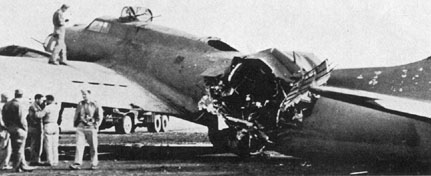
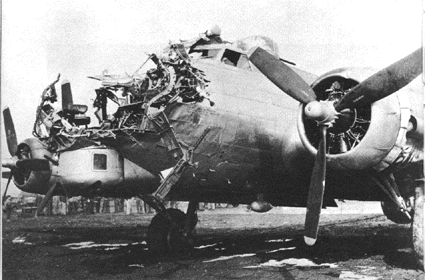
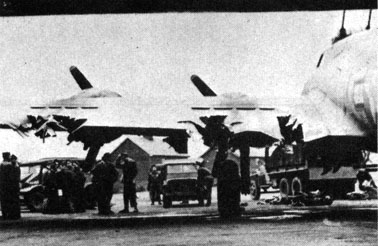
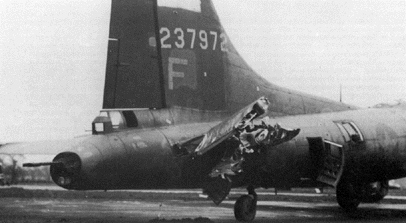
Talking about WWII. If B-17s could fly with half their wings, tails and fuselage missing, why construct them complete in the first place?

sidehole.jpg


Unpossible!
 
Has anyone seen the B-777 wing stress test video. I beleive it is youtube, I beleive the wing stretches 21 feet before it breaks. If they design the wing to bend that far, and the most it will probably ever move under extreme circumstances is less than half of that. I can imagine 350 knots maximum speed is probably about half as fast as they can really go. Which puts them up near the sound barrier which is probably when the plane would break apart. That video of the wing, you start whincing knowing its going to snap at any second its pretty neat.
 
Has anyone seen the B-777 wing stress test video. I beleive it is youtube, I beleive the wing stretches 21 feet before it breaks. If they design the wing to bend that far, and the most it will probably ever move under extreme circumstances is less than half of that. I can imagine 350 knots maximum speed is probably about half as fast as they can really go. Which puts them up near the sound barrier which is probably when the plane would break apart. That video of the wing, you start whincing knowing its going to snap at any second its pretty neat.

You mean this one:

 
Talking about WWII. If B-17s could fly with half their wings, tails and fuselage missing, why construct them complete in the first place?

[qimg]http://www.daveswarbirds.com/b-17/photos/body/sidehole.jpg[/qimg]

Unpossible!
Yeah and
nose5.gif

and
wingedge.jpg

and
stabil1.gif

and
rudder1.gif


Yeah, those Boeing aircraft really suck. There is no way they would go way beyond the published design limitations.
 

Back
Top Bottom