Hoping that an engineer can help me with a question

LashL

Goddess of Legaltainment™
Joined
Aug 12, 2006
Messages
36,711
This is a bit of an unusual request but I am hoping that some of the engineering wizards here can help me out.

The hypothetical scenario is this:

Old, redundant hydro wires are being removed along the length of a street.They are attached, of course, from pole to pole down the street. They are removed in sections which are equivalent to the distance between two poles. The sections are removed from east to west. As each section is removed, it is cut on the east side of the pole and lowered to ground. Before the cut is made on the east side of the pole, the wire to the west of the proposed cut is tied off and secured to the pole and J hook to ensure that only the cut portion to the east comes down. After each section on the east is lowered to the ground, the process is repeated while moving on to the next section to the west.

The problem is this:

Let's say that we are now at pole number 5, as we move from east to west, and that the previous sections between poles 1 & 2, between poles 2 & 3, and between poles 3 & 4, have all been lowered to the ground in accordance with the plan. So, now the section between poles 4 and 5 is on the ground at the easterly end but is still attached to pole 5 at height. To remove the section between poles 4 & 5, we secure the wire to pole 5 on the west side of where we are going to cut, and then cut on the east side of pole 5, so that the remaining part of the section between 4 & 5 will fall to the ground to join the easterly part of that section which is already on the ground.

However, something goes wrong and the wire not only falls to the east as planned but also falls to the west. On the west side, it hits a person who is situated between pole 5 and pole 6. The wire still remains attached at height, though, to pole 6.

The question is this:

How would one go about calculating the speed and acceleration that the wire fell and how would one go about calculating the force with which the wire hit the person?

(I can provide details of height, weight, circumference of the wire, distance, etc. for actual calculations as well, but I would really like to learn what criteria an engineer would require to figure out the answers and what formulae would be used to figure out the answers.)

Thank you in advance for your assistance.

Edit to add: As an aside, the reason I'm asking this is because I received a report late Friday afternoon that purports to calculate the items mentioned above, but the report strikes me as wholly, grossly, and flagrantly inadequate. I will be hiring an expert to respond to that report, but it strikes me as so hopelessly inept that it is bugging me, even on the weekend. Thus, I hope to get some input from engineers here on what information you would need and what formulas you would utilize to tackle the questions.
 
Last edited:
Sounds like you represent the injured party. Not a problem.

I don't quite understand the details of the wire fall. Can we simplify the situation? Did the wire fall from one pole?

It is possible to model the fall of a rigid beam supported on one side and falling in a vacuum. The beam rotates at one support as it accelerates downward. The gravitational force is considered acting at the center of mass. The angular acceleration is inversely proportional to the angular inertia. The speed of the beam at impact depends on the height. The part of the beam, i.e. how far from the fulcrum, impacts the victim, does matter.

If one knows the type of beam, it might be possible to estimate the effect of air resistance. Very heavy beams falling relatively small distances are not affected much by air resistance. Light beams falling far are.

A nonrigid wire introduces another level of uncertainty. Wires do not fall as a unit, and estimating their air resistance would be a challenge. Insulated wires are pretty light for the surface area. Perhaps some empirical measurements have been made on wires falling in air.

I would think it would be easier, frankly, to do a test. Mount the wire on an exemplar pole. Photograph the fall and compute the speed. The impact force depends on a lot of hard to measure things, like how quickly the wire is stopped by the victim. Probably it would be better to test that also, on something that acts like the victim's body when struck.

Don't the injuries speak for themselves?
 
Sounds like you represent the injured party. Not a problem.

Actually, no. I'm on the other side. And just so that it is clear, I am just trying to figure out what a legitimate expert would require in order to assess this situation in order to write a report (since the one I received appears to be totally looney tunes, even to my non-engineering mind). I am trying to figure out, for my own edification, what factors, distances, numbers, and information a legitimate engineer would require in order to make a realistic assessment of the events because, frankly, reading this report makes me doubt the writer's qualifications in their entirety and makes me think that he's a full blown woo of some kind.

I don't quite understand the details of the wire fall. Can we simplify the situation? Did the wire fall from one pole?

Yes. Only one end of the wire fell. The other end remained attached to the next pole to the west.

It is possible to model the fall of a rigid beam supported on one side and falling in a vacuum. The beam rotates at one support as it accelerates downward. The gravitational force is considered acting at the center of mass. The angular acceleration is inversely proportional to the angular inertia. The speed of the beam at impact depends on the height. The part of the beam, i.e. how far from the fulcrum, impacts the victim, does matter.

This is helpful, even though it was not a rigid beam. Some of the things that surprised me so much about this report are that there was no mention of the fact that only one end of the cable fell, no consideration of the location of the fellow who was struck by the wire, no consideration of the fulcrum, no consideration of the fact that the wire may very well have (and probably did) hit the ground first before striking the fellow, no measurements taken by the so-called "expert", etc.

In the report, the falling wire was treated as though it was a solid beam, unsupported at either end, being dropped much like one might imagine dropping a pencil held like this <=========o from a height of an inch or two from a desktop. But it was a semi-rigid cable that could not and did not fall in the manner of a solid beam, and that was still attached to a pole on one end.

It seems to me that all of the calculations this guy made were based on outrageously wrong premises, and ell completely vertically as if it was a completely distance of the victim from the fulcrum. I couldn't figure out, in my admittedly non-engineer mind, how one could assess the alleged force of impact without even accounting for the location of the person viz the falling wire.

If one knows the type of beam, it might be possible to estimate the effect of air resistance. Very heavy beams falling relatively small distances are not affected much by air resistance. Light beams falling far are.

I don't have the specific piece of cable from the incident, but can work out the weight from the sample that I do have. A 210 inch (17.5 ft.) sample of it weighs ~7.5 pounds. The actual piece that was being removed was ~100 ft. in length, and it was approximately 20 feet above the ground prior to being removed.

Given the height of only 20 feet, I suspect that air resistance would not have had much of a role, and I am content to disregard it for purposes of this discussion if it is negligible.

A nonrigid wire introduces another level of uncertainty. Wires do not fall as a unit, and estimating their air resistance would be a challenge. Insulated wires are pretty light for the surface area. Perhaps some empirical measurements have been made on wires falling in air.

This is also helpful, thank you.

I would think it would be easier, frankly, to do a test. Mount the wire on an exemplar pole. Photograph the fall and compute the speed. The impact force depends on a lot of hard to measure things, like how quickly the wire is stopped by the victim. Probably it would be better to test that also, on something that acts like the victim's body when struck.

Yes, this makes good sense, of course. I can and will have a recreation done, as you suggest, but my purpose in asking the questions that I have asked above is to try to comprehend this report which strikes me as completely bogus, and to try to understand what information, numbers, measurements, etc. would be required by a legitimate expert to come up with calculations of speed and acceleration of descent, and more importantly, force of impact, without recreating the scene, since this purported expert did not do any such thing. In other words, I want to understand what he should have done, what information he should have sought, what measurements he should have taken, etc., in order to give an informed expert opinion.

Don't the injuries speak for themselves?

I certainly think so. He received not a cut, not a scratch, not even a bruise. He didn't fall down, he didn't even fall to his knees, he didn't lose consciousness, he suffered no physical injury at all. But he now claims that he suffered a severe brain injury.

Which is where the force calculations come in. This writer of the report says that the force of the wire hitting the fellow was something in excess of 3,787 pounds of force per square inch, and that the contact location was ~ 0.62 square inches.

I have no idea what that means in real terms, but it sounds highly dubious to me that someone could be hit with that kind of force over a very small area and not even have a bruise, cut, scrape, fall, etc.

Anyway, as I said, this is just bugging me because I don't think I have ever seen such a terrible "expert" report - on any subject matter, and boy, I've seen a lot of them on a myriad of topics - to date. (There is a lot more crap in it that leads me to that conclusion, which is not relevant to this thread.)

Thank you for your assistance, cooper.
 
To get a figure for the actual force of impact like that you would need to calculate the rate of deceleration of the wire upon landing on the man. I'd say this would be extremely difficult as it would involve all sorts of assumptions about the softness of the man's head and the stiffness of his neck and even his knees cushioning the impact.
 
Which is where the force calculations come in. This writer of the report says that the force of the wire hitting the fellow was something in excess of 3,787 pounds of force per square inch, and that the contact location was ~ 0.62 square inches.

From what I can gather from a quick web search, that (the total force) is a bit more than the force necessary to break the average person's skull at the sides or back.

He received not a cut, not a scratch, not even a bruise.
Certainly it is possible to be struck over a large area of the skull and experience brain damage without any visible cut or bruise, but with such a small contact area that would seem unlikely.
 
Edit to add: As an aside, the reason I'm asking this is because I received a report late Friday afternoon that purports to calculate the items mentioned above, but the report strikes me as wholly, grossly, and flagrantly inadequate. I will be hiring an expert to respond to that report, but it strikes me as so hopelessly inept that it is bugging me, even on the weekend. Thus, I hope to get some input from engineers here on what information you would need and what formulas you would utilize to tackle the questions.


You need a drawing.

Lawyers tend to think in grammer, but this is a classic case of a problem in which - first of all - an accurate sketch is made - and then the force vectors are calculated.

That is how to start with the engineering method. Also, oftentimes drawing the little simple-but-accurate sketch is not so simple.:)
 
LashL:
Examining the worst-case "distance toward pole 6" from pole 5 , the distance is the height of the attachment to the pole.
That will be reduced somewhat because the wire will likely not lie on the ground at the bottom of pole 5 and make a 90 degree angle up to the pole 5 attachment, but the line will actually form a curve.
Air resistance will be neglegible, unless the pole is very tall, and can generally be ignored.
Velocity will be about 8.025*(sqrt(h)), in feet/sec (assuming h is in feet). That is at the very end of the wire.
What you will need is line material, diameter, length (total), pole height, and the type of surface it is laying on, as well as the line coating type and condition (for friction)--this, along with weight (from material and diameter), will help get you the distance from pole 5 the line actually leaves contact with the ground so you can calculate the true distance past pole 5 it will actually fall
 
You need a drawing.

Lawyers tend to think in grammer, but this is a classic case of a problem in which - first of all - an accurate sketch is made - and then the force vectors are calculated.

That is how to start with the engineering method. Also, oftentimes drawing the little simple-but-accurate sketch is not so simple.:)
What mhaze said...
 
I am not an engineer and would not dare to play one on the Internet.:D But as a humble physicist, I note the the original calculations represent a worst possible case interpretation. Taking account of all the factors noted to date will produce a smaller figure for the force of impact. You don't necessarily need to include them all in your calculations; just as many as it takes to reduce the force to something "negligible".
 
No expert on this area at all, but aren't these wires under tension? I suspect the effect of even a fairly small amount of released tension would outweigh the effect of gravity.
 
Thank you, all of you, for your help.

I will scan in a drawing, as suggested, and will post it with the measurements, distances, etc.

The wire is normally under tension, yes, when it is in use. However, prior to removing the wire, the workers had already released the tension of the entire span that was to be removed, before they cut the first section. They do that precisely so that the sections come down without going flying due to tension.

I appreciate all of your assistance, and will try to get the drawing scanned in this afternoon.
 
No expert on this area at all, but aren't these wires under tension? I suspect the effect of even a fairly small amount of released tension would outweigh the effect of gravity.

Any tension on the wire in question is a result of the weight of the suspended portion of the wire and friction between the wire and ground.
One end has already been cut and is laying on the ground.

ETA:
Whoops==looks like that is wrong. If I understand LashL's post correctly, both ends were still attached to poles, and upon cutting, the cut end went away from the load direction?
I definitely need a picture!
 
Last edited:
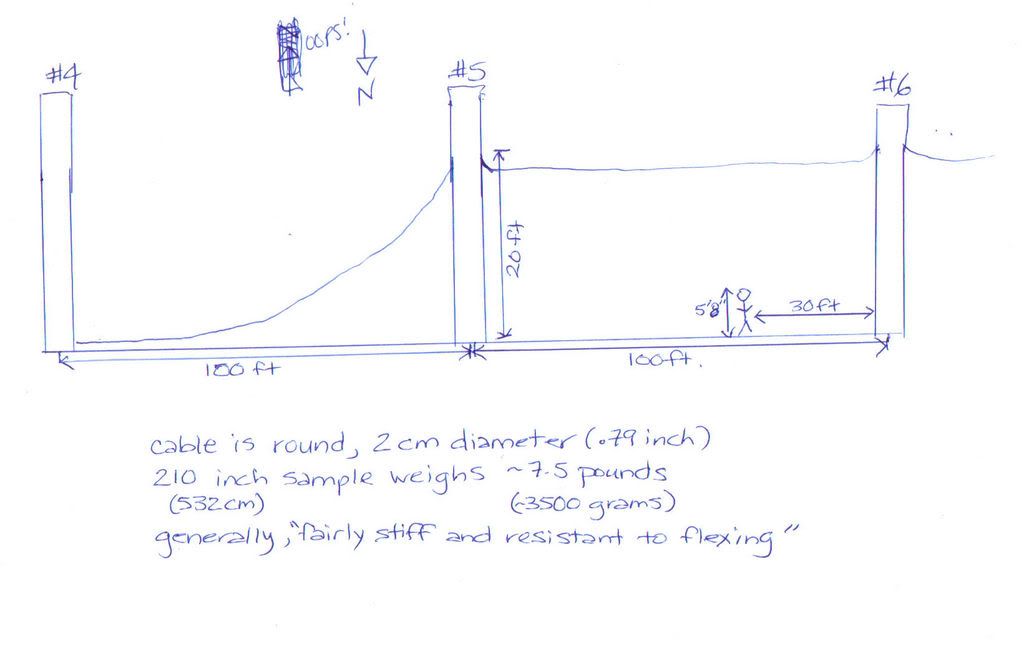
Okay, here is a crude sketch of the scene.

The cable is approximately 2 cm (0.79 inch) in diameter.

According to the report, the sample piece is 532 cm. (210 inches) long and weighs ~3500 grams (~7.5 pounds) *note, by my calculation, 3500 grams = ~7.7 pounds.

The wire was attached to the poles at a height of ~20 feet.

The man was standing ~30 feet east of pole #6, ~70 feet west of pole #5.

The man is ~5'8" tall.

The distance between poles is ~100 feet.

sketch.jpg


When they cut the wire at pole #5, the part to the east went down as intended and simply dropped to the ground to the east of that pole.

But the section of wire between pole 5 and 6 also went down, striking the man. The wire did, however, remain attached to pole 6 at all times.
 
Last edited:
Actually, no. I'm on the other side. And just so that it is clear, I am just trying to figure out what a legitimate expert would require in order to assess this situation in order to write a report (since the one I received appears to be totally looney tunes, even to my non-engineering mind). I am trying to figure out, for my own edification, what factors, distances, numbers, and information a legitimate engineer would require in order to make a realistic assessment of the events because, frankly, reading this report makes me doubt the writer's qualifications in their entirety and makes me think that he's a full blown woo of some kind.


Yes. Only one end of the wire fell. The other end remained attached to the next pole to the west.


This is helpful, even though it was not a rigid beam. Some of the things that surprised me so much about this report are that there was no mention of the fact that only one end of the cable fell, no consideration of the location of the fellow who was struck by the wire, no consideration of the fulcrum, no consideration of the fact that the wire may very well have (and probably did) hit the ground first before striking the fellow, no measurements taken by the so-called "expert", etc.

In the report, the falling wire was treated as though it was a solid beam, unsupported at either end, being dropped much like one might imagine dropping a pencil held like this <=========o from a height of an inch or two from a desktop. But it was a semi-rigid cable that could not and did not fall in the manner of a solid beam, and that was still attached to a pole on one end.

It seems to me that all of the calculations this guy made were based on outrageously wrong premises, and ell completely vertically as if it was a completely distance of the victim from the fulcrum. I couldn't figure out, in my admittedly non-engineer mind, how one could assess the alleged force of impact without even accounting for the location of the person viz the falling wire.


I don't have the specific piece of cable from the incident, but can work out the weight from the sample that I do have. A 210 inch (17.5 ft.) sample of it weighs ~7.5 pounds. The actual piece that was being removed was ~100 ft. in length, and it was approximately 20 feet above the ground prior to being removed.

Given the height of only 20 feet, I suspect that air resistance would not have had much of a role, and I am content to disregard it for purposes of this discussion if it is negligible.


This is also helpful, thank you.


Yes, this makes good sense, of course. I can and will have a recreation done, as you suggest, but my purpose in asking the questions that I have asked above is to try to comprehend this report which strikes me as completely bogus, and to try to understand what information, numbers, measurements, etc. would be required by a legitimate expert to come up with calculations of speed and acceleration of descent, and more importantly, force of impact, without recreating the scene, since this purported expert did not do any such thing. In other words, I want to understand what he should have done, what information he should have sought, what measurements he should have taken, etc., in order to give an informed expert opinion.


I certainly think so. He received not a cut, not a scratch, not even a bruise. He didn't fall down, he didn't even fall to his knees, he didn't lose consciousness, he suffered no physical injury at all. But he now claims that he suffered a severe brain injury.

Which is where the force calculations come in. This writer of the report says that the force of the wire hitting the fellow was something in excess of 3,787 pounds of force per square inch, and that the contact location was ~ 0.62 square inches.

I have no idea what that means in real terms, but it sounds highly dubious to me that someone could be hit with that kind of force over a very small area and not even have a bruise, cut, scrape, fall, etc.

Anyway, as I said, this is just bugging me because I don't think I have ever seen such a terrible "expert" report - on any subject matter, and boy, I've seen a lot of them on a myriad of topics - to date. (There is a lot more crap in it that leads me to that conclusion, which is not relevant to this thread.)

Thank you for your assistance, cooper.

1. Did the guy have a construction helmet on? If so, it would seem possible to have no obvious trauma but to have a concussion.

2. Medical reports should show such a thing if it had occurred.

3. I hate to say this but the wire could have acted like a whip.
 
1. Did the guy have a construction helmet on? If so, it would seem possible to have no obvious trauma but to have a concussion.

2. Medical reports should show such a thing if it had occurred.

3. I hate to say this but the wire could have acted like a whip.

1) No, he was not a worker. He was just a guy standing on the boulevard beneath the wire, who refused to move when asked to do so.

2) Medical reports show only "minor head injury" and "muscle strain to neck", "no bruises, no swelling, no lacerations, no loss of consciousness", and no treatment was ordered except to apply heat to his neck.

3) No need to hate to say it. :) I am just after the truth and the facts.
 
If 210 inches weighs near 8 lb, then 1200 inches (100') weighs like 40 lbs. A 40 lb object falling 20 feet can injure. Not all 40 lbs fell, true. An analytic solution is difficult because wire can act chaoticly. Local areas can move at faster speeds than others. Nor will a single test tell much. It is a good problem to consider more.
 
Well the expert is a moron, so you're on safe ground.

Imagine it *was* a rigid rod stretched between the poles. Then when it falls it pivots (since its pinned at the top of pole 6), like a pendulum. The free end of the pendulum (the piece which was attached at the top of pole 5) hits the ground long before anything hits the guy (unless he's about 14 feet tall). So you can discount his analysis by that simple observation....
 
1) No, he was not a worker. He was just a guy standing on the boulevard beneath the wire, who refused to move when asked to do so.

2) Medical reports show only "minor head injury" and "muscle strain to neck", "no bruises, no swelling, no lacerations, no loss of consciousness", and no treatment was ordered except to apply heat to his neck.

3) No need to hate to say it. :) I am just after the truth and the facts.
I think any whipping effect is unlikely as the wire as not under tension and the tip of it did not touch him.
One thing that's always worth doing in these kind of situations is to take the assumptions the other guy makes and to apply them to what else you know about the situation.

So you're expected to believe that if a solid beam of weight ____pounds fell 94 feet and landed on the guy, he wouldn't move.

It can provide a quick and easy test of how plausible the assumptions are.
 
If 210 inches weighs near 8 lb, then 1200 inches (100') weighs like 40 lbs. A 40 lb object falling 20 feet can injure. Not all 40 lbs fell, true. An analytic solution is difficult because wire can act chaoticly. Local areas can move at faster speeds than others. Nor will a single test tell much. It is a good problem to consider more.

I find it fascinating myself, even though I do not have the technical background to figure out the appropriate tests to apply. I anticipate doing a "re-construction" of the event to see what actually happens when we recreate the circumstances, but since I received this report on Friday afternoon, I have been curious about the calculation methods, etc.

Well the expert is a moron, so you're on safe ground.

Imagine it *was* a rigid rod stretched between the poles. Then when it falls it pivots (since its pinned at the top of pole 6), like a pendulum. The free end of the pendulum (the piece which was attached at the top of pole 5) hits the ground long before anything hits the guy (unless he's about 14 feet tall). So you can discount his analysis by that simple observation....

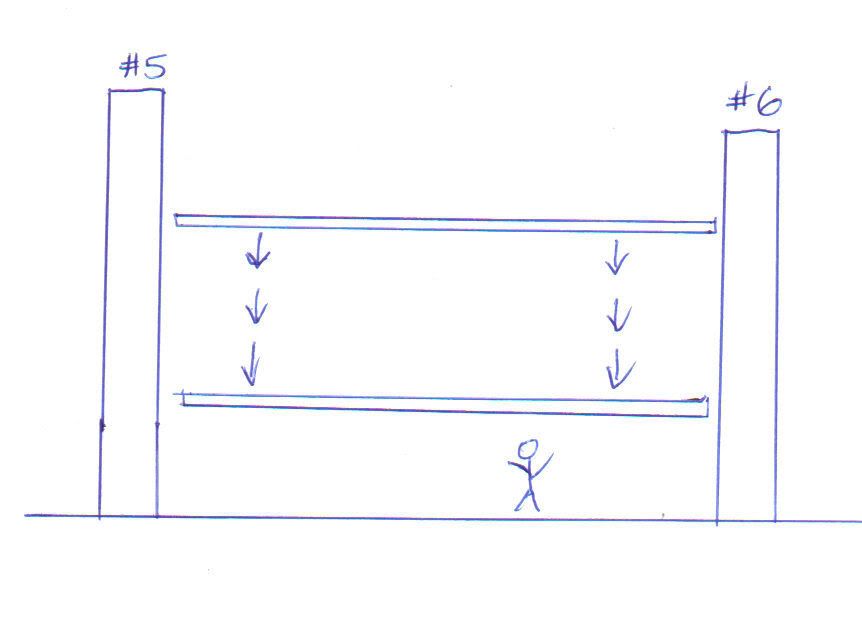
Yes, he is a moron. He is not considering at all the fact that the wire was only detached from pole #5 and NOT from pole #6. He has treated it as though the cable was a rigid rod that fell in "free fall" parallel to the ground with no support on either side, like this:

sketch2.jpg


I know how wrong he is, and I know that I can easily refute his report, but it has made me curious about it would accurately be calculated. :)

I think any whipping effect is unlikely as the wire as not under tension and the tip of it did not touch him.
One thing that's always worth doing in these kind of situations is to take the assumptions the other guy makes and to apply them to what else you know about the situation.

So you're expected to believe that if a solid beam of weight ____pounds fell 94 feet and landed on the guy, he wouldn't move.

It can provide a quick and easy test of how plausible the assumptions are.

Indeed. :)
 
it would be tricky to calculate accurately - once the one end of the wire hits the ground, quite how it impacts the guy will depend on how flexible the cable is. For instance if its not flexible at all (the "beam" limit) then it never hits him. If there is a lot of friction between the cable and the ground it may also not hit him at all!

Something can probably be computed in a worst case scenario by using a model of the cable as like a chain with independent links, but I'd have to think about it.
 

Back
Top Bottom