• Quick note - the problem with Youtube videos not embedding on the forum appears to have been fixed, thanks to ZiprHead. If you do still see problems let me know.

Bigfoot - The Patterson-Gimlin Film

Status
Not open for further replies.
Lets.

How can anyone say what's natural about an entity we know virtually nothing about? In addition, we don't even know her condition. For all we know she could have recently given birth and was lactating. As my wife would tell you, she was enlarged and swollen.
As I've said before, It's an exercise in futility to make comparisons of this kind, because frankly, we just don't know enough about these creatures to arrive at specific conclusion.

We can make out generalities like its got arms, legs, breasts etc. And we can all say they're moving. But what we cannot say is that they're moving properly or improperly, because no one here really knows. This is not a human we are examining here.
[/QUOTE]
Some investigators costructed a digital model of Patty's skeleton; bigfoot foot bone structure was inferred base in alleged footprints, behavior extrapolated from eyewitnesses reports. Muscle groups are identified in Patty, but we can not make inferences on her breasts?

Luminous, if this creature is real, its not true that we know virtually nothing of it. If the investigators are correct, they are from the Hominidae family, either from the Homininae or Ponginae subfamilies. And we know a lot about these animals, enough, IMHO to compare Patty with real large apes. Enough, IMHO to suspect her breasts are a possible indication of a blunder in the building/modification of the costume.

Female bigfoot breasts (assuming they are real animals) must be composed of adipose tissue, they must be modified sudoriferous glands and they must be attached to the chest just like womens (as well as female gorillas, chimpanzees, orang-utangs and bonobos) breasts are.

As for the long forearms, well costumes are built to masquerade human body proportions. Thye are by no means evidence of Patty being the real deal. Neither possible moving fingers.
 
Originally Posted by Luminous
As I've said before, It's an exercise in futility to make comparisons of this kind, because frankly, we just don't know enough about these creatures to arrive at specific conclusion.
Yet you have no problem arriving at the specific conclusion that Patty is real ..

Would you consider informing Dr. Meldrum it is an exercise in futility to infer things like the ' mid-tarsal break ' when there is no physical specimen to confirm such a thing.?
 
Luminous, before you find yourself painted into a corner over unsupportable claims about the film subject's gait, why don't you read the following essay very carefully:

http://home.clara.net/rfthomas/papers/screen.html

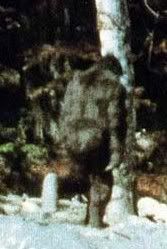
Unless you understand what a "compliant gait" is all about, the "lower level leg lift" seen here in frame 72 seems very "inhuman".


rearview1.jpg


Luminous, have you ever practiced walking with a compliant gait? Have you ever been photographed while doing this?
 
tube wrote:
Luminous, before you find yourself painted into a corner over unsupportable claims about the film subject's gait,

Here's a question for the skeptics, concerning Patty's compliant gait....

Why did the "guy-in-the-suit" walk with such an unnatural gait in the first place???

Was this type of gait something commonly reported for Bigfoot, up to this point in time?
 
Tube,

He's already painted himself into a corner. I'm waiting to see how long it takes him to figure out how he got there.


Reading assignments for Luminous.


From Archaeology
Volume 57 Number 4, July/August 2004
Conversations: Bigfoot Exposed!
A scientist examines the evidence.


"As a paleoanthropologist, how do you approach analyzing a film of Bigfoot?"

"You've probably seen the Patterson film. It's not a great piece of nature
photography. But you can take the data at face value and see if you can rule
out a person in a costume.
Bigfoot advocates said that the thing on the film was too large to be a
human: "If the thing is eight feet tall, and it's walking around
effortlessly, it can't be a person." And the other thing people said was,
"It walks funny. It's impossible for people to walk like that." These are
extraordinary claims. Because if these are both true, then that film is
quite a spectacular piece of evidence.
First of all, I consulted what's called an anthropometric source book, which
contains a ridiculous number of measurements on populations of human beings.
Even if this thing on the film was as large as Krantz and others were
claiming, it was not outside the range of human variation. But as it turns
out, you can't measure reliably off of that film--there are too many unknown
variables."


"I've seen Duck Soup."

"Okay. Groucho uses this compliant gait. And it turns out that when people adopt a compliant gait, some strange things happen--which are actually in evidence in the film. A compliant gait tends to increase your stride length. At the film site people were saying, "Well, the footprints left by this thing here are so far apart, this couldn't be a human." Two of us and a couple of volunteers using the compliant gait basically matched Bigfoot's stride. It's very easy to learn how to walk like this."

David Daegling, Ph.D.
Associate Professor of Anthropology, University of Florida


Read this paper by Daniel Schmitt,
Associate Professor, Biological Anthropology, Duke University,


http://jeb.biologists.org/cgi/content/full/206/9/1437

or this one by both Schmitt and Daegling.

http://findarticles.com/p/articles/mi_m2843/is_3_23/ai_54600089


Sweaty, maybe Patterson read something about a compliant gait and primates at one time?


m
 
Last edited:
Your claims are becoming more ridiculous by the hour. You are entering into desperation mode.

Nobody would say that there isn't wood debris out there in the large clearing at Bluff Creek. But the film itself never shows Patty stepping, jumping or climbing over anything. As far as anyone can tell, she chooses a pathway that doesn't force her to negotiate over any of this stuff. You show still images of debris piles that are so large she would have to climb over them like a monkey or jump like a gazelle. It never happens. The reason is because she walks around them.

You need to learn about how camera lenses cause illusions of depth, and how objects in the foreground can appear to be located at the same position as the subject. You need to watch Patty's head to see that it essentially remains level during her entire walk. This suggests that she never high-steps, jumps or climbs over anything.

Most importantly, you need to do a hell of a lot better than you are doing to challenge the prevailing theory that Patterson filmed a guy walking in a Bigfoot suit. At this point, you suck.

And at this point, you don't exist. Bye, Bye...
 
tube wrote:


Here's a question for the skeptics, concerning Patty's compliant gait....

Why did the "guy-in-the-suit" walk with such an unnatural gait in the first place???

Was this type of gait something commonly reported for Bigfoot, up to this point in time?

Well, I can give you one possibility. The characteristics of the suit forced him to.
I recently watched a stabilized version of the PGF (on the 'Best Evidence' program). For some time I've had the feeling that I recognised Patty's walk, but couldn't place it. I finally did. Guys in chem warfare suits walk this same way.
'80's to '90's vintage chem suits consisted of; a heavy quilted jacket and pants outfit with an activated charcoal linning, gas mask and hood, several layers of gloves and overboots. This was all worn over the regular uniform. Depending on the MOPP level, a helmet and pistol belt were worn as well.
The overboots were of a peculiar design. They had an almost tubular upper, with the sole in a diamond pattern. The slipped on over the normal boots, and then the points to each side and in front and back were drawn up and laced. We called them clown shoes or pixie boots. They were quite clumsy, causing frequent tripping over surface irregularities and the other boot. Care had to be taken to swing the feet wide, and lift them more than usual to keep the extended toes from snagging. That, along with the bulk of the garments caused the peculiar gait. In addition the tendency to trip, tunnel vision from the mask caused you to concentrate on the gound ahead, and give a hunched over stance. Finaly, difficulty in turning the head with the mask, hood and helmet caused you to turn the whole upper body to look around, rather than the head. Patty does this in the PGF.
This, of course, does not prove that Patty was a bloke in a suit, but it is why I can say with great confidence that Patty moves like a bloke in a suit.

Robert Klaus

P.S. The chem suits, and particularly the boots have been considerably inproved since then. They current design is much like a rubber galosh.
 
Yep. I wore a MOPP suit for Uncle Sam just like that. Had to wear it and still do my job, too. 1992, Camp Sears, ROK.

Patty is looking straight at the ground because of the limited field of view through the mask, imo.
 
Two comments:

1- Regarding Kitakaze's account, there's at least another JREF member who's skeptic about bigfoot and had an experience that could be interpreted as a bigfoot encounter by some.

2- Regarding Patty's hair, claimed to be so different from gorilla suits (supposed to have long shaggy hair). Lets suppose gorilla suits available to P&G had indeed long shaggy hair. So what? "Hmmm... I think this hair is too long, don't like that look... Hey, pass me that scissors, would you?". Not to mention Ivan Marx's bigfoot also had short hairs...

I see Marx's 77 suit as nothing more than a stretchable velvet material, what you call hair I see velvet fuzz.

The point is they used long hair on gorilla suits to cover zippers and clasps etc. Why would Patterson be foolish enough to use short hair knowing that zippers and clasps would easily be seen?

Don't even think of telling me that Patterson's "suit" wouldn't need zippers or clasps to hold it all together. The reason you can't find any zippers and clasps is because THERE ARE NONE.
 
The article Tube linked to has some typical pro gaffs also ..
15. René Dahinden (personal communication and Perez 1992) reports that, on one of his numerous visits to the film site, he and others present were incapable of walking the distance traveled by the film subject in the time that it did so (assuming a film speed of 24 fps).

Well duh !

Like we really see a continuous film of Patty ...

For all we know, she could have paused for lunch and a potty break ...
 
Last edited:
No we shouldn't rule out eyewitness testimony, though we should be aware of influences which can affect our perceptions (drugs or alcohol, poor lighting conditions, time of day, optical illusion, weather, stress, fatigue, age, etc.). For example, a fleeting glimpse on a dark, foggy night, after working a 12-hour shift, should not be accorded the same reliability as a long look at a creature at close range, on a clear day.

What I was specifically referring to were anecdotal accounts, which could be a story passed along by someone who is not the direct witness, or it could be an account written up in a newspaper 100 years ago.

RayG

I see what you mean Ray and I agree 100%
 
Luminous,


I realize the following statement was not directed at me but it kind of relates to some perplexing questions that I have had for quite some time. Odds are I will kind of change the subject on you, but that's just kind of how I am. Of course I'm just a nobody so these questions may not be perplexing to others.


"My answer to your question is the same for North America. I believe we're dealing with an endangered species. One that is quite possibly on the brink of maintaining a breeding population. Though I have hopes that evidence may be forthcoming (hopefully within the next ten years), There's also a strong possibility that they go extinct without us ever knowing they were here."


So are you saying, that at one time in the not so distant past (3-500 years???) there were maybe 20-40,000 of these creatures walking around N. America, and, that it has been whitemans encroachment upon their land that has expedited their demise? If this is true then would not the Native American stories/legends be more along the lines of a living breathing creature than that of a creature that seems to be more spiritual/mythical in nature? For instance the bear, eagle etc., have always been revered as sacred, strong, respected, and in some cases feared, but, their body parts have always been used in warrior adornments, jewelry, head dresses etc. to show the warriors strength, ability, power, wisdom etc. Why no squatch adornments? In some Native American cultures I believe the bear was even revered as a god, but they still killed it.


Generally speaking animals were the intermediaries between the real world and the supernatural world. There are many, many legends of animals in Native American culture that are fairly mythical in yet we know that the animal existed simply because parts of that animal were used in everyday life, food, clothing, adornments etc. Why no squatch?


Most of my knowledge in regards to Native Americans is curtailed to the west coast, particularly Wa. State so I will use the Makah as an example for this question. Many suggest that the reason no one (with the opportunity) has killed a squatch is because they look too human. My knowledge of the Makah tells me that they would not have had a problem with this. It's well known that the Makah not only scalped members of neighboring tribes but also on occasion would cut their heads off and put it them on stakes in front of their lodge, if you look at the first photo I posted that is a head dress of scalps. They did this for pretty much the same reasons I stated above, to show the warriors strength, ability, power, success etc. Why no squatch head/scalps? One would think that 500 years ago with such a large population of squatch they would have crossed paths quite frequently.


Imagine if you would the implications or the mojo of the warrior who wears a necklace of squatch teeth and the head dress of its scalps. It seems fairly reasonable IMO that if a warrior had the opportunity to kill a sasquatch, he would have. At the very least one would think that stories of these attempts would have been passed down from generation to generation. Most Native stories (that I am familiar with) in regards to this creature have to do with the Shaman and good vs.evil a slightly more mythical slant as compared to real world reality.


Anyone?


BTW here's a pic when its legs are not quite so bent and back not quite so slouched over. Try to find one where it is standing completly upright so we can see the arms true length. Good luck with that one.


m


Kathy Moskowitz Strain of AIBR would be more qualified and more knowledgeable to answer the specific nature of your questions. Sorry I can't be more help.
 
Some investigators costructed a digital model of Patty's skeleton; bigfoot foot bone structure was inferred base in alleged footprints, behavior extrapolated from eyewitnesses reports. Muscle groups are identified in Patty, but we can not make inferences on her breasts?

Luminous, if this creature is real, its not true that we know virtually nothing of it. If the investigators are correct, they are from the Hominidae family, either from the Homininae or Ponginae subfamilies. And we know a lot about these animals, enough, IMHO to compare Patty with real large apes. Enough, IMHO to suspect her breasts are a possible indication of a blunder in the building/modification of the costume.

Female bigfoot breasts (assuming they are real animals) must be composed of adipose tissue, they must be modified sudoriferous glands and they must be attached to the chest just like womens (as well as female gorillas, chimpanzees, orang-utangs and bonobos) breasts are.

As for the long forearms, well costumes are built to masquerade human body proportions. Thye are by no means evidence of Patty being the real deal. Neither possible moving fingers.

It sounds like you have this all wrapped up. I've said what I came to say. You either believe it or reject it. Either way, it doesn't matter to me. I've got some other things I need to tend to, so I apologize for cutting this short. Feel free to continue on in my absence. Best wishes...
 
Daegling writes:

"Another peculiarity of the film subject is the forward pitch of the trunk during locomotion. This is again atypical of striding bipedalism, but when humans do adopt this strange posture, a compliant gait becomes the obligate form of bipedalism (Yaguramaki et al. 1995)."

http://home.clara.net/rfthomas/papers/screen.html

You see this in frame 72, and you see it in human test subjects:


IMG_1866.jpg


Check out the strangely straightened arm of the test subject.

I should like to propose that this "inhuman" characteristic, the "strangely straightened arm" be included in the "Tube walk scorecard", as a rebuff and challenge to all scoftics who would seek to emulate my inhuman gait.

I suspect that only one human in a million can walk like this...
 
Status
Not open for further replies.

Back
Top Bottom