• Quick note - the problem with Youtube videos not embedding on the forum appears to have been fixed, thanks to ZiprHead. If you do still see problems let me know.

PS Audio Noise Harvester

Who's having the placebo? The one who buys it with the intention of not hearing a difference or the one who buys it to test whether he does or not?


This is ValhaalPC he posts at the AVSforum about his PSAudio findings and what it does. He is a kook. I cant post the link to his thread, but its at the AVS forum under the 20000 plus post section and its one of the top threads about the PSA premier power plant. Just take a look at his pictures.
 
This is ValhaalPC he posts at the AVSforum about his PSAudio findings and what it does. He is a kook. I cant post the link to his thread, but its at the AVS forum under the 20000 plus post section and its one of the top threads about the PSA premier power plant. Just take a look at his pictures.

Looks like the toroid xfrmr may be wired to reject common mode noise. A poorly designed system can easily be sensitive to hf common mode spikes and in some systems there may be a noise reduction. The bulk of claims is technobabble.
 
Oops. It appears that the thing goes across only the hot and return lines and this does nothing for common mode noise - which could actually work. Trying to cut differential noise by paralleling the line in is an especially poor way to do it. Line filters are usually serial and these work can far better on any noise type. I can't imagine a topology that would work here. It would be good if one of you with the device sketch out the circuit.
 
Ok here is the link. He has some big pictures of his paper happy self.

http://www.avsforum.com/avs-vb/showthread.php?t=800063&page=1&pp=30

The company that makes the stuff claims this:
The edges of ERS does have exposed conductive fibers and should be handled and installed with care. The electrical resistance of ers is .026 ohms per square yard.

This is an odd way to spec a conductive sheet. The resistance edge to edge is a constant independent of units. That is, the resistance is the same whether measured across edges of a square yard, square food, or square mile. The usual is to spec it simply as ohms per square.

Why not just use a laminated copper screen?
 
A reply from PS Audio

Sorry guys, I don't normally read this forum but it seems a great one. Forgive me if I post this answer to one of the replies and then not answer any follow ups as I am not normally monitoring this forum. I have two others that take up most of my available time, but feel free to email me directly with any questions about engineering or products.

By way of introduction, I am Paul McGowan, CEO of PS Audio and the co-inventor of the Noise Harvester along with our Director of Research, Laszlo Juhasz. While I understand the Harvester has a lot of folks in a tizzy, it reall does work to remove noise. At the end of my reply, I describe the basic circuit and how it works. This is not magic, just engineering.

Anyway, here goes:

Let's look at what poster MortFurd has to say:

"Complete, utter, and absolute BS.
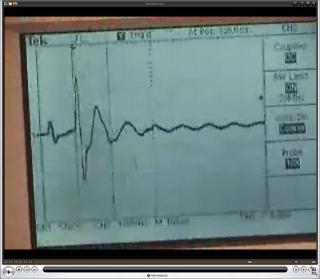
Take a look at the pictures here. Whatever they were measuring, it wasn't a powerline. You get 60 Cycle AC out of an American power outlet. They've got a nasty spike on DC, and there's no AC to be seen. The accompanying text describes the pictures as showing the harvester removing the noise caused by a dimmer. This is a flat out lie. House hold light dimmers work on AC, so the either the description is false or the pictures are wrong. "

OK, let's start with that. If the scope showed the 60Hz waveform, then you couldn't see the very high frequency noise caused by a dimmer. The scope photo shows the dimmer noise only, in fact, it is triggering on the noise and cannot show the 60Hz - one is at a very high frequency and low amplitude and the other is very low frequency and high amplitude.

If it were to show the 60Hz, which is 120 volts, then the high frequency noise would appear like a little zit riding on the 60Hz. And, since the noise amplitude is about 1.2 volts, that zit would be a mere 1% of the 60Hz and thus you wouldn't really see it.

Scopes have the ability to look at a small event in the absence of the larger event that it may be a part of. What you are looking at here is the magnified smaller event without the larger event being visible. I hope that makes sense - as I tried to explain above, you cannot see both - if for no other reason than one event is 99 times larger than the other.

I really object to MortFurd proclaiming this as a "flat out lie". It's amazing to me the arrogance coupled with ignorance that causes someone to proclaim this type of rude mis-statement. MortFurd's conclusion is based soley on his own ignorance and had he asked, instead of jumped to a conclusion, this wouldn't happen.

<EM>

As for the "DC" comment, the scope is set to trigger on the noise caused by the dimmer - so it doesn't move in the way one would expect to see with AC, - so it starts out as a flat line which looks like DC to the untrained eye - so MortFurd assumes it's DC. It's the way the scope handles triggered AC. We do this so we can look at one event and see the change.

Yes dimmers work on AC. They use a device called a triac. The triac chops the AC waveform by remaining off, starting at the zero crossing, then turn on sometime after zero crossing depending on how much light you want. The reason dimmers are so noisy is what I just described. When the triac turns on and starts delivering current, there is a sharp rise in the voltage/current which causes harmonics to be generated (both on the line and in the air). These harmonics are typically in the 8kHz to 12kHz region, where the Harvester is most sensitive. The scope is triggering on this repeating waveform and so it appears not to move.
 
Sorry guys, I don't normally read this forum but it seems a great one. Forgive me if I post this answer to one of the replies and then not answer any follow ups as I am not normally monitoring this forum. I have two others that take up most of my available time, but feel free to email me directly with any questions about engineering or products.

By way of introduction, I am Paul McGowan, CEO of PS Audio and the co-inventor of the Noise Harvester along with our Director of Research, Laszlo Juhasz. While I understand the Harvester has a lot of folks in a tizzy, it reall does work to remove noise. At the end of my reply, I describe the basic circuit and how it works. This is not magic, just engineering.

Anyway, here goes:

Let's look at what poster MortFurd has to say:

"Complete, utter, and absolute BS.
Take a look at the pictures here. Whatever they were measuring, it wasn't a powerline. You get 60 Cycle AC out of an American power outlet. They've got a nasty spike on DC, and there's no AC to be seen. The accompanying text describes the pictures as showing the harvester removing the noise caused by a dimmer. This is a flat out lie. House hold light dimmers work on AC, so the either the description is false or the pictures are wrong. "

OK, let's start with that. If the scope showed the 60Hz waveform, then you couldn't see the very high frequency noise caused by a dimmer. The scope photo shows the dimmer noise only, in fact, it is triggering on the noise and cannot show the 60Hz - one is at a very high frequency and low amplitude and the other is very low frequency and high amplitude.

If it were to show the 60Hz, which is 120 volts, then the high frequency noise would appear like a little zit riding on the 60Hz. And, since the noise amplitude is about 1.2 volts, that zit would be a mere 1% of the 60Hz and thus you wouldn't really see it.

Scopes have the ability to look at a small event in the absence of the larger event that it may be a part of. What you are looking at here is the magnified smaller event without the larger event being visible. I hope that makes sense - as I tried to explain above, you cannot see both - if for no other reason than one event is 99 times larger than the other.

I really object to MortFurd proclaiming this as a "flat out lie". It's amazing to me the arrogance coupled with ignorance that causes someone to proclaim this type of rude mis-statement. MortFurd's conclusion is based soley on his own ignorance and had he asked, instead of jumped to a conclusion, this wouldn't happen.

<EM>

As for the "DC" comment, the scope is set to trigger on the noise caused by the dimmer - so it doesn't move in the way one would expect to see with AC, - so it starts out as a flat line which looks like DC to the untrained eye - so MortFurd assumes it's DC. It's the way the scope handles triggered AC. We do this so we can look at one event and see the change.

Yes dimmers work on AC. They use a device called a triac. The triac chops the AC waveform by remaining off, starting at the zero crossing, then turn on sometime after zero crossing depending on how much light you want. The reason dimmers are so noisy is what I just described. When the triac turns on and starts delivering current, there is a sharp rise in the voltage/current which causes harmonics to be generated (both on the line and in the air). These harmonics are typically in the 8kHz to 12kHz region, where the Harvester is most sensitive. The scope is triggering on this repeating waveform and so it appears not to move.


Ah, so I'm guessing that you are running the caps in series with one toroid winding, essentially forming a high pass, then using the step up side into some sort of clamping circuit that shunts the higher frequences on the AC line. I'm suprised audio equipment picks this stuff up.
 
Sorry guys, I don't normally read this forum but it seems a great one. Forgive me if I post this answer to one of the replies and then not answer any follow ups as I am not normally monitoring this forum. I have two others that take up most of my available time, but feel free to email me directly with any questions about engineering or products.

By way of introduction, I am Paul McGowan, CEO of PS Audio and the co-inventor of the Noise Harvester along with our Director of Research, Laszlo Juhasz. While I understand the Harvester has a lot of folks in a tizzy, it reall does work to remove noise. At the end of my reply, I describe the basic circuit and how it works. This is not magic, just engineering.

Anyway, here goes:

Let's look at what poster MortFurd has to say:

"Complete, utter, and absolute BS.
Take a look at the pictures here. Whatever they were measuring, it wasn't a powerline. You get 60 Cycle AC out of an American power outlet. They've got a nasty spike on DC, and there's no AC to be seen. The accompanying text describes the pictures as showing the harvester removing the noise caused by a dimmer. This is a flat out lie. House hold light dimmers work on AC, so the either the description is false or the pictures are wrong. "

OK, let's start with that. If the scope showed the 60Hz waveform, then you couldn't see the very high frequency noise caused by a dimmer. The scope photo shows the dimmer noise only, in fact, it is triggering on the noise and cannot show the 60Hz - one is at a very high frequency and low amplitude and the other is very low frequency and high amplitude.

If it were to show the 60Hz, which is 120 volts, then the high frequency noise would appear like a little zit riding on the 60Hz. And, since the noise amplitude is about 1.2 volts, that zit would be a mere 1% of the 60Hz and thus you wouldn't really see it.

Scopes have the ability to look at a small event in the absence of the larger event that it may be a part of. What you are looking at here is the magnified smaller event without the larger event being visible. I hope that makes sense - as I tried to explain above, you cannot see both - if for no other reason than one event is 99 times larger than the other.

I really object to MortFurd proclaiming this as a "flat out lie". It's amazing to me the arrogance coupled with ignorance that causes someone to proclaim this type of rude mis-statement. MortFurd's conclusion is based soley on his own ignorance and had he asked, instead of jumped to a conclusion, this wouldn't happen.
<EM>

As for the "DC" comment, the scope is set to trigger on the noise caused by the dimmer - so it doesn't move in the way one would expect to see with AC, - so it starts out as a flat line which looks like DC to the untrained eye - so MortFurd assumes it's DC. It's the way the scope handles triggered AC. We do this so we can look at one event and see the change.

Yes dimmers work on AC. They use a device called a triac. The triac chops the AC waveform by remaining off, starting at the zero crossing, then turn on sometime after zero crossing depending on how much light you want. The reason dimmers are so noisy is what I just described. When the triac turns on and starts delivering current, there is a sharp rise in the voltage/current which causes harmonics to be generated (both on the line and in the air). These harmonics are typically in the 8kHz to 12kHz region, where the Harvester is most sensitive. The scope is triggering on this repeating waveform and so it appears not to move.


Explain why the scope says its DC then?

Also why didnt you put the little device that made the buzzing sound at the dimmer back up when you plugged the NH back in? Why did you just say see it works?

Also interesting to note that 60HZ is the noise we are really worried about in audio from power lines. Wonder why Paul never presented any of this groundbreaking stuff to a peer review?
 
Last edited:
Full response from Paul at his website forum he left this stuff out here for some reason.


Quote"<I>
The oscilloscope they are using is set to 5Volts per centimeter, so that spike is about 12 Volts. If you were to dump enough noise onto a household power line to cause a 12 volt spike, then you are probably talking about something on the order of several hundred watts of noise. Granted this is a very short peak (~20microseconds) but if it were to repeat 60 times per second, it would in fairly short order burn out the harvesters, which are claimed can remove "8 to 10 watts each."


Well, here he is absolutely correct based on the available information. However, what isn't being said is that we used a 10X scope probe so what you are seeing is 10 times less or 1.2 volts, not 12. Most scopes cannot take 120 volts in so we always use a 10X probe to reduce the voltage so as not to damage the scope. To us, this is obvious, to the untrained, it is not obvious. My apologies.

It wasn't so much the size or magnitude of the voltage we were trying to show, but the magnitude of the change that was important. What he means, BTW, is 5 volts per division, not CM.

What kills me though is that the assumptive close in all these messages is that the Harvester is a scam and here's proof of it. That's just so counter productive to learning. The Harvester does exactly what we suggest it does and it would make so much more sense to come at this from a learning perspective. Sigh.

<B>
Furthermore, the LED must be just an added "blinky." An LED that can dissipate 8 watts would probably be so bright you couldn't stand it. Think bright blue strobe light. Probably very distracting when you're trying to listen to classical music.

I find LED light bulbs rated for 3 watts continuous that can be used as replacements for the bulbs used in low voltage halogen track lights. Imagine how much brighter 8 watts would be."
 
And the more of the Quote


The LED is not just an "added blinky" it is how the Harvester dissipates the stored noise energy. But, again, I can't fault MortFurd too hard on this because his assumption is based on wrong information which I admit, without further information he can only draw this conclusion (since he's not an engineer familiar with how one would read 120 volts).

However, it would further his understanding if he simply asked when this didn't make sense and we'd be happy to explian so he would.

The Harvester is real. Honestly, it's a very simple device! I tried to explain it before, let me try one more time.

There is a capacitor and the primary (input) of a transformer in series across the AC line. This forms a high pass filter that is tuned to about 8kHz.

The secondary of the transformer (the output)is send through a diode bridge to convert it to DC. Then, using some tricky electronics, we take that DC and charge a capacitor with the energy that's harvested from the line (where the unit got its name). When the capacitor is full, we dump the energy into the LED.

Thus, the only power used to blink the light is harvested from noise on the AC line that is above 8kHz. There are no batteries or tricks going on. It is a straightforward engineering design when the light blinks, it is powered by noise.

The laws of nature require us to understand that if we take energy from one source and expend it somewhere else, irregardless of how (heat, light, motion), then the energy is lower at the source because it has been moved to where it was directed, to make light, heat or motion.

Speco, you're not dumb. If you were, I wouldn't even bother with you. Relax for one moment. I am not making this up. It really works this way. Show the description above of how this device works to someone you may know that actually understands circuitry or physics. They will tell you that what I wrote is 100% true.

The only question that is legitimate is how much of an effect does it have on line noise and your system? Now that is a fair and reasonable question.
 
The Harvester is real. Honestly, it's a very simple device! I tried to explain it before, let me try one more time.

There is a capacitor and the primary (input) of a transformer in series across the AC line. This forms a high pass filter that is tuned to about 8kHz.

The secondary of the transformer (the output)is send through a diode bridge to convert it to DC. Then, using some tricky electronics, we take that DC and charge a capacitor with the energy that's harvested from the line (where the unit got its name). When the capacitor is full, we dump the energy into the LED.

My guess about the circuit was pretty close and it does in fact turn noise into light. No doubt there exists equipment that it would reduce the audio noise on due to poor design.
 
Explain why the scope says its DC then?

Also why didnt you put the little device that made the buzzing sound at the dimmer back up when you plugged the NH back in? Why did you just say see it works?

Also interesting to note that 60HZ is the noise we are really worried about in audio from power lines. Wonder why Paul never presented any of this groundbreaking stuff to a peer review?


While the "harvester" is hyped, the demo and waveforms are consistent with what I now believe the design to be. Nothing wrong with the scope pics either. They are triggering, probably with hf reject, near the 60hz signal peak. Horizontal is 100us/div. Vertical scale offset would be used to center the signal. The alteration in waveform is about what I would expect for this design. Strong attenuation of high freq and conversion to a lower freq ringing.

Not that it should make any difference in well designed equipment.
 
About the scope:

I own such a scope, and it comes with 10x probes as default. It has provisions for changing probe attenuation in the menu, in order to show correct values. The default setting in the menu is 10x, so if the pictures from PS Audio shows the wrong values, they must deliberately have changed probe attenuation in the menu. Now, why would anyone do that?
 
Actually, in the video you can see that in the scope menu the probe attenuation is indeed set to 10x:


PS Audio said:
Well, here he is absolutely correct based on the available information. However, what isn't being said is that we used a 10X scope probe so what you are seeing is 10 times less or 1.2 volts, not 12. Most scopes cannot take 120 volts in so we always use a 10X probe to reduce the voltage so as not to damage the scope. To us, this is obvious, to the untrained, it is not obvious. My apologies.

This means that WYSIWYG on the scope. What was that about the untrained, again?
 
Last edited:
And while I'm at it:

There is no way that he is measuring the power line directly, either. The scope coupling is DC, which means that the base line of this measurement is about 0V (no offset on the scope). At 100 us/div, 60 Hz AC will have a pretty steep slope when it passes through 0V.

So, the only explanation is that he is measuring something else. Simple as that. He may be measuring at some point inside the Harvester, but we're not told what is is, except that it is "line noise".
 
And Paul never answers the question of about 4:30 into the video why he doesnt put the "power Sleuth" back up after putting the NH in line. And it would be interesting to see it happen uncut keep the sleuth on and hear the noise and then plug the NH in without the cutchot he uses now.

And we never see Lazlo plug the NH in its all off camera. Shady.
 
Sorry guys, I don't normally read this forum but it seems a great one. Forgive me if I post this answer to one of the replies and then not answer any follow ups as I am not normally monitoring this forum. I have two others that take up most of my available time, but feel free to email me directly with any questions about engineering or products.

By way of introduction, I am Paul McGowan, CEO of PS Audio and the co-inventor of the Noise Harvester along with our Director of Research, Laszlo Juhasz. While I understand the Harvester has a lot of folks in a tizzy, it reall does work to remove noise. At the end of my reply, I describe the basic circuit and how it works. This is not magic, just engineering.

Anyway, here goes:

Let's look at what poster MortFurd has to say:

"Complete, utter, and absolute BS.
Take a look at the pictures here. Whatever they were measuring, it wasn't a powerline. You get 60 Cycle AC out of an American power outlet. They've got a nasty spike on DC, and there's no AC to be seen. The accompanying text describes the pictures as showing the harvester removing the noise caused by a dimmer. This is a flat out lie. House hold light dimmers work on AC, so the either the description is false or the pictures are wrong. "

OK, let's start with that. If the scope showed the 60Hz waveform, then you couldn't see the very high frequency noise caused by a dimmer. The scope photo shows the dimmer noise only, in fact, it is triggering on the noise and cannot show the 60Hz - one is at a very high frequency and low amplitude and the other is very low frequency and high amplitude.

If it were to show the 60Hz, which is 120 volts, then the high frequency noise would appear like a little zit riding on the 60Hz. And, since the noise amplitude is about 1.2 volts, that zit would be a mere 1% of the 60Hz and thus you wouldn't really see it.

Scopes have the ability to look at a small event in the absence of the larger event that it may be a part of. What you are looking at here is the magnified smaller event without the larger event being visible. I hope that makes sense - as I tried to explain above, you cannot see both - if for no other reason than one event is 99 times larger than the other.

I really object to MortFurd proclaiming this as a "flat out lie". It's amazing to me the arrogance coupled with ignorance that causes someone to proclaim this type of rude mis-statement. MortFurd's conclusion is based soley on his own ignorance and had he asked, instead of jumped to a conclusion, this wouldn't happen.

<EM>

As for the "DC" comment, the scope is set to trigger on the noise caused by the dimmer - so it doesn't move in the way one would expect to see with AC, - so it starts out as a flat line which looks like DC to the untrained eye - so MortFurd assumes it's DC. It's the way the scope handles triggered AC. We do this so we can look at one event and see the change.

Yes dimmers work on AC. They use a device called a triac. The triac chops the AC waveform by remaining off, starting at the zero crossing, then turn on sometime after zero crossing depending on how much light you want. The reason dimmers are so noisy is what I just described. When the triac turns on and starts delivering current, there is a sharp rise in the voltage/current which causes harmonics to be generated (both on the line and in the air). These harmonics are typically in the 8kHz to 12kHz region, where the Harvester is most sensitive. The scope is triggering on this repeating waveform and so it appears not to move.
Why don't you take some of the money you are raking in and actually attend some engineering courses? Specifically, one dealing with the usage of oscilloscopes. You really need help, there.

1. The scope is set to DC coupling on the channel you are measuring. You actually have a DC level of 20Volts with a spike on it.

2. The time base is set to 100microseconds per centimeter. Were there any 60Hz AC in the signal being measured, there would be a significant curve to the shown signal. The width of the screen is 10 centimeters, which is 1000 microseconds, commonly known as 1 millisecond. One cycle of 60Hz AC is 16.7 milliseconds. One half wave is therefore ~8.3 milliseconds. 1/8 of a semicircle would be quite noticeable on the scope picture. The peak of a half wave AC (in the US) would be ~77Volts - 1/8 of that would be about 2 cm on the scope. Even granting worst case (you hit the sine wave exactly at peak in the center of your scope picture) there would still be a downturn of the scope trace of ~1.5Volts at the right and left edges of the picture. That's 3 mm on the scope screen, enough to be seen easily. That's a hash mark and a half, since scopes usually have 2mm hash marks (which your does.)

3. Triggering on DC does not mean (as you imply) that AC is ignored. The scopes are not built to filter anything, with two exceptions a) Frequencies above the scope's design limits are lost and b) DC can be filtered out when measuring AC.

On some of your later comments:
1. If you are using 10X probes, your situation becomes really BAD. The power calculations I wnet through go up by that same factor of 10, and you will be trying to dump more power through a poor little LED - and from the photos that other have posted in this thread, you aren't even using an LED designed for high current. All I see is what looks like a 5mm LED. If you are using a 10X probe, that spike becomes 120Volts. Ouch for your LED.

2. Further clarification: A 10X probe DIVIDES the input signal by 10, so that you must multiply the shown voltage by 10 to get the correct value. Are you telling me you used a 1X probe on a scope set for 10X?

3. Untrained? I spent 10 years working with scopes daily. I've built audio frequency signal analysers. I think I bloody well understand how to read what is shown on the scope face.

4. Powering the LED on noise over 8kHz is no sweat. It won't do you much good, but you can make it blink. So what? I can make an LED blink using nothing but the miniscule amount of power that a crystal radio can receive. Blinking an LED proves bloody zip about power dissipation.

5. Again, if you were dissipating any amount of power capable of making a difference to a properly built amplifier (see Schneibter's info on noise rejection and power supply design) an LED capable of handling that amount of power would blink like a bleeding strobe light.

6. Your description of the operation of the gadget makes quite clear just what is going on. You are powering a blinky on the noise on the powerline. Do you know just how little energy it takes to make a blinky run? Properly designed, a blinky can run on a single AA cell for a year. Your "harverster" isn't neccessarily "harvesting" any significant amount of power at all.

7. Were your device actually effective, it would be more so if you just attached a high power (5watt or more) low resistance resistor to the output of your tranformer. The resistor could dissipate far more power than that poor little LED.

8. Since your scope pictures do NOT show AC, they are at best staged. I consider them to be out and out lies, however, as the staging could only be done to conceal the ineffectiveness of your device. Staging it would allow you to control the impedance of all the signals involved - including the impedance of the spike - which would let you show a higher reduction in the voltage of the spike. What's the current flow during the spike?

How much power does your "harverster" dissipate? Simple question, and you should have the answer to hand - if you have the slightest clue what you are doing.


Please remember that not everyone on this planet is ignorant of basic facts of electricty and the use of test equipment.

 

Back
Top Bottom