Density of concrete dust at WTC - A Question

Horatius

NWO Kitty Wrangler
Joined
May 9, 2006
Messages
29,691
We've all seen the myriad assertions by people like our friend BS5678, that the concrete in the WTC towers was "pulverized" or "disintegrated". BS has on occassion mentioned that 99% of the concrete was pulverized.

I've been thinking for a while now that some simple calculations might put the lie to that assertion, but I haven't been able to find some numbers I need to make the calcs, and was hoping someone could point me to a source.

We've seen reports such as the EPA analysis which characterizes the makeup of the dust found near Ground Zero, but there's no information on the average density of the dust. My thought is, we have good numbers for the area over which the dust was laid, and the thickness of the dust layer. If we had a good number for the density, we could get a rough estimate of the total mass of the dust, and compare it to the known mass of the Towers.

As anyone who's done brickwork can tell you, cutting bricks or concrete produces an unexpectedly large amount of dust for the volume of solid material you cut through. I'd expect the total amount of dust to be a surprisingly small percentage of the mass of the towers.

Unfortunately, the only sources I've been able to find quote the density of solid concrete. You'd expect the dust to be significantly lower density, but I don't know by how much. So, is there anyone out there who can point me to a good cite for the average density of concrete dust in general, or the dust of the WTC in particular?

Or do I have to break out the sledgehammer and scales?
 
Not sure on density, but either that EPA study, or the other one I've cited (I'll send link if you need it) does discuss the average particle size in the samples broken down in ranges (based upon their sifting methods).
 
We've all seen the myriad assertions by people like our friend BS5678, that the concrete in the WTC towers was "pulverized" or "disintegrated". BS has on occassion mentioned that 99% of the concrete was pulverized.

I've been thinking for a while now that some simple calculations might put the lie to that assertion, but I haven't been able to find some numbers I need to make the calcs, and was hoping someone could point me to a source.

We've seen reports such as the EPA analysis which characterizes the makeup of the dust found near Ground Zero, but there's no information on the average density of the dust. My thought is, we have good numbers for the area over which the dust was laid, and the thickness of the dust layer. If we had a good number for the density, we could get a rough estimate of the total mass of the dust, and compare it to the known mass of the Towers.

As anyone who's done brickwork can tell you, cutting bricks or concrete produces an unexpectedly large amount of dust for the volume of solid material you cut through. I'd expect the total amount of dust to be a surprisingly small percentage of the mass of the towers.

Unfortunately, the only sources I've been able to find quote the density of solid concrete. You'd expect the dust to be significantly lower density, but I don't know by how much. So, is there anyone out there who can point me to a good cite for the average density of concrete dust in general, or the dust of the WTC in particular?

Or do I have to break out the sledgehammer and scales?
well, density is weight/volume. So which state do you measure from? Compacted, after settling? Dispersed, just prior to settling, occupying the maximum volumein air? or somewhere in between.
Technically, the density of dust = the density of its original composition...
 
Not sure on density, but either that EPA study, or the other one I've cited (I'll send link if you need it) does discuss the average particle size in the samples broken down in ranges (based upon their sifting methods).

Yes, but without knowing the packing fraction of the particles, any estimates we get would be just guesses,and thus not useful for convincing anyone who might be on the fence. I'm hoping for something a bit more reliable.
 
well, density is weight/volume. So which state do you measure from? Compacted, after settling? Dispersed, just prior to settling, occupying the maximum volumein air? or somewhere in between.
Technically, the density of dust = the density of its original composition...

This is why I'm hoping someone at the scene actually measured some samples for density. Anyone who's ever sifted flour can tell you that the volume of a powder can change quite a bit depending on how packed it was. I'm hoping to get some sort of typical range of densities, so we could at least get a rough estimate of maximums and minimums that doesn't depend just on our hunches....
 
Yes, but without knowing the packing fraction of the particles, any estimates we get would be just guesses,and thus not useful for convincing anyone who might be on the fence. I'm hoping for something a bit more reliable.

Well, assuming a spherical shape and figuring packing density from there would give a good first approximation, I'd think. Some irtregualr shapes will fit together well, others won't...it seems that spheres might be a good "in-between" range to start with.

Heck, you could just do the calculation assuming a 100% efficient packing, just to see the absolute maximum that it could have been.
 
I once saw an old house collapse, all on its own. It produced an astonishing cloud of thick, choking dust.

It was orders of magnitude smaller than the Twin Towers. The sheer volume of dust it produced, however, was impressive, rolling down a residential street and completely obscuring vision for ten or fifteen minutes before it began to settle.

Could the tower collapse produce dust along with tons and tons of macro debris? Certainly it could. In fact, it did.
 
I once saw an old house collapse, all on its own. It produced an astonishing cloud of thick, choking dust.
...
Could the tower collapse produce dust along with tons and tons of macro debris? Certainly it could. In fact, it did.

Exactly. I'm hoping such a calculation might convince someone of that.

So many of these guys base all their arguments on intuition, it'd be nice if we could show them clearly that at least one intuitive belief is seriously flawed. It might lead them into questioning others.

Yeah, I know, wishfull thinking, right?
 
Well, assuming a spherical shape and figuring packing density from there would give a good first approximation, I'd think. Some irtregualr shapes will fit together well, others won't...it seems that spheres might be a good "in-between" range to start with.

Heck, you could just do the calculation assuming a 100% efficient packing, just to see the absolute maximum that it could have been.

I may end up doing that. By 100%, do you mean the maximum packing fraction possible for spheres, or are you suggesting just treating it as solid concrete? Solid concrete would give us a pretty definite maximum, but isn't terribly realistic. You just know that'd be the one point the Troothies would keep harping on.
 
I may end up doing that. By 100%, do you mean the maximum packing fraction possible for spheres, or are you suggesting just treating it as solid concrete? Solid concrete would give us a pretty definite maximum, but isn't terribly realistic. You just know that'd be the one point the Troothies would keep harping on.

I meant treat it as solid concrete. Yes, it's unrealistic, but it's the absolute maximum possible of the ejected mass. I have a suspicion it would still be a small percentage of the WTC mass.
 
I meant treat it as solid concrete. Yes, it's unrealistic, but it's the absolute maximum possible of the ejected mass. I have a suspicion it would still be a small percentage of the WTC mass.
that would be my suggestion too, if you take absolute maximum density and find it to be 1/10th the mass of concrete at the WTC thats pretty cut and dry
 
I meant treat it as solid concrete. Yes, it's unrealistic, but it's the absolute maximum possible of the ejected mass. I have a suspicion it would still be a small percentage of the WTC mass.

Well, if I don't get any better numbers in the next few days, I'll try it with both the solid density, and a calculated density assuming spheres of the average size in the EPA report with various common packing fractions. It's not perfect, but may be better than nothing.
 
Well, here it is....

Start with some numbers. Of course these numbers are subject to change based on improved info input by others. We need the volume of the dust layer, and the density of the concrete, as well as the fraction of the dust that was concrete.

From the above linked EPA document, they collected one sample (USGS 4, see fig. 2) from 0.8km away. This is the maximum they report, which seemed consistent with other numbers I found.

The thickness of the dust layer was variously described as a couple of inches, with one CT site saying up to 10 cm. I went with 5.1cm (~2 inches) as the thickness.

We need to decide on a "shape" of the layer of dust to determine the volume. The true shape would be quite difficult to determine what with shadowing effects of other buildings, so I decided to just assume a uniform circular deposition out to the 0.8km=800m range, with a uniform layer thickness of 5.1cm=0.051m. This is the "poker chip" model, which is essentially a very short cylinder.

Volume of a cylinder Vpc = pi R*R h with R=800m, h=0.051m, Vpc=102,538 cubic meters.

From the EPS report, the concrete dust made up between 19.3% and 30.5% of the dust layer, I used 25% as an average.

Assuming the density of the concrete dust was comparable to that of solid concrete, I used d = 2300 kg/m3.

Thus the mass of the concrete dust was Vpc(0.25)2300 = 58 959 350kg, round to 60 000 000 kg, or 60 000 metric tonnes.

It's unclear what the mass or volume of the concrete used in the towers was. One site listed 160 000 cubic meters for each tower, giving us 320 000 cubic meters in total. compared to Vpc(0.25) = 25, 634 cubic meters, we get about 8% of the total volume turned to dust.

Another site listed the mass as 600 000 tons (I think that's imperial, but they didn't specify). That converts to about 545 454 metric tonnes, or about 237 153 cubic meters. It's not clear if that number was for one tower or two, but in any case, it agrees to within an order of magnitude with the above value. If this is for both towers, the percentage turned to dust is about 11%, if it's just one tower, it would be half that, or 5-6%.


So we have between 5-11% of the concrete turned to dust.

Of course, changing some assumptions will alter that, but most of my assuptions were in favour of there being more mass in the dust layer rather than less. If we were to increase the volume by having a larger R or h value, this would up the mass. All other assumptions, if changed for more realistic assumptions, would lower it. A uniform cylindrical layer is almost certainly not the best model. If were were to assume a roughly ellipsoidal distribution, volume would be two thirds of Vpc, and a cone-shape would be one third of Vpc. Also, the density of the concrete dust will certainly be less than that of solid concrete. The EPA report seems to indicate that the dust particles were generally rectangular in cross section, and so would be expected to pack fairly loosely, which again lowers the final % number.

So, take that for what it's worth. Any corrections or comments are welcomed.
 
From my experience in civil engineering labs, I think if you worked on an average density of 1.600t/m3 for the loose concrete dust, you should be close enough. There are too many variables to put any kind of accurate figure on it, without doing lab tests on numerous samples of the actual material. The density of concrete say 25mPa is around 2.350t/m3, depending on the ingredients - aggregates, cement etc. Cement has an s/g of about 3.200. I would imagine that the WTC dust would include all sorts of particles, including masonry, mortar, etc etc.
 
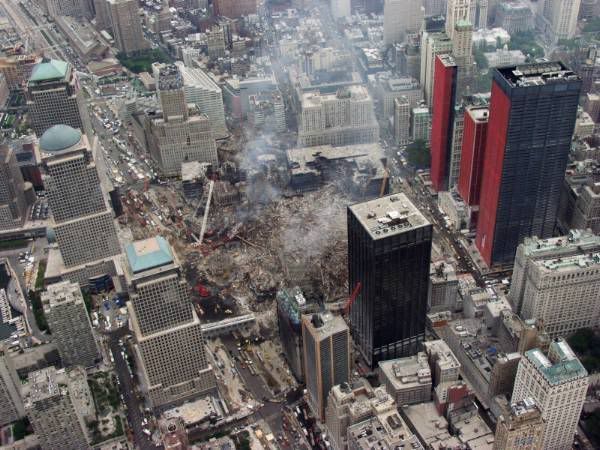
Assuming your calcs are in the ballpark, this raises a great mystery. Whatever became of the other 95% of the concrete? It certainly isn't found at ground zero.
21a_flattenedManhattan_1701.jpg
 
Assuming your calcs are in the ballpark, this raises a great mystery. Whatever became of the other 95% of the concrete? It certainly isn't found at ground zero.
[qimg]http://i18.photobucket.com/albums/b108/janedoe444/trouble/21a_flattenedManhattan_1701.jpg[/qimg]


you can certainly tell from that picture taken a couple of thousand feet up. There are many pictures from ground zero that show lots of concrete and other materials. I sure you have seen them many times in the threads you have started. the rubble from any collapsed building I have ever seen is always a fraction of the total volume of the buildings. They are mostly air. That why we are able to walk around in them
 
Assuming your calcs are in the ballpark, this raises a great mystery. Whatever became of the other 95% of the concrete? It certainly isn't found at ground zero.
http://i18.photobucket.com/albums/b108/janedoe444/trouble/21a_flattenedManhattan_1701.jpg

hey, boy!
That's some3 eyesight you got there, making out details atwo (rule8) ing miles distance
try those picture in the other thread, which you abandoned since you found out you were wrong--again...
http://www.internationalskeptics.com/forums/showthread.php?postid=1974213#post1974213

and other places....


From http://arkanwolfshade.spaces.live.com/blog/cns!9E151F6EB6C7A35D!304.entry

I don't believe that 90,000 is even remotely scientific either. I'm not sure there is a good estimate of how much concrete there was.


That 90,000 figure seems to be coming from the CTist who is being debunked. Without sourcing, we can't really rely on it. My first number came from http://hypertextbook.com/facts/2004/EricChen.shtml which seems to be a site that collects numbers from other sites for comparison. That's also where I got my numbers for the concrete density. http://hypertextbook.com/facts/1999/KatrinaJones.shtml

If the 90,000 figure is accurate, our % goes way up, but still not the 99+% some people have claimed. But again, this number is seriously out of whack with other estimates.
 
From my experience in civil engineering labs, I think if you worked on an average density of 1.600t/m3 for the loose concrete dust, you should be close enough. There are too many variables to put any kind of accurate figure on it, without doing lab tests on numerous samples of the actual material. The density of concrete say 25mPa is around 2.350t/m3, depending on the ingredients - aggregates, cement etc. Cement has an s/g of about 3.200. I would imagine that the WTC dust would include all sorts of particles, including masonry, mortar, etc etc.

Now these are the sorts of numbers I was hoping to find! So, with your value of 1.600t/m3, we get a correction factor of 16/23 for the density value I used, or 0.69. This makes my final % range about 3.5%-7.6% of the original mass turned to dust, depending on what we determine the original mass to be.

ETA: for the underlined part, that's what the 0.25 factor covers. The report linked in the first post indicated the range of concrete dust as being between 19.3 and 30.5% of the total, so I used the midpoint of 25% to get a ballpark figure.
 
Last edited:

Back
Top Bottom