Apollyon
Muse
- Joined
- Jun 2, 2006
- Messages
- 942
Do not forget that we have produced an alternate explanation - that it is conduit and/or plumbing.Do not forget that none have produced an alternative explanation for what it is other than rebar.
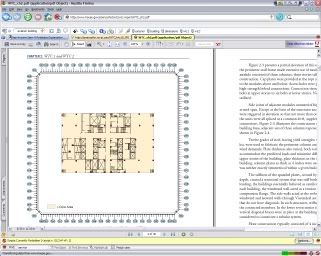
http://www.house.gov/science/hot/wtc/wtc-report/WTC_ch2.pdfEach building had a square floor
plate, 207 feet 2 inches long on each side. Corners were chamfered 6 feet 11 inches. Nearly an acre of floor
space was provided at each level. A rectangular service core, with overall dimensions of approximately 87 feet
by 137 feet, was present at the center of each building, housing 3 exit stairways, 99 elevators, and 16
escalators. Figure 2-1 presents a schematic plan of a representative aboveground floor.
No, he doesn't say "floor beams."
Eagar correctly calls them "floor joists." They are also properly referred to in other studies as "floor trusses."
So what straw man are you going to come up with next to avoid providing proof of your claim that the columns were butt-welded?
Please stop with your hand-waving and answer.
Do not forget that we have produced an alternate explanation - that it is conduit and/or plumbing.
more than cheaper and easier, i think it would be mandatory, otherwise the core would be sitting on the floor trusses.
How was it compromised? If you mean the wiretaps and PATRIOT Act, I agree.
Do not forget that none have produced an alternative explanation for what it is other than rebar.
Tube will not bend like that without kinking. No way!
Is there something wrong with you?[qimg]http://www.internationalskeptics.com/forums/attachment.php?attachmentid=2246&stc=1&d=1150909669[/qimg]
See the butt weld in the interior box column to the right and above the floor beam intersection. It can be distinguished by the different texture from grinding the weld smooth and the coloration of the steel from the heat of the weld.
It can easily bend like that when heated, which it was because jet fuel had gone down the elevator shafts.Tube will not bend like that without kinking. No way!
If it's conduit it could've been INSTALLED curved. Cable has to exit the risers some how and 90 degree intersections are bad for cables. They bend them with a nice soft radius.Plastic, plenum-rated conduit will.
Is there something wrong with you?
Seriously?
I already responded to your bogus claim of that picture showing a butt-weld. What that shows is where the standoffs for the beam clips are welded on. If you take the picture into Photoshop and blow it up a bit you can plainly see the raised surface. It the same sort of clips clearly shown on the far end of the column in this construction photo linked previously:
http://www.internationalskeptics.com/forums/showpost.php?p=1716047&postcount=1208
It can easily bend like that when heated, which it was because jet fuel had gone down the elevator shafts.
And you actually claim the concrete core was 17' thick?
The beam clips are still on the column indexing the beams!!!!!! And tubing is LESS likely to bend smoothly when heated. Stick with pencil pushing.
I show the core wall at base is 17 feet thick.
http://www.ttb.com/process.htmThe heat-induction pipe bending process was originally used during World War II to harden surfaces of gears and ball bearings. The pipe bending industry uses the heat-induction pipe bending process by placing an induction coil around the pipe to be bent. The induction coil heats a narrow, circumferential section of pipe to a temperature of 800 to 2,200 F, depending on the material type. At proper pipe bending temperature, the pipe passes through the induction coil at a slow, gradual rate as the bending force is applied.
custom pipe bending
After bending occurs, the heated area is quenched by a water or air spray. This pipe bending process produces a quality product, however its typical cost is higher than other methods. Pipe sizes up to 48" outside diameter and larger are commonly bent by this pipe bending method for applications including power plants, highway road signs and petroleum pipelines.

If it's conduit it could've been INSTALLED curved. Cable has to exit the risers some how and 90 degree intersections are bad for cables. They bend them with a nice soft radius.
There are dozens of mentions of core columns in that document, but this is the only mention of the word concrete in any sort of relationship with the core. 5" concrete fill on a metal deck does not in any way describe a core created by slip-form concrete extrusion. In fact, see the attached figure, which depicts this construction method. Observe that it does not involve concrete walls. If concrete walls were significant in the construction of the core, don't you think that that fact should have been mentioned? In fact, the only component of the core that is concrete is this floor (aside from perhaps the base of the foundation on the first basement level).The core consisted of 5-inch concrete fill on metal deck supported by floor framing of rolled structural shapes, in turn supported by a combination of wide flange shape and box-section columns. Some of these columns were very large, with cross-sections measuring 14 inches wide by 36 inches deep. In upper stories, these rectangular box columns transitioned into heavy rolled wide flange shapes.
Those appear to be the vertical columns, not floor trusses, judging by their size and shape. (See the above link for information on the profiles used, and their positions.) And in any event, there is a fundamental problem with using a butt weld in the location that you seem to have described (if you think I'm looking at it wrongly, circle the spot, and re-post). No engineer would permit a crucial member to be butt-welded in a location where it could clearly experience tensile, compressive and shear loading, without significant additional reinforcement (such as bolted gussets). Furthermore, note the proximity of distorted steel members to the undamaged weld. How do you propose that the weld withstood these forces, allowing the rest of the attached beam to deflect catastrophically, despite the fact that in common steel construction, welds are the weakest, softest and most ductile regions? If that were actually a butt weld, it would have failed first.http://www.internationalskeptics.com/forums/attachment.php?attachmentid=2246&stc=1&d=1150909669
See the butt weld in the interior box column to the right and above the floor beam intersection. It can be distinguished by the different texture from grinding the weld smooth and the coloration of the steel from the heat of the weld.
Those appear to be the vertical columns, not floor trusses, judging by their size and shape.
If it's conduit it could've been INSTALLED curved. Cable has to exit the risers some how and 90 degree intersections are bad for cables. They bend them with a nice soft radius.
You can't be serious. That is a highly controlled set of circumstances that a a man on the ground cannot reproduce, let alone happen by accident inside of a falling mass of steel debri 700 feet below the fire with a few spots hot enough to provide the required heat. OMG! The only bend in pipe or tube that a man can do with heat successfully without collapsing the tube is a wrinkle bend. A series of bends incrementing the entire curve.
Apparently the lie the murderers are hiding behind is so important to support that you are willing to sacrifice your marginal credibility.
...
For that matter, metal tubes heated to a high temperature will.
...
...
It can easily bend like that when heated, which it was because jet fuel had gone down the elevator shafts.
...
...
And tubing is LESS likely to bend smoothly when heated.
...