smartcooky
Penultimate Amazing

No, it doesn't if your determinations is to pick the best person for the job.Really depends on the job.

No, it doesn't if your determinations is to pick the best person for the job.Really depends on the job.

You can see a copy of the Turnitin report for Arday's thesis linked at the bottom of this substack article. The matches to Zwozdiak-Myers are mostly in the interpretation/discussion/implication sections, contrary to claims that they are in the literature review. These sections also contain extensive plagiarism of other sources. The plagiarism is the type often seen in student work, where citations taken from the plagiarised source appear within one continuous segment of matching text. This can make it appear that sources are acknowledged, but the pattern matching report flags that the sources are actually taken secondhand from an unattributed source. This is not a matter of using quotes without correct conventions.
One question is why this was not picked up when the thesis was examined, as Turnitin would have been in regular use by then.
At every institution I have studied or taught in, it was clear that a finding of plagiarism does not require intent (although intent is considered when determining penalties). There is no way an undergraduate essay should pass with this much unattributed content, let alone a PhD thesis.

Thanks for acknowledging you are prejudiced. Please reevaluate whether this is a personality trait worth cultivating or curtailing. Making a blanket statement that Sociology is a worthless degree tells us more about you than about Sociology as a subject, which forms the bedrock of politics, social relations and economics. Jason Ardy was a Professor of Sociology at Cambridge. You were not. Cry harder.Back from your flouncy I see. Looks like @GlennB wins his bet!!
Sauce for the goose lady
No. I don't
Sociology IS a Mickey Mouse degree
There seems to be disagreement on the plagiarism issue. That Turnitin report shows an overall rating of 24%, which is below the threshold, and only Zwozdiak-Myers registers more than 1%, reaching 6%. I'm not sure how that can be characterised as "extensive plagiarism of other sources". Given the nature of a thesis, which is going to be referencing and quoting other people's work, that doesn't seem cut and dried to me, but I'm not an expert. Some people who are have stated the accusation is false.
What if all three are equally knowledgeable and good candidates, but one of them has had to overcome more adversity to reach that position?Well that might be so for you, but it is not so for me. Say three candidates are "able to the the job", a black man, a woman and a white man, and the white guy is clearly more knowledgeable and a better candidate than the other two. Do you think I should pick the better candidate?
Well, it would be exceedingly rare for all three to be so exactly equal that you couldn't pick one that is a better fit. As an employer of over 30 years, I've never had that happen, so I can't say. But if faced with that situation, I think I would probably draw lots.What if all three are equally knowledgeable and good candidates, but one of them has had to overcome more adversity to reach that position?
Plagiarism isn't based on a 'threshold' for matching text; it's based on whether or not sources are properly attributed. A piece of work can be plagiarised with a Turnitin score of zero if somebody takes the ideas, research or arguments of others and rewrites them so there is zero matching to source materials, but they do not credit the sources appropriately. Likewise, if somebody copied and pasted entirely from other works and had a Turnitin score of 100%, but they encase the entirety of the copied material in quotation marks or used long quote format with proper attribution of sources, that is not plagiarism (although it would obviously fail).There seems to be disagreement on the plagiarism issue. That Turnitin report shows an overall rating of 24%, which is below the threshold, and only Zwozdiak-Myers registers more than 1%, reaching 6%. I'm not sure how that can be characterised as "extensive plagiarism of other sources". Given the nature of a thesis, which is going to be referencing and quoting other people's work, that doesn't seem cut and dried to me, but I'm not an expert. Some people who are have stated the accusation is false.
Well, it would be exceedingly rare for all three to be so exactly equal that you couldn't pick one that is a better fit. As an employer of over 30 years, I've never had that happen, so I can't say. But if faced with that situation, I think I would probably draw lots.
No, they are not all under the literature review. And plagiarism is not based on how many times you cite a source or what percentage you match to it.Of that proportion, 12 are repetitions of the same Zwozdiak-Myers source. All under 'literature review', which is, as you might expect from the subject header, an overview of other peopleäs work in that field.
This is misleading because there are exeptions, for example, employers are allowed (and sometimes required) to treat disabled people more favorably than non-disabled people to remove workplace barriers.In the UK positive discrimination is just as illegal under Employment Law as any detrimental discrimination as per the Equality Act. Employers CAN encourage applications from under-represented demographics, but they are under no obligation to actually hire them. One way around the issue is to peruse application forms 'blind', the name, age and address of the applicant withheld until the shortlist is drawn up.

Yeah, I have used Turnitin extensively and it used to be worth using for current work, but not anymore now that students and researchers will have AI create their work for them. Turnitin will only claim a few phrases or the citations are plagiarized. It probably won't even flag up quotes because they will be hallucinations. And its AI detector is rubbish compared with, say, Pangram. *Plagiarism isn't based on a 'threshold' for matching text; it's based on whether or not sources are properly attributed. A piece of work can be plagiarised with a Turnitin score of zero if somebody takes the ideas, research or arguments of others and rewrites them so there is zero matching to source materials, but they do not credit the sources appropriately. Likewise, if somebody copied and pasted entirely from other works and had a Turnitin score of 100%, but they encase the entirety of the copied material in quotation marks or used long quote format with proper attribution of sources, that is not plagiarism (although it would obviously fail).
I have acted as academic misconduct chair at my institution, so I do know how to interpret a Turnitin report.
ETA: A Turnitin report is not a 'plagiarism detector' as some people seem to think. It just identifies where material in a piece of work matches other sources in the database and what those sources are. Whether this constitutes plagiarism depends entirely on whether sources are correctly attributed, as explained above. A numerical score cannot determine that. If sources are properly attributed, the assessor can clearly see whether the work lacks originality because it relies too heavily on source material. If sources are not properly attributed, the writer may unfairly receive credit for others' work.
Yes, good old-fashioned plagiarism is very rare these days. Most students who would have plagiarised in the past now use AI instead. One clue is that use of AI can completely remove the small pattern matches that you would typically see with normal paraphrasing.Yeah, I have used Turnitin extensively and it used to be worth using for current work, but not anymore now that students and researchers will have AI create their work for them. Turnitin will only claim a few phrases or the citations are plagiarized. It probably won't even flag up quotes because they will be hallucinations. And its AI detector is rubbish compared with, say, Pangram. *
That said, Turnitin can be useful for older works such as Arday's. Looking at the PDF, it definitely looks like straight-up plagiarism. In some ways, he is in good company. Plagiarism has been rife even among other Cambridge academics, supposed literary heroes, and there has been lots and lots of academic fraud from apparent heroes of science such as Philip Zimbardo and Marc Hauser. Or Alan Dershowitz and Christopher Hitchens. No excuse of course!
*In fact, if good old fashioned plagiarism shows up among my students I am almost happy to see that they worked that hard! Churning out slop via Chat GPT is much easier. Of course, these days I make sure my students write their essays on browser-locked desktops in dedicated computer rooms that I had to plead with my university to prevent them phasing out in favour of BYOD.

Reporting a retired academic to the police for harassment after two polite emails is something of an over-reaction. Which, as you say, reflects the fact that he knew his jaiket was on a shoogly peg. Setting the (very expensive) pit-bull reputation management law firm of Carter Ruck on the Times Higher Education Supplement to stop the publication of an article that was entirely legitimate journalism is another of the same.
But the fact is that the retired academic didn't contact him again, and the Times Higher Education Supplement pulled the piece. Nobody else knew about any of this until it came out after Nathan Cofnas published his blog article and the story began to grow legs. You're portraying this as if he had obtained a public injunction requiring everyone to stop contacting him, when that was very much not the case.
Let's use an extreme example. Suppose a journalist writes to Elon Musk and asks him about his extraordinary lies and fabulist claims, and the journalist gets an email from the ◊◊◊◊◊◊◊ police telling her to stop contacting Musk or else, would we not think it was an outrageous thing for the police to do?No, I am saying that requests to not be contacted should be respected.
John Moores Liverpool Uni investigated this issue and cleared Arday of plagiarism. So why do people keep insisting he is guilty? Plagiarism is more about presenting someone else's idea/s as one's own, knowingly. Were a student to keep repeating 'I think, therefore I am', say, without properly ascribing it to the source is not necessarily claiming authorship of the idea but merely bad form, at worst.No, they are not all under the literature review. And plagiarism is not based on how many times you cite a source or what percentage you match to it.
That is a legal obligation to provide reasonable adjustment (or in the US, accommodation) at the interview or employment stage. Except under extremely limited circumstances they are not obliged to favour them over the non-disabled.This is misleading because there are exeptions, for example, employers are allowed (and sometimes required) to treat disabled people more favorably than non-disabled people to remove workplace barriers.
If positive discrimination was illegal without exeptions, DEI would be illegal, and its not, its UK goverment policy (even if its not explicitly stated).
Because the evidence is available for first-hand examination.John Moores Liverpool Uni investigated this issue and cleared Arday of plagiarism. So why do people keep insisting he is guilty?
Most institutions do not require proof of intent for a finding of plagiarism.Plagiarism is more about presenting someone else's idea/s as one's own, knowingly.
Irrelevant.Were a student to keep repeating 'I think, therefore I am', say, without properly ascribing it to the source is not necessarily claiming authorship of the idea but merely bad form, at worst.
Well, maybe John Moores Liverpool Uni [sic] cleared him of plagiarism and more fool them! They have egg on their faces, the stupid morons!John Moores Liverpool Uni investigated this issue and cleared Arday of plagiarism. So why do people keep insisting he is guilty? Plagiarism is more about presenting someone else's idea/s as one's own, knowingly. Were a student to keep repeating 'I think, therefore I am', say, without properly ascribing it to the source is not necessarily claiming authorship of the idea but merely bad form, at worst.
Yes, Jason Arday was hounded by a society that demands different standards for young Black men than white guys. Yes, the amount of scrutiny he received was obviously connected to the colour of his skin.
But also, he definitely did plagiarize. And not just a little bit. His work is riddled with clear, obvious, and extensive theft from other published academic papers.
Take his thesis. You can find it here. As many well-meaning left-wing people are saying online, Liverpool John Moores University—where Arday did his PhD—investigated this work and did not find any evidence of misconduct. The alleged plagiarism was “honest and reasonable error” caused by some deficiencies in his supervision.
This is absolute gibberish. You can very clearly tell that much of the thesis is straightforwardly copied from earlier work. There are sentences in the abstract of his 2015 thesis that are identical to sentences in the 2009 thesis from Brunel university by Paula Zwozdiak-Myers. Here’s a link to the 2009 thesis—download it and check for yourself. Arday’s work has extensive identical sections lifted directly from Zwozdiak-Myers’ work.
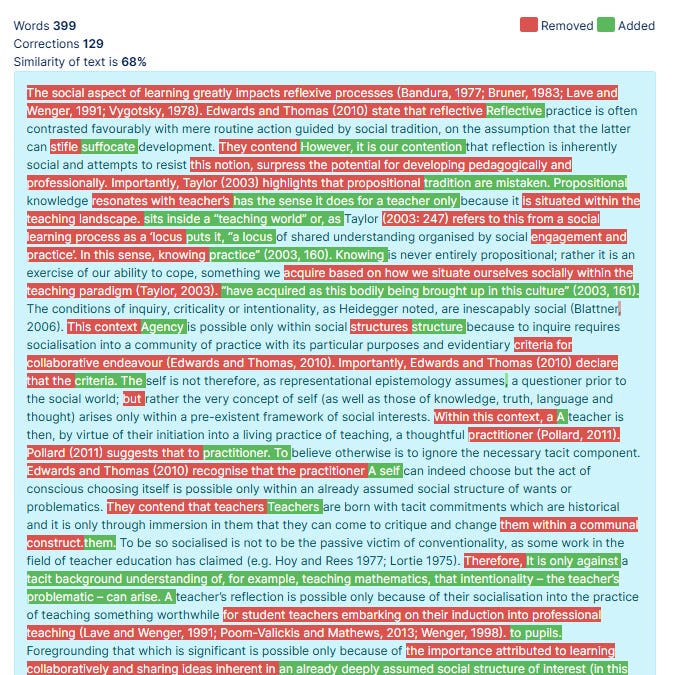
I had a quick go at identifying further plagiarism that has not yet been reported in Arday’s thesis, and it was trivially easy. Here’s a section starting at the bottom of page 44 of Arday’s thesis and taking up all of page 45. I’ve entered the text into a free online text comparison tool that flags it as 68% identical to segments of this 2010 paper.
 gidmk.substack.com
It could be argued that Elon Musk is a public individual with public views. Arday was just a poxy lecturer, whom an avowed racist decided to go after. As an autistic person, Arday's sensibilities were likely extremely heightened by this badgering hack with 'questions', which to Arday could have felt exceedingly threatening to the core of his being. So much so, he attempted to appease matters - autistic persons are often people pleasers because they are aware they unwittingly make all kinds of faux pas, so are always conscious of the possibility of inadvertently breaching social mores - and adjusted the 300 miles in one month to 600, in an effort to mitigate the perceived terrible crime of exaggeration.Let's use an extreme example. Suppose a journalist writes to Elon Musk and asks him about his extraordinary lies and fabulist claims, and the journalist gets an email from the ◊◊◊◊◊◊◊ police telling her to stop contacting Musk or else, would we not think it was an outrageous thing for the police to do?