
-
Security incident: ISF was recently accessed by intruders. Please change your password, and change it anywhere else you used it. Read more
You are using an out of date browser. It may not display this or other websites correctly.
You should upgrade or use an alternative browser.
You should upgrade or use an alternative browser.
Apollo 11 Moon Landing Revisited: Hoax ~vs~ Debunk
- Thread starter Vixen
- Start date


Mojo
Mostly harmless

Only if you're someone like Boris Johnson.I wrote what I meant to write. I speak four languages and in old school England using Latin phrases was and still is perfectly every day speech.
your complaint here is that what is seen in the footage from the Apollo missions shows what you would expect to see if it had been filmed on the Moon.There is no wind or atmosphere on the Moon. This is factual. A moving vehicle creates wind behind it and it is this wind that uplifts the dust behind it to remain airborne for a period causing the 'rooster tails' effect. This cannot happen on the Moon; there is no wind behind the moving Rover and any dust thrown up by the wheels would immediately fall directly to the ground in a parabolic arc.
JayUtah
Penultimate Amazing

They certainly illustrate the danger of not properly understanding one's own assumptions.Vixen, would you mind very much if I used some of your posts for teaching my A level physics students. I think they could be highly beneficial.
No, a dune buggy doesn't "create wind behind it." Yes, you have to wear face protection while driving one, but that's because the air is still and you're the one moving through it. What a dune buggy does create behind it, however, is turbulence. As the lighter dust aerosolizes, it moves randomly with the turbulence and reveals it. Turbulence is not wind, nor does the wake of a dune buggy persist as long as the cloud.
A better example of off-road motoring is the hill climb. There you can see rooster tails while the vehicle is standing still or moving very slowly and therefore not "creating wind," as Vixen believes happens.
You don't need a dune buggy and a hill to create an aerosol cloud. Just go to a dry dusty place on a still day, pick up a handful of dust, and toss it into the air. You'll get a nice aerosol cloud. And it's not because the motion of your arm "created wind." That's just how aerosolization works. You don't need "wind" to get it. All you need is air—moving or not.
Here's the extreme example. At the bar we sometimes offer premium "smoked" drinks such as the Smoked Rum Martinez. For this, we use a culinary smoker to blow smoke into a carafe which is then corked while the rest of the drink is prepared. The smoke aerosolizes and wafts about, even in the relatively unmoving air contained in the carafe. Sometimes after the drink is mixed, the recorked carafe gets set aside for several hours. The smoke collects in the bottom 2-3 cm of the carafe. The air inside of the carafe is (for all intents and purposes) perfectly still, but very small amounts of normal kinetic gas motion and minimal convection are still occurring and this is enough to prevent the smoke from settling in a single solid layer on the bottom of the carafe. Aerosols occur even when the air is as still as it can possibly be.
The underlying error among conspiracy theorists of all genres is trying to measure the evidence against a faulty yardstick. The evidence doesn't meet their expectations, therefore there must something wrong with the evidence. A conspiracy theorist is generally predisposed not to question the expectations because the whole point of a conspiracy theory is to make the believer think they're smarter than they actually are. When the premise is, "They thought they could fool us, but I'm too smart to be fooled," the last thing the claimant will do is question the validity of the expectation.
When you start teaching beginning students, it's hard to correct misconceptions because the student will not always articulate all the premises. You don't know know initially what faulty belief is leading the student into error. The more experienced teacher learns which particular recognizable errors stem from which particular misconceptions and can often correct students by accurately guessing what unstated misconception is at play. When the student is eager to learn, a supportive dialogue will usually reveal the underlying misconception. But when the student is more often than not only willing to say, "Because I said so," you sometimes just have to leave the arrogant to their confusion and pack them off to business school instead.
theprestige
Penultimate Amazing

What assistance? I was pointing and laughing.Thanks for your assistance
Yes, I know.but ceteris paribus is what I intended.

O
Ouch!Vixen, would you mind very much if I used some of your posts for teaching my A level physics students. I think they could be highly beneficial.
LondonJohn
Penultimate Amazing
- Joined
- May 12, 2010
- Messages
- 21,455
I wrote what I meant to write. I speak four languages and in old school England using Latin phrases was and still is perfectly every day speech. I am sorry it upset you but I had no way of knowing in advance it would have such an effect on you. I must apologise though for slipping into Economics jargon having been an accountant all these years; for 'fixed variable' just read 'constant'. There is no wind or atmosphere on the Moon. This is factual. A moving vehicle creates wind behind it and it is this wind that uplifts the dust behind it to remain airborne for a period causing the 'rooster tails' effect. This cannot happen on the Moon; there is no wind behind the moving Rover and any dust thrown up by the wheels would immediately fall directly to the ground in a parabolic arc. This is factual. I have no intention of upsetting you or dissipating your fond beliefs. Even NASA describes the clouds of dust behind the buggy as being 'rooster tails'; whoops! Therefore, even NASA inadvertently admits that sequence was shot on Earth. You are quite welcome to disbelieve this fact and I do hope I haven't accidentally upset you.
Ohhh....this whole post is both fundamentally ignorant/wrong and truly pathetic (in both the strict and colloquial definition of the word).
And, as a classically-educated Englishman (for my sins, arguably), I can 100% assure the thread that NOBODY outside of pretentious cranks would ever dream of using the phrase "ceteris paribus" in normal speech or writing. It's patently obvious why Vixen employs the phrase in this and other threads, and it's equally obvious what a tragic fail it is.
ETA: "Fixed variable" LMAO (If my accountant started talking about "fixed variables", I'd be getting a new accountant sharpish...)
Last edited:
I Am The Scum
Philosopher

- Joined
- Mar 5, 2010
- Messages
- 5,935
An even simpler example:A better example of off-road motoring is the hill climb. There you can see rooster tails while the vehicle is standing still or moving very slowly and therefore not "creating wind," as Vixen believes happens.
@Vixen Do you think the reason the truck's wheels are kicking up all that mud is because the vehicle is moving fast?
catsmate
No longer the 1

- Joined
- Apr 9, 2007
- Messages
- 36,957
Indeed. Like much pseudoscience the supposed ability to detect lies by observation falls apart on scrutiny.Research on Non-verbal Signs of Lies and Deceit: A Blind Alley - PMC
pmc.ncbi.nlm.nih.gov
It's also a cherry-pick. Hoax claimants set up the "analysis" by saying that these men just got back from the Moon and therefore they should be giddy with excitement. The Apollo 11 press conference took place on August 12, 1969, not right after the mission. This was after three weeks of quarantine in a glorified caravan with a doctor and an engineer. I've spent some time in one of the Apollo MQFs. It's cramped and spartan.
Hoax claimants pull this same cherry-picked nonsense with the famous MQF interview. They post pictures of the crew listening attentively to Pres. Nixon. They all have allegedly dour expressions, which the "experts" say is wrong. But they don't show you the other pictures of the Apollo 11 crew smiling and waving excitedly to photographers and crew on the aircraft carrier through the MQF window. You have to go find those yourself.
Last edited:
Thermal
August Member

How we doing on getting a skull emoji as a forum option?Ouch!

I'm sure you'll be able to provide a reliable citation for this bizarre usage. You can, can't you?I must apologise though for slipping into Economics jargon having been an accountant all these years; for 'fixed variable' just read 'constant'.
You've gone full-on looney-tunes moon hoaxer, haven't you? Quelle fromage, Rodney.Therefore, even NASA inadvertently admits that sequence was shot on Earth. You are quite welcome to disbelieve this fact and I do hope I haven't accidentally upset you.
JayUtah
Penultimate Amazing
I doubt she will, because (as she says) the photo was shot on...So post the settings - ISO and shutter speed and tell us how it compares to the settings for the pics taken on tge moon.
I doubt she has any clue what the exposure settings were. She just pointed her phone and let it do all the work. Phones don't know that you have to stop down the lens when photographing sunlit celestial objects....my old smart phone, obviously crappy...
Thankfully I am not so hamstrung. The shiny bits of the Moon are currently facing away from Earth, so we'll have to wait a week or so to demonstrate that. However, Jupiter is currently in the night sky. These were shot through a 200 mm lens, ISO 160 and f/5.6, duplicating a wide-open Zeiss Biogon shooting on ISO 160 (Apollo Ektachrome) film. Jupiter is in the upper right corner of each image. The inline images are thumbnails; click for full size.

1/30 second. Jupiter is just barely becoming visible, but no stars.

1/4 second. Jupiter is clearly visible and there is one faint star at lower left. (I didn't look up which one it was.)

5 seconds. Camera shake is visible along with some unavoidable DCT artifacts. (The forum seems to want to lower the JPEG quality for storage and transmission reasons.) The dark patch on the right is a tree. Our first star is now unmistakably visible without pushing the brightness in the digital image. A few other stars are now visible.

10 seconds. Jupiter is blooming the lens and is therefore overexposed at this point. A handful of stars visible.

30 seconds. Jupiter unusably overexposed. Star trails visible from a number of stars, including the very brightest that appeared at first.
Of course I could post what happens when I take pictures in daylight at f/5.6 with a 30-second shutter speed, but you all know what a perfectly white rectangle looks like.
@Vixen, will you acknowledge that daylight exposure settings are completely unsuitable for photographing stars, and that therefore you should not expect to see stars in Apollo lunar surface photography?
Last edited:
JayUtah
Penultimate Amazing
Correct. I've posted peer-reviewed research to that effect, which I take to be more reliable than some guy trying to monetize his YouTube channel. When used properly, forensic psychology evaluates the mental state of participants in a trial. They determine whether a defendant is competent to stand trial. They evaluate witnesses to see whether they can be considered reliable. After the trial, they propose treatments for victims and convicted offenders.Indeed. Like much pseudoscience the supposed ability to detect lies by observation falls apart on scrutiny.
Occasionally some of them will "go off the reservation" and act as expert witnesses claiming that various folk techniques such as polygraphy, stress analysis, and body language are reliable indicators of deception. For a long time in law, the notion that some people, by virtue of training or experience, were more adept at detecting deception via behavioral or non-verbal cues was taken as a reasonable foundation for testimony. It has not proven to be so when studied.
Sadly, when clicks are the commodity you can generate a bunch of them with sensational, provocative content more than with good science. In case there's any question about this particular bozo, he's also pretending to be a photo analyst and telling us all about the UFOs on the Moon. Utterly irresponsible.
Last edited:
Thermal
August Member
Interestingly, the Latin for rooster tail is cauda galli, not to be confused with cuculus inanis.Ohhh....this whole post is both fundamentally ignorant/wrong and truly pathetic (in both the strict and colloquial definition of the word).
And, as a classically-educated Englishman (for my sins, arguably), I can 100% assure the thread that NOBODY outside of pretentious cranks would ever dream of using the phrase "ceteris paribus" in normal speech or writing. It's patently obvious why Vixen employs the phrase in this and other threads, and it's equally obvious what a tragic fail it is.
ETA: "Fixed variable" LMAO (If my accountant started talking about "fixed variables", I'd be getting a new accountant sharpish...)
Foster Zygote
Dental Floss Tycoon

- Joined
- Jun 24, 2006
- Messages
- 23,337
Utterly and completely wrong. The aerodynamic wake of a moving vehicle is not the only thing that can cause dust to be lifted when a vehicle passes. The wheels play a role as well. Some wheels are especially good at lifting dirt and dust because of the way they're designed. In the video Jay provided of the desert racer, one can see the effects of the paddle-like surfaces on the tires, which are literally called 'sand paddles' and are designed to dig into the sand for traction. You can see a wave-like effect caused by each individual paddle as it throws up sand.There is no wind or atmosphere on the Moon. This is factual. A moving vehicle creates wind behind it and
it is this wind that uplifts the dust behind it to remain airborne for a period causing the 'rooster tails' effect.
Here's a slow motion video showing the same effect:
The Apollo LRV wheels consisted of steel wire mesh with flat titanium chevrons. They dug into the regolith and threw it aloft as they rotated. Here you can even see the maps used to replace the broken fender during Apollo 17 that I mentioned earlier.

The real difference between air and no air is that in air, fine particles become suspended - they form clouds of dust that billow and roll with the air in which they're suspended. With no air, the dust that's thrown up - even the finest microscopic particles fall back to the ground as fast as a bowling ball would. There is no fluid medium for dust to become suspended in so it doesn't form clouds that roil around as the vehicle passes. This is exactly what we see in the Apollo 16 mm DAC motion pictures.
You're trying to assert that the lack of air means that we shouldn't see any dust being thrown up by the LRV, but that's just wrong. If you put a wire whisk on the end of a rod and stuck it into the lunar regolith and flipped the end of it up out of the dust, do you think that no dust would be thrown aloft because there's no air?
JayUtah
Penultimate Amazing
To be clear, this YouTuber isn't claiming the Apollo missions were fake. "The astronauts are lying in the press conference," is the intersection between hoax claimants and UFO claimants. The two camps differ over what is allegedly being lied about. Among some UFO claimants, the Apollo missions provided evidence of UFO or alien encounters that was hushed up. Timothy Good's Above Top Secret is generally considered the standard exposition of this particular conspiracy theory. It's so badly reasoned it's funny. He tries to spin the notion that he doesn't understand radio jargon (e.g., the International Phonetic Alphabet) into a conclusion that the astronauts were speaking in some kind of code to hide what they were reporting."Astronauts don't behave exactly the way I think they should, therefore fake."
Similarly throughout his various videos, this YouTuber tries to dissect every word, phrase, or nuance of the astronauts' statements to make it sound like they're hiding something. He starts out all his videos by announcing that he's an expert, but then just as quickly disclaims that any of his statements should be considered expert judgment. He's either applying his claimed expertise or he isn't. The disclaimer is likely there to keep him out of hot water with various professional organizations whose membership he would need to maintain in order to do his day job.
Conspiracy theories love this sort of "analysis" because it's untestable and therefore unfalsifiable. "Oh, see, there he dipped his chin—that's an indicator of deception." "See how one astronaut doesn't look at the other when he's talking—that's an indicator of deception." "See how that astronaut licked his lips before he answered—that's an indicator of deception." None of these claims can be tested with respect to the press conference. And when they're tested under controlled conditions, the predictions only get to about 54% accuracy (i.e., indistinguishable from chance). So people can keep making YouTube videos about it and debating the expectations endlessly. Please like and subscribe, it really helps the channel.
To be fair, the YouTuber notes this. He knows the astronauts were just out of quarantine, and he knows that there are other stressors that might explain the behavior he considers anomalous. He doesn't say how he knows it's deception; he just does.It's also a cherry-pick. Hoax claimants set up the "analysis" by saying that these men just got back from the Moon and therefore they should be giddy with excitement. The Apollo 11 press conference took place on August 12, 1969, not right after the mission.
Both Buzz Aldrin and Michael Collins wrote multiple memoirs. Armstrong never did, but he did authorize a biography. Armstrong was famously introverted and private. Aldrin is just straight-up weird, but there are reasons for that. It's not hard to learn quite a bit about these men that might inform an interpretation of the press conference. Did this YouTuber do anything more than watch eighty minutes of video and draw all his conclusions from that?
It's pretty clear this guy is a UFO true believer. He tries to rehabilitate Bob Lazar, for example. To be sure, he also talks about true crime and other alleged behavioral science. But his stock-in-trade is watching videos of people he's never met or studied and pretending he can tell all sorts of things about them from these brief encounters. It's not like he's doing much research. He announces the recently "declassified" Apollo photos that allegedly show UFOs. And he pretends to have the photography chops to interpret them. (He does not.) But these photos are not " newly declassified," nor were they ever classified. They've been part of NASA's standard Apollo photo offerings for 50 years. High-quality scans of them (with all the UFOs intact) have been around for 20 years. The only thing that's new in this release is the boxes drawn around the various specks and artifacts and some speculative explanations thrown in to distract from the Epstein files and the failing war in Iran. This YouTuber is clearly just trying to drum up some salacious stuff to get clicks.
"The astronauts are lying, therefore UFOs," versus "The astronauts are lying, therefore hoax," illustrates the dangers of begging the question, which is why really good lawyers love to get these bozos on the witness stand. There has to be a nexus between the evidence proffered and the thing claimed. You don't get to say, "There was some behavior I don't understand, therefore [fill in desired conclusion]."
Take the bag found in Neil Armstrong's closet. Ignore for the moment that @Vixen doesn't know a Hasselblad from a ham sandwich. What does the discovery allegedly prove? Was he supposed to have taken that stuff to the Moon, but stuffed it in the closet instead because he didn't really go? Was all that stuff supposed to have been left on the Moon, but Armstrong brought it back as souvenirs? Was it even flown hardware? NASA had dozens upon dozens of Maurer 16 mm data acquisition motion picture cameras. It had dozens upon dozens of EVA tethers. It had dozens upon dozens of Beta cloth bags. Even if we concede that Armstrong misbehaved and stole some souvenirs out of the Apollo 11 spacecraft, or, in the best case, kept some NASA property at his house, how does this amount to hoaxes or coverups? There is this weird desperate argument among hoax claimants that presumes only infallible astronauts can be believed. Any expression of ordinary human shortcoming gets rewritten as the willingness and desire to commit wholesale fraud.
Foster Zygote
Dental Floss Tycoon
- Joined
- Jun 24, 2006
- Messages
- 23,337
We aren't asking to see them. We're asking you how you achieved them. And since the Apollo crews used SLR film cameras, showing us a smart phone image of something that isn't even a star is completely irrelevant.As I said that was taken by my old smart phone, obviously crappy compared to my old SLR's and Leica lenses. It was a few years back but I still have all the old negatives and slides - too many thousands to have the time to dig them out. Strangely, many old professional studio photos taken in the early 1900's have remained in better condition than some more modern ones.
You claimed that the lack of stars in the Apollo images was suspicious, and backed that up by claiming that you yourself had shot images of stars "no problem". Since then you've no doubt done a bit of searching to see what stellar photography with film cameras would actually entail (you did, after all, mention a tripod) and have realized that f-5.6, 1/125 exposure and ISO 160 isn't going to successfully image stars under any circumstances. But there's no way you're going to admit that you're wrong or that you lied.
JayUtah
Penultimate Amazing
...to serve exactly the same purpose as sand paddles. Our Baja cars use different tires depending on where we race. We have two bona fide sand dune sites—complete with actual sand. For the salt flats we use regular racing tires. For the dust-and-gravel that makes up most of the rest of the West Desert or the Grand Staircase Escalante we use knobbies. If you go to, say, Moab and rent four-wheelers, that's what you get.The Apollo LRV wheels consisted of steel wire mesh with flat titanium chevrons.
I don't think that's her claim, because she said the dust should go up and come back down in a "parabolic wave" (no such thing) or a "parabolic arc" (such a thing, but simplistic). It's not as if you should expect a big, singular, well-defined, mouth-downward parabola starting at where the tire meets the ground and landing some distance behind the tire in a neat little spot. That's simplistic. As I explained before at length, each particle has its own departure conditions and follows its own subsequent parabolic path. The combined visual effect of all these similar paraboloid trajectories is the forward-rotating swirl I identified. In a vacuum you can expect to see something that's roughly geometrically coherent before the cloud disperses and falls to the ground, but the thing you see writ large is not a parabola, nor expected to be one.You're trying to assert that the lack of air means that we shouldn't see any dust being thrown up by the LRV, but that's just wrong. If you put a wire whisk on the end of a rod and stuck it into the lunar regolith and flipped the end of it up out of the dust, do you think that no dust would be thrown aloft because there's no air?
Foster Zygote
Dental Floss Tycoon
- Joined
- Jun 24, 2006
- Messages
- 23,337
There was an episode of Last Week Tonight in which they examined the sort of "profiling" claims often sold to police agencies. It's amazing how much of it is just ◊◊◊◊◊◊◊◊, often self contradictory, with no solid grounding in any reliable science."Astronauts don't behave exactly the way I think they should, therefore fake." No, body language is not an accurate predictor of deception. People trying to dissect the press conference for every nuance of meaning is one of the saddest attempts at argument. The physical and historical evidence is overwhelming, so they have to resort to pop psychology.
Vixen, my recommendation is to watch the entire interview, not some cherry picked bits offered by a guy looking to promote his YouTube channel with some low hanging fruit. The Apollo 11 crews weren't celebrities, they were military test pilots. Don't expect them to be raconteurs who revel in public attention. While Collins was probably the most socially adept of the three, he was a fairly low-key personality. Armstrong was famously averse to celebrity, and could often come off as a bit shy. Again, they were chosen for their skills as pilots and engineers, not PR. That being said, if you watch the entire interview, you'll see them occasionally enthusiastic and humorous. Just like you might expect them to sound while sitting through yet another boring press interview.
Axxman300
Philosopher

Aside from all the fantastic Apollo knowledge being dropping in this thread, my favorite thing so far has been our protagonist questioning the lack of stars in the lunar photos, and the dust kicked up by the lunar rover being proof it was filmed on the ground...followed by posting a picture of the moon our protagonist took with Saturn in the background. One being bright enough to wash out the rest of the galaxy, and the other being one of two gas-giants in our solar system, which are rooster-tails on steroids (I know, there's more to them than that, but let me have my moment).
In other news, NASA is back at it again:
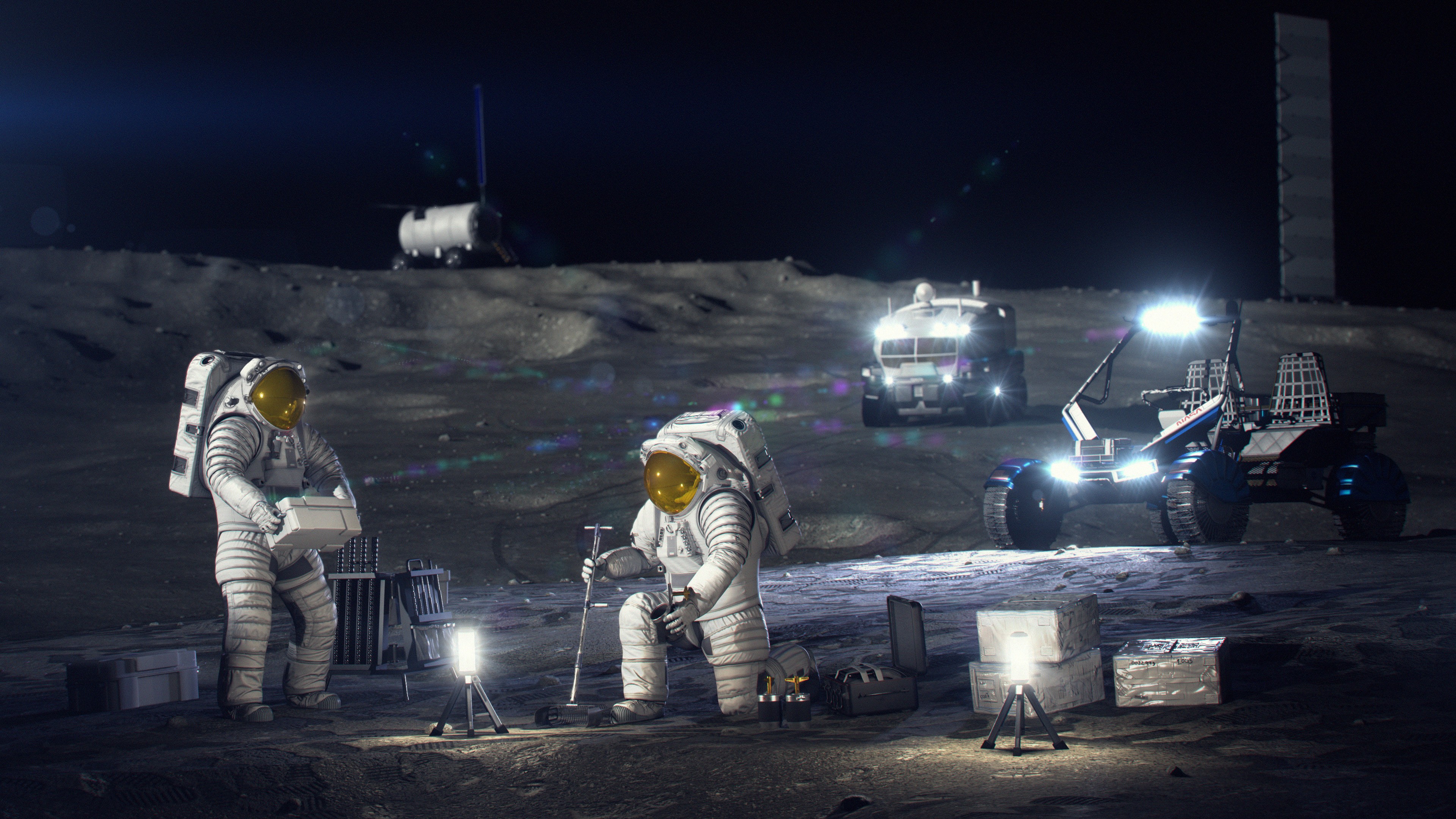
 www.nasa.gov
This is a blurb about an upcoming briefing on NASA's moonbase strategy, and future missions. We're back, baby.
In other news, NASA is back at it again:
NASA to Provide Update on Moon Base Strategy, Missions - NASA
NASA will host a news conference at 2 p.m. EDT, Tuesday, May 26, to share Moon Base plans and highlight progress toward a sustained presence on the lunar
www.nasa.gov
This is a blurb about an upcoming briefing on NASA's moonbase strategy, and future missions. We're back, baby.