• Security incident: ISF was recently accessed by intruders. Please change your password, and change it anywhere else you used it. Read more

Apollo 11 Moon Landing Revisited: Hoax ~vs~ Debunk

Somebody took it apart and put it back together and had a screw left over?
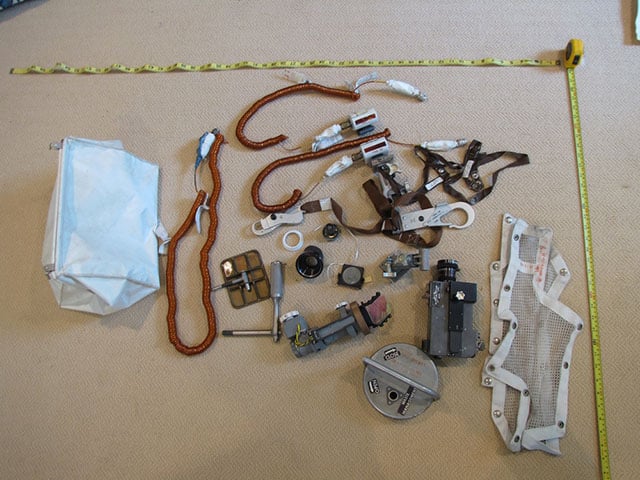
During the missions, the lens cap was taken off and just put in a suit pocket at the start of the EVA. The camera we used was an unflown specimen from the initial production run. Its owner (the Kansas Cosmosphere, IIRC) added the chain so that the cap wouldn't get lost. It wasn't an original part of the artifact or design, much to our relief.
 
TIL.

The stuff I didn't realise since July 1969.
(I'd forgotten how young I was and like most kids of the era, had models of Mercury, Gemini and Apollo craft hanging from the ceiling and sitting on shelves (even though I was only around for Apollo).

I plead the Fifth. 🤣
What happens in Trona Pinnacles stays in Trona Pinnacles
Nope.

You have the liquid-cooling garment. That's long underwear with a network of fine plastic tubes woven into it. The backpack circulates water through this network to remove body heat. Or not, since the system ended up working really well. Many of the crews said they were actually too cold on the Normal setting. There was a little wheel on the bottom corner of the backpack that worked like a thermostat control. Most of the crews set it on the warm side.

Then you have the pressure garment. That's what holds in the air. The helmet, boots, and gloves have metal rings that attach to the PGA at the neck, wrists, and ankles and make the pressure-tight seal there. You can see all the various devices that make the suit flexible despite the pressure it contains. You can also see the cables that run through friction colletts. This is to help you hold your arms and legs in a flexed position, where the pressure would want to spring them back straight.

The ingress air seal is via pressure-tight zippers. On the inside you have two overlapping rubber flaps that are pressed together by the internal pressure to create the seal. Then along the outside you have the zipper that holds the opposite edges together. It's a rather ingenious way to do it.

View attachment 71348

The outer layer is the thermal and micrometeoroid protection layer, which is several alternating layers of white Beta cloth (a kind of fiberglass fabric) and thin polymer films. You use several layers to absorb small micrometeoroids. But that's the white layer that you commonly associate with the space suit. The outer layer is fastened by Velcro strips and normally stays put over the blue rubber layer. However, on one mission the crew took the outer layer off one suit to adjust the friction cables for one crew member's comfort.

The pressure-bearing "fishbowl" helmet was covered by a non-pressurized white EVA helmet. That had the plain and golden visors. I mentioned the gauntlets already. Then you have silicone and Chromel-R booties that strap on over the pressure-bearing boots.

If you want the whole story, Bill Ayrey's Lunar Outfitters is the standard reference.


Up to 75% of any given theater is held together with gaffer tape. It's structural. 😁
 
The silvery part on the gloves and booties is a fabric called Chromel-R, a woven mesh of very fine nickel-chromium alloy wire for protection against abrasion. It's really tough stuff. In the suit we used in the video, that was replaced by silver nylon since Chromel-R was $1300 a yard in 1965.

Adam savage mentions it in the videos about his replica suit.


Last edited:
Speaking of the moon buggy sequence in Apollo 15 - or was it 17 - as you know, there is no spreading effect on the dust thrown up by wheels on the moon (lack of any wind and all that) yet it shows a classic 'rooster' tails sequence after it - which we expect to see on Earth - but we'd want to see the parabolic pure physics version, ceteris paribus, on the moon, i.e., no 'rooster tail'-style line of flying dust behind the buggy.
Can you clarify why you're using the phrase ceteris paribus (all other things being equal) here? It makes no sense, given all the things that are not equal, such as:
- unique moon buggy wheels/tyres of mesh construction
- unique-to-the-moon levels of gravity,
- unique-to-the-moon moon dust
- unique lack of atmosphere.
What are the other things that would be equal to this situation?
 
Can you clarify why you're using the phrase ceteris paribus (all other things being equal) here? It makes no sense, given all the things that are not equal, such as:
- unique moon buggy wheels/tyres of mesh construction
- unique-to-the-moon levels of gravity,
- unique-to-the-moon moon dust
- unique lack of atmosphere.
What are the other things that would be equal to this situation?
You need to remember that classic paper on vehicular movement: The wheels on the bus go round and round..
 
Since the idiom is referring to you realizing that you know the least, by far, about the Apollo Program than the other participants in this thread, you'll be the first to know.


Getting back to those stars you so easily photographed, could you just tell us the following?

- Camera type
- Film type
- Aperture setting (if applicable)
- Exposure setting (if applicable)
- Any accessory equipment you used to facilitate taking the images

Good heavens! Ladies running around with tripods and cameras! Whatever next? "Make me a cup of tea, luv, and stop trying to be erudite. This is the <fx lowers pitch> Man's Room."
 

Neil Armstrong is a notable historical figure but does the narrator really have to gush in such an embarrassing manner, like a star-struck schoolboy?

In any case, Armstrong's second wife, Carol, discovered a 'dusty old Hasselblad' in Armstrong's NASA bag after he died ...

Neil Armstrong’s wife stunned after discovering secret bag of objects he was supposed to leave on the moon​

The bag dubbed ‘McDivitt Purse’ was initially stored in the Lunar Module and contained item from the Apollo 11 mission. https://www.good.is/when-neil-armstrongs-wife-discovered-his-secret-bag-of-moon-objects-in-a-closet/
 
Can you clarify why you're using the phrase ceteris paribus (all other things being equal) here? It makes no sense, given all the things that are not equal, such as:
- unique moon buggy wheels/tyres of mesh construction
- unique-to-the-moon levels of gravity,
- unique-to-the-moon moon dust
- unique lack of atmosphere.
What are the other things that would be equal to this situation?
Obvs no random variables that could affect the fixed variables, which would be including correcting for the Moon's gravity being one-sixth of that of earth, like-for-like vehicle, like-for-like-weight, direction, speed and velocity. A random variable could be the weather or temperature, which could possibly change our expectation of the end result. For example, you could test acceleration due to gravity in the fall of an object, e.g., particles of dust and pebbles thrown up by the wheels of a buggy, by testing on earth in a lab with say, an AC vibrator and tickertape for the accceleration due to gravity and then observe the various forces that cause such dust to linger in the air behind observed said vehicle. On Earth, this would be wind that causes the 'rooster tail' effect, rather than the detritus falling in a parabolic wave. But there is no wind on the Moon. On the Moon, the lack of wind is a fixed variable and we should never see a 'rooster tail' effect, regardless of weather, temperature or other random variables such as weight or type of dust. The fact we DO see a 'rooster-tail' effect on the Apollo buggy shots of the dust whipped up behind it, indicates it was filmed on Earth, not on the Moon.
 
Last edited:
That's not what your link says. Where did you get the 'dusty old Hasselblad' quote?


Here:

Needell added that Armstrong’s space artifacts “tell a number of stories,” the technical story that has been so carefully documented and the human story of those who were involved. “It was a most satisfying discovery process,” he said. Several of the items, including the camera and waist tether, are currently on display in a new gallery.

Obviously, given the Hasselblad 'has been left on the moon', they can hardly display that.
 
No, clearly that's not where you got 'dusty old Hasselblad' since the article doesn't say that, and the camera it does mention was an entirely different type.
There's a better picture here:


Apparently there are twelve other Hasselblads left on the Moon <phew!>
 
Good heavens! Ladies running around with tripods and cameras! Whatever next? "Make me a cup of tea, luv, and stop trying to be erudite. This is the <fx lowers pitch> Man's Room."
Now you're just being histrionic to distract from your lie. Don't pretend that gender has anything to do with this, and don't you dare imply that I ever implied that it does. Don't get angry with someone else because you've trapped yourself in another lie.

You only said that photographing stars was "no problem" in an attempt to defend the claim that there should be stars in the Apollo photos. Like so many conspiracy theorists, you rely on your own erroneous intuition about how you think things work, rather than actual knowledge. You mentioned a tripod, so you must have done a post hoc search for "how to photograph stars" and realized that it's much more involved than simply pointing a camera at the night sky and pressing the shutter release.
 

ISF - Join now!

Every member here is approved by hand. No bots, no spam, just people who care about evidence and honest debate.

Membership is free!

Create your free account

Back
Top Bottom