• Quick note - the problem with Youtube videos not embedding on the forum appears to have been fixed, thanks to ZiprHead. If you do still see problems let me know.

Million year old human skull?

Yup. I recently seen a picture of a brontosaurus and was told it's an apatosaurus.
Because apparently they found the juveniles and the full size adults in fossil records were not two separate species.

Or so the relatively good documentary said.
 
"Scientists have digitally reconstructed a million-year-old humanoid skull found in China.

"They claim the skull challenges the established timeline of human evolution."


Plausible?

The study was published today in Science:


Wow. This is big! If true, that upends everything we know, or think we do, about when and where we came from.

Thanks for posting this. Didn't see any coverage of this in regular newspapers or TV, I should've thought something this big might've merited that.

Don't know the first thing about this myself, and zero independent opinion about its plausibility. But thanks for posting this here, will "Watch" this thread to see what others have to say about how this develops.
 
It's important to remember here that the focus is not on "hey, we dated a skull to a million years", it's "hey, this million-year old skull relates to other skulls in a way we didn't expect".
 
Everything in the dinosaur books I loved as a kid is now known to be wrong.
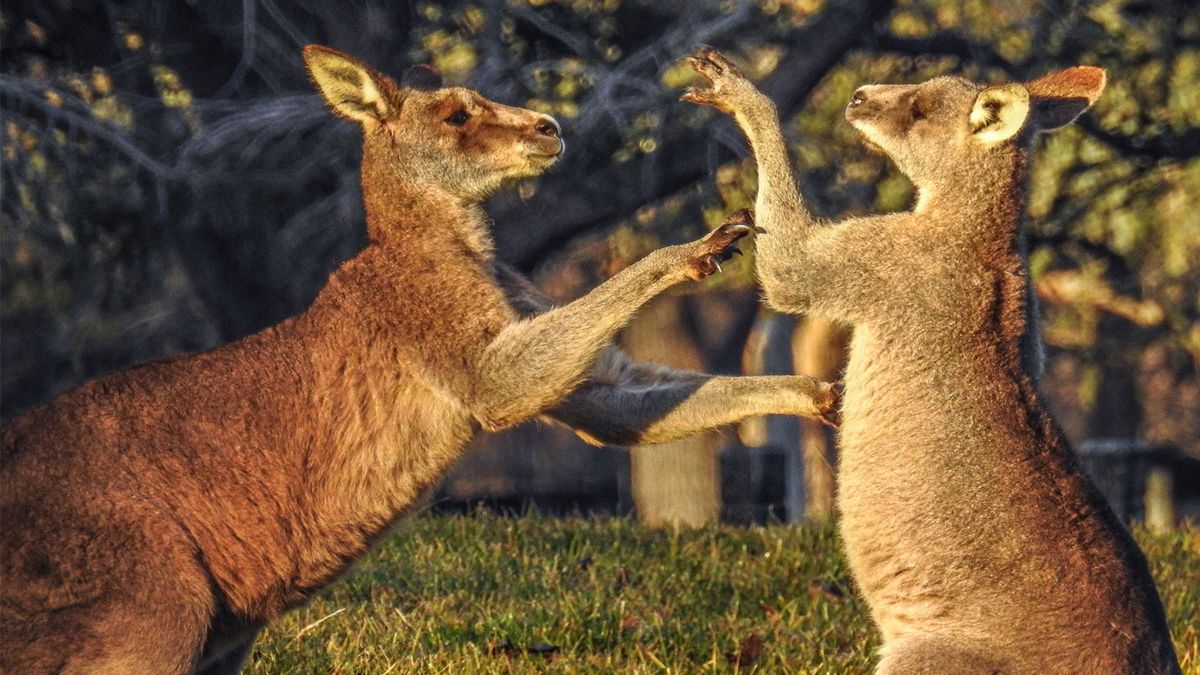
Even as a kid I challenged some things I was being told about dinosaurs. One of the things that has stuck with me is how we were told the T-Rex had "puny" arms, that they weren't really used, that they were vestigial. But I had also learned about your country's wildlife i.e. Kangaroos. I'd seen Kangaroos and they struck me as being a similar shape profile and proportions to the T-Rex drawings we had in the books and anyone thinking Kangaroo arms are puny needs to see them boxing. Yeah compared to their hind legs the arms are not as muscular but they are anything but puny and certainly not vestigial.
 
"Scientists have digitally reconstructed a million-year-old humanoid skull found in China.

"They claim the skull challenges the established timeline of human evolution."


Plausible?

The study was published today in Science:

It's very interesting because the establishment view - of which the cited, Chris Stringer (curator of the Human Evolution section of the Natural History Museum [well worth a visit!]) is the accepted leading authority - is cited as giving the theory credence.


"If Yunxian sits close to the origins of both the H. longi/Denisovan and H. sapiens clades, it may represent one of the most important windows yet into the evolutionary processes that shaped our genus around one million years ago," Professor Stringer said.

He believed the research helped to resolve the "Muddle in the Middle" – the puzzle in human evolution from about 300,000 to one million years ago, where there is much debate on how various human species evolved.

"When I began working in human evolution over 50 years ago the East Asian record was either marginalised, or its fossils were only ever considered as direct ancestors of recent East Asians," Professor Stringer said.


"But what we now see from Yunxian — and from Harbin, Denisova, and many other sites — is that East Asia preserves crucial clues to the later stages of human evolution in general
ibid.

If you've ever read Chris Stringer's fascinating books on this topic, he is a strong adherent to the 'Out of Africa' school of thought. But there has always been the puzzle of Denisovan Man, so-named after the Siberian cave it was found in, who was clearly Asian. Add into the mix that it was once thought Homo sapiens never mixed with Homo neanderthalensis (so-named after the cave in Germany), when it is now well-known that they did. But here's the thing, whilst Europeans tend to show 2% Neanderthal genes*, persons of direct Asian descent (i.e., South East Asians, the Chinese peoples) show as much as 4%. This indicates that whilst the extinct Neanderthals inhabited what is now known as Europe, the peoples of the far east of Eurasia (as the continent is really called) mixed with them at a time when the north Europeans migrated back to Africa, from whence they originated, during the LGM** 18K years ago, and not moving back until 10K - 8K years later as the ice caps melted. This ice cap was centred around the mountains of current day Sweden and Norway, and there is an 'alternative view' that not all Europeans retreated southwards but that some stayed in areas that escaped the brunt of the ice age, for example in low plains to the north and northeast of the mountains. IOW not all proto-Europeans, Neanderthals or Denisovans necessarily harked from Africa, as is the 'fact' for at least modern day man, but may have all co-existed together in Asiatic regions. So it is of interest that Prof Stringer now gives credence to the million-year-old 'human' skull found in China.

*Africans, presumably who never left Africa, to migrate northwards - and thus, encounter the Neanderthals - in all those thousands of years, tend to show zero neanderthal genes BUT it is thought some migrated northwards into Europe and then returned back to Africa over various millennia.

**The Last Glacial Maximum (LGM) was the period of greatest ice sheet extent during the last Ice Age, which occurred 26.5K - 19K years ago.

 
Last edited:
It's hard to define exactly what counts as a "human". Anything of the genus "homo"? The farther back we go, the more monkey-like, and less "human" presumably it would be. Obviously our most recent common ancestor with other great apes can't be "human" unless we count other species of apes as fellow humans. The estimates for that vary by millions of years, but the most recent end of the range of estimates is about 5 million years ago. So 1 million years is clearly millions of years after that split, and much closer to "human" than to a chimpanzee.

This is where the so-called 'missing link' comes in. Whilst we are all primates, it doesn't mean we are actually descended from great apes, but that we separated at some stage but this intermediate step remains an unsolved mystery.

 
Even as a kid I challenged some things I was being told about dinosaurs. One of the things that has stuck with me is how we were told the T-Rex had "puny" arms, that they weren't really used, that they were vestigial. But I had also learned about your country's wildlife i.e. Kangaroos. I'd seen Kangaroos and they struck me as being a similar shape profile and proportions to the T-Rex drawings we had in the books and anyone thinking Kangaroo arms are puny needs to see them boxing. Yeah compared to their hind legs the arms are not as muscular but they are anything but puny and certainly not vestigial.
Kangaroos don't use their arms to "box". That's a complete misapprehension. When a kangaroo (usually a male) gets aggressive , he rears up on his tail and rakes with his legs, which come conveniently equipped with claws perfect for evisceration. At best, he uses his arms to grab and hold his victim until its intestines fall to the ground as food for scavengers amid a shower of blood.
 
Kangaroos don't use their arms to "box". That's a complete misapprehension. When a kangaroo (usually a male) gets aggressive , he rears up on his tail and rakes with his legs, which come conveniently equipped with claws perfect for evisceration. At best, he uses his arms to grab and hold his victim until its intestines fall to the ground as food for scavengers amid a shower of blood.
I was referring to when people used to put boxing gloves on kangaroos. That aside:


...snip...

The way kangaroos fight each other is much more like boxing than the way they fend off predators. A kangaroo's front legs are shorter and less powerful than their hindlegs, and although they will use both front and back legs in a fight with a dingo, the males scrap with each other during mating season in a ritualized sort of boxing match

...snip...

My point was that just because there is a huge difference in strength etc. between back and front arms doesn't mean the arms are vestigial or useless.
 
Last edited:
Well... if by "boxing" you are referring to the specific non-lethal sparring that they do for dominance and social reasons, like the sport boxing that humans do, I guess. But only if you're boxing with your feet.
 
It's important to remember here that the focus is not on "hey, we dated a skull to a million years", it's "hey, this million-year old skull relates to other skulls in a way we didn't expect".

Yes, I'm trying to follow what they're suggesting this means, but just through the news stories so far, and it's a little hard to glean what they're actually saying. Pretty clearly it is not "here's a modern human who lived a million years ago".

Some of the hominids who were around a million years ago were our ancestors and others weren't. If I follow correctly, our conventionally-agreed ancestor, homo erectus, was around in that era but it would be hundreds of thousands of years later that they gave rise to the Neanderthals and to us. The new claim appears to be that this fossil does not seem to be homo erectus, but rather another line, somewhat closer in development to us (by coincidence or not), and perhaps it's possible this was in fact an ancestor of ours and we emerged in Asia longer ago than it's been assumed we did in Africa.
 
Yes, I'm trying to follow what they're suggesting this means, but just through the news stories so far, and it's a little hard to glean what they're actually saying. Pretty clearly it is not "here's a modern human who lived a million years ago".

Some of the hominids who were around a million years ago were our ancestors and others weren't. If I follow correctly, our conventionally-agreed ancestor, homo erectus, was around in that era but it would be hundreds of thousands of years later that they gave rise to the Neanderthals and to us.
My recollection is that Homo habilis is generally thought to be the oldest example of the genus Homo, but that H. sapiens doesn't descend necessarily from either. These are both species on the 2 Ma BCE time scale. Whether tool use or upright gait is your sine qua non of the genus is not really important. Both traits date to far earlier than the proposed H. longi. As we've noted, what makes this find remarkable is that within genus Homo it seems to have morphological traits more consistent with modern humans than with any of the dead-end early species. But the caveat is that these determinations are invariably made from so very few specimens that it's hard to be confident.

Osteological morphology in modern humans is so very well developed that we can very confidently determine a vast amount of information from fragmentary skeletal remains. It's tempting to use the same techniques in physical anthropology in early hominins but the statistical basis just isn't strong enough. As we learned from some dinosaur species, we cannot control the selectivity factors for the specimens we have in hand, so we cannot distinguish the factors that separate species from the factors that separate individuals. Keeping in mind that the reconstruction technique employed here necessarily included correcting for distortion, you have to bear in mind that the placement of this skull in the grand scheme of things is fundamentally based on a kind of extrapolation that is itself susceptible to revision.

The new claim appears to be that this fossil does not seem to be homo erectus, but rather another line, somewhat closer in development to us (by coincidence or not), and perhaps it's possible this was in fact an ancestor of ours and we emerged in Asia longer ago than it's been assumed we did in Africa.
It's very tempting to jump to the conclusion that this new find could fit into the evolutionary path that resulted in H. sapiens. After all, that's kind of what this branch of science is all about. But over the decades in which I've been exposed to it, the reality is becoming more apparent that there are a lot of dead-end species, just as we would expect from a process driven by natural selection. And all that evolutionary litter is scattered throughout the record. Finding the one thread we're interested in, given the difficulty of obtaining data, is an increasing exercise in patience.
 
My point was that just because there is a huge difference in strength etc. between back and front arms doesn't mean the arms are vestigial or useless.
They are just too short to reach much, I mean can they even reach their other arm with one? The suggestion from a leading paleontologist who was that maybe the arms are vestigial but need to be there because the head needed shoulders to properly support it.

The problem is what could they actually use them for.
 
It's very interesting because the establishment view - of which the cited, Chris Stringer (curator of the Human Evolution section of the Natural History Museum [well worth a visit!]) is the accepted leading authority - is cited as giving the theory credence.


"If Yunxian sits close to the origins of both the H. longi/Denisovan and H. sapiens clades, it may represent one of the most important windows yet into the evolutionary processes that shaped our genus around one million years ago," Professor Stringer said.

He believed the research helped to resolve the "Muddle in the Middle" – the puzzle in human evolution from about 300,000 to one million years ago, where there is much debate on how various human species evolved.

"When I began working in human evolution over 50 years ago the East Asian record was either marginalised, or its fossils were only ever considered as direct ancestors of recent East Asians," Professor Stringer said.


"But what we now see from Yunxian — and from Harbin, Denisova, and many other sites — is that East Asia preserves crucial clues to the later stages of human evolution in general
ibid.

If you've ever read Chris Stringer's fascinating books on this topic, he is a strong adherent to the 'Out of Africa' school of thought. But there has always been the puzzle of Denisovan Man, so-named after the Siberian cave it was found in, who was clearly Asian. Add into the mix that it was once thought Homo sapiens never mixed with Homo neanderthalensis (so-named after the cave in Germany), when it is now well-known that they did. But here's the thing, whilst Europeans tend to show 2% Neanderthal genes*, persons of direct Asian descent (i.e., South East Asians, the Chinese peoples) show as much as 4%. This indicates that whilst the extinct Neanderthals inhabited what is now known as Europe, the peoples of the far east of Eurasia (as the continent is really called) mixed with them at a time when the north Europeans migrated back to Africa, from whence they originated, during the LGM** 18K years ago, and not moving back until 10K - 8K years later as the ice caps melted. This ice cap was centred around the mountains of current day Sweden and Norway, and there is an 'alternative view' that not all Europeans retreated southwards but that some stayed in areas that escaped the brunt of the ice age, for example in low plains to the north and northeast of the mountains. IOW not all proto-Europeans, Neanderthals or Denisovans necessarily harked from Africa, as is the 'fact' for at least modern day man, but may have all co-existed together in Asiatic regions. So it is of interest that Prof Stringer now gives credence to the million-year-old 'human' skull found in China.

*Africans, presumably who never left Africa, to migrate northwards - and thus, encounter the Neanderthals - in all those thousands of years, tend to show zero neanderthal genes BUT it is thought some migrated northwards into Europe and then returned back to Africa over various millennia.

**The Last Glacial Maximum (LGM) was the period of greatest ice sheet extent during the last Ice Age, which occurred 26.5K - 19K years ago.

Interesting thoughts. I'm currently looking at a fascinating period in Scottish pre-history known as the Loch Lomond stadial. This was around 11,000 to 12,000 years ago, a time when the north-west of the country re-acquired a small ice cap during a particularly cold spell following the retreat of the last ice age.

We know there was human habitation here 14,000 years ago, as remains have been found, but the scientists seem to think that they scarpered again when the cold returned at the time I mentioned. I'm not so sure. The landscape as described, east and south of the ice cap, is far less hostile than places that have had indigenous inhabitants for millennia, like northern Canada. I suspect there simply aren't the remains to prove it, or they haven't found them yet.

Cycling up Glen Roy, I'm just tickled pink by the idea of stone age inhabitants fishing 350 metres above me in "Loch Roy", or maybe having a looney dook in the height of summer.
 
Last edited:
Cycling up Glen Roy, I'm just tickled pink by the idea of stone age inhabitants fishing 350 metres above me in "Loch Roy", or maybe having a looney dook in the height of summer.

Erratum. That would be 350 metres above sea level, but 150 metres above me on my bicycle.
 
Steve Novella talked about this skull on the latest episode of The Skeptic's Guide to the Universe. The upshot of the new research is that it pushes back the date at which the clade that contains Homo sapiens branched off from the Homo longi clade to about a million years. We thought it was much more recent than that.

Here's the obviously machine-produced transcript of the segment if you'd like to read rather than listen:

 
It's very interesting because the establishment view - of which the cited, Chris Stringer (curator of the Human Evolution section of the Natural History Museum [well worth a visit!]) is the accepted leading authority - is cited as giving the theory credence.


"If Yunxian sits close to the origins of both the H. longi/Denisovan and H. sapiens clades, it may represent one of the most important windows yet into the evolutionary processes that shaped our genus around one million years ago," Professor Stringer said.

He believed the research helped to resolve the "Muddle in the Middle" – the puzzle in human evolution from about 300,000 to one million years ago, where there is much debate on how various human species evolved.

"When I began working in human evolution over 50 years ago the East Asian record was either marginalised, or its fossils were only ever considered as direct ancestors of recent East Asians," Professor Stringer said.


"But what we now see from Yunxian — and from Harbin, Denisova, and many other sites — is that East Asia preserves crucial clues to the later stages of human evolution in general
ibid.

If you've ever read Chris Stringer's fascinating books on this topic, he is a strong adherent to the 'Out of Africa' school of thought. But there has always been the puzzle of Denisovan Man, so-named after the Siberian cave it was found in, who was clearly Asian. Add into the mix that it was once thought Homo sapiens never mixed with Homo neanderthalensis (so-named after the cave in Germany), when it is now well-known that they did. But here's the thing, whilst Europeans tend to show 2% Neanderthal genes*, persons of direct Asian descent (i.e., South East Asians, the Chinese peoples) show as much as 4%. This indicates that whilst the extinct Neanderthals inhabited what is now known as Europe, the peoples of the far east of Eurasia (as the continent is really called) mixed with them at a time when the north Europeans migrated back to Africa, from whence they originated, during the LGM** 18K years ago, and not moving back until 10K - 8K years later as the ice caps melted. This ice cap was centred around the mountains of current day Sweden and Norway, and there is an 'alternative view' that not all Europeans retreated southwards but that some stayed in areas that escaped the brunt of the ice age, for example in low plains to the north and northeast of the mountains. IOW not all proto-Europeans, Neanderthals or Denisovans necessarily harked from Africa, as is the 'fact' for at least modern day man, but may have all co-existed together in Asiatic regions. So it is of interest that Prof Stringer now gives credence to the million-year-old 'human' skull found in China.

*Africans, presumably who never left Africa, to migrate northwards - and thus, encounter the Neanderthals - in all those thousands of years, tend to show zero neanderthal genes BUT it is thought some migrated northwards into Europe and then returned back to Africa over various millennia.

**The Last Glacial Maximum (LGM) was the period of greatest ice sheet extent during the last Ice Age, which occurred 26.5K - 19K years ago.

Stringer has certainly conceded ground to multiregionalists more than the other way around. And the question of just how much contact and gene flow occurred after the most recent OOA 60-90 kya or thereabouts I think misses the much earlier migrants out of Africa! They are always overlooked by most of the public like they were failed prototype humans who never contributed to living people.
 
Stringer's OOA template is the 'establishment' one, which follows from Darwin's. But Darwin himself had challengers, such as Haeckel, who believed in a lost continent - why not? - he called Lemuria - from whence mankind sprung. Then there was Edgar Cayce and his Atlantis theory. Or even Graham Hancock and his mysterious 'Gods'. So we might ask, why are the latter three theories considered 'wacky' but the first perfectly obviously the correct one? The answer came to me at a Birkbeck College summer school - wherein one could sign up for a week's jolly at Westonbirt Girls School, where accommodation was in the girls' dormitories - and a whole list of speakers lined up for entertaining lectures. One lady had a session on her alternate theory of Egyptology, and complained bitterly about being sidelined, ignored, reprimanded and snubbed by the 'establishment' Egyptologists. So we don't actually know which theory is correct or proven when it comes to very ancient human history, all we have are the scientific theories of the best minds. But it helps to have the 'establishment' theory, rather than a hodge-podge of conflicting ones.
 
Stringer's OOA template is the 'establishment' one, which follows from Darwin's. But Darwin himself had challengers, such as Haeckel, who believed in a lost continent - why not? - he called Lemuria - from whence mankind sprung. Then there was Edgar Cayce and his Atlantis theory. Or even Graham Hancock and his mysterious 'Gods'. So we might ask, why are the latter three theories considered 'wacky' but the first perfectly obviously the correct one? The answer came to me at a Birkbeck College summer school - wherein one could sign up for a week's jolly at Westonbirt Girls School, where accommodation was in the girls' dormitories - and a whole list of speakers lined up for entertaining lectures. One lady had a session on her alternate theory of Egyptology, and complained bitterly about being sidelined, ignored, reprimanded and snubbed by the 'establishment' Egyptologists. So we don't actually know which theory is correct or proven when it comes to very ancient human history, all we have are the scientific theories of the best minds. But it helps to have the 'establishment' theory, rather than a hodge-podge of conflicting ones.
Surely the answer is that the first theory might be wrong, but at least it doesn't presuppose the existence of completely unrelated "wacky" things.
 

Back
Top Bottom