theprestige
Penultimate Amazing

Everybody thinking the trolley problem is interesting.


It's the "◊◊◊◊, Marry, Kill" of ethics discussions.Everybody thinking the trolley problem is interesting.
Isn't your most recent philosophy thread essentially a trolley problem, but with the criminally insane on one of the tracks?Everybody thinking the trolley problem is interesting.
This is exactly what I'm talking about. Practical questions of applicable morality in society are interesting, for obvious reasons. The toy problem that philosophers like to noodle on is not. Every practical problem of moral trade-offs in society can be contemplated and solved for some arbitrary moral guideline, without ever invoking or even knowing about the trolley problem. But here you are.Isn't your most recent philosophy thread essentially a trolley problem, but with the criminally insane on one of the tracks?
Hey, I don't care much for it either. It's an abstraction. But then, we are talking about culling people, so the association sort of falls into place on its own.This is exactly what I'm talking about. Practical questions of applicable morality in society are interesting, for obvious reasons. The toy problem that philosophers like to noodle on is not. Every practical problem of moral trade-offs in society can be contemplated and solved for some arbitrary moral guideline, without ever invoking or even knowing about the trolley problem. But here you are.
In fact, most toy problems that philosophers like to noodle on are far less interesting than philosophers would have you believe.

That's funny. My pet peeve is people thinking the troll-y problem is interesting.Everybody thinking the trolley problem is interesting.

It is, at least the first one or two times you run it down. Every time it gets brought up in the threads, you run across some zany takes. There was one very recently where a long time poster confidently asserted that action was better than inaction, justifying switching the track. Other posters immediately say one dead body is better than 5, and also flip that track.Everybody thinking the trolley problem is interesting.
Interesting choice of words.It is, at least the first one or two times you run it down.


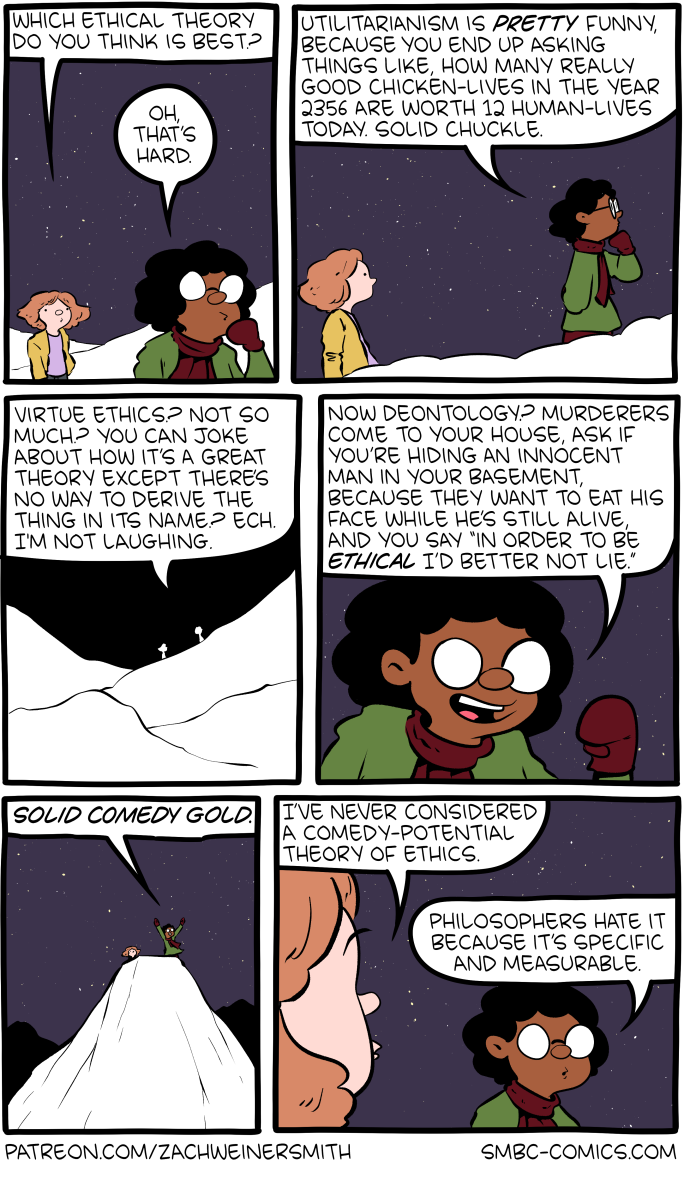

Yep, Socrates was so wokeThe postmodern philosophers deconstructed that definition. Nowadays philosophy means we can't know anything. Thanks, Derrida!

When I first encountered this school of philosophy, I didn't know what to make of it. At first I thought that maybe these people were just much smarter than me in the way that people who know how to write papers about quantum mechanics or string theory or cutting edge mathematics are much smarter than me. Later on I came to a different conclusion: writing in a way that is difficult for others to understand isn't necessarily a sign of intelligence. Maybe they don't want you to understand; it's enough for them if you merely end up thinking that they are smarter than you. It's enough for them if they get to be a tenured professor at a prestigious university with all of the social status that goes along with that.The postmodern philosophers deconstructed that definition. Nowadays philosophy means we can't know anything. Thanks, Derrida!

Much of modern philosophy is simply talking about what previous philosophers talked about. There comes a point where you start to think that all the actually original thoughts have already been had.
That one for sure. My thinking could easily be an illusion. I could just be someone else's fantasy. A sad fantasy to have for sure but still.....Cogito ergo sum, the logical argument, should simply be replaced by Sum as a postulate. Gets rid of a whole lot of the idiocy, but of course it's not quite as clever as Descarte's first principle.
Really? Because I have the exact opposite assessment. I think it's the most useless thing in the world but also the most interesting, excepting entertainment media (the best of which is at least partly philosophy as well).But I'm of the opinion that philosophy may be the most important subject to learn and may be the most boring subject to do a deep dive on.
