Does the Shroud of Turin Show Expected Elongation of the Head in 2D?"

You can have an arbitrary confidence interval. But the ones used in this work are not arbitrary. They do have meaning. Just perhaps not the meaning you think, or the meaning that would enliven your claim. But you're getting closer.

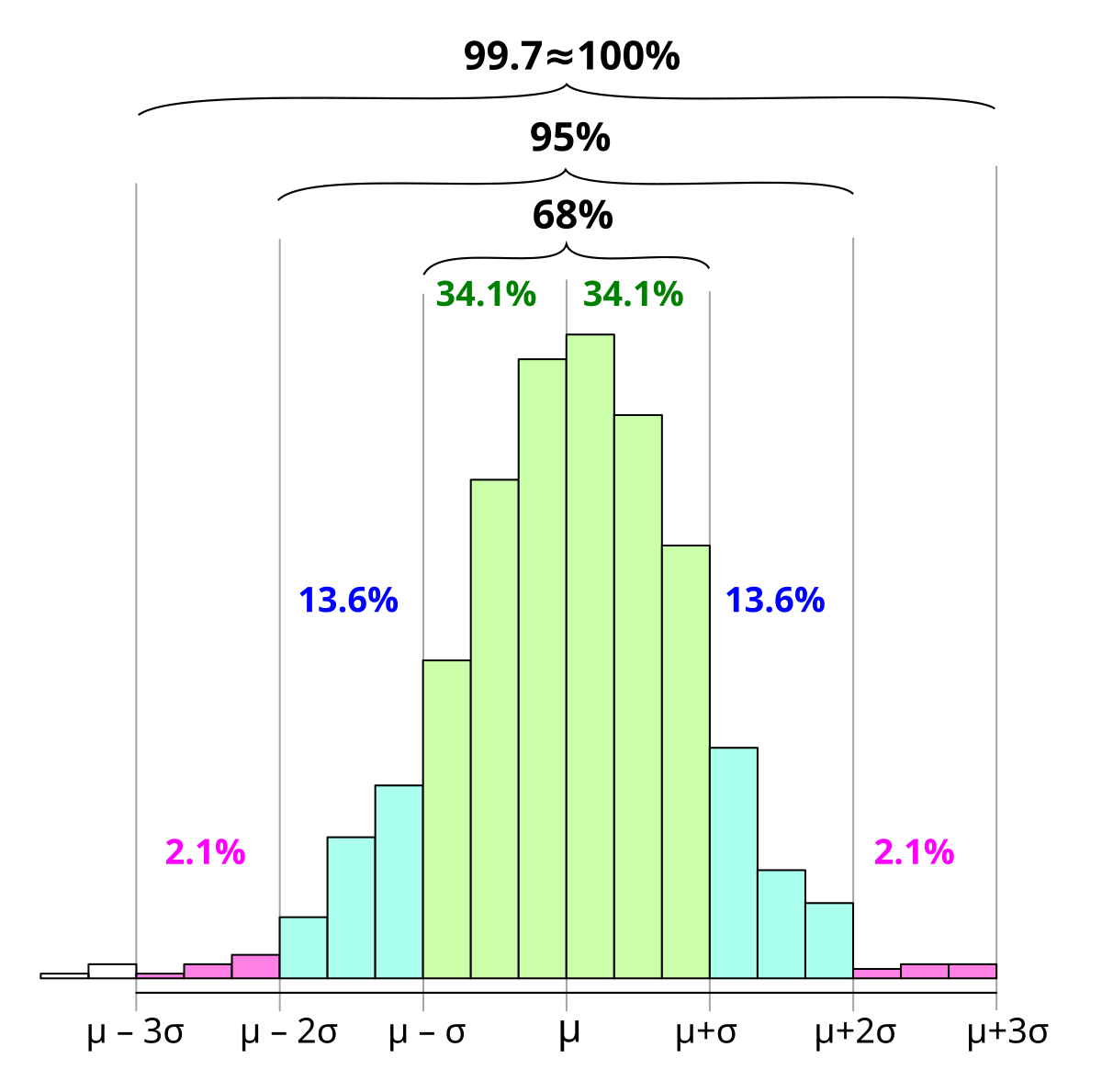
You reported that Damon et al. used 95%. That's not completely true. They give dates using weighted and unweighted data values for confidence intervals of both 68% and 95% (p. 614, cf. Table 3). Why 68% specifically? Why not 60% or 75% or something like that? Where does the 68 come from? Where does the 95 come from? Why that number?
C'mon, @bobdroege7 ! Even I know this one, and I'm a liberal arts major (albeit one that was briefly an Economics major who took some relevant intro courses once upon a time)!
 
Last edited:
You're the one assuring us that Casabianca can be certain that the radiocarbon data should not be trusted because it doesn't conform to a rigidly drawn line in the sand. You owe us an explanation for where you think that rigidity comes from.

Do I?

I am not rejecting Damon, and asserting Casabianca because of confidence intervals.

The rigidity of my argument comes from the fact that when you mix materials of differing ages together and then try to get a valid radiocarbon date from that mess, you need some measurement to assure that you are not dealing with too big a mix of differently aged materials in your sample.

I have tried to explain that, but you don't seem to be listening.

Please address that, and you should know that that test comes before the confidence intervals can be assigned.
 
The rigidity of my argument comes from the fact that when you mix materials of differing ages together...
No, don't change the subject.

I have tried to explain that, but you don't seem to be listening.
I'm not letting you change the subject.

Please address that, and you should know that that test comes before the confidence intervals can be assigned.
No. You kept hammering the statistics as the reason we have to believe Casabianca. Now that you're floundering, you want to pretend Casabianca was really somehow talking about something else.

Where do those 68, 95, 99 numbers come from? Why those numbers specifically?
 
Last edited:
C'mon, @bobdroege7 ! Even I know this one, and I'm a liberal arts major (albeit one that was briefly an Economics major who took some relevant intro courses once upon a time)!

I am a liberal arts major as well, see my sig line.

Liberal Arts are where the hard science lands, you know Physics, Chemistry, and Math if you call that a science.
 
No, don't change the subject.


I'm not letting you change the subject.


No. You keep hammering the statistics as the reason we have to believe Casabianca.

Where do those 68, 95, 99 numbers come from? Why those numbers specifically?
I am not changing the subject, this is where I have been arguing all along, you keep trying to drag me into the weeds, and I have allergies.

And yes, it is the statistical test for homogeneity that is the crux of the biscuit, which you keep running from as fast as you can.

But here is the answer to your question, even though it is irrelevant.

 
And yes, it is the statistical test for homogeneity that is the crux of the biscuit, which you keep running from as fast as you can.
No, you're the one running from the statistics and trying to substitute for that a lot of speculation about what you think happened.

But here is the answer to your question, even though it is irrelevant.
I get to say what's relevant to my rebuttal. You've Googled an answer, but you didn't have much luck when you did that for chi-squared. You got the Pearson test for categorical variables, not the correct use of the chi-square distribution. I sent you a whole textbook on statistics, and you were confused about why it was talking about probability. You don't enjoy a presumption of competence.

What categorical change occurs in the underlying data as you cross standard-deviation boundaries? What lets you map confidence intervals that are defined by standard deviations into corresponding qualitative, categorical, or natural changes in the underlying data? What then do you get to say about where the data "breaks" as its standard score crosses a standard-deviation boundary?
 
Last edited:
1. Figure it out, I already told you, it's in the twist.
:rolleyes: So you cannot provide an example of the 'herringbone' weave cloth in the time-frame you claim for the alleged shroud.

And a rather pathetic attempt to shift the burden of proof too.
2. Nope, the earlier fire did not damage the cloth in the same places as the 1532 fire, as there is no evidence of the damage from the 1532 fire in the Pray Codex.
:rolleyes: And yet shroudies, like you, claim that the supposed damage to the alleged shroud in the Codex match the burns on the Lirey cloth. Burns that happened in 1532.
Further, you have produced no evidence for your claimed earlier fire.
3. I already posted that, and you only need about 1 mg to do a test.
No you didn't you're lying again. You posted links to the same books I had linked to, and quoted, earlier. Books I suspect you have never even read.
Those books provide no evidence for the secret AMS test, no evidence that the claimed AMS facility existed, just assertions allegedly from a man conveniently dead when the book was published.
Further, your assertion that "you only need about 1 mg to do a test" (an example of your frantic Googling....) is true today; but it wasn't true forty years ago. Oh, and while we're here @bobdroege7, what is the mass of the "single thread" that was supposedly tested?

Seriously, this is desperately pathetic even by your dubious standards.
 
Do I?
...when you mix materials of differing ages together and then try to get a valid radiocarbon date from that mess, you need some measurement to assure that you are not dealing with too big a mix of differently aged materials in your sample.
Oh look, another pathetic attempt at distraction. There was no magic invisible patch, no matter how much your and the god-botherers want there to have been one.
 
Here is a very useful and revealing bibliography of peer-reviewed articles on the Shroud of Turin. Joseph Marino updated the bibliography last year. Notice that the anti-authenticity articles are in the distinct minority:

Sweet Jeebus but this is just pathetic. A desperate attempt to throw a layer of science over the desperate attempts of the god-botherers to justify the Lire cloth and reinforce their belief.
 
Look, for radiocarbon dating to be valid, the sample has to be all of the same age. If you have a mix of different aged materials in your sample, you do not get accurate results.

...snip...

bob - you may have missed my posts, could you answer the following questions?

For those that believe the shroud is the shroud used to cover the body of Jesus:

  • Why is the shroud of Turin not the type of shroud that was typical of Jewish burials around 35 CE?
  • Why if it is a 2000-year-old atypical shroud could this not have been a shroud that had been wrapped around another person's body?
  • Where/what is the provenance that the shroud of Turin is in fact the shroud that wrapped Jesus's body?
  • Where was the shroud from around 35 CE to 1100 CE?
 
No, you're the one running from the statistics and trying to substitute for that a lot of speculation about what you think happened.


I get to say what's relevant to my rebuttal. You've Googled an answer, but you didn't have much luck when you did that for chi-squared. You got the Pearson test for categorical variables, not the correct use of the chi-square distribution. I sent you a whole textbook on statistics, and you were confused about why it was talking about probability. You don't enjoy a presumption of competence.

What categorical change occurs in the underlying data as you cross standard-deviation boundaries? What lets you map confidence intervals that are defined by standard deviations into corresponding qualitative, categorical, or natural changes in the underlying data? What then do you get to say about where the data "breaks" as its standard score crosses a standard-deviation boundary?
Yes I googled an answer I already knew, it is still irrelevant to the reason why the Damon paper fails. And it is still not the reason Damon and Casabianca used a 95% confidence interval.

It is not a chi^2 distribution, it is a chi^2 test, that's in the Damon paper. If I got it wrong, then Damon got it wrong, I don't think so.

I'll return to a question I asked you, what does the distribution of the data from the Damon paper look like for the shroud samples?

Is it acceptable to use standard deviation on data that is shaped the way the Damon data looks like?

You are making an assumption that the data has certain features, but the chi^2 test shows that the data does not have those features.

We need to stop talking past each other.
 
Last edited:
bob - you may have missed my posts, could you answer the following questions?
Around 35 CE, Jews did not wrap their dead like Egyptian mummies. They laid them in tombs covered witph a shroud for about a year, then the bones were collected and put in a box.

The shroud was in Edessa, in what is now Turkey, and then in Constantinople until that city fell in 1204.

Yes, it does not have to be Jesus of Nazareth, it could be another guy.
 
Around 35 CE, Jews did not wrap their dead like Egyptian mummies. They laid them in tombs covered witph a shroud for about a year, then the bones were collected and put in a box.

The shroud was in Edessa, in what is now Turkey, and then in Constantinople until that city fell in 1204.

Yes, it does not have to be Jesus of Nazareth, it could be another guy.
Do you have any evidence whatsoever that a burial shroud was a long linen sheet folded over the body at the head? Cuz I am not seeing that anywhere.

And please don't say the Pray Codex, because no one even thinks that is a Shroud representation. Even if it was agreed, it's a millennium off by way of evidence of first century Judean burial practices.
 
:rolleyes: So you cannot provide an example of the 'herringbone' weave cloth in the time-frame you claim for the alleged shroud.
And a rather pathetic attempt to shift the burden of proof too.

:rolleyes: And yet shroudies, like you, claim that the supposed damage to the alleged shroud in the Codex match the burns on the Lirey cloth. Burns that happened in 1532.
Further, you have produced no evidence for your claimed earlier fire.

No you didn't you're lying again. You posted links to the same books I had linked to, and quoted, earlier. Books I suspect you have never even read.
Those books provide no evidence for the secret AMS test, no evidence that the claimed AMS facility existed, just assertions allegedly from a man conveniently dead when the book was published.
Further, your assertion that "you only need about 1 mg to do a test" (an example of your frantic Googling....) is true today; but it wasn't true forty years ago. Oh, and while we're here @bobdroege7, what is the mass of the "single thread" that was supposedly tested?

Seriously, this is desperately pathetic even by your dubious standards.
You were wrong before, and you are still wrong now.

Linen and other cloths rarely last 2000 years, and neither do the looms, and then you are still hammering a fallacy that absence of evidence is not evidence of absence.

The Pray Codex predates the 1532 fire, so those burn marks on the Pray Codex predate the 1532 fire, that should be obvious even to you.

I didn't do any frantic googling to get the 1 mg number, I just counted the number of tests done at the Arizona and Zurich labs and divided by the amount of material they got as documented in the Damon paper.
 
Around 35 CE, Jews did not wrap their dead like Egyptian mummies.
Strawman. No-one has claimed this.
They laid them in tombs covered witph a shroud for about a year, then the bones were collected and put in a box.
Irrelevant.
The shroud was in Edessa, in what is now Turkey, and then in Constantinople until that city fell in 1204.
We await your evidence for this assertion....
Yes, it does not have to be Jesus of Nazareth, it could be another guy.
Or absolutely no-one, given the "shroud" was created in the fourteenth century.....
 
You were wrong before, and you are still wrong now.
Oh dear, more evasion.
You claimed there were examples of herringbone weave, such as the Lirey cloth, dating from first century Palestine, remember? Before you skipped on to claiming the cloth was produced in Italy, something you have yet to produce evidence of.......
Linen and other cloths rarely last 2000 years, and neither do the looms, and then you are still hammering a fallacy that absence of evidence is not evidence of absence.
Yet you claim the supposed shroud survived.....
Can you see the double standard? I'm sure everyone else can.
The Pray Codex predates the 1532 fire, so those burn marks on the Pray Codex predate the 1532 fire, that should be obvious even to you.
And yet you (and other shroudies) claim that the supposed marks on the alleged shroud shown in the Codex shows the same marks as are on the Lirey cloth.
Now, what about this other fire you claim caused the marks?
I didn't do any frantic googling to get the 1 mg number, I just counted the number of tests done at the Arizona and Zurich labs and divided by the amount of material they got as documented in the Damon paper.
And yet you got the wrong number......

Remember your supposed secret test, according to the "sources" you've mentioned (and which I've read, unlike you) was performed on a single thread, now how much would that weigh?
 
I'll return to a question I asked you...
No, stop trying to direct my rebuttal.

We need to stop talking past each other.
You need to stop trying to derail my rebuttal.

In an ordinary, valid data set, what observable, fundamental shifts occur in the underlying data at those confidence-interval boundaries that let you say something about data that falls outside them?
 
Last edited:
Yes I googled an answer I already knew...
No.

You spent far more energy explaining to us why you didn't have to tell us the very simple answer that represents a fundamental tenet of statistics than it would have taken you to answer the question had you already known it. Instead of stalling for weeks, you could have simply said, "The percentages correspond to the percentage of data that falls within standard-deviation delimited intervals in a two-tailed distribution." You learn that on the first day you study distributions. I finally gave you enough hints that you got a Google hit you could use. Now I'm asking questions designed to discover whether you actually know why the answer is the answer. Keep in mind you already admitted you have no formal education in statistics. So it seems we need to remediate that a tad before you can understand the rebuttal.

Believe me, we're all familiar with the pattern in which someone stalls and bluffs for a long time until the answer is essentially spoon-fed to them, whereupon they say, "Oh, yeah, that; I knew it all along."

...it is still irrelevant to the reason why the Damon paper fails. And it is still not the reason Damon and Casabianca used a 95% confidence interval.
Then tell us the real reason. I'll wait.

You are making an assumption that the data has certain features, but the chi^2 test shows that the data does not have those features.
No, you're still trying to treat these statistical tests as some kind of "specification." And no, it is not "the" chi-squared test. When people talk about "the chi-squared test," they're talking about Pearson's test for categorical covariance, which is the most commonly-used application of the chi-squared distribution. The Ward & Wilson test is another kind of test that also uses the chi-squared distribution. It's not the same as Pearson's covariance test for at least two reasons: first, Ward and Wilson do not assume that the data are normally distributed (we'll get to that when you're up to speed); and second, Ward and Wilson's data are not categorical.
 
Last edited:
No, stop trying to direct my rebuttal.


You need to stop trying to derail my examination of your understanding of the statistical basis for your defense of Casabianca.

In an ordinary, valid data set, what observable, fundamental shifts occur in the underlying data at those confidence-interval boundaries that let you say something about data that falls outside them?

Your rebuttal has to lie where my rejection of the Damon paper lies, that's where the discussion lies, not in some irrelevant off shoot.

My understanding is irrelevant, but the statistical analysis in the Casabianca paper is relevant.

Do we have an ordinary valid data set with respect to the Damon data set as found in the Casabianca paper?
 

Back
Top Bottom