Stacyhs, thanks again! I didn't know or didn't remember that the cartoon cost 182,000 euros, I only recalled it was costly. Is there a reference for the cost? I assume I am correct that the contract and funds for the cartoon went to her relative. What were the grounds for her acquittal? Was there any evidence that Comodi received any kickback (compensation) from her relative for directing the contract to him?Comodi was acquitted in the case regarding the cartoon so she didn't have to pay for it. The fact that the prosecution had a cartoon created that cost 182,000 euros paid for by the state is yet another example of the prosecution having access to funds that the defense does not have. Knox and Sollecito had to pay for their own expert witnesses, etc.

-
Security incident: ISF was recently accessed by intruders. Please change your password, and change it anywhere else you used it. Read more
You are using an out of date browser. It may not display this or other websites correctly.
You should upgrade or use an alternative browser.
You should upgrade or use an alternative browser.
Cont: The Trials of Amanda Knox and Raffaele Sollecito: Part 32
- Thread starter LondonJohn
- Start date
An important ECHR case, Cioffi v. Italy 17710/15, was published today, 5 June 2025. There were violent disorders in Naples on 17 March 2001 against an event, the Third Global Forum on Reinventing Government, that was being held in the city. Police and demonstrators clashed when the demonstrators attempted to dismantle barriers and enter a protected area; the police charged the demonstrators, the demonstrators threw dangerous objects at the police, and the police responded with force. Injured demonstrators sought treatment in the emergency rooms of city hospitals. Other persons, not involved in the demonstrations, were also present in the emergency rooms as patients or accompanying patients.
At 12:30 pm, police received orders to transfer all patients in the hospital emergency rooms to a specific police station. A deputy chief of police was assigned the task of coordinating the activities in the police station for the transferred individuals, and he delegated authority in the activities involving the transferred persons (a total of 85 individuals, including the applicant Cioffi, a trainee lawyer), to two senior police officials. Records indicate Cioffi was held from no later than somewhat before 1:00 pm to no later than his release somewhat after 5:30 pm.
The police in the station, according to Italian court records, proceeded to inflict serious mistreatment upon the transferred persons, including but not limited to threats and beatings. The ECHR judgment states:
Concerning Italy holding the police responsible for the misconduct that was proven by Italian courts to have occurred, the ECHR stated:
100. The Court reiterates that it falls first to the national authorities to redress any violation of the Convention. In the present case, it acknowledges the fact that the domestic courts thoroughly examined the impugned events, established the circumstances of the applicant’s ill-treatment and recognised his right to compensation, as emphasised by the Government.
Source: https://hudoc.echr.coe.int/eng?i=001-243366
At 12:30 pm, police received orders to transfer all patients in the hospital emergency rooms to a specific police station. A deputy chief of police was assigned the task of coordinating the activities in the police station for the transferred individuals, and he delegated authority in the activities involving the transferred persons (a total of 85 individuals, including the applicant Cioffi, a trainee lawyer), to two senior police officials. Records indicate Cioffi was held from no later than somewhat before 1:00 pm to no later than his release somewhat after 5:30 pm.
The police in the station, according to Italian court records, proceeded to inflict serious mistreatment upon the transferred persons, including but not limited to threats and beatings. The ECHR judgment states:
Because of the length of the information in the ECHR judgment, I will skip to Cioffi's claims as summarized by the ECHR (I recommend reading the entire judgment):13. Following a preliminary investigation, thirty-one law-enforcement officers of different ranks were charged with offences in connection with the events of 17 March 2001. These included kidnapping (sequestro di persona) with the aggravating factor that it had been carried out by State officials abusing their authority; unlawful personal searches and inspections (perquisizione e ispezione personali arbitrarie); destruction and damage of property (danneggiamento); abuse of office; forgery committed by State officials in the drafting of public documents (falsità ideologica commessa dal pubblico ufficiale in atti pubblici); criminal coercion (violenza privata); and bodily harm (lesione personale), including, inter alia, causing contusions to the applicant’s head and back, with a number of aggravating factors, such as committing the offence while exercising a public function, operating in a number greater than five, taking advantage of the vulnerability of the injured, and using service batons to commit the offence.
14. On 13 July 2004 they were committed to stand trial in the Naples District Court. The applicant joined the proceedings as a civil party alongside nineteen other individuals.
Here is the ECHR analysis:65. The applicant pointed out that the domestic courts had confirmed his account of the ill-treatment he had suffered at the hands of the police. In particular, he had been subjected to several beatings, spat on and forced to kneel on the floor with his face to the wall and his hands behind his head. He had not been allowed to use his phone to communicate his whereabouts and his phone had been destroyed. He stated that when he had identified himself as a trainee lawyer and requested explanations for his having been taken into custody, for which he saw no legitimate reason, he had been subjected to more physical and verbal abuse. He cited the first-instance court’s finding to the effect that he had become a “designated target” for the law-enforcement officers, who had attempted to arouse feelings of fear in him through threats.
66. As to the legal classification of the treatment to which he had been subjected, he considered that it amounted to torture for the purposes of the Court’s case-law, since in his view it had been inflicted with a punitive and retaliatory intent.
67. He added that the fear and anguish he had experienced as a result of this treatment ought to be taken into account by the Court. He emphasised that the treatment he had endured was in no way attributable to actions on his part. He also contested the Government’s submission to the effect that the impugned events had occurred because of the difficult situation caused by clashes between the police and demonstrators, as those events occurred several hours after the clashes and not during the demonstration itself.
68. The applicant focused on the failure to punish the law‑enforcement officers and argued that, despite the domestic courts’ acknowledgment of the seriousness of the offences at issue, those responsible had not received appropriate punishment. Most of the offences had gone unpunished as a result of the expiry of statutory limitation periods, which were too short in relation to the time necessary to conduct in-depth investigations in cases as complex as the one under scrutiny. Indeed, while the applicant argued that the proceedings had been lengthy, he nevertheless conceded the Government’s submission that the proceedings had lasted fourteen years because the case was particularly complex, concerned a large number of police officers and many victims, in an exceptional context of police violence.
69. He further submitted that the sentences that had been handed down, which were the minimum sentences applicable for the related offences, were derisory in comparison to the seriousness of the offences committed. The effectiveness of criminal sanctions had been further undermined, in his view, by the application of pardons and suspended sentences.
70. He submitted that the Italian legal framework had proved to be inadequate for the purposes of punishing the violations complained of and providing the necessary deterrent effect to prevent similar violations from occurring in the future.
71. The applicant added that some of the officers involved in the impugned events had not been subjected to disciplinary sanctions, that they had been suspended from duty for only a few days, that most of them were still in active service and that some had even been promoted.
72. Lastly, he emphasised that he remained without compensation fourteen years after the impugned events and argued that any award of damages after bringing civil proceedings could not, in any event, have afforded sufficient redress for a violation of his rights under Article 3 since those responsible had gone unpunished.
Many of the police officers who were convicted of offenses in the case were pardoned or benefited from the statute of limitations (because the trials went on so long that the time limits were exceeded). The punishment for some consisted of a written warning entered into their personnel file.85. Turning to the facts of the present case, the Court observes at the outset that the domestic courts established in considerable detail the different forms of ill-treatment to which the persons held at the police station, and the applicant in particular, had been subjected (see paragraphs 15 to 34 above). As the Court finds no cogent reason to depart from such findings, and noting the Government’s statement to the effect that they fully endorsed the findings of the national courts, it regards the ill-treatment complained of as proven.
86. In particular, the Court notes that, upon their arrival at the police station, the individuals held there, which included the applicant, were made to walk through a hallway lined by law-enforcement officers who, amongst other things, took turns slapping, kicking, and tripping them (see paragraph 17 above). The applicant had also been forced to kneel on the floor with his face to the wall and his hands behind his head, and in order to enforce that posture, he had been shoved, kicked and punched from behind by officers (see paragraph 18 above). What further emerges from the findings of the domestic courts is that the applicant was also subjected to several beatings and that he sustained contusions to the head and back (see paragraphs 18 and 23 above). The physical abuse against the applicant was described as “very violent” by the first-instance court, which also found that he had become a “designated target” for the officers (see paragraph 19 above). The Court notes that there has not been and, on the basis of the material available to it, there can hardly be any suggestion that the treatment to which the applicant was subjected while entirely under the authorities’ control, as described above, was made necessary by his conduct (see Bouyid, cited above §§ 88 and 100-01).
87. The Court further notes that the first-instance court singled out the applicant as among the recipients of “particularly odious” verbal abuse
(see paragraph 19 above). This conduct had aimed, according to that court, to instil and prolong a state of fear in the applicant. The Court also notes that, as emphasised by the applicant and as shown by the findings of the domestic courts, the applicant identified himself as a trainee lawyer and requested explanations, as he stated he did not see any reason for his transfer to the police station, there having been no formal arrest, and having already undergone an identity check by the police at the hospital (see paragraph 19 above). The first-instance court described the applicant’s attempts to obtain information as having been met by further physical and verbal abuse, to the point that he had had no choice but to desist, a circumstance which the court referred to as “particularly unacceptable” (see paragraph 19 above). Moreover, this treatment had been coupled with the inability of the applicant, who spent approximately five hours in the police station, to contact the outside world in order to make his situation known (see paragraphs 16 and 18 above). In the Court’s view, there can be little doubt that these circumstances must have caused the applicant considerable emotional and psychological distress.
88. Having regard to all the foregoing elements, the Court concludes that the applicant was subjected to treatment contrary to Article 3 of the Convention, and that such treatment should be regarded as both inhuman and degrading.
Concerning Italy holding the police responsible for the misconduct that was proven by Italian courts to have occurred, the ECHR stated:
The Italian government objected that Cioffi could no longer be considered a victim of mistreatment because some of the officers had been convicted, even if they had been pardoned later or merely given written warnings. The ECHR did not agree:99. Having regard to all of the above, the Court is not persuaded that the authorities’ overall response to the impugned ill-treatment in the instant case can be considered adequate in terms of its capacity to punish the inhuman and degrading treatment at issue and as having sufficient deterrent effect to prevent the commission of future acts similar to those complained of by the applicant. It follows that the requirements of an effective investigation have not been fully satisfied in the present case.
100. The Court reiterates that it falls first to the national authorities to redress any violation of the Convention. In the present case, it acknowledges the fact that the domestic courts thoroughly examined the impugned events, established the circumstances of the applicant’s ill-treatment and recognised his right to compensation, as emphasised by the Government.
In conclusion, the ECHR stated:101. However, in cases of wilful ill-treatment by State agents in breach of Article 3, the Court has repeatedly found that, in addition to acknowledging of the violation, two measures are necessary to provide sufficient redress. Firstly, the State authorities must have conducted a thorough and effective investigation capable of leading to the identification and punishment of those responsible. Secondly, an award of compensation is required where appropriate or, at least, the opportunity to apply for and obtain compensation for the damage sustained as a result of the ill-treatment (see Gäfgen, cited above, § 116).
102. Given the Court’s findings to the effect that the investigation was not effective (see paragraph 99 above), it cannot but conclude that the applicant may still claim to be a “victim” of a breach of his rights under Article 3 of the Convention. Accordingly, the Government’s objection must be dismissed.
This Cioffi v. Italy ECHR case is significant for the Knox - Sollecito case. It shows how reluctant the Italian judicial system is to acknowledge misconduct by police unless there is overwhelming evidence, and even more reluctant to hold any police officer who commits misconduct to be held accountable through an appropriate punishment that matches the severity of the criminal misconduct. It should be recalled that the first violation found in Knox v. Italy is a violation of Convention Article 3 in the procedural limb, and to date, Italy has done nothing known to the public to remedy that violation.103. The Court finds that there has been a violation of Article 3 of the Convention under both its substantive and procedural limbs.
Source: https://hudoc.echr.coe.int/eng?i=001-243366
Stacyhs
Penultimate Amazing

I can't answer your questions because the article I read about her acquittal had no other details.Stacyhs, thanks again! I didn't know or didn't remember that the cartoon cost 182,000 euros, I only recalled it was costly. Is there a reference for the cost? I assume I am correct that the contract and funds for the cartoon went to her relative. What were the grounds for her acquittal? Was there any evidence that Comodi received any kickback (compensation) from her relative for directing the contract to him?
Stacyhs
Penultimate Amazing
Here is an aerial photo of the Lana's house and garden in relation to Guede's apartment. Notice the Sant'Angelo Park gate in the upper left-hand corner and Guede's apt. that is a few seconds walk from it. Guede would have known of this small, obscure gate to the park making it much more plausible that he threw the phones into the Lana's garden (which is invisible from the road due to tall trees and bushes) than either Knox or Sollecito. There would have been no reason for them to walk that way to get rid of the phones whereas it's logical that Guede would have. Guede either walked home through the park and tossed them before going up the path to the gate or later by exiting the gate, walking down the path, and then back up. When I walked that area in the late afternoon on a beautiful May day, I saw no one, not even a car, so it's much more private than inside the city walls.
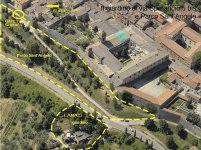
Here is a photo of the Lana's garden. You can see how the trees completely block the view of the house from the rood and it sits below the road so Guede likely thought he was tossing them into a wooded area.
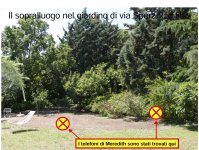
Here is a photo of the Lana's garden. You can see how the trees completely block the view of the house from the rood and it sits below the road so Guede likely thought he was tossing them into a wooded area.
I found an article with some information I didn't know, although it doesn't address my previous questions - there may be no public information on some of those.I can't answer your questions because the article I read about her acquittal had no other details.
For the issues with the expenses for the cartoon, Manuela Comodi was not tried in a criminal court. She was tried by the CSM (High Council of the Magistrates aka High Council of the Judiciary), the disciplinary body for judges and prosecutors ("magistrates" in Italy) as defined in Articles 104, 105, and 107 of the Italian Constitution*. The prosecutor appearing before the CSM is the Attorney General (Chief Prosecutor) of the CSC. The hearing or trial was described in media articles; I Google translated one dated 6 December 2013 in Umbria24.**
The cartoon itself used the latest technology available when it was made ("4D" - supposedly simulating realistic motions) and cost 182,740 euros, which included 30,000 euros in VAT. The charge against Comodi was that she had caused "unjust damage to the Treasury [of Italy]" and had given the company making the cartoon "an undue advantage" [apparently by not seeking competitive bids] so that the payment was not properly motivated [justified] and the proper criteria [standards] for the large sum were not applied. The prosecution called for Comodi to be issued a warning (a light sanction) for her alleged "inexcusable negligence" in the way she handled the expenditure and financial justification for the cartoon. However, the CSM disciplinary section did not agree and acquitted her, so no warning was issued.
* https://www.senato.it/documenti/repository/istituzione/costituzione_inglese.pdf
** https://www.umbria24.it/cronaca/omi...di-per-la-liquidazione-delle-spese-del-video/
Last edited:
I believe there was a consistent pattern of the police and prosecution ignoring or minimizing evidence of Guede's role in the crimes against Kercher. While some may claim that this was a display of favoritism to Guede - actions motivated by the hypothesized role of Guede as a police informant or some other speculation such as the influence from Guede's wealthy foster family - it may simply have resulted from the desire of the police and prosecutor to falsely attribute as much of the crime as possible to Knox and/or Sollecito to hide the weaknesses of the case against them.Here is an aerial photo of the Lana's house and garden in relation to Guede's apartment. Notice the Sant'Angelo Park gate in the upper left-hand corner and Guede's apt. that is a few seconds walk from it. Guede would have known of this small, obscure gate to the park making it much more plausible that he threw the phones into the Lana's garden (which is invisible from the road due to tall trees and bushes) than either Knox or Sollecito. There would have been no reason for them to walk that way to get rid of the phones whereas it's logical that Guede would have. Guede either walked home through the park and tossed them before going up the path to the gate or later by exiting the gate, walking down the path, and then back up. When I walked that area in the late afternoon on a beautiful May day, I saw no one, not even a car, so it's much more private than inside the city walls.
View attachment 61702
Here is a photo of the Lana's garden. You can see how the trees completely block the view of the house from the rood and it sits below the road so Guede likely thought he was tossing them into a wooded area.
View attachment 61703
TomG
Muse

- Joined
- Jan 24, 2014
- Messages
- 696
I remember reading an "unpublished" interview that reporter Bob Graham had with Mignini, where the question of whether or not Rudy was an informant or not came up. I seem to remember that Mignini replied that it wouldn't be surprising if he was considering Rudy's background. I can't find any trace of it now, despite searches. Does anyone have a link?I believe there was a consistent pattern of the police and prosecution ignoring or minimizing evidence of Guede's role in the crimes against Kercher. While some may claim that this was a display of favoritism to Guede - actions motivated by the
hypothesized role of Guede as a police informant or some other speculation such as the influence from Guede's wealthy foster family - it may simply have resulted from the desire of the police and prosecutor to falsely attribute as much of the crime as possible to Knox and/or Sollecito to hide the weaknesses of the case against them.
The unusual release of Guede at the request of the Perugia police after he was arrested after being found armed and illegally in a nursery school must have some explanation. One reasonable candidate explanation is that he was an informant for the Perugia police.I remember reading an "unpublished" interview that reporter Bob Graham had with Mignini, where the question of whether or not Rudy was an informant or not came up. I seem to remember that Mignini replied that it wouldn't be surprising if he was considering Rudy's background. I can't find any trace of it now, despite searches. Does anyone have a link?
Last edited:
Stacyhs
Penultimate Amazing
I suspect Guede was an informant or had some kind of relationship with the Perugia police but, admittedly, there is no actual evidence of this.
What I also suspect is that Curatolo had some relationship with the police as the Kercher case was not the only time he'd testified in court. He'd testified in at least 2 previous cases:
What I also suspect is that Curatolo had some relationship with the police as the Kercher case was not the only time he'd testified in court. He'd testified in at least 2 previous cases:
As readers here are no doubt well aware, there is no bail or similar system in Italy. If a person is arrested, for example, as Guede was at the scene of a crime - the nursery school that he had illegally entered, and where he was found to be carrying a knife that he had apparently taken from the school's kitchen - the procedure after arrest would be to bring the suspect/accused person before a judge. The judge would then decide on personal precautionary measures, if any, that would be required under Italian law. The laws concerning precautionary measures and coercive measures (relating to limitations imposed on the suspect/accused) begin with CPP Article 272 (personal freedom may only be limited only in accordance with the laws listed in the CPP) and continue through CPP Article 315 (compensation for unjust detention).The unusual release of Guede at the request of the Perugia police after he was arrested after being found armed and illegally in a nursery school must have some explanation. One reasonable candidate explanation is that he was an informant for the Perugia police.
Some relevant laws for understanding how odd the (apparently) unsupervised release of Guede after his arrest in the Milan nursery school include, but may not be limited to:
CPP Article 274, paragraph 1, subparagraph c: Precautionary measures shall be ordered if there is a real danger of the suspect/accused committing serious crimes using weapons or any other violent tool against persons....
CPP Article 297, paragraph 1: The effects of precautionary detention shall start as soon as the moment in which the suspect/accused has been captured, arrested, or placed under temporary detention.
Lawful precautionary measures include but are not limited to: detention in a prison (CPP Article 285), house arrest (CPP Article 284), and requiring the suspect/accused to be free but to make periodic appearances at a specific police facility (CPP Article 282). CPP Article 275-bis provides that in ordering house arrest or in place of precautionary detention in prison, a judge may order monitoring procedures through electronic means or other technical devices (e.g., electronic ankle bracelets).
Source: The Italian Code of Criminal Procedure: Critical Essays and English Translation, ed. M. Gialuz, L. Luparia, and F. Scarpa, Wolters Kluwer Italia (C) 2014.
Last edited:
While searching for information on Rudy Guede, I came across this 28 November 2021 article from il Giornale:
As stated in the article, a foreigner convicted of a crime with a sentence exceeding 2 years may be expelled from Italy after serving the sentence (CP Article 235). Guede, however, having been released in 2021, having served about 16 years for the murder/rape of Kercher "in complicity with unknown persons", applied for asylum in Italy, and apparently was granted asylum or other permission to remain.
I translated the Italian text of CP Article 235, and it specifically refers to the expulsion or removal of foreigners who are also citizens of other European Union member states, as well as "the cases expressly provided for by law". I don't know if this wording means that a citizen of the Ivory Coast, for example, was not allowed to be expelled or removed under CP Article 235.
Sources:
https://www.ilgiornale.it/news/cronache/rudy-guede-rischia-lespulsione-1992393.html
https://www.altalex.com/documents/news/2013/12/19/delle-misure-amministrative-di-sicurezza
Rudy Guede rischia l'espulsione. E chiede asilo all'Italia
La legge italiana prevede l'espulsione per gli stranieri che abbiano commesso un reato superiore ai 2 anni di pena. Il 34enne ha presentato domanda di protezione internazionale
As stated in the article, a foreigner convicted of a crime with a sentence exceeding 2 years may be expelled from Italy after serving the sentence (CP Article 235). Guede, however, having been released in 2021, having served about 16 years for the murder/rape of Kercher "in complicity with unknown persons", applied for asylum in Italy, and apparently was granted asylum or other permission to remain.
I translated the Italian text of CP Article 235, and it specifically refers to the expulsion or removal of foreigners who are also citizens of other European Union member states, as well as "the cases expressly provided for by law". I don't know if this wording means that a citizen of the Ivory Coast, for example, was not allowed to be expelled or removed under CP Article 235.
Sources:
https://www.ilgiornale.it/news/cronache/rudy-guede-rischia-lespulsione-1992393.html
https://www.altalex.com/documents/news/2013/12/19/delle-misure-amministrative-di-sicurezza
Last edited:
Stacyhs
Penultimate Amazing
If he's convicted of the rape and beating up of his former girlfriend, I wouldn't be surprised if he's deported after serving his sentence. But some never learn.
There is an excellent website "Knox auguries of innocence" which makes the point there has been an effort by the Italian authorities to minimise Guede's role in Meredith's murder, deflect attention from Guede and treat him leniently and this attitude extents to the guilters. On the TJMK/PMF hate sites they viciously attack Amanda and Raffaele but they largely ignore Guede. It has been argued one of the aims of the hate sites is minimise Guede's role in Meredith's murder and place as much blame as possible for Meredith's murder on Amanda and Raffaele which could be one factor why guilters such as Vixen regard Amanda and Raffaele as guilty regardless of the facts and the anger guilters feel over the Hellman and supreme court acquittals . If Amanda and Raffaele are convicted, minimising Guede's role in Meredith's murder and passing the blame to Amanda and Raffaele can be justified but this is not the case if Amanda and Raffaele are acquitted. To minimise Guede's role and place as much as blame as possible on Amanda and Raffaele, guilters are prepared to express utter absurdities eg that Amanda and Raffaele came back to stage a rape when Guede had raped Meredith. By claiming that Amanda and Raffaele staged a rape rather than Guede actually raped Meredith, this is a way of minimising Guede's role.I believe there was a consistent pattern of the police and prosecution ignoring or minimizing evidence of Guede's role in the crimes against Kercher. While some may claim that this was a display of favoritism to Guede - actions motivated by the hypothesized role of Guede as a police informant or some other speculation such as the influence from Guede's wealthy foster family - it may simply have resulted from the desire of the police and prosecutor to falsely attribute as much of the crime as possible to Knox and/or Sollecito to hide the weaknesses of the case against them.
Welshman, thanks for reminding us of the excellent "Amanda Knox: Auguries of Innocence" online publication*. It contains many clear observations and analyses of the case. The 16 September 2015 analysis of the Marasca CSC panel MR is excellent, although it may miss noting the forecast or plan of resistance in the MR to the then-anticipated 2019 ECHR judgment Knox v. Italy. Here's an excerpt (note that "the conviction" in the excerpt refers only to the conviction of Knox and Sollecito on the murder/rape charges and of Knox on the "aggravated calunnia" charge; the conviction of Knox on the "simple" calunnia charge was final and could not be lawfully altered by the Marasca CSC panel):There is an excellent website "Knox auguries of innocence" which makes the point there has been an effort by the Italian authorities to minimise Guede's role in Meredith's murder, deflect attention from Guede and treat him leniently and this attitude extents to the guilters. On the TJMK/PMF hate sites they viciously attack Amanda and Raffaele but they largely ignore Guede. It has been argued one of the aims of the hate sites is minimise Guede's role in Meredith's murder and place as much blame as possible for Meredith's murder on Amanda and Raffaele which could be one factor why guilters such as Vixen regard Amanda and Raffaele as guilty regardless of the facts and the anger guilters feel over the Hellman and supreme court acquittals . If Amanda and Raffaele are convicted, minimising Guede's role in Meredith's murder and passing the blame to Amanda and Raffaele can be justified but this is not the case if Amanda and Raffaele are acquitted. To minimise Guede's role and place as much as blame as possible on Amanda and Raffaele, guilters are prepared to express utter absurdities eg that Amanda and Raffaele came back to stage a rape when Guede had raped Meredith. By claiming that Amanda and Raffaele staged a rape rather than Guede actually raped Meredith, this is a way of minimising Guede's role.
It is important to step back a bit and see what Marasca did accomplish:
- He annulled the conviction definitively without further possibility of review.
- He states in the strongest possible terms that Amanda and Raffaele had nothing to do with the murder.
- He eviscerates the prosecutor and police over the deplorable quality of the investigation.
- He strongly criticizes the likes of Massei and Nencini for ignoring evidence that undercut their theories and, more generally, for not evaluating evidence in ways clearly established by Italian law.
In short, the subtext of everything Marasca says is that Guede, acting alone, killed Meredith Kercher. An American judge might well have felt free to state this plainly. A subtle Italian judge, operating in an environment where professional courtesy is important, pays you the compliment of assuming you are smart enough to work this fact out for yourself following the clues he has given.
* https://amandaknoxauguriesofinnocence.wordpress.com/
Last edited:
As some readers may be aware (and I learned today), the original "Auguries of Innocence" is a poem by William Blake (1757-1827). A focus of the poem may be that those who practice cruelty and injustice will themselves suffer. Here are some comments excerpted from a summary and analysis by Oliver Tearle, University Teacher in English at Loughborough University:Welshman, thanks for reminding us of the excellent "Amanda Knox: Auguries of Innocence" online publication*. It contains many clear observations and analyses of the case. The 16 September 2015 analysis of the Marasca CSC panel MR is excellent, although it may miss noting the forecast or plan of resistance in the MR to the then-anticipated 2019 ECHR judgment Knox v. Italy. Here's an excerpt (note that "the conviction" in the excerpt refers only to the conviction of Knox and Sollecito on the murder/rape charges and of Knox on the "aggravated calunnia" charge; the conviction of Knox on the "simple" calunnia charge was final and could not be lawfully altered by the Marasca CSC panel):
* https://amandaknoxauguriesofinnocence.wordpress.com/
After the opening lines of Blake’s poem, the most famous are probably ‘A Truth thats told with bad intent / Beats all the Lies you can invent’. Often repeated with reference to politicians or other people who would justify harm and injustice by using facts to support their position, these lines are among Blake’s most resonant.
A lie, for Blake, would carry its own punishment: like letting your own dog starve, it is an act of self-harm that rebounds upon the perpetrator. As Mark Twain once said, if you tell the truth, you don’t have to remember anything; nor will you have your conscience nagging you that you have done something Immoral with a capital ‘I’. But this is why misusing pure truth is worse: it is an assault on innocence, because (good) truth is being pressed into service for immoral ends. Truth – and, by extension, innocence – is thus being corrupted once more.
‘Auguries of Innocence’ might be regarded as a sort of verse manifesto for much of Blake’s writing, laying out, through a long sequence of examples, his moral position. Blake was consistent in speaking out against injustice and moral wrong, and ‘Auguries of Innocence’ shines further light on how Blake saw evil deeds harming not just the victim but also the perpetrator.
ETA: Near the beginning of Blake's poem are the following lines:
A Robin Red breast in a Cage
Puts all Heaven in a Rage
Sources:

A Summary and Analysis of William Blake’s ‘Auguries of Innocence’
By Dr Oliver Tearle (Loughborough University) Unlike many of his other celebrated poems, William Blake’s ‘Auguries of Innocence’ languished unpublished in notebooks for decades after his death, and…
 interestingliterature.com
Last edited:
Some ECHR cases against Italy reinforce the opinion that one of the primary drivers of injustice in Italy is a desire by the Italian government and/or courts to minimize expenditures from the Italian treasury, even when those expenditures are fair and lawful. An example is AVELLONE AND OTHERS [Committee] v. ITALY 6561/10 final 09/07/2020. (The case was considered so readily determined from ECHR case law that the ECHR judged it before a Committee of 3 judges rather than a Chamber of 7 judges.)
In 1985, Italy passed a law increasing the pensions of some group(s) of pensioners to increase with a calculation of the cost of living, effective with the enactment of the law. When individuals retired and sought their pensions, the pension authority (INSP) calculated the increase from their date of retirement, not from the date the law went into effect. The pensioners sought relief in the pension authority's administrative court, but it sided with the authority. They then took the case to the civil courts, and won their case at every level, including the CSC - pension increases would be calculated from the date the law went into effect. However, while these court cases were ongoing, the Italian parliament passed a new law, giving an "authentic interpretation" to the 1985 law, specifying that it was to be Italian law that the pensions were to be increased with the cost of living only starting from the date of retirement, and it was retrospective. This new law went into effect on 1 January 2008. The Italian courts now reversed themselves and followed the new law. A group of 30 retirees lodged an application with the ECHR complaining of a violation of Convention Article 6.1, on the grounds that the parliament had interfered with the court judgments in process. Some of the applicant retirees had lost as much as about 2,200 euros, but some had suffered no monetary loss.
The ECHR judgment excluded those applicants who had suffered no monetary loss. The ECHR found a violation of Convention Article 6.1 (inline citations omitted):
While the Italian government submitted an Action Plan in 2021, this case remains pending before the CoM.
Conclusion: While "protection of reputation" and "assuring impunity for illegal acts of authorities" may be motivations for the re-conviction of Knox for calunnia and the denial of compensation for unjust detention for Sollecito, a desire to minimize expenditures from the Italian treasury, even if the expenditures would be lawful, just, and fair, is another apparent motivation of the Italian state and its branches.
Sources:
 hudoc.echr.coe.int
ECHR judgment
hudoc.echr.coe.int
ECHR judgment
 hudoc.exec.coe.int
CoM Case Status
hudoc.exec.coe.int
CoM Case Status
hudoc.exec.coe.int
Action Plan
In 1985, Italy passed a law increasing the pensions of some group(s) of pensioners to increase with a calculation of the cost of living, effective with the enactment of the law. When individuals retired and sought their pensions, the pension authority (INSP) calculated the increase from their date of retirement, not from the date the law went into effect. The pensioners sought relief in the pension authority's administrative court, but it sided with the authority. They then took the case to the civil courts, and won their case at every level, including the CSC - pension increases would be calculated from the date the law went into effect. However, while these court cases were ongoing, the Italian parliament passed a new law, giving an "authentic interpretation" to the 1985 law, specifying that it was to be Italian law that the pensions were to be increased with the cost of living only starting from the date of retirement, and it was retrospective. This new law went into effect on 1 January 2008. The Italian courts now reversed themselves and followed the new law. A group of 30 retirees lodged an application with the ECHR complaining of a violation of Convention Article 6.1, on the grounds that the parliament had interfered with the court judgments in process. Some of the applicant retirees had lost as much as about 2,200 euros, but some had suffered no monetary loss.
The ECHR judgment excluded those applicants who had suffered no monetary loss. The ECHR found a violation of Convention Article 6.1 (inline citations omitted):
47. The Court has repeatedly held that although the legislature is not prevented from regulating, through new retrospective provisions, rights derived from the laws in force, the principle of the rule of law and the notion of a fair trial enshrined in Article 6 preclude, except for compelling public-interest reasons, interference by the legislature with the administration of justice designed to influence the judicial determination of a dispute....
48. The Court is not persuaded by the arguments advanced by the Government that the disputes were not decided on the basis of the law of authentic interpretation. While it is true that in the judgments mentioned by the Government (see paragraph 45 above) the Court of Cassation expressly maintained that the outcome would have been the same, since the disputes had to be resolved on the basis of the new interpretation, the Court notes that such an interpretation followed the approach of the Constitutional Court in judgment no. 401/2008 (see paragraph 18 above), which in turn concerned the constitutionality of Law no. 244/2007.
49. The Court notes that the Government did not submit any judgment of the Court of Cassation predating the enactment of the Law that had endorsed the position of the INPS. On the contrary, the Court notes that before the enactment of Law no. 244/2007 the domestic courts repeatedly found in favour of the applicants’ position, and the interpretation of the relevant legal provisions was also endorsed by the Court of Cassation on one occasion (see paragraph 10 above). Given that the legal provisions had mostly been interpreted in favour of the applicants during the decades when the adjustment of the increase in line with the cost of living had been challenged in the domestic courts, it follows that the legislative interference (shifting the balance in favour of one of the parties) in the present case was not foreseeable.
50. In reality, the enactment of Law 244/2007 when the proceedings were pending did determine the substance of the disputes. Indeed, the Law had the effect of definitively modifying the outcome of the pending litigation to which the State was a party, endorsing the State’s position to the applicants’ detriment.
51. Lastly, even accepting that the State was attempting to adjust a situation it had not originally intended to create and ensure respect for the original will of the legislature, it could have done so without resorting to a retrospective application of the law....
52. The foregoing considerations are sufficient to enable the Court to conclude that there has been a violation of Article 6 of the Convention.
While the Italian government submitted an Action Plan in 2021, this case remains pending before the CoM.
Conclusion: While "protection of reputation" and "assuring impunity for illegal acts of authorities" may be motivations for the re-conviction of Knox for calunnia and the denial of compensation for unjust detention for Sollecito, a desire to minimize expenditures from the Italian treasury, even if the expenditures would be lawful, just, and fair, is another apparent motivation of the Italian state and its branches.
Sources:
HUDOC - European Court of Human Rights
The HUDOC database provides access to the case-law of the Court (Grand Chamber, Chamber and Committee judgments and decisions, communicated cases, advisory opinions and legal summaries from the Case-Law Information Note), the European Commission of Human Rights (decisions and reports) and the...
hudoc.echr.coe.int
HUDOC-EXEC
hudoc.exec.coe.int
HUDOC-EXEC
hudoc.exec.coe.int
Last edited:
Vixen
Penultimate Amazing

Here is an aerial photo of the Lana's house and garden in relation to Guede's apartment. Notice the Sant'Angelo Park gate in the upper left-hand corner and Guede's apt. that is a few seconds walk from it. Guede would have known of this small, obscure gate to the park making it much more plausible that he threw the phones into the Lana's garden (which is invisible from the road due to tall trees and bushes) than either Knox or Sollecito. There would have been no reason for them to walk that way to get rid of the phones whereas it's logical that Guede would have. Guede either walked home through the park and tossed them before going up the path to the gate or later by exiting the gate, walking down the path, and then back up. When I walked that area in the late afternoon on a beautiful May day, I saw no one, not even a car, so it's much more private than inside the city walls.
View attachment 61702
Here is a photo of the Lana's garden. You can see how the trees completely block the view of the house from the rood and it sits below the road so Guede likely thought he was tossing them into a wooded area.
View attachment 61703
Oh please. Sollecito also lived nearby Lana's garden. Did you forget Guede and Sollecito lived very close by each other?
 Perugia Guede-Sollecito proximity by Username Vixen, on Flickr
 key Perugia proximity by Username Vixen, on Flickr
Source: John Follain, Death in Perugia
It was Knox who was charged with stealing the phones (later dropped) and if you recall she knew when she called Mez next day that Mez would not be answering her phones any time soon (unlike Filomena).
Last edited:
How could anyone except possibly Guede be charged with stealing the phones, since as far as has been made known, no forensic testing such as fingerprint or DNA profiling was conducted on the phones. DNA evidence showed that Guede had handled Kercher's handbag.
The charge of stealing the phones leveled against Knox was merely a part of the frame-up against her and Sollecito.
The charge of stealing the phones leveled against Knox was merely a part of the frame-up against her and Sollecito.
Stacyhs
Penultimate Amazing
1. "Oh please. Sollecito also lived nearby Lana's garden. Did you forget Guede and Sollecito lived very close by each other?"Oh please. Sollecito also lived nearby Lana's garden. Did you forget Guede and Sollecito lived very close by each other?
Source: John Follain, Death in Perugia
It was Knox who was charged with stealing the phones (later dropped) and if you recall she knew when she called Mez next day that Mez would not be answering her phones any time soon (unlike Filomena).
I know exactly where Guede and Sollecito lived. I've been there. But the fact remains that Guede's apt. was literally a few seconds walk from the gate in a secluded alley and he'd have seen that gate almost daily. Sollecito lived near it, but it was not in an area he would frequent. Unless, you want to claim he used it to access the park to shoot up. Which, of course, is disproved my his hair narcotics test. On the other hand, Guede was a small time drug dealer.
As Raffaele was just getting finishing his IT degree, he'd know how to turn off both cell phones in order to hide their whereabouts.
2. "It was Knox who was charged with stealing the phones (later dropped)"
The charges were not "dropped", she was convicted of stealing the phones (charge "D") by Massei and acquitted on charge D by Hellman. Chieffi annulled Hellmann's acquittal of charge D. Nencini convicted them on charge D.
3. "...if you recall she knew when she called Mez next day that Mez would not be answering her phones any time soon (unlike Filomena)."
Will you please stop the psychic mindreading act? If you recall, Knox was acquitted of the murder and of stealing the phones so just how would she know "that
Vixen
Penultimate Amazing
1. "Oh please. Sollecito also lived nearby Lana's garden. Did you forget Guede and Sollecito lived very close by each other?"
I know exactly where Guede and Sollecito lived. I've been there. But the fact remains that Guede's apt. was literally a few seconds walk from the gate in a secluded alley and he'd have seen that gate almost daily. Sollecito lived near it, but it was not in an area he would frequent. Unless, you want to claim he used it to access the park to shoot up. Which, of course, is disproved my his hair narcotics test. On the other hand, Guede was a small time drug dealer.
As Raffaele was just getting finishing his IT degree, he'd know how to turn off both cell phones in order to hide their whereabouts.
2. "It was Knox who was charged with stealing the phones (later dropped)"
The charges were not "dropped", she was convicted of stealing the phones (charge "D") by Massei and acquitted on charge D by Hellman. Chieffi annulled Hellmann's acquittal of charge D. Nencini convicted them on charge D.
3. "...if you recall she knew when she called Mez next day that Mez would not be answering her phones any time soon (unlike Filomena)."
Will you please stop the psychic mindreading act? If you recall, Knox was acquitted of the murder and of stealing the phones so just how would she know "thatMezMeredith would not be answering her phones"?
Please quit the hypotheticals and what-ifs 'would, could, and should'. IF the phones were stolen by Guede, he WOULD have removed the SIM cards and passed the phones on to his stolen goods go between. IF Guede was going to steal a couple of cheap manky phones he WOULD have also taken the far more valuable three laptops and Filomena's expensive jewellery and camera openly lying around. He COULD have used one of her tote bags to carry the blag in, being of his ethnicity, a strong fit athletic type with criminal tendencies and likely ate cats and dogs, as per MAGA stereotypes, beloved of the PIP.
Let's stick to known facts. Knox had a cocaine dealer on her speed dial. She was getting through up to €400 a day. Whilst Mez had €300 rent money missing, Knox had a similar amount remaining in her possession. Both Knox and Sollecito bragged about being drug users. Both said after the murder they would never take drugs again.
The fact is, Mrs Lana heard Knox ringing one of the phones dumped in her garden. She immediately took it to the police and to report threatening phone calls about her toilet blowing up. The postal police promptly and efficiently identified the phone as being registered with Filomena (who had given it to Mez as being cheaper to use than her English phone). The postale police were so efficient, they sent a squad car with a couple of cops to hand the phone back in person*.
So, who do I believe, the postal police who caught the pair hanging around at the scene canoodling or a cunning convict who is now making a lot of money out of the dreadful crime?
Whilst the undercover cop Stasi-style secret police remnants of the old Mussolini fascist police state dictatorship lingers on in Italy, with its wire-tapping and ears to the wall furtiveness, and is to be looked upon with opprobrium by those of us who believe in transparency, in this instance, it well demonstrates how covert intelligence gathering identified the key suspects very quickly. Obviously such undercover intelligence can't be used in court and the police still had to build an evidence-based case. The phone logs - or lack thereof - were very useful evidence here.
*Imagine losing your phone and the cops bringing it round to you in person within the hour of it being handed in.

But after this experience, believe me Dad, I will never smoke another joint in my life. ~ Extract from Raffaele Sollecito's letter to his father -- Published in The Observer, Sunday November 25 2007
Last edited: