
• Security incident: ISF was recently accessed by intruders. Please change your password, and change it anywhere else you used it. Read more

Ed Applying luma curve to photos and footage

That is a very poor answer and explaination.
Irrelevant. I have given you an extensive review of your methods and claims. You appear unable to address them.

Besides your words. What is your evidence?
My words are sufficient evidence to anyone who understands mathematics. You are trying very hard to reverse the burden of proof. You are the one claiming that your luminance mapping has revealed "unnatural" light. You are the one claiming your technique "bends" light to accomplish this. You are the one claiming this effect is evidence of an "alpha halo" which you insinuate (but will not explain how) presents a problem for the authenticity of the images you have studied.

None of this has any support. You are simply making naked assertions.
 
Irrelevant. I have given you an extensive review of your methods and claims. You appear unable to address them.


My words are sufficient evidence to anyone who understands mathematics. You are trying very hard to reverse the burden of proof. You are the one claiming that your luminance mapping has revealed "unnatural" light. You are the one claiming your technique "bends" light to accomplish this. You are the one claiming this effect is evidence of an "alpha halo" which you insinuate (but will not explain how) presents a problem for the authenticity of the images you have studied.

None of this has any support. You are simply making naked assertions.
Irrelevant? You also decide whats Irrelevant?
 
Irrelevant? You also decide whats Irrelevant?
Irrelevant. I have given you an extensive review of your methods and claims. You appear unable to address them.


My words are sufficient evidence to anyone who understands mathematics. You are trying very hard to reverse the burden of proof. You are the one claiming that your luminance mapping has revealed "unnatural" light. You are the one claiming your technique "bends" light to accomplish this. You are the one claiming this effect is evidence of an "alpha halo" which you insinuate (but will not explain how) presents a problem for the authenticity of the images you have studied.

None of this has any support. You are simply making naked assertions.
Your words are sufficient.

Mine are not.

That is a frightening statement you should sternly evaluate
 
Toy image apps.
Yes.

Ok. Please name a non toy. Ill try that.
We use in-house tools, as do many image analysis houses. However, Adobe Photoshop—properly operated—can perform more finely-controlled mappings.

I mention "toy" apps because how you go from RGB color space to a luminance-chrominance color space such as YUV matters. Toy applications do this implicitly, as does Photoshop without proper parameterization. The implicit conversion weights for perceptual luminance. As such it weighs the green channel more heavily than green or blue. Energy-based conversion uses the energy implied by the wavelength of each channel, so it weighs blue the heaviest.
 
Irrelevant? You also decide whats Irrelevant?
Your opinion of the sufficiency of my answer is irrelevant. You cannot engage with my answers on any level.

Your words are sufficient.

Mine are not.

That is a frightening statement you should sternly evaluate
My words are sufficient because I have provided a thorough explanation for the mathematical deficiency in your approach. Your response to it was, "Did you write all that?" You have not engaged with it beyond that.

Your words are insufficient because you are simply insisting your method works, and you are unable to answer any of the reviewers' questions for how you determined that it does.
 
@nt1, have you tried falsifying your result? Take a still from.a genuine videoed image from the same time frame (around 2001) which has been digitized and downloaded through YouTube, then run it through your editor, and see if the masking effect shows? You claimed this earlier with an airplane image but im.not sure if the original image was digitized from 25 yr old video et al.

Alternatively, could anyone else here familiar with nt1's process duplicate it?
Yes i have. I believe i have shown them here.

I will now.

Here is wtc7. 2000. Day of. Notice the same black line across all buildings unbroken. Notice that the same black line does not trace all buildings in the 9/11 footage

2000 footage. Notice the solid black line is smooth and straight. Notice the 9/11 footage displays a zig zag pattern. Showing it is not natural light..


Notcie they look near identical. Notice they behave different.

One. Smooth.
One a zig zag broken line.

Ill be happy to reapond further.

Im not like these others throwing a huffy fit. Id love to be shown or proved wrong logically with exact examples.
 

Attachments

  • Screenshot_20250523_122524.jpg
    Screenshot_20250523_122524.jpg
    182.3 KB · Views: 2
  • Screenshot_20250523_122612.jpg
    Screenshot_20250523_122612.jpg
    244.4 KB · Views: 3
  • Screenshot_20250524_201638_Photos.jpg
    Screenshot_20250524_201638_Photos.jpg
    166.9 KB · Views: 2
  • Screenshot_20250524_201526_Photos.jpg
    Screenshot_20250524_201526_Photos.jpg
    69 KB · Views: 2
  • Screenshot_20250524_223045.jpg
    Screenshot_20250524_223045.jpg
    145.1 KB · Views: 2
@nt1, have you tried falsifying your result? Take a still from.a genuine videoed image from the same time frame (around 2001) which has been digitized and downloaded through YouTube, then run it through your editor, and see if the masking effect shows? You claimed this earlier with an airplane image but im.not sure if the original image was digitized from 25 yr old video et al.

Alternatively, could anyone else here familiar with nt1's process duplicate it?
Yes i have taken multiple sources. Yes i have found the closest to originals i can when available.

Yes i will show where and how applied it.

Yes. Youcsre correct that YouTube videos should not be the only source and last source if possible

But yes.

I have found downloading photos from the most durect source ans screenshoting youtube differs only slightly. That does not negate your point. You are correct. But yes. I have and can. Ill take any and all sources anyone wants to provide.

Also. This isnt my baby. Im not a content creator with this as my bread an butter. I brought something that anyone can take to a computer ai source and fact check. And when you do. Do it three times with different angles. Be sure you dont take the first source and first answer and settle. That isnt science.

The level of response i have recieved here from some, reminds me of the monolith in 2001 with the apes.

I notice you have tried to press the issue with genuine questions.
 
9/11 zig zag.
2000 solid straight line.
 

Attachments

  • Screenshot_20250524_223045.jpg
    Screenshot_20250524_223045.jpg
    145.1 KB · Views: 2
  • Screenshot_20250524_201526_Photos.jpg
    Screenshot_20250524_201526_Photos.jpg
    69 KB · Views: 2
One. Smooth.
One a zig zag broken line.
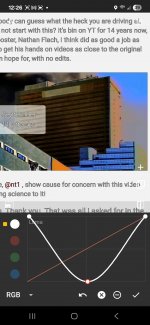
Your luminance map reduces the quantization of luminosity and actually removes data from the original image. In your adjusted image, the image data that would have provided a smooth transition across the edge has been removed by your misuse of the tool. That is why the image then appears aliased. It is not because this stair-step pattern exists in the original image and has somehow been hidden in an alpha-masked channel. It is because you created the effect by reducing the available quantization.

Im not like these others throwing a huffy fit. Id love to be shown or proved wrong logically with exact examples.
What makes you think you can dictate the manner in which you are allowed to be refuted?
 
Yes.


We use in-house tools, as do many image analysis houses. However, Adobe Photoshop—properly operated—can perform more finely-controlled mappings.

I mention "toy" apps because how you go from RGB color space to a luminance-chrominance color space such as YUV matters. Toy applications do this implicitly, as does Photoshop without proper parameterization. The implicit conversion weights for perceptual luminance. As such it weighs the green channel more heavily than green or blue. Energy-based conversion uses the energy implied by the wavelength of each channel, so it weighs blue the heaviest.
In house tool apps.

So tools not available to the public that can be verified by the general public? Can we have a name* for the in house tools?
 
Your luminance map reduces the quantization of luminosity and actually removes data from the original image. In your adjusted image, the image data that would have provided a smooth transition across the edge has been removed by your misuse of the tool. That is why the image then appears aliased. It is not because this stair-step pattern exists in the original image and has somehow been hidden in an alpha-masked channel. It is because you created the effect by reducing the available quantization.


What makes you think you can dictate the manner in which you are allowed to be refuted?
What makes you think*you can dictate the manner in which* you refute,* with impunity ?
 
Your luminance map reduces the quantization of luminosity and actually removes data from the original image. In your adjusted image, the image data that would have provided a smooth transition across the edge has been removed by your misuse of the tool. That is why the image then appears aliased. It is not because this stair-step pattern exists in the original image and has somehow been hidden in an alpha-masked channel. It is because you created the effect by reducing the available quantization.


What makes you think you can dictate the manner in which you are allowed to be refuted?

Removes data?

No, bending a curve does not remove data.
 
Address the explanation in the second paragraph.
You cant take my "so....."

by itself and out of context.

Leave the context in you want replied to.

You are losing integrity by doing that.

And i dont want you to lose integrity.

because then we are both wasting our time.
 
Removes data?

No, bending a curve does not remove data.
I explained how it does. Since you don't seem to understand, I'll explain it again.

If I have an original image in which one pixel has luminosity Y=0.45 and another pixel with luminosity Y=0.55, an inverted paraboloid luminance map centered on Y=0.50 will map those two different pixels to the same luminosity, say Y′=0.95. If two pixels have different luminosity in the source and the same luminosity in the adjustment, the adjustment has lost data.

Luminance maps such as those you've employed are useful only as the first step in edge detection. They are band-pass filters that selectively amplify certain specific luminosities, generally those statistically determined to be transitional pixels between light and dark regions. Your method is nothing more than crude edge detection.
 
You are losing integrity by doing that.

And i dont want you to lose integrity.
Don't worry about my integrity. I'll do that. Just address my explanations. You're latching onto quick points you can make that distract from your inability to explain how you think your method achieves the results you claim it does. Are you willing and able to discuss how conversions between color spaces and color models might affect your findings?
 
@nt1, have you tried falsifying your result?
The biggest confounding telltale is in the images he's using that include text. He's apparently screen-shotting displays that contain both the images of interest and explanatory text from the AI he's using to make his argument for him. Notice how, in the images after he's applied his luminance map, the same "halo" appears around the text. This is because the transitional pixels that smooth the rendered text fall into the luminosity range that is selectively amplified by his luminance map.
 

ISF - Join now!

Every member here is approved by hand. No bots, no spam, just people who care about evidence and honest debate.

Membership is free!

Create your free account

Back
Top Bottom