Merged Strict biological definitions of male/female

It is more than just the SRY gene, it's the location of that gene and also the receptor for the protein produced by that gene.
And some other genes as well.
The determining factor is the SRY gene. That's the element that triggers the developmental pathway. You are correct that the message has to be received as well - but the receptor isn't the trigger. It can also very rarely be translocated due to mutation. But at the end of the day, the SRY gene is what guides the fetus along the path of sexual differentiation.
That's right, I am saying that sex is determined, but not defined.
You're saying it, but you're wrong.
 
But that merely results is a spectrum of "characteristically male physical features at birth"
Come to think of it, the situation would be even worse than that, since we would have defined sex-indicative features in a binary way (male/non-male) in order to make the bimodal plot work in the first place.
 
I think what you're looking for is in post #2406, the ink from whyevolutionistrue.
(y):) Nice to get some recognition and acknowledgement around this place ... ;):)

Though it's #2046 and in case anyone else wants the specifics:

 
Come to think of it, the situation would be even worse than that, since we would have defined sex-indicative features in a binary way (male/non-male) in order to make the bimodal plot work in the first place.
Don't see that that necessarily follows. As I've indicated before, heights and personality traits are "sexually dimorphic" and it seems relatively easy to plot them to emphasize the bimodality in those traits:

HumanUse_MultidimensionalGenderSpectrum_1A.jpg
HumanUse_Statistics_Heights_1A.jpg
Though in the first case mathematical "purists" might object to presenting those personality traits -- nominal categories -- in a spectrum ... ;):)
 
<snip>

That's right, I am saying that sex is determined, but not defined.
There are probably dozens of definitions that have defined the sex categories, some that are more or less standard and well regarded by most biologists worth their salt. See:

ParkerLehtonenDefinitions1A.jpg
The problem is generally that too many people get their knickers in twist over them largely because they "think" it deprives them of their "humanity" :rolleyes:. Many of them, like most of the transloonies, have turned the sexes into "immutable identities" based on some "mythic essences" instead of recognizing them as labels for transitory reproductive abilities.
 
I guess what I am trying to say in less words is; since both categorical and continuous variables can be bimodal ...
It might be splitting hairs, but I'm not sure that one can say that "sex" -- as a binary and nominal categorical variable -- is also bimodal:

However, a bimodal distribution has two distinct peaks – showing that data points are distributed across two separate values.


There are no peaks in a binary category since there are no intervening values less than those categories. See:

maximum: 3. mathematics: a value of a function that is greater than any neighbouring value


... the real issue is that sex is categorical (with everyone or almost everyone being in one of two categories) ...
The standard biological definitions has it that some third of us are sexless. See Griffiths Aeon article:


Too many people are fixated on the scientifically untenable "idea" that everyone has to have a sex from conception to death.
 
To be honest, I think Novella seems to be doing some motte-and-bailley judging by his recent write-up of his talk at CSI-con. It would be good to see the actual video of the talk because Novella claims Coyne misunderstood his talk when he responded to it the next day in his own talk.

But Novella is being disingenuous is his own description of his talk is anything to go by. He argues that some DSDs are analogous to other biological difficulties of classification such as the archaeopteryx (is it a bird? Is it a therapod?) and he once, on the podcast rather fatuously said that the trans-rights people should adopt the platypus as their mascot (yeah, that will go down well, Steve!)

But as people here have noted, even if you could find a particular individual or pattern of development which defies easy classification, such people are almost entirely irrelevant to any policy debates and yet seems to be one of the prongs of the argument that policies should be reassessed.

Yes - Novella's take is pretty bad. He is blatantly ignoring the reason why female and male arose (i.e. to facilitate sexual reproduction). He tries to designate the brain as a sexual organ and again conflates clearly deleterious variation (DSDs) with benign variation. His example of complete androgen insensitivity syndrome (CAIS) people as not being male or female - we know they would be functional males if it were not for the mutations in the AR gene. It's again special pleading for one organ system (and species).

And again for the peanut gallery (& lurkers) - if we count defects - there is no statement we can make about any group of organisms

note -his bird example seems to show he also doesn't understand cladistics/nested hierarchies - birds are a subset of theropods. Of course, classifying organisms would be impossible if we count those with severe genetic defects.

It seems pretty clear his position is ideologically driven.

I agree Coyne is getting DSDs slightly wrong - I think he's hedging his bets on maybe there being mutants where we can't identify what went awry. but with todays tools - (near) whole genome sequencing, better imaging, etc - this is unlikely.
 
Last edited:
Bimodal generally implies something quantitative and ordinal on the x-axis, such as height, weight, number of gametes produced throughout adulthood, number of genes in the 23rd pair of chromosomes, etc.

Do you happen to have the Coyne quote handy? That's an uncharacteristically sloppy use of scientific language.
As I explained in this post, the mode of distribution is simply the value with the highest probability or frequency. Therefore, a nominal distribution will have at least one mode.
 
That is the way I always think of it because I have never seen any reference to modes used in statistics except in relation to variables that can be ordered on the X axis. However, after reading Coynes piece a while back I looked into it and realised that categorical/nominal variables can also have modes. Since a mode is just the most frequent value it doesn't matter whether the frequency is a value on a continuous or categorical scale. For example, if I asked people for their favourite colour and got 45% red, 45% blue and 10% purple, I would technically have a bimodal variable. It's just isn't commonly encountered in that context because people are usually thinking of a peaks meaning smooth curves, which requires at least ordinal data on the X axis. (A bimodal nominal variable would also have peaks, but where they occur on the graph would be arbitrary and could not be fitted with a curve.)

"To be a bit more precise, biological sex in humans is bimodal: if you do a frequency plot with “sex” on the X axis and “frequency of individuals conforming to that sex” on the Y axis, you get a huge peak at “male”, another huge peak at “female”, and then a few tiny blips in between that conform to hermaphrodites or intersexes."

The following excerpt from a more-recent post of Jerry's might help clarify his views. Criticizing a paper in Science claiming that sex is "somewhat continuous," he wrote:

The proportion of individuals who are either male or female, based having the developmental equipment for making big or small gametes, is not “somewhat continuous”. It is nearly completely binary, with only 0.018% of individuals (as the authors admit, about 1 in 5600—they say 2 in 10,000—being of indeterminate sex, including intersexes). That means that 99.982% of individuals lie in the two peaks, or rather two straight lines shooting upwards. This is not at all “somewhat continuous” it is all but binary with a teeny blip in the center. Call that “very very very very strongly bimodal” if you wish, but the proportion of indeterminate individuals is miniscule, and these individuals are not a third sex, but represent developmental anomalies. Essentialism is in effect the case here: there are only two sexes and a very few individuals of indeterminate sex.​

 
As I explained in this post, the mode of distribution is simply the value with the highest probability or frequency.
Taking mode in the strict mathematical sense and taking "sex at birth" as a nominal distribution would result in a unimodal distribution, since most newborns are male. Once again, claims of bimodality just won't work.

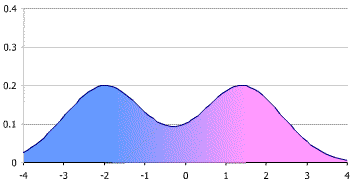
That said, the claims being made by the "sex is bimodal" crowd is not that sex is a nominal categorical variable but rather a continuous spectrum, as illustrated here.
 
Last edited:
The determining factor is the SRY gene. That's the element that triggers the developmental pathway. You are correct that the message has to be received as well - but the receptor isn't the trigger. It can also very rarely be translocated due to mutation. But at the end of the day, the SRY gene is what guides the fetus along the path of sexual differentiation.

You're saying it, but you're wrong.
Some my former Dev Bio colleagues (notably mostly female ones) would note at this point in the seminar that two X chromosomes are required for normal female development (and one X and one Y for normal male development).
 
The determining factor is the SRY gene. That's the element that triggers the developmental pathway. You are correct that the message has to be received as well - but the receptor isn't the trigger. It can also very rarely be translocated due to mutation. But at the end of the day, the SRY gene is what guides the fetus along the path of sexual differentiation.

You're saying it, but you're wrong.

There are some other genes involved, not just the SRY gene.

And if the SRY gene is absent, how does it guide the fetus in developing as a female?

Genes, chromosomes, and hormones determine sex.
 
The following excerpt from a more-recent post of Jerry's might help clarify his views. Criticizing a paper in Science claiming that sex is "somewhat continuous," he wrote:

The proportion of individuals who are either male or female, based having the developmental equipment for making big or small gametes, is not “somewhat continuous”. It is nearly completely binary, with only 0.018% of individuals (as the authors admit, about 1 in 5600—they say 2 in 10,000—being of indeterminate sex, including intersexes). That means that 99.982% of individuals lie in the two peaks, or rather two straight lines shooting upwards. This is not at all “somewhat continuous” it is all but binary with a teeny blip in the center. Call that “very very very very strongly bimodal” if you wish, but the proportion of indeterminate individuals is miniscule, and these individuals are not a third sex, but represent developmental anomalies. Essentialism is in effect the case here: there are only two sexes and a very few individuals of indeterminate sex.​

I wonder if there is any similar topic where 99% of a thing is A or B and <1% is indeterminant and some folks say it's a spectrum or you can't quite tell which is which.

Or where folks claim that overlapping bell curves means you can't make a distinction between two different groups.
 
Last edited:
That said, the claims being made by the "sex is bimodal" crowd is not that sex is a nominal categorical variable but rather a continuous spectrum, as illustrated here.
While I'm having a go at SGU, here is the relevant transcript excerpt:
I like this approach of thinking of it as as being bimodal. And so I think we'll start there and then we'll sort of backtrack. So when we talk about bimodality I'm not sure if that's a concept that comes naturally to a lot of people. I don't know if you guys remember way back in like your early math classes when you would learn measures of central tendency. But you learned about the mean, median and the mode, right? The average, the median and these are all different ways to say that's sort of the central point of a population or of a sample. So we often talk about the average, that's if you add everybody up and then divide by the number of everybody's. And then we say on average you know, on average people have two arms but not everybody has two arms. On average people you know have, I don't know, brown eyes. But of course not everybody has brown eyes. But on average we could say that and then you have the median, which is sort of the point in a row of frequencies, that falls in the middle, and that's not always going to give you the same answer, as the mean. And then you have the mode. And the mode is let's say we're looking at a certain feature, eye color, and we want to say, you know we take a group of of kids in a class and then we say, what color are your eyes, and for every blue eyed person we put a tick mark in that column, for every brown eyed person we put a tick mark, for every green eyed person we put a tick mark. And then we'll see you know what is the mode, it's the most frequent expression. So when we talk about something being bimodal, it literally looks like a normal curve, except it has two bumps instead of one. Can everybody envision that?

Emphasis mine.
 
Last edited:
There are some other genes involved, not just the SRY gene.

And if the SRY gene is absent, how does it guide the fetus in developing as a female?

Genes, chromosomes, and hormones determine sex.
Yes, there are other genes involved in both male and female sex determination, e.g. the main function of SRY is to trigger SOX9 - the more conserved player in triggering male development. Indeed (as has been explained) there are many genes involved in every organ system. The underlying developmental complexity still results in two reproductive phenotypes (+2 eyes, a functioning liver, etc.).

You - and I think everyone I've heard espouse the 'sex is a spectrum' misunderstanding - have implied or admitted the view is ideologically driven. No matter how well-intentioned, this is bad for science and trust in science.

ETA - the ~20K genes in our genome coordinate to result in what we typically consider one individual.
 
Last edited:
There are some other genes involved, not just the SRY gene.

And if the SRY gene is absent, how does it guide the fetus in developing as a female?
Genes, chromosomes, and hormones determine sex.
And you claim to be formally trained as a biologist?


Y-chromosomes contain the master-switch gene for sex determination, called the sex-determining region Y, or the SRY gene in humans. In most normal cases, if a fertilized egg cell has the SRY gene, it develops into an embryo that has male sex traits. If the zygote lacks the SRY gene or if the SRY gene is defective, the zygote develops into an embryo that has female sex traits.

FFS, I learned this in high school. As a claimed formally trained biologist, there is no question you should already know this.
 
Last edited:
Yes, there are other genes involved in both male and female sex determination, e.g. the main function of SRY is to trigger SOX9 - the more conserved player in triggering male development. Indeed (as has been explained) there are many genes involved in every organ system. The underlying developmental complexity still results in two reproductive phenotypes (+2 eyes, a functioning liver, etc.).

You - and I think everyone I've heard espouse the 'sex is a spectrum' misunderstanding - have implied or admitted the view is ideologically driven. No matter how well-intentioned, this is bad for science and trust in science.

ETA - the ~20K genes in our genome coordinate to result in what we typically consider one individual.
Sad to see that the once-respected Steven Novella has fallen into the trap of placing ideology ahead of objective, observable scientific truth.

Thank goodness for people like Dr. Colin Wright and Dr. Emma Hilton for always placing scientific truth at the forefront of this discussion.

IMO, anyone who thinks sex is a spectrum and not binary is every bit as much an evolution-denier as a Young Earth Creationist even if they deny it for different reasons.
 
Wow. And eye colour is categorical.
Right? It's like they are trying to be fractally incorrect.
@bobdroege7 , can you please provide some examples of sex as a spectrum leading to better medical outcomes?
I'm going to take a crack at this since Bob D. evidently won't do so: HRT for CAIS.

Estrogen replacement helps along female puberty, secondary sexual characteristics, and promotes bone mass.
 

Back
Top Bottom