I don't think you are able to distinguish whether a belief is true or false and whether you think positive or negative consequences would follow from it being true or false. This seems to be surprisingly common. In fact no negative consequences follow automatically from simply describing things as they are in reality, and apparently positive consequences that result from false beliefs result in unintended harms in the long run.I'll answer the why, and the belief is not false.
It's become political, I don't think law makers should get between doctors and patients.
If I don't stand up for trans people there will be nobody to stand up for me when they come for me.
It's a basic human rights issue.
I do know a handful of trans people, and their rights should not be restricted.

-
Security incident: ISF was recently accessed by intruders. Please change your password, and change it anywhere else you used it. Read more
You are using an out of date browser. It may not display this or other websites correctly.
You should upgrade or use an alternative browser.
You should upgrade or use an alternative browser.
Merged Strict biological definitions of male/female
- Thread starter d4m10n
- Start date
smartcooky
Penultimate Amazing

...and this is the part that is, and always will be, doomed to failure. If there were any truth to this "sex on a spectrum" nonsense, then you would be able to look at this photo...Coyne's view was discussed before. He argued that sex is a categorical variable where almost all cases fit in to one of two categories, but a miniscule number might not be obviously allocated to one of these categories due to unusual DSDs. Therefore he said that sex is technically bimodal but for nearly all intents and purposes it is binary (as you could say that a tossed coin could land heads, tails or on its edge, but for practical purposes a coin toss is binary).
I don't know whether he has revised this view.
However, this is nothing to do with what Novella and others are arguing, which is more related to trying to represent sex as a continuous variable ranging from male to female, with two peaks representing male and female modes, and no indication of how maleness and femaleness are quantified.

...and place all ten faces on a line from "100% male" at one end to "100 female" at the other, and then explain the measuring system you used to determine where you placed them.
smartcooky
Penultimate Amazing
I don't think you are able to distinguish whether a belief is true or false and whether you think positive or negative consequences would follow from it being true or false. This seems to be surprisingly common. In fact no negative consequences follow automatically from simply describing things as they are in reality,
and apparently positive consequences that result from false beliefs result in unintended harms in the long run.
This is a reference to Merton's Law of Unintended Consequences.
Allowing biological males who self-ID as women into women's safe spaces has the unintended consequence of making those spaces less safe for actual women (biological females), i.e. those for whom those safe spaces are intended.
angrysoba
Philosophile

Are they 100% AI?...and this is the part that is, and always will be, doomed to failure. If there were any truth to this "sex on a spectrum" nonsense, then you would be able to look at this photo...
...and place all ten faces on a line from "100% male" at one end to "100 female" at the other, and then explain the measuring system you used to determine where you placed them.
angrysoba
Philosophile
To be honest, I think Novella seems to be doing some motte-and-bailley judging by his recent write-up of his talk at CSI-con. It would be good to see the actual video of the talk because Novella claims Coyne misunderstood his talk when he responded to it the next day in his own talk.Coyne's view was discussed before. He argued that sex is a categorical variable where almost all cases fit in to one of two categories, but a miniscule number might not be obviously allocated to one of these categories due to unusual DSDs. Therefore he said that sex is technically bimodal but for nearly all intents and purposes it is binary (as you could say that a tossed coin could land heads, tails or on its edge, but for practical purposes a coin toss is binary).
I don't know whether he has revised this view. However, this is nothing to do with what Novella and others are arguing, which is more related to trying to represent sex as a continuous variable ranging from male to female, with two peaks representing male and female modes, and no indication of how maleness and femaleness are quantified.
But Novella is being disingenuous is his own description of his talk is anything to go by. He argues that some DSDs are analogous to other biological difficulties of classification such as the archaeopteryx (is it a bird? Is it a therapod?) and he once, on the podcast rather fatuously said that the trans-rights people should adopt the platypus as their mascot (yeah, that will go down well, Steve!)
But as people here have noted, even if you could find a particular individual or pattern of development which defies easy classification, such people are almost entirely irrelevant to any policy debates and yet seems to be one of the prongs of the argument that policies should be reassessed.
A Discussion about Biological Sex - NeuroLogica Blog
At CSICON this year I gave talk about topics over which skeptics have and continue to disagree with each other. My core theme was that these are the topics we absolutely should be discussing with each other, especially at skeptical conferences. Nothing should be taboo or too controversial. We...
theness.com
Coyne may well know his onions when it comes to the mating habits of fruit flies but when it comes to statistics he's clearly a scientific illiterate if not an outright pigheaded ignoramus. Something that I referred to several times in several of his blog posts which included a link to a tweet by Colin Wright which emphasized the point:Coyne's view was discussed before. He argued that sex is a categorical variable where almost all cases fit in to one of two categories, but a miniscule number might not be obviously allocated to one of these categories due to unusual DSDs. Therefore he said that sex is technically bimodal but for nearly all intents and purposes it is binary (as you could say that a tossed coin could land heads, tails or on its edge, but for practical purposes a coin toss is binary).
I don't know whether he has revised this view. However, this is nothing to do with what Novella and others are arguing, which is more related to trying to represent sex as a continuous variable ranging from male to female, with two peaks representing male and female modes, and no indication of how maleness and femaleness are quantified.

“Trans women are women”: J. K. Rowling is demonized again
J. K. Rowling has got herself in trouble again by implying, in the following tweet, that trans women—biological men who take on the gender identity of a woman—aren’t identical to biological w…
 whyevolutionistrue.com
A second post of mine though under another handle:
“sex in humans is bimodal: if you do a frequency plot with ‘sex’ on the X axis and ‘frequency of individuals conforming to that sex’ on the Y axis, you get a huge peak at ‘male’, another huge peak at ‘female’, and then a few tiny blips in between that conform to hermaphrodites or intersexes’
With all due respect, Professor, I think you’re labouring under a serious misapprehension about the nature of population distributions.

A defense of the binary in human sex
As a biologist, I get especially irked at the repeated claim that sex in humans is “a spectrum, not a binary.” In fact, as I’ve discussed several times before (e.g., here, here, h…
whyevolutionistrue.com
He was not "amused" ... Though at least he didn't delete my comments which is more than I can say for many others supposedly on the right side of history -- not mentioning any names though Andrew Doyle's rings a bell ...
But the point is that various "sexually dimorphic" traits are bimodal -- BECAUSE the means (averages) for each sex have a significant degree of separation -- but sex itself is NOT bimodal. For example, see Figure 1 in the Wikipedia article on multimodal distributions:

Figure 1. A simple bimodal distribution, in this case a mixture of two normal distributions with the same variance but different means. The figure shows the probability density function (p.d.f.), which is an equally-weighted average of the bell-shaped p.d.f.s of the two normal distributions. If the weights were not equal, the resulting distribution could still be bimodal but with peaks of different heights.
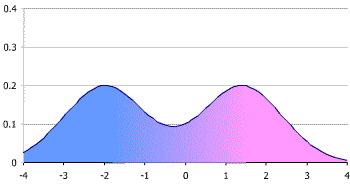
Multimodal distribution - Wikipedia
The scale can be any trait, though the classic example is to use heights since there's about a 4 inch (10 centimeter) difference in the average heights of men and women. From my "primer" on statistics:

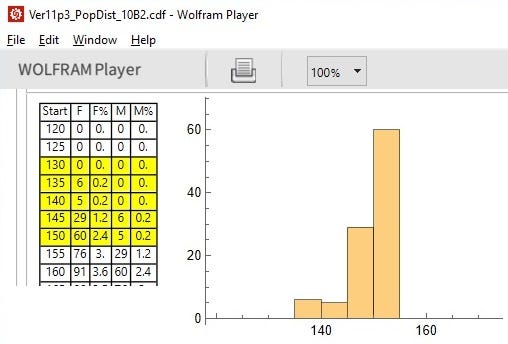
Lies, Damned Lies, & Statistics
Never the Twain or three should meet ...
 humanuseofhumanbeings.substack.com
The X axis is an ordinal variable -- heights in centimeters, the Z (vertical) axis is frequency (what percentage of the population has a given height), and the implicit Y axis -- into the page -- is for the nominal categorial variable sex, two possibilities being, of course, male and female.
But when you add the individual Z values for each sex then one gets the bimodal distribution illustrated in the Wikipedia article. Bottom line: distributions of sexually dimorphic traits -- physical or psychological -- are bimodal but sex itself isn't. From quite a good article co-authored by Wright:

d4m10n
Penultimate Amazing

Bimodal generally implies something quantitative and ordinal on the x-axis, such as height, weight, number of gametes produced throughout adulthood, number of genes in the 23rd pair of chromosomes, etc.Coyne's view was discussed before. He argued that sex is a categorical variable where almost all cases fit in to one of two categories, but a miniscule number might not be obviously allocated to one of these categories due to unusual DSDs. Therefore he said that sex is technically bimodal but for nearly all intents and purposes it is binary…
Do you happen to have the Coyne quote handy? That's an uncharacteristically sloppy use of scientific language.
Last edited:
That is the way I always think of it because I have never seen any reference to modes used in statistics except in relation to variables that can be ordered on the X axis. However, after reading Coynes piece a while back I looked into it and realised that categorical/nominal variables can also have modes. Since a mode is just the most frequent value it doesn't matter whether the frequency is a value on a continuous or categorical scale. For example, if I asked people for their favourite colour and got 45% red, 45% blue and 10% purple, I would technically have a bimodal variable. It's just isn't commonly encountered in that context because people are usually thinking of a peaks meaning smooth curves, which requires at least ordinal data on the X axis. (A bimodal nominal variable would also have peaks, but where they occur on the graph would be arbitrary and could not be fitted with a curve.)Bimodal generally implies something quantitative and ordinal on the x-axis, such as height, weight, number of gametes produced throughout adulthood, number of genes in the 23rd pair of chromosomes, etc.
"To be a bit more precise, biological sex in humans is bimodal: if you do a frequency plot with “sex” on the X axis and “frequency of individuals conforming to that sex” on the Y axis, you get a huge peak at “male”, another huge peak at “female”, and then a few tiny blips in between that conform to hermaphrodites or intersexes."Do you happen to have the Coyne quote handy? That's an uncharacteristically sloppy use of scientific language.
A defense of the binary in human sex
As a biologist, I get especially irked at the repeated claim that sex in humans is “a spectrum, not a binary.” In fact, as I’ve discussed several times before (e.g., here, here, h…
whyevolutionistrue.com
A frequency plot in this case is a histogram where bars represent categories and frequencies are counts. He is saying you would have two very tall bars for female/male and a very few cases that can't be classified within these categories. I would quibble with him describing them as 'in between' and there is clearly some disagreement about whether there are any cases that can't be fitted into male/female. However, he is not saying that there is a continuous scale from male to female (which is why I think he should not use the term 'in between') and he is saying it is binary for practical purposes.
This is not the same as Novella and others are arguing, where they are trying to imply a continuous distribution from male to female or can't coherently say what they are implying.
Paul2
Philosopher

- Joined
- Nov 6, 2004
- Messages
- 8,565
I think what you're looking for is in post #2406, the ink from whyevolutionistrue.Bimodal generally implies something quantitative and ordinal on the x-axis, such as height, weight, number of gametes produced throughout adulthood, number of genes in the 23rd pair of chromosomes, etc.
Do you happen to have the Coyne quote handy? That's an uncharacteristically sloppy use of scientific language.
d4m10n
Penultimate Amazing
I'd be okay with a categorical histogram approach (ordering is ultimately arbitrary) but I'm really not okay with nonsense like this:A frequency plot in this case is a histogram where bars represent categories and frequencies are counts. He is saying you would have two very tall bars for female/male and a very few cases that can't be classified within these categories. I would quibble with him describing them as 'in between' and there is clearly some disagreement about whether there are any cases that can't be fitted into male/female.
Semi-pro science communicators over at SGU have created the false impression that we can plot a continuous curve on an ordinal x-axis.
People have (alas!) been taught to think of it that way by self-identified skeptics who believe they are actually educating the masses.It's just isn't commonly encountered in that context because people are usually thinking of a peaks meaning smooth curves, which requires at least ordinal data on the X axis.

Easier just to restrict the set of mammals under consideration to those having conceived at least one potential descendent.Coyne...is saying it is binary for practical purposes.
Sex classification may not be binary; sexual reproduction clearly is binary.
Last edited:
This is what I was trying to say. A mode is just the most frequent value. For a continuous variable the value is a point on a continuous scale, while for a categorical variable (nominal or ordinal) it is the category with the highest frequency count. Either can have two modes. If a binary categorical variable where both categories have equal frequencies can be described as bimodal, then sex can be both binary and bimodal (although it would probably only be described as the former since this is more informative). Nor is it a major issue if you want to quibble over whether or not a few cases with DSDs can or can't be fitted into one of the two categories, since it doesn't change the underlying categorical nature of the variable (which I think is what Coyne is saying).I'd be okay with a categorical histogram approach (ordering is ultimately arbitrary) but I'm really not okay with nonsense like this:
Semi-pro science communicators over at SGU have created the false impression that we can plot a continuous curve on an ordinal x-axis.
Yes, because they have been taught to think of it that way by self-identified skeptics who believe they are actually educating the masses.
However, Novella and others in the sex is a spectrum crowd are trying to change the underlying nature of the variable, and the graphs they are using clearly imply that sex is a continuous rather than categorical variable. This is done by conflating sexual characteristics that can be plotted on a continuous scale with sex itself, and by implying that people with DSDs are somewhere between male and female and that this somehow changes the essentially categorical nature of sex.
Usually, people are taught about the mean, median and mode all being equal in a normal distribution, which is I think why it is harder to think about modes in relation to categorical variables that don't have mean or median.Yes, because they have been taught to think of it that way by self-identified skeptics who believe they are actually educating the masses.
Last edited:
I guess what I am trying to say in less words is; since both categorical and continuous variables can be bimodal, the real issue is that sex is categorical (with everyone or almost everyone being in one of two categories) and not continuous, not whether it is binary or bimodal (which can be the same thing). The fact that people take 'bimodal' to mean 'continuous' is causing confusion that is probably being exploited by the 'sex is a spectrum' position.
Last edited:
d4m10n
Penultimate Amazing
Spectrums are by nature continuous and ordinal (e.g. EM radiation by frequency or wavelength) but I've yet to hear anyone in the "sex is a spectrum" crowd even suggest WTF their x-axis is supposed to be when they illustrate their idea of sexual bimodality. I suppose one could come up with a synthetic variable like "number of characteristically male physical features at birth" along with a list of those features in order to get to something sort of like the top graph from SGU #869, but I'm not sure if they would allow themselves to get that far into the categorization process because you'd end up with a graph so strongly bimodal as to make it seem like the bottom graph was closer to the truth than the top one.However, Novella and others in the sex is a spectrum crowd are trying to change the underlying nature of the variable, and the graphs they are using clearly imply that sex is a continuous rather than categorical variable. This is done by conflating sexual characteristics that can be plotted on a continuous scale with sex itself, and by implying that people with DSDs are somewhere between male and female and that this somehow changes the essentially binary nature of sex.
The other major problem with taking that approach is that the number of characteristically male features really doesn't matter if you produce male gametes, and the number of characteristically female features doesn't matter if you produce female gametes; gametic sex trumps all else because reproduction is ultimately a process not a schema.
smartcooky
Penultimate Amazing
In other words, they are doing what most ideologues, zealots and True BelieversTM do when inconvenient facts don't match their preferred narrative... changing the facts rather than the narrative.However, Novella and others in the sex is a spectrum crowd are trying to change the underlying nature of the variable, and the graphs they are using clearly imply that sex is a continuous rather than categorical variable. This is done by conflating sexual characteristics that can be plotted on a continuous scale with sex itself, and by implying that people with DSDs are somewhere between male and female and that this somehow changes the essentially categorical nature of sex.
smartcooky
Penultimate Amazing
I suppose one could come up with a synthetic variable like "number of characteristically male physical features at birth" along with a list of those features
But that merely results is a spectrum of "characteristically male physical features at birth" This would be no different than plotting birth weight or elapsed gestation period (or time premature or overdue) on a chart. Those characteristics could be across a spectrum, but they do not put the sex itself on a spectrum.
Emily's Cat
Rarely prone to hissy-fits

It means that they do not constitute a mathematical or statistical spectrum, even if you can extend the meaning of spectrum to a figurative one in non-math contexts.So what if there's no way to order a range or series of nominal categories? That doesn't mean that they don't constitute a spectrum, only that there's a limited number of arithmetic operations that can be done with the data.
Emily's Cat
Rarely prone to hissy-fits
I think we've gone through this a few times now.It wasn't my analogy.
Is sex determined by what gamete is produced?
Sex is determined via the mechanism that drives differentiation of the sexual reproductive system in fetal development. Sex determination in humans is via the SRY gene - which is located on the Y chromosome in normal humans. That specific gene triggers during early fetal development (IIRC around week 6?) and it directs the fetus to follow either a mullerian or a wolffian pathway. Sex determination in alligators occurs vie that temperature of the nest.
bobdroege7
Illuminator
- Joined
- May 6, 2004
- Messages
- 4,409
More appropriate medical treatment for one.@bobdroege7, what are the practical applications of defining sex as a spectrum?
But then, what are the practical applications of defining sex as binary.
I am saying sex is determined by genes, chromosomes, hormones and other factors.
It's determined, not defined.
bobdroege7
Illuminator
- Joined
- May 6, 2004
- Messages
- 4,409
I think we've gone through this a few times now.
Sex is determined via the mechanism that drives differentiation of the sexual reproductive system in fetal development. Sex determination in humans is via the SRY gene - which is located on the Y chromosome in normal humans. That specific gene triggers during early fetal development (IIRC around week 6?) and it directs the fetus to follow either a mullerian or a wolffian pathway. Sex determination in alligators occurs vie that temperature of the nest.
It is more than just the SRY gene, it's the location of that gene and also the receptor for the protein produced by that gene.
And some other genes as well.
That's right, I am saying that sex is determined, but not defined.
theprestige
Penultimate Amazing

Can you give an example of a condition where medical treatment would be improved by considering sex as a spectrum?More appropriate medical treatment for one.
Can you give an example of inappropriate medical treatment arising from considering sex as binary?
Numerous and self-evident.But then, what are the practical applications of defining sex as binary.
I have no opinion about that.I am saying sex is determined by genes, chromosomes, hormones and other factors.
It's determined, not defined.