Merged Strict biological definitions of male/female

Except that's not how alive or dead is defined. ...
:rolleyes: Do note the "might":

For example, we might say -- following from Hilton's acceptance of the standard biological definitions -- that "alive" denotes those with a beating heart.

https://www.merriam-webster.com/dictionary/might

It was just a "thought-experiment" to emphasize that it's possible that a category can be defined such that the presence of an on-going process is essential to qualify for membership in that category.

SAME thing with "produces gametes" ...
 
....
I think Steersman is correct to the extent that there is a technical definition of male and female which applies and is useful in reproductive biology and in understanding the evolution of sex across anisogamous species.
:thumbsup: :)

Nevertheless I accept that there is a technical definition of male and female which applies and is useful in reproductive biology and in the study of the evolution of sex.
:thumbsup::thumbsup: :)

A five year old child can coherently and correctly be referred to as male or female ...
Sure, you can refer to them as such. But, as you've suggested, the implication is still that they're really not male and female, only potentially so, only nominally male or female.

You might note what Griffiths has to say about "prospective narration":

Assigning sexes to pre-reproductive life history stages involves ‘prospective narration’ – classifying the present in terms of its anticipated future. Assigning sexes to adult stages of non-reproductive castes or non-reproductive individuals is a complex matter whose biological meaning differs from case to case. .... If we label the egg ‘male’ or ‘female’ we are engaging in ‘prospective narration’, labelling a current event by the future events that we predict will follow (Danto 1982, O’Hara 1988). .... So while we can justifiably engage in prospective narration and use terms like ‘male embryo’ these embryos are not male in the same sense as a reproductively competent adult. .... We could justifiably label it an ‘incipient male’, but it is not yet male, in fact it is currently still female, and soon it will be neither male or female for a time. When we assign a sex to an organism not yet reproductively competent we are engaging in prospective narration.

https://philarchive.org/rec/GRIWAB-2

But that is still begging the question as to what it means to be female or male in the first place. A major part of the whole problem -- too many trying to sweep the distinguishing and essential differences under the carpet for one reason or another.
 
You might note what Griffiths has to say about "prospective narration":


We're getting into philosophy now? Cool. Schopenhauer (following Kant) points out that we only perceive the world via detection by our senses, processing by our nervous systems, and then integration into vorstellung (representation or idea) by our minds; all of which processes are unreliable. The only experience we can be certain is fully real is our own will. What, then, can we justifiably call male or female? Reliant on our senses and brains, we cannot directly experience genes, phenotypes, gametes, reproduction, species, or any of the supposed elements of ignorant scientific "definitions." The only certain relevant factor is whether someone or something's will to be male or female is stronger than your own or others' will to the contrary. Faced with these undeniable premises, we must define female is "having sufficient will to be represented in ones mind as a producer of large gametes." (Accordingly, most ladybugs and poodles are female.)
 
Pray tell, exactly what is your definition for "male" and "female"?
In what context and for what purpose? There is more than one correct and useful definition depending on what activity you are engaged in.
Kinda think you're still making the sexes into spectra,
Nope.
that you "think" there are a whole bunch of criteria that qualify organisms, of all anisogamous species, as either male or female -- any one of which is sufficient.
Nope, I don't think that either.

Seems you're still kinda clueless about the difference between proxies and defining traits -- and despite my frequent links to illuminating articles thereon:
The only clueless person here is you - and you are deliberately and incorrigibly clueless because that is the only way you can support your extremist proposition that there is just one valid definition of male and female regardless of context and purpose. On the other hand, it is patently obvious, even within biological and medical research that biologists use more than one definition depending on the context and that there are other contexts outside biology where the One True DefinitionTM leads to absurdities. I have agreed with you that there is a narrow definition which depends on an organism's current ability to produce small or large gametes that is useful and relevant to some specialised biological disciplines, but that's not enough for you - you want to bully everyone into saying that that is the only valid definition. Well, you're not going to succeed because that is patent nonsense.
 
Last edited:
If what you table is not the biological definitions then, of course, they are not the biological definitions. It's not a matter of me "rejecting them".

Actually, it is exactly that.

You have decided, in advance, that anyone who doesn't agree with your "unique-to-you" interpretation of the simple present tense "produces" is automatically wrong. Even though you have been shown that such an interpretation would either have to be unique to biology, or it would break every other use of the term

smartcooky: "That building over there is a Widget Factory. It produces widgets"

Steersman: "Is it producing widgets at the moment?"

smartcooky: "No. Today is Sunday and they are closed"

Steersman: "Oh, well its not a Widget Factory then!"

-----------------------

smartcooky: "That man over there is Jerry Bruckheimer. He's a well known film producer. He produces movies"

Steersman: "Is he producing any movies at the moment?"

smartcooky: "No. He's just finished one film and hasn't yet started his next one"

Steersman: "Oh, well he's not a film producer then!"

-----------------------

smartcooky: "A cow is a farm animal that produces milk. There's one over there in the field, on that dairy farm"

Steersman: "Is it producing any milk at this moment"

smartcooky: "No. Morning milking has finished and the cow is out in the field with the other cows

Steersman: "Oh, well its not a cow then!"

It has been explained to you numerous times by everyone on this thread, that your interpretation of this is flat-out wrong, you refuse to accede! You unilaterally declare yourself to be correct, and everyone else to be wrong, and then are rude to, or insult anyone who disagrees with you

And no, none of the definitions, or meanings, or dictionary references, or Wikipedia entries you have linked to substantiate your argument. Every one of them still require your "unique-to-you", idiosyncratic interpretation to make them mean what you claim they mean.

 
Kinda think I've done so. Dozens of times. Most of you lot are just not listening.

The problem with your definition isn't that you haven't provided a context for it, I wasn't directing that towards you. The problem with your definition is that it is stupid and not fit for purpose.
 
The problem with your definition isn't that you haven't provided a context for it, I wasn't directing that towards you. The problem with your definition is that it is stupid and not fit for purpose.

LoL. In your entirely unevidenced opinion. Which ain't worth diddly ...

But WHICH purpose? You might note that hecd2 has just recently agreed that "that there is a narrow definition which depends on an organism's current ability to produce small or large gametes that is useful and relevant to some specialised biological disciplines".

You might also note that the standard biological definitions for the sexes are virtually the same as those in popular and readily available dictionaries -- Google's use of those from Oxford Languages in particular:

male: of or denoting the sex that produces small, typically motile gametes, especially spermatozoa, with which a female may be fertilized or inseminated to produce offspring
https://www.google.com/search?q=mal...ExNjEzajBqN6gCCLACAQ&sourceid=chrome&ie=UTF-8

Absolutely diddly-squat there -- that I can see and I've taken a real close look, even between the lines ... :rolleyes: -- about "organized around". What a puzzle ... :rolleyes:

But rather amused to note that Merriam-Webster says "typically has the capacity to produce relatively small, usually motile gametes". Maybe sometime they produce large ones? ... :rolleyes:
 
LoL. In your entirely unevidenced opinion. Which ain't worth diddly ...

But WHICH purpose? You might note that hecd2 has just recently agreed that "that there is a narrow definition which depends on an organism's current ability to produce small or large gametes that is useful and relevant to some specialised biological disciplines".

You might also note that the standard biological definitions for the sexes are virtually the same as those in popular and readily available dictionaries -- Google's use of those from Oxford Languages in particular:


https://www.google.com/search?q=mal...ExNjEzajBqN6gCCLACAQ&sourceid=chrome&ie=UTF-8

Absolutely diddly-squat there -- that I can see and I've taken a real close look, even between the lines ... :rolleyes: -- about "organized around". What a puzzle ... :rolleyes:

But rather amused to note that Merriam-Webster says "typically has the capacity to produce relatively small, usually motile gametes". Maybe sometime they produce large ones? ... :rolleyes:


Which all amounts to "I'm right because I'm right, so there!!"
 
We're getting into philosophy now? Cool. ...

Yeah -- I've always liked Nietzsche's comment on the breed: :rolleyes:

They muddy the water, to make it seem deep.
https://www.goodreads.com/quotes/119332-they-muddy-the-water-to-make-it-seem-deep

Faced with these undeniable premises, we must define female is "having sufficient will to be represented in ones mind as a producer of large gametes." (Accordingly, most ladybugs and poodles are female.)

So you're Ok with Lia Thomas and Roxanne Tickle and their ilk "self-identifying as females"? Cool. Though it seems I've been mistaken in thinking the consensus in this benighted neck of the woods was to the contrary. My bad ... :rolleyes:
 
Which all amounts to "I'm right because I'm right, so there!!"
:rolleyes: You're just butthurt that you don't have any definitions of your own, and any credible legal and biological sources that endorse them.

So you have to bastardize and corrupt the commonly accepted ones -- in both reputable biological journals and popular dictionaries like Google/OxfordLanguages. Because "muh humanity!!" :rolleyes:
 
I have agreed with you that there is a narrow definition which depends on an organism's current ability to produce small or large gametes that is useful and relevant to some specialised biological disciplines ...

Great. ICYMI, my earlier response to you on that:

https://www.internationalskeptics.com/forums/showpost.php?p=14410039&postcount=1622

... but that's not enough for you - you want to bully everyone into saying that that is the only valid definition. Well, you're not going to succeed because that is patent nonsense.

You're still unable to say exactly what it means to have a sex. All you're pointing at are traits that supposedly correlate with "male" and "female". Any one of which is supposedly sufficient to qualify organisms as members of those sexes. The result of which is turning the sexes into spectra; the terms become meaningless.
 
:rolleyes: You're just butthurt that you don't have any definitions of your own, and any credible legal and biological sources that endorse them.

I do, but it is a waste of time posting them here, since you have declared yourself to be the sole arbiter of what is and what is not a credible source, and who is and who is not a reputable biologist ... which amounts to....


'any source or biologist I agree with is credible or reputable, while any source or biologist I disagree with is neither.'... which further amounts to

"I am right because I am right"
 
As for your "biological and legal", there's two quite different bailiwicks there. Most of you lot want to make the "social" definitions for the sexes -- no better than "boys have penises and girls have vaginas" -- into the biological definitions. You're no better than the transloonie nutcases who want to turn the sexes into spectra.

I find this hilarious and somewhat perceptive. Are you doing performance art?
 
You're still unable to say exactly what it means to have a sex. All you're pointing at are traits that supposedly correlate with "male" and "female". Any one of which is supposedly sufficient to qualify organisms as members of those sexes. The result of which is turning the sexes into spectra; the terms become meaningless.
I have stated precisely what definition is coherent and unambiguous for assigning a sex to humans outside the narrow specialised biological fields of comparative reproductive biology and the evolution of sex. The narrow definition on which you are insisting leads to absurd anomalies and is useless for all legal and social purposes and many if not most medical and biology disciplines, particularly for humans. Your extremist view that there can only be one definition and that it must apply for all purposes and and in all fields is patently absurd. It is also quite unhelpful in the social debate about sex, gender, and what it means to be a man and or a woman.
 
Yeah -- I've always liked Nietzsche's comment on the breed: :rolleyes:


https://www.goodreads.com/quotes/119332-they-muddy-the-water-to-make-it-seem-deep


So you're Ok with Lia Thomas and Roxanne Tickle and their ilk "self-identifying as females"? Cool. Though it seems I've been mistaken in thinking the consensus in this benighted neck of the woods was to the contrary. My bad ... :rolleyes:


Just pointing out the potential consequences of basing your definitions on the opinions of philosophers. "Philosophy of science" is still philosophy.

ETA: A little puzzle for you; who was Nietzsche referring to as "they" in the quote you posted?
 
Last edited:
Just pointing out the potential consequences of basing your definitions on the opinions of philosophers. "Philosophy of science" is still philosophy.

Fine, but not all philosophy is irrelevant to biology, and many of the quite reputable biologists who have created the standard biological definitions for the sexes are clearly basing them on those philosophical principles.

But I'm just pointing out the serious consequences of making the defining of the sexes into a game that anyone can play. So who do you think has the greatest and deepest insight into what it actually means to be male and female, to have a sex? What single trait do you think is common to all the males on the planet, and what single trait do you think is common to all the females on the planet?

ETA: A little puzzle for you; who was Nietzsche referring to as "they" in the quote you posted?

Good question, one I've periodically wondered about myself. But, given that he was something of a philosopher himself -- or so I've been told, it seems plausible to argue he was referring to philosophers in general. Lot of woo and incoherent twaddle that comes in under the rubric of "philosophy", particularly if one includes the historical record.
 
I have stated precisely what definition is coherent and unambiguous for assigning a sex to humans outside the narrow specialised biological fields of comparative reproductive biology and the evolution of sex.

Except we're not talking about "assigning a sex to humans". Genitalia is what is typically used when babies are born, and we know that is not terribly reliable -- see Khelif & Tickle and their ilk.

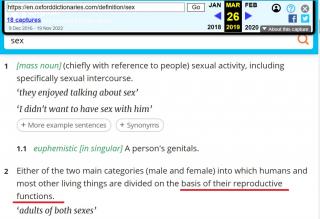
Those are STILL just proxies, a concept you seem to have some difficulty with. The issue is what it MEANS to be male and female, what is the "essence" of those categories. For reference see the Oxford definition for the parent category, i.e., "sex":


Babies don't HAVE any "reproductive function" -- AT ALL. Likewise with most intersex and transwomen who cut their nuts off.

The narrow definition on which you are insisting leads to absurd anomalies and is useless for all legal and social purposes and many if not most medical and biology disciplines, particularly for humans.

Not quite sure how many times I have to point out that Griffiths in particular emphasized that the biological definitions weren't designed for granting legal and social status, for adjudicating access to toilets and sports leagues.

And there ARE many quite solid reasons for those biological definitions.

Your extremist view that there can only be one definition and that it must apply for all purposes and and in all fields is patently absurd. It is also quite unhelpful in the social debate about sex, gender, and what it means to be a man and or a woman.

If you want to define man and woman as those humans with gonads of past, present, or future functionality then fine with me. But if you want to include "male" and "female" as defining criteria then you either accept the biological definitions and their consequences, or accept that what you're using is no better than folk-biology and that the sexes are just "social categories". But if you choose the latter then why can't Tickle and company do likewise?
 

Back
Top Bottom