Emily's Cat
Rarely prone to hissy-fits

That's the problem with those who look at the words of so-called experts and then cherry-picking some of those words that support their predetermined conclusions, while pretending the rest of what was said doesn't exist. It must be very annoying to have some stubborn "never going to back down" like me (or you for that matter) coming along and pointing out the inconvenient stuff.
Of course, the argument will be made that I cherry-picked some of Griffiths' words. However, the difference is that I don't regard Paul Griffiths as an authority on biology - he's a philosopher, not a scientist. Unlike actual scientists such as Dr. Emma Hilton, who operate on the basis of facts, observations, experimentation and evidence to reach their conclusions, philosophers rely on feelings and opinions to base their pontifications upon.
As a wiser man than me once said. "Science looks at what is. Philosophy looks at why it is".
Yep.
It's also a matter of looking at the entirety of someone's position, and incorporating context.
We could arguably say that a "leg" is an appendage attached to the hip bone that evolved to support locomotion on land. It covers the core principles of what a leg is. We might also note that human infants can't walk, and neither can paraplegics. But we understand that specific instances of the system not working as evolved doesn't materially change the nature of the system, nor does it change the evolutionary mechanism by which we ended up with legs. I think almost all of us recognize that the legs of an infant are still legs, even if that infant can't walk yet. And we recognize that the legs of a paraplegic are still legs. Heck, I think we'd all recognize that an amputee who has lost their legs completely still at one point had legs, and we can say that humans as a species have legs and still consider that to be a true and factual statement.

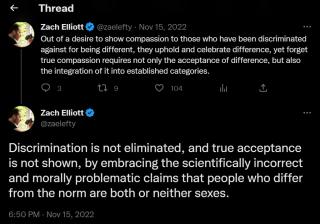
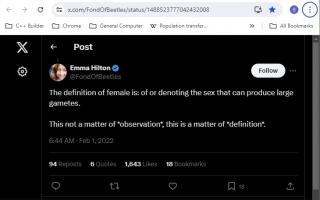


 You can't be a member of the sex that produces large gametes unless you're actually producing large gametes. The same way that you can't be a teenager unless you're between the ages of 13 & 19.