gabeygoat
Master Poster

my first thought too.
I like when "small government" people want martial law.

To quickly and easily lay this line of thinking to rest, the entire US population IS the "Militia".

Really? When was the last time you mustered? Do you have the required amount of ball and powder in storage? Who is your commanding officer?

And so we return to the question: Is a well-regulated Militia still necessary for the security of a free State?
And so we return to the question: Is a well-regulated Militia still necessary for the security of a free State?
The right exists independently of the need for a militia. That much, at least, is clear from the text of the amendment.
The real question is whether the lack of a need for the militia means the government can infringe on the right at will, without any further justification for doing so.
The truth is, you don't believe in the right, and your nonsense about militias is a red herring.
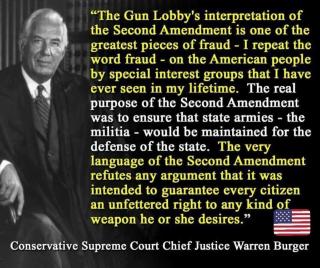

This article explains the original intent of the 2nd Amendment, who the militia were, what its purpose was, how it differs from the "well-regulated" militia, and who the militia is today.
Originally, the militia comprised all citizens who could be called up to be part of the well-regulated militia. Today, the well-regulated militia is termed the "organized militia," which comprises the National Guard and the Naval Militia. The purpose of the Second Amendment was to provide a pool of armed citizens who could be called up if ever it were necessary to form a well-regulated (organized) militia.

For a start, if the dictator has the loyalty of the military, they have a whole lot more resources - trillions of dollars - than you do. You would be forced into a run-and-gun insurgency while they hunt you down. How long could you, personally, maintain that, do you think?Yes, I think so. Our next president may well be a man who has shown he has no respect for democracy or the rule of law, and who would like to install himself as dictator for life. Under these circumstance, I can't rule out the possibility that an armed civil uprising could be necessary to restore democracy and the rule of law.
That is not clear from the text of the amendment, which actually implies the opposite. It is clear from District of Columbia vs. Heller (2008) which interpreted the amendment in that way.That was never the question. The text is clear: The right exists independently of the need for a militia. The question is, and in modern times always has been, whether the lack of a need for militia means the state can infringe on the right without any further justification.
This article explains the original intent of the 2nd Amendment, who the militia were, what its purpose was, how it differs from the "well-regulated" militia, and who the militia is today.
Originally, the militia comprised all citizens who could be called up to be part of the well-regulated militia. Today, the well-regulated militia is termed the "organized militia," which comprises the National Guard and the Naval Militia. The purpose of the Second Amendment was to provide a pool of armed citizens who could be called up if ever it were necessary to form a well-regulated (organized) militia.
A fundamental flaw in "unorganized militia" arguments is that although it comes from a law it has crap all to do with the intent of the founding fathers. The law in question is from 1916 and was intended to justify the draft in the lead up to the US entering the first world war.
Trying to use it to explain the second amendment is like trying to use a divorce to explain why marriage is a good thing. That law existed to push people into federal service and that does not work well with any idea about protecting states from the federal govrenment.
For a start, if the dictator has the loyalty of the military, they have a whole lot more resources - trillions of dollars - than you do. You would be forced into a run-and-gun insurgency while they hunt you down. How long could you, personally, maintain that, do you think?
Second, if the dictator doesn't have the loyalty of the military, then it's going to be the military that takes them down, not you.
Third, and this is a genuine question, when was the last time an armed civilian uprising restored democracy and the rule of law to a dictatorship, and everything afterwards ended up perfectly okay? I can't think of any, but I'm not well-versed in global geopolitics, so if you have any examples I'd welcome them.


Well, we still have state militias here, namely the so-called National Guard. They can be federalized, but in a civil war they'd have to pick sides.
The National Guard is part of the Military in the US.
MILITIA: HISTORICAL
(in the US) all able-bodied citizens eligible by law to be called on to provide military service supplementary to the regular armed forces.
As several links to the US Code in this thread have shown, the National Guard is the main component of the organized militia.
Key word* for the distinction. Though the National Guard members are clearly members of their specific Military Branch, hence the Military.
Supplemental to the military would be the Historic definition of Militia as defined above.

Key word* for the distinction. Though the National Guard members are clearly members of their specific Military Branch, hence the Military.
Supplemental to the military would be the Historic definition of Militia as defined above.

No. The Constitution refers to the "Militias of the several States." These are what are now known as the National Guard. At the time of the writing of the Constitution, the "Militia" consisted of these state Militias plus other citizens not serving in the Army or Navy.
Don't believe the Constitution? How about what the National Guard itself says: the National Guard itself says: "The militia, called the National Guard since 1916, has served community, state, and nation for nearly 400 years, and citizen-soldiers have fought in every major American conflict from 1637 to present day operations in Afghanistan and Iraq."
