As of right this instant, galaxies will be moving away at 70 km/s/Mpc in both dS and LCDM.
For an infinitesimal amount of time, they should be expanding at the exact same rate, if you want to go by that.
In the instant immediately preceding the present, so one infinitesimal of time before now, LCDM would have been expanding faster than dS.
In the instant immediately following the present, so one infinitesimal of time after now, LCDM will be expanding slower than dS.
LCDM's expansion rate will drop to about ~55 km/s/Mpc, while the dS model stays steady.
So the expansion rate is dropping, but drops less and less, always approaching but never reaching http://latex.codecogs.com/gif.latex?H_0 \sqrt{\Omega_\Lambda}.
LCDM's expansion rate will drop to about ~55 km/s/Mpc, while the dS model stays steady.
So the expansion rate is dropping, but drops less and less, always approaching but never reaching http://latex.codecogs.com/gif.latex?H_0 \sqrt{\Omega_\Lambda}.
As of right this instant, galaxies will be moving away at 70 km/s/Mpc in both dS and LCDM.
For an infinitesimal amount of time, they should be expanding at the exact same rate, if you want to go by that.
In the instant immediately preceding the present, so one infinitesimal of time before now, LCDM would have been expanding faster than dS.
In the instant immediately following the present, so one infinitesimal of time after now, LCDM will be expanding slower than dS.
LCDM's expansion rate will drop to about ~55 km/s/Mpc, while the dS model stays steady.
So the expansion rate is dropping, but drops less and less, always approaching but never reaching http://latex.codecogs.com/gif.latex?H_0 \sqrt{\Omega_\Lambda}.
Please explain to me, if you will, what makes the now so special that only at this moment in time and space both dS and LCDM have the exact same values?
Please explain to me, if you will, what makes the now so special that only at this moment in time and space both dS and LCDM have the exact same values?
In the FLRW model, H0 is Hubble's constant, which isn't constant. It represents the expansion rate as of right now. That's what the subscript 0 is telling us.
So if two models have the same H0, they will have the same expansion rate at t0, (or tnow if you prefer).
Just to be totally clear, the expansion rate was assumed to drop like a brick. It would hit zero and keep going. The sky would be blueshifted and we would be headed toward a big crunch.
We thought we would be measuring it's deceleration with the supernovae project. It turned out we measure an acceleration. Instead of free falling, something is propping it up. We call that something "dark energy".
So it's not really getting faster. It's getting slower at a slower rate. That's what they're calling the "accelerating universe."
Imagine the brick has a little rocket booster, which pushes back against gravity, in an increasing but limited way, so that the brick is never moving up, but eventually it comes to a stop and floats several feet above the ground.
Now, instead of gravity accelerating something toward the ground, think about expansion accelerating something toward the sky.
Gravity pulls back on it, so it causes deceleration in that direction.
Gravity weakens as the expansion happens, due to the density of matter become lower. So it's pull becomes weaker.
Plus you've got dark energy pushing up. So instead of gravity decelerating expansion, it's influence wanes and dark energy takes over and accelerates it.
The expansion rate is getting slower. It's first derivative is negative.
But the rate at which it is getting slower is not being sped up by gravity, but slowed down by dark energy.
The second derivative is positive.
It's not getting faster.
It's getting slower, but it's slowing down at a rate at which it is slowing down. At t=infinity it will stop slowing down.
And that's the so-called acceleration. The brick never moves up, but something has to be pushing up in order for it to float.
You're asking someone who says the universe isn't expanding whether the expansion he denies is accelerating.
The Hubble parameter H(t) = ((da/dt)(t))/(a(t)) is one way to quantify the universe's rate of expansion. The Hubble parameter appears within the Friedmann equations, which are mathematical consequences of the FLRW metric combined with the Einstein field equations. The Hubble parameter was therefore identified as an important parameter several years before Georges Lemaître and then Edwin Hubble interpreted red shifts as evidence for an expanding universe. With the discovery of the Lemaître-Hubble law, the Hubble parameter acquired the name by which we refer to it today.
The Hubble parameter H(t) is estimated to be approximately 70 km/s/Mpc at present, but the value of H(t) has been diminishing over time.
Mike Helland says the universe isn't expanding, which is to say Mike Helland believes H(t) = 0 now and in the past and forever in the future. Mike Helland has also been denying the sentence I just wrote, because he wants people to believe his dishonestly equivocal use of the H0 notation in his equations has something to do with mainstream cosmology's definition of H0.
a(t) is the scale factor that appears within the FLRW metric form. da/dt is another way to quantify the universe's rate of expansion. The value of da/dt is positive, which means the universe is expanding. Whether that measure of the expansion rate is accelerating or decelerating depends upon the value of the second derivative d2a/dt2. In the distant past, that second derivative was negative, which means the expansion rate given by da/dt was decelerating due to gravity. In the distant future, that second derivative is expected to be positive, which means the expansion rate given by da/dt will be accelerating due to dark energy.
Mike Helland says the universe isn't expanding, which is to say Mike Helland believes both da/dt and d2a/dt2 are zero. Mike Helland will probably deny the sentence I just wrote, because he wants people to take Helland physics seriously even though Helland physics is all about denying the fact that da/dt is nonzero.
The transition from negative d2a/dt2 (decelerating expansion) to positive d2a/dt2 (accelerating expansion) is a long slow process. That transition from a matter-dominated universe to a universe dominated by dark energy is ongoing. Whether the expansion of the universe is still decelerating or has begun to accelerate is an empirical question whose answer depends upon the same sort of empirical evidence that has been used to estimate that the current value of the Hubble parameter H(t) lies somewhere between 65 and 75 km/s/Mpc.
Different methods of estimating the current value of H(t) yield different estimates. Cosmologists refer to that fact as the Hubble tension.
Although all credible estimates of the Hubble parameter say its current value lies within the range of 65 to 75 km/s/Mpc, Mike Helland interprets that range of uncertainty as evidence that the true value of the Hubble parameter is H0 = 0. Yes, that is a stupid inference, but that stupid inference is the foundation of Helland physics.
I will say more about this in a day or two, when I have more time to draw pictures.
Although all credible estimates of the Hubble parameter say its current value lies within the range of 65 to 75 km/s/Mpc, Mike Helland interprets that range of uncertainty as evidence that the true value of the Hubble parameter is H0 = 0. Yes, that is a stupid inference, but that stupid inference is the foundation of Hubble physics.
Being able to reason and consider different solutions is not a weakness or flaw.
Mike Helland says the universe isn't expanding, which is to say Mike Helland believes H(t) = 0 now and in the past and forever in the future. Mike Helland has also been denying the sentence I just wrote, because he wants people to believe his dishonestly equivocal use of the H0 notation in his equations has something to do with mainstream cosmology's definition of H0.
Mike Helland says the universe isn't expanding, which is to say Mike Helland believes both da/dt and d2a/dt2 are zero. Mike Helland will probably deny the sentence I just wrote, because he wants people to take Helland physics seriously even though Helland physics is all about denying the fact that da/dt is nonzero.
Although all credible estimates of the Hubble parameter say its current value lies within the range of 65 to 75 km/s/Mpc, Mike Helland interprets that range of uncertainty as evidence that the true value of the Hubble parameter is H0 = 0. Yes, that is a stupid inference, but that stupid inference is the foundation of Helland physics.
That's such a childish interpretation. It's beneath you.
You can call "H" the Helland constant in my model if you wish. I seriously think that's unwarranted.
Edwin Hubble discovered a relationship between distance and redshift. He never fully bought into the whole recessional velocity thing. Even in modern mainstream cosmology, cosmic redshift is not technically thought of as recession velocity (ie, not relativistic Doppler effects).
He writes in 1937:
Now the red-shifts observed in nebular spectra behave as velocity-shifts behave - the fractional shift dw / w is constant throughout a given spectrum - and they are readily expressed as velocities of recession. The scale is so convenient that it is widely used, even by those cautious observers who prefer to speak of `apparent velocities' rather than actual motion. For instance, the law of red-shifts is frequently called the 'velocity-distance relation'.
By 1941 he was arguing against the expanding universe. Here's an article from Dec, 1941.
Not long after this he was working in a wind tunnel for the Army to help with WWII.
I'm sure you have the mentality that if Hubble lived long enough, he'd have accepted the expanded universe. Maybe. I guess that's not really the point.
Contrary to what you say, I don't question the expanding universe because of the Hubble tension. The Hubble tension developed after I started questioning it. So did the Planck confirmation of CMB anomalies (which was the first I had heard about them). So did a clear view of an "early" universe that looks a lot more like the local universe than anyone expected.
A reasonable person would wonder if our theory about the universe's beginning actually relates to reality. And many are.
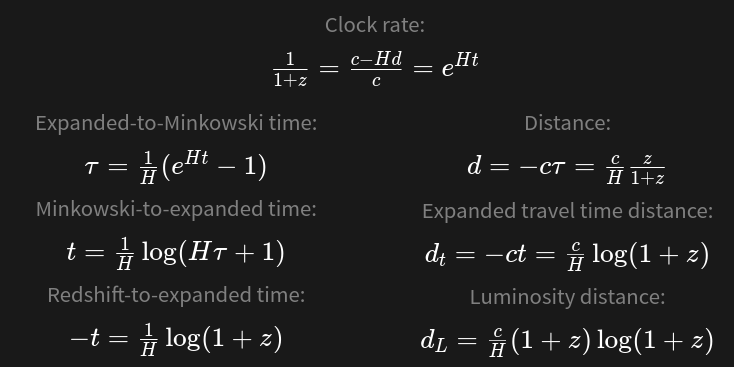
In the dS model, the current distance to a galaxy is given by:
http://latex.codecogs.com/gif.latex?d = z \frac{c}{H_0}
That's not an approximation in this model, that's how it works out.
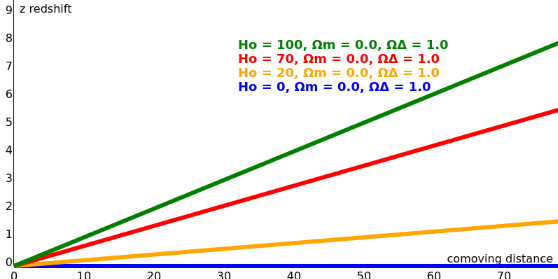
If you plot this as redshift over distance you get this:
Here I'm showing multiple values for H0. Imagine a galaxy at each marker on the x-axis, 10 Gly, 20 Gly, etc. Look up, and you'll see it's redshift.
When H0 is zero, there is no redshift. The higher the expansion rate (H0), the higher the line, and the higher the redshift.
In this view, a steeper line means more expansion. These lines have constant slopes, so each line has the same steepness at all times. Their derivatives are flat lines (at c/H0) and their second derivatives equal 0.
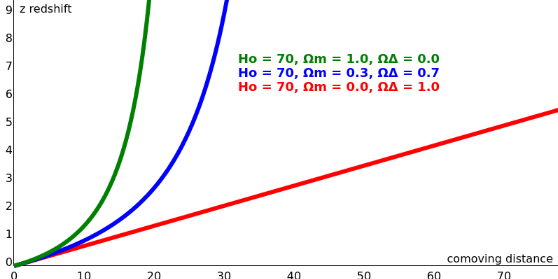
Let's compare a dS H0 = 70 (red) with LCDM H0 =70 (blue), and also a "matter only" FLRW H0 = 70 (green).
This tells us the expansion rate was higher in the past for the green and blue models.
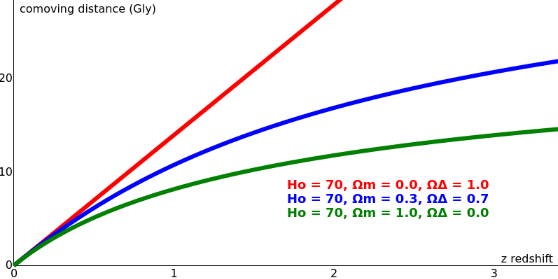
It's more convenient though to flip it over, so we're looking at distance over redshift.
This just means that the "flatter" the line is, the faster expansion is happening. You don't need as much distance (up) to get the same redshift (right). Like before, but opposite.
The graph is the present at z=0 on the left, and it goes farther into the past as you go z>0 to the right.
So green and blue are flatter as you go right, which means they were expanding faster.
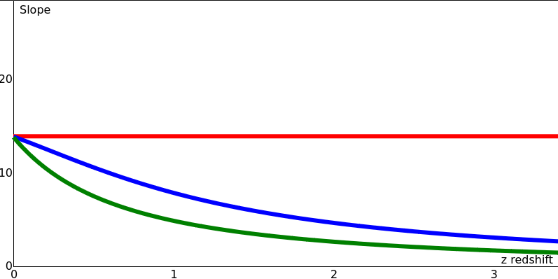
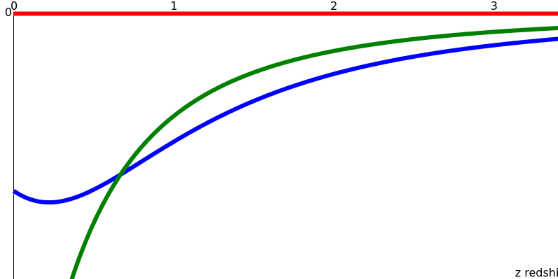
If you find the slope of each line you get this:
You see the red line, dS, is flat at 13.9, which is c/H0.
The green and blue lines are not though. Let's take another derivative.
The red line goes to d2z=0 as expected.
The blue line is doing something interesting there though. That's LCDM. That's the point where dark energy took over from gravity as the main influence on the expansion rate.
In the future, so going left, it should approach the red line asymptotically.
Given that the universe is expected to be around at least for a few more trillion years, it's actually a remarkable coincidence this meeting of matter and dark energy densities just happened relatively recently. And we're living when 1/H0 is approximately the age the universe. That's a strange, perhaps anti-Copernican position in which to find ourselves.
If you compare it to itself, no. It's getting slower.
If you compare it to a matter only model, which was what we assumed was happening prior to 1998, it's not slowing down nearly as fast as expected. And at t=infinity, it won't be getting slower at all.
Sean Carroll's website is "preposterousuniverse.com". That describes the mentality at the time. The (derivative of the*) expansion rate isn't dropping like the green line that last image. It's made an upward turn. When they talk about the "accelerating" universe, it's most descriptive when contrasted to the late 20th century models.
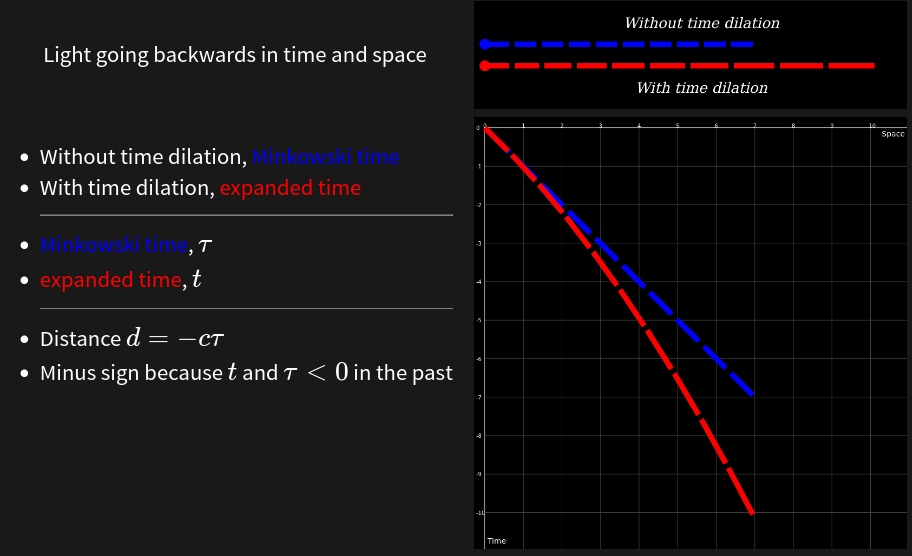
You just add a little time dilation, which is observed, to each step, and you get a light cone identical to a de Sitter universe.
The distance equation is the same as a de Sitter universe, which is not the same as other static models.
This creates an observable sphere centered on an observer with a radius of c/H.
Let's split the sphere into 10 equal volumes. So, the first volume is a sphere. The next volume is a larger sphere with the same center minus the volume of the first sphere, etc. So layers. Like an ogre.
So just find those radii, convert to redshift, and I get this:
Each volume is equal, so therefore, should contain the same amount of galaxies.
My model predicts, uniquely I think, that there will be the same amount of galaxies in these ranges:
Code:
0.00 < z < 0.87
0.87 < z < 1.41
1.41 < z < 2.03
...
12.95 < z < 27.98
27.98 < z < infinity
decelerating and accelerating expansion of the universe
A couple of days ago, I said I'd say more about whether the universe's expansion is accelerating after I had time to draw some pictures.
Those pictures show how the Hubble parameter H(t) and the scale factor a(t) change over time in five different FLRW models.
[size=+2]Parameters[/size]
[size=+1]Scale factor[/size]
The scale factor a(t) appears within the FLRW metric form, and models the universe's expansion over time. In four of the five FLRW models considered below, a(t0) = 1 at the present time t0.
The universe in which we live contains a significant density of matter, so our universe does not resemble a de Sitter model at this time. As our universe continues to expand, however, its matter density will decrease. As its matter density approaches zero, our universe will come to resemble a de Sitter model. To obtain a de Sitter model that approximates our universe in the far future, its scale factor a(t0) must have a value other than 1 at the present time.
Mike Helland has been talking about de Sitter models that assume a(t0) = 1. That is one of the two most significant mistakes I've noticed in his recent discussions of de Sitter models.
[size=+1]Hubble parameter[/size]
The first Friedmann equation, which is a mathematical consequence of the FLRW metric and the basic field equations of general relativity, states a relationship that involves the Hubble parameter H(t) defined by H = ȧ/a. From that definition, we get the differential equation
da/dt = H a
The graphs shown below were obtained by solving that differential equation for each of the five FLRW models considered here.
The Hubble constant H0 is defined as the value of the Hubble parameter at the present time, which is to say H0 = H(t0). Current estimates of H0 place its value somewhere between 65 and 75 km/s/Mpc. In four of the five FLRW models considered below, I will assume H0 = 70 km/s/Mpc.
To obtain a de Sitter model that approximates our universe in the far future, its Hubble parameter at the present time must differ from the value of H0 in our universe.
Mike Helland has been talking about de Sitter models whose Hubble parameter coincides with the value of H0 in our universe. That is the other significant mistake I've noticed in his recent discussions of de Sitter models.
Please explain to me, if you will, what makes the now so special that only at this moment in time and space both dS and LCDM have the exact same values?
All five of the FLRW models considered here assume flat space, and assume the present-day density parameters are zero except for ΩM and ΩΛ. WIth those assumptions, ΩΛ = 1 − ΩM.
[size=+2]Five FLRW models[/size]
[size=+1]Einstein-de Sitter model[/size]
In Einstein-de Sitter models, ΩM = 1 and ΩΛ = 0. With those density parameters, the universe will continue to expand forever, but its Hubble parameter H(t) will converge toward zero.
Einstein-de Sitter models were popular from the late 1960s through the 1980s, when it was fashionable to assume the cosmological constant Λ is zero.
The particular Einstein-de Sitter model considered here assumes a(t0) = 1 and H(t0) = 70 km/s/Mpc.
[size=+1]FLRW with ΩM = 0.5 and ΩΛ = 0.5[/size]
During the 1990s, it became clear that ΩM < 1. For a while, it seemed as though ΩM = 0.5 might be a reasonable estimate for the matter density.
To show the consequences of a model that lies in between Einstein-de Sitter and the current consensus model (described next), this model assumes ΩM = 0.5, ΩΛ = 0.5, a(t0) = 1, and H(t0) = 70 km/s/Mpc.
[size=+1]FLRW with ΩM = 0.3 and ΩΛ = 0.7[/size]
Mainstream cosmologists currently believe the universe in which we live is approximated by an FLRW model with ΩM = 0.3, ΩΛ = 0.7, a(t0) = 1, and H(t0) = 70 km/s/Mpc. Uncertainties surrounding the value of H0 lead to uncertainty in the values of the density parameters, so I have rounded all of those parameters to a single significant digit.
[size=+1]de Sitter A (A is for "asymptotic")[/size]
In de Sitter models, ΩM = 0.0, ΩΛ = 1.0, and the Hubble parameter is a constant.
The realistic FLRW model with ΩM = 0.3, ΩΛ = 0.7, and H0 = 70 km/s/Mpc eventually converges toward a de Sitter model whose Hubble parameter is about 58.5662 km/s/Mpc. Using that value of the Hubble parameter as a boundary condition, I calculated that this model's scale factor at the present time needs to be about 1.06428.
[size=+1]de Sitter B (B is for "bad")[/size]
If we were too lazy to calculate the parameters of a de Sitter model to which our universe appears to be converging, we might instead assume a de Sitter model whose Hubble parameter is 70 km/s/Mpc and whose scale factor is 1 at the present time.
I do not know of any good reason to discuss the model I refer to as de Sitter B.
The only reason I am discussing the de Sitter B model is that Mike Helland has been talking about it. It is possible that the graphs shown below will help some readers to understand why the de Sitter B model has almost nothing to do with the universe in which we live.
[size=+2]Pictures[/size]
[size=+1]Hubble parameter[/size]
In this graph, the black curve represents the Hubble parameter in a realistic model of our universe. As can be seen, it converges to the Hubble parameter of the de Sitter A model.
The blue/green curve shows a Hubble parameter that's converging to a value less than 50 km/s/MPc. If two FLRW models for a flat universe have the same parameters except for their matter density, then the one with a higher density of matter will converge to a lower Hubble parameter.
The Einstein-de Sitter model's Hubble parameter converges toward zero, but that happens so slowly that you can't really see it in this graph.
[size=+1]Deceleration and acceleration of the scale factor[/size]
All five curves of this graph depict an expanding universe.
The three models that contain matter start with a Big Bang. Models with a greater matter density represent younger universes. This graph shows why the estimated age of our universe has increased as our estimates of its matter density have decreased from ΩM = 1 to ΩM = 0.3.
Although the Einstein-de Sitter universe expands forever, its expansion is also decelerating forever. To say that more precisely: The first derivative of its scale factor is positive at all times, but the second derivative of its scale factor is negative at all times.
In both of the de Sitter models, the universe is expanding at an exponential rate. In those models, the rate of expansion is accelerating.
In FLRW models that contain both matter and dark energy, the universe expands rapidly just after the Big Bang, but that rate of expansion is decelerating at first due to gravity. As the second derivative of the scale factor slowly transitions from negative to near zero, the expansion rate approaches a straight line. As the matter density drops due to expansion, the gravitational effect is overcome by dark energy, and the rate of expansion begins to accelerate. In the far future, the rate of expansion accelerates toward the exponential rate of a de Sitter model.
At the lower left of the graph, you see five different curves corresponding to the five FLRW models. At the upper right of the graph, the scale factor of the realistic model is so close to the scale factor of the de Sitter A model that their curves essentially coincide.
To give a better look at that convergence, the following graph zooms in on a part of the graph in which the realistic model is converging toward the de Sitter A model.
The realistic model does not converge to the de Sitter B model.
In the following quotation, Mike Helland's red line corresponds to the de Sitter B model. That means the claim I highlighted is false.
The blue line is doing something interesting there though. That's LCDM. That's the point where dark energy took over from gravity as the main influence on the expansion rate.
In the future, so going left, it should approach the red line asymptotically
.
Mike Helland is right about my obvious stupidity. He made the claim I highlighted about a certain second derivative, which is indeed zero.
I misunderstood his claim. I thought he was talking about the first derivative.
The fact remains that Mike Helland's de SItter B model is not an asymptotic approximation to any realistic model of the universe in which we live. To make it sound as though it were an asymptotic approximation, he had to do all of the following:
Start with a graph of present-day comoving distance as a function of non-negative redshift. (That graph is all about the past and present. Because that graph says nothing about the future, it says nothing about the asymptotic behavior of any universe or model.)
Take the first derivative of that distance r with respect to z, not with respect to time. (The relationship between z and time is non-linear, so the relationship between r(z) and the scale factor a(t) is far from simple or intuitive. Because Mike Helland's graph of dr/dz says nothing about the future, it says nothing about the asymptotic behavior of the scale factor a(t) or da/dt.)
Take the second derivative of r with respect to z. (The relationship between d2r/dz2 and d2a/dt2 is even less intuitive than the relationship between dr/dz and da/dt. Because none of Mike Helland's graphs say anything about the future, they say nothing about the asymptotic behavior of the scale factor a(t) or da/dt or d2a/dt2.)
I suspect Mike Helland was trying to state the fact stated in the next item of this list when he wrote "The red line goes to d2z=0 as expected." (If I had any basic knowledge of calculus, I'd wonder why someone who knows calculus would write that instead of saying "For the red line, d2r/dz2=0.")
For any de Sitter model, the second derivative d2r/dz2 is zero. (If I had any basic knowledge of calculus and had also taken the time to understand exactly what Mike Helland was trying to say, I'd have known that.)
Because d2r/dz2 is zero for all de Sitter models, a graph of d2r/dz2 cannot possibly distinguish between (A) de Sitter models that accurately model the asymptotic future of our universe and (B) de Sitter models that fail to model the asymptotic future of our universe.
To get the word "asymptotic" into the conversation, Mike Helland wrote the claim I falsely accused of being false: "In the future, so going left, it should approach the red line asymptotically." ("In the future, so going left" was a reminder that none of Mike Helland's graphs actually say anything about the future, so none of Mike Helland's graphs provided any support for the true claim I falsely accused of being false.)
As stated, Mike Helland's claim was true because the asymptotic behavior of our universe is indeed expected to converge toward a de Sitter model.
Mike Helland's claim was highly misleading, however, because the asymptotic behavior of our universe is not expected to converge toward the particular de Sitter B model shown in his graphs.
This site uses cookies to help personalise content, tailor your experience and to keep you logged in if you register.
By continuing to use this site, you are consenting to our use of cookies.