Dear Users… (A thread for Sysadmin, Technical Support, and Help Desk people) Part 10

Status
Not open for further replies.
Sure. That's very much not the usual situation, though. The vast majority of clients of Microsoft's cloud solutions are not like that.

This particular outage occurred just as I was finishing my last day before a 4-day weekend, so I never found out how long it lasted. I'd be pretty surprised if it was more than an hour. During a non-peak time when almost nobody was using it. That amount of sloppiness is more than acceptable when as I say the downtime is exceptionally rare compared to the old system.
I do understand. I have worked and contracted to businesses where even a couple of hours outage was inconvenient but acceptable.

Our situation is we have a government mandate that we MUST move all our operations to cloud-based in order to "save money". Not even counting the serious issues of having our now-cloud-based patient scheduling systems offline, affecting patient admissions, discharges, movements, consults, surgeries, etc., it simply is not cheaper than when we did it in-house. Seriously not, and we knew that going in because we can count.

The conservative bean-counters in the state government office block are trying to treat hospitals like they were Amazon warehouses - shifting a patient hither and yon is exactly the same as shifting a carton about, in their eyes. No it ain't, especially if it involves sick children, which our hospital does. They don't seem to see that even a short system outage means days of rescheduling problems, delayed procedures and postponed surgeries. Great for the best treatment for sick kids! :mad: Our old in-house systems were not only cheaper, although they were getting clanky they did not stop working 24x7x365.

Sorry to harp on this, but it is a real bugbear here just now. We don't have a problem with cloud for non-clinical purposes. But when it comes to patient care, it isn't reliable enough yet.
 
Last edited:
OMG. I really don't miss the ridiculous numbers of people, including 'IT People' and 'IT HELPDESK people' who couldn't work out how to cut and paste on a computer.

Same deal, instead of sending me the text of an error message, they'd send me a screenshot of the first few lines of an error message.

Seriously people!

Click on the text of the error, Ctrl-A, Ctrl-C, Ctrl-V into the email you're going to send, or into a text file.

That key combination was probably invented in the 1950's!!!
 
OneNote used to be installed on PCs at <Big bank> and way back then it had a pretty decent OCR function if you pasted a screenshot into it. With each new version though almost every part of OneNote seemed to get worse.
 
OMG. I really don't miss the ridiculous numbers of people, including 'IT People' and 'IT HELPDESK people' who couldn't work out how to cut and paste on a computer.

Same deal, instead of sending me the text of an error message, they'd send me a screenshot of the first few lines of an error message.

Seriously people!

Click on the text of the error, Ctrl-A, Ctrl-C, Ctrl-V into the email you're going to send, or into a text file.

That key combination was probably invented in the 1950's!!!


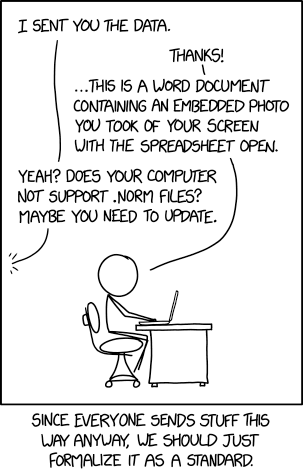
One level worse, a screen shot pasted into a Word document. So now you have to open Word, and then hope that the image has enough resolution so that when you export it from Word that you can actually read the text in the screenshot.
 
ob xkcd.

norm_normal_file_format.png
 
ob xkcd.

[qimg]https://imgs.xkcd.com/comics/norm_normal_file_format.png[/qimg]

Exactly! (Very late acknowledgment of the issue by Randall Munroe, though. :D That's from 2019, and I retired in 2018, and had been having the problem years before that.)
 
I do understand. I have worked and contracted to businesses where even a couple of hours outage was inconvenient but acceptable.

Our situation is we have a government mandate that we MUST move all our operations to cloud-based in order to "save money". Not even counting the serious issues of having our now-cloud-based patient scheduling systems offline, affecting patient admissions, discharges, movements, consults, surgeries, etc., it simply is not cheaper than when we did it in-house. Seriously not, and we knew that going in because we can count.
The conservative bean-counters in the state government office block are trying to treat hospitals like they were Amazon warehouses - shifting a patient hither and yon is exactly the same as shifting a carton about, in their eyes. No it ain't, especially if it involves sick children, which our hospital does. They don't seem to see that even a short system outage means days of rescheduling problems, delayed procedures and postponed surgeries. Great for the best treatment for sick kids! :mad: Our old in-house systems were not only cheaper, although they were getting clanky they did not stop working 24x7x365.

Sorry to harp on this, but it is a real bugbear here just now. We don't have a problem with cloud for non-clinical purposes. But when it comes to patient care, it isn't reliable enough yet.

Modern accountancy for you.
 
I read a worked example of how one guy was swapping back from AWS to his own servers but I can't find it yet (retweeted by a guy I follow who tweets a lot) but maybe I'll find it. This was a recent post (so recent AWS experience, it changed a lot in the time I used it) and who'd been carefully monitoring usage, costs etc and just couldn't keep it cheap. Priced some Dell servers with redundancy etc and it was significantly cheaper.
I've read a few articles where people worked out that AWS is great value on the small scale as you can (as we did) fire up and stop servers easily to meet demand. But as you scale up the prices get steeper.
 
"cheaper" is not actually a term many financial departments like outside a few irrelevances - like going to 60gsm paper rather than 80gsm paper to save 50p per ream, ignoring all the times documents had to be re-printed because the cheaper paper jammed print heads and paper feeds, couldn't use it for duplex printing and it was blamed for one laser printer setting on fire. Sorry got carried away about a real case I know about.

But seriously too many execs like being able to move IT to a "service" charge, that means they don't have balance sheets with all this horrible hardware that they have to write off from time to time, they don't need the employees to run it - headcount is toxic, don't need the premises.

Yes in any rational system a true cost comparison would be carried out, but that would involve execs being bothered about the state of the company in 10 years' time....
 
"cheaper" is not actually a term many financial departments like outside a few irrelevances - like going to 60gsm paper rather than 80gsm paper to save 50p per ream, ignoring all the times documents had to be re-printed because the cheaper paper jammed print heads and paper feeds, couldn't use it for duplex printing and it was blamed for one laser printer setting on fire. Sorry got carried away about a real case I know about.

But seriously too many execs like being able to move IT to a "service" charge, that means they don't have balance sheets with all this horrible hardware that they have to write off from time to time, they don't need the employees to run it - headcount is toxic, don't need the premises.

Yes in any rational system a true cost comparison would be carried out, but that would involve execs being bothered about the state of the company in 10 years' time....

This is developing into a derail, but a potential solution is to lease the equipment on-site. The leasing company "owns" the kit and does all the upgrades, etc., but it lives on your premises. So you get the benefits of on-prem kit with the benefit of being "service charged" for it. That the total outlay over the equipment lifetime is way higher than making it a capital purchase is neither here nor there. The money comes from "a different bucket" ;)
 
This is developing into a derail, but a potential solution is to lease the equipment on-site. The leasing company "owns" the kit and does all the upgrades, etc., but it lives on your premises. So you get the benefits of on-prem kit with the benefit of being "service charged" for it. That the total outlay over the equipment lifetime is way higher than making it a capital purchase is neither here nor there. The money comes from "a different bucket" ;)

This was clamped down on a number of years ago in the UK. If you're effectively taking out a finance lease so you own all the risks / costs of the equipment, you have to account for it as if you own it.

It's been a while since I last worked in that sector, so the details may be off slightly, but it's something like that.
 
Status
Not open for further replies.

Back
Top Bottom