Efficacy of Vaccination.

Thor 2

Philosopher
Joined
May 25, 2016
Messages
7,174
Location
Tiny town west of Brisbane.
As a person of limited medical science knowledge I am puzzled by what I read about the different vaccines and their efficacy.

What I read about the covid vaccines suggests to me, that they do not stop the vaccinated from being infected, but stop or lessen the severity of the effects of the disease. This is contrary to my previous understanding of how vaccines work.

I was always given to understand, that if vaccinated and exposed to a virus, your antibodies would slaughter the nasty germs, and you would be rid of them. If the effect is just to lessen the severity of the virus effect, then do you still have those germs in you, so that you can pass them on to some other dude?

The above seems contrary to the notion that we can achieve herd immunity and the effectiveness of vaccination to achieve this.
 
Couple of things:
the body deals with infections all the time, but if the immune system can react quickly, it never becomes an issue.
Whether it can do that depends on your health, your earlier immune response to the vaccine and the degree of mutation of the pathogen: if only half the antibodies recognize the antigen, then the immune response will be weaker.
However, even a weaker response will make it harder for a virus to multiply in numbers that would allow for further transmission. Remember, all that's needed is to push the average number of transmissions per infected person's below 1, not to 0, to stop the spread.
Vaccination, even with reduced efficacy, drastically increases protection for the population.
 
Last edited:
Vaccines improve you immune response, details vary by disease and vaccine. An improved immune response can mean that exposure doesn't lead to infection, or, if that fails, that infections doesn't spread as far in your body, or doesn't grow to as great a load as it might have been, or doesn't persist as long.
 
As a person of limited medical science knowledge I am puzzled by what I read about the different vaccines and their efficacy.

What I read about the covid vaccines suggests to me, that they do not stop the vaccinated from being infected, but stop or lessen the severity of the effects of the disease. This is contrary to my previous understanding of how vaccines work.

I was always given to understand, that if vaccinated and exposed to a virus, your antibodies would slaughter the nasty germs, and you would be rid of them. If the effect is just to lessen the severity of the virus effect, then do you still have those germs in you, so that you can pass them on to some other dude?

The above seems contrary to the notion that we can achieve herd immunity and the effectiveness of vaccination to achieve this.

It is complicated. The immune system is complicated and vaccines differ.

On a simplistic level the immune system polices what happens inside the body, so it cannot have an effect until the germ (virus) is inside of the body - you are infected. Most vaccines do not stop infection but they enable the body to rapidly terminate the infection before you become ill and before you enter into a state when you can infect others. Good examples of this would be smallpox vaccine or injected polio vaccine, or measles vaccine.

However, there is something called mucosal immunity. This is immunity at the level of the layer between you and the outside of the body in the gut and airways. A specific type of immunity occurs here, mediated by immunoglobulin A. Immunity at this point can stop infection getting into your body so preventing infection. A good example of this is oral polio vaccine. A nasal flu vaccine exists which produces mucosal immunity but it really only works reliably in children. By enhancing specific mucosal immunity the virus can be stopped at the barrier between inside and outside of the body so technically no infection occurs.

Rabies vaccine is unusual in that you can give it post infection, and because the infection spreads relatively slowly up nerves from the site of infection to the brain, you can produce an effective immunity before the virus gets to the brain and kills you. (Because the virus hides inside nerves it does not provoke a natural immune response).

A bad vaccine is BCG vaccine for TB. It enhances the immune response to TB this is good in preventing disseminated TB in the body. It is not good in preventing TB in the lungs, infectious TB. So BCG is best at preventing TB meningitis in children (highly fatal) but poor at preventing infectious pulmonary TB, it may even increase the risk, it appears to limit TB to the lungs, so may increase the risk of developing infectious TB. It is very good at preventing leprosy!

So covid vaccines are disease modifying. They probably do not provoke good mucosal immunity so do not prevent infection. They do reduce the severity of the illness, reduce the virus production in your body so reduce the likelihood of you infecting anyone else. The vaccines are near 100% effective at preventing death, but only reduce infections by 60%, and probably reduce transmissibility if infected by half. Nearly but not quite enough to prevent the virus from continuing to circulate in a fully vaccinated community.

trials of nasal vaccines which should provoke mucosal immunity and be more effective at reducing transmissibility are under way, but generating good mucosal immunity is difficult and best done with live attenuated virus. The adenovirus vector vaccines may be able to do this, if given orally / nasally.

 
As a person of limited medical science knowledge I am puzzled by what I read about the different vaccines and their efficacy.

What I read about the covid vaccines suggests to me, that they do not stop the vaccinated from being infected, but stop or lessen the severity of the effects of the disease. This is contrary to my previous understanding of how vaccines work.

It depends on the vaccine... but it's the same as if you catch a virus and then catch the same virus again. Normally, the second time around, especially if the virus has not mutated, the immune system will know how to deal with it. You'll still get the infection, but your body reacts quicker and more efficiently. So yes, your antibodies slaughter the nasty germ, but they still have to mobilise, and be advised of the infection first. This also means that you're less likely to pass it on to someone else.

As for getting as many people as possible immunised, this is so that the infection is prevented or lessened enough in as many people as you can so as to avoid mutations that may be resistant to these immune measures, and eventually wipe out the specific virus. That's what happened with Variola.
 
Last edited:
Many thanks for the info in the above posts.

Just reading the ABC news regarding the lifting of restrictions about to happen in the UK, and what has happened in The Netherlands when this was done. I lifted this from the article:

In mid-June, COVID-19 infections in the Netherlands had dropped to their lowest levels in nine months, 13 million vaccinations had been administered to the population of 17.5 million people, and bars and restaurants were open.


And yet in the last 24 hours the number of new infections has jumped by over 11,000. Herd immunity?
 
You know, if you have a better idea then vaccination tell us about it.
in the real world, you have to use the best tool you have available, not sit around waiting for a perfect tool that might never come.
 
And yet in the last 24 hours the number of new infections has jumped by over 11,000. Herd immunity?
There are several reasons for this:-

1. Being vaccinated doesn't guarantee you won't 'catch' the virus. But you will probably be asymptomatic or have milder symptoms.

2. Vaccinated people can still spread the virus.

3. Unvaccinated people are still vulnerable.

4. 'Herd immunity' only makes it harder for the virus to propagate. It doesn't 'eliminate' it until/unless there are not enough vulnerable hosts to infect.

The percentage of fully vaccinated people in the Netherlands has leveled off at 43%. That means the virus still has plenty of opportunity to propagate. The new Delta variant is much more virulent than previous ones, so it can still achieve R0 > 1 even with nearly half the population vaccinated, especially since now half of them think they are bulletproof.
 
The simple version is that vaccines don't prevent infection they prevent disease. While often these used interchangeably they probably shouldn't be.
 
You know, if you have a better idea then vaccination tell us about it.
in the real world, you have to use the best tool you have available, not sit around waiting for a perfect tool that might never come.


Steady on there dudalb, I'm not suggesting that vaccination is not a good idea.

From the constructive input from some others here, and other reading I have done, I can see that some vaccinations are more effective than others. It would seem the efficacy of the Codiv vaccines, to stop folk from getting sick, is quite good but the efficacy in stopping the spread not quite so. The experience in The Netherlands seems to suggest this.

I would assume, given the above, that those who are not vaccinated, are foolish to think they are protected by herd immunity.
 
The simple version is that vaccines don't prevent infection they prevent disease. While often these used interchangeably they probably shouldn't be.
The use of the word efficacy implied that vaccines prevented infection, and it did so at a very high rate! The virus is mutating. Vaccines are becoming less effective at preventing infection. To encourage people that they should get vaccinated, the focus has shifted to preventing disease.
 
The use of the word efficacy implied that vaccines prevented infection, and it did so at a very high rate! The virus is mutating. Vaccines are becoming less effective at preventing infection. To encourage people that they should get vaccinated, the focus has shifted to preventing disease.

There are almost no vaccines that prevent infection. The point of vaccines in general is to prevent disease.

The two mRNA vaccines are actually remarkably effective compared to most other vaccines out there.

Yes, SARS-CoV-2 is acquiring adaptations to help it avoid immune response. Most viruses do. This is why the flue vaccine changes every year,
 
The use of the word efficacy implied that vaccines prevented infection, and it did so at a very high rate! The virus is mutating. Vaccines are becoming less effective at preventing infection. To encourage people that they should get vaccinated, the focus has shifted to preventing disease.

No you inferred it.

Those with some technical knowledge of the issue and familiar with the technical meaning of e.g. efficacy in this situation never would have understood or meant that efficacy equalled vaccines preventing infection. This is why there was a great deal of discussion about whether vaccines would reduce transmission and if so how much. Would we just produce many asymptomatic 'carriers' rather than symptomatic infections. That is why when vaccine efficacy was talked about it was in terms of; 'efficacy at preventing death' (near 100%), 'efficacy at preventing serious illness' (hospitalisation and death) about 90%, 'efficacy at preventing infection' (including asymptomatic infection measured by serial e.g. weekly nasal swabbing or development of anti-viral antibodies that differ from vaccine antibodies) about 60%.

Separately from the efficacy trials in vaccinated people vs controls there were studies of transmission from (naturally) infected vaccinated persons to household members. This suggested that transmission was reduced to 30% as compared with non vaccinated. That is to say if vaccinated you have a roughly 40% chance of getting infected as compared with unvaccinated neighbour and 30% chance of transmitting to your household, so in this very narrow scenario you have reduced risk to your household as compared with your neighbour's household to about 12% (40 x 30%).
 
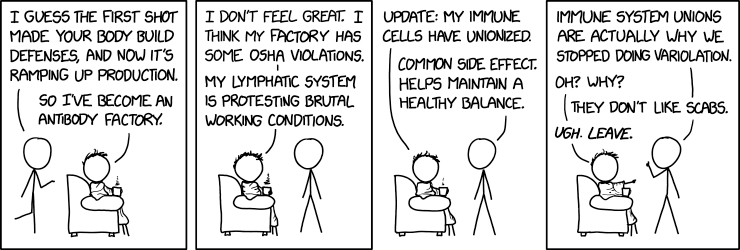
Slightly OT but.....
immune_factory.png
 
This thread is about the mechanisms by which vaccination works, in general. It is not about specifics regarding Covid-19, there are several other more appropriate threads for that. Nor is it for conspiracy theories about Covid-19, which belong in the thread in Conspiracy Theories.

Several posts have been moved to AAH since they were off topic for this thread.
Replying to this modbox in thread will be off topic  Posted By: zooterkin
 
vaccine against HPV

"Vaccines have other advantages over natural infections. For one, they can be designed to focus the immune system against specific antigens that elicit better responses.

"For instance, the human papillomavirus (HPV) vaccine elicits a stronger immune response than infection by the virus itself. One reason for this is that the vaccine contains high concentrations of a viral coat protein, more than what would occur in a natural infection. This triggers strongly neutralising antibodies, making the vaccine very effective at preventing infection." The Conversation.
 
The holy grail of vaccines is so-called "sterilizing immunity" which is caused by "neutralizing antibodies".

When virions invade your body, the only become dangerous when they actually enter your cells and start using the cell machinery to multiply themselves. A neutralizing antibody is an antibody which manages to incapacitate virions before they enter a cell and can start multiplying. Anything less than a neutralizing antibody will enable the virus to infect you, and, theoretically, that you transmit virus to another person.

However, sterilizing immunity is very rare. For instance, the Salk polio vaccine, IPV, does not confer it either: you can get infected in your intestinal mucosa, and transmit polio virus through your feces, though this is very rare. And this example shows that sterilizing immunity is not needed to eradicate disease: the whole First World uses IPV, yet there are no instances of polio. Rota vaccine is another example:
https://www.gavi.org/vaccineswork/c...prevent-infection-heres-why-thats-not-problem
 
The holy grail of vaccines is so-called "sterilizing immunity" which is caused by "neutralizing antibodies".

When virions invade your body, the only become dangerous when they actually enter your cells and start using the cell machinery to multiply themselves. A neutralizing antibody is an antibody which manages to incapacitate virions before they enter a cell and can start multiplying. Anything less than a neutralizing antibody will enable the virus to infect you, and, theoretically, that you transmit virus to another person.

However, sterilizing immunity is very rare. For instance, the Salk polio vaccine, IPV, does not confer it either: you can get infected in your intestinal mucosa, and transmit polio virus through your feces, though this is very rare. And this example shows that sterilizing immunity is not needed to eradicate disease: the whole First World uses IPV, yet there are no instances of polio. Rota vaccine is another example:
https://www.gavi.org/vaccineswork/c...prevent-infection-heres-why-thats-not-problem

Whoah! Holy nostalgia, Batman! Welcome back to the forum ddt!
 

Back
Top Bottom