I don't think space is expanding.

Status
Not open for further replies.
Mike Helland said:
"How fast does the little arrow rotate? As fast as the photon’s wavelength—that’s what a photon’s wavelength is. The wavelength of yellow light is ~570 nanometers: If yellow light travels an extra 570 nanometers, its little arrow will turn all the way around and end up back where it started."

https://www.greaterwrong.com/posts/o.../feynman-paths

If that's the case, the decelerating photons lose frequency and speed, but not wavelength.

So... wouldn't the photons act the same (in a vacuum) regardless of speed?
Not logically possible. If the light speed changes, then the wavelength must change. The frequency cannot change, as the same number of cycles must arrive per second as started out. As Zig keeps telling you, you can't throw cycles away.
 
Not logically possible. If the light speed changes, then the wavelength must change. The frequency cannot change, as the same number of cycles must arrive per second as started out. As Zig keeps telling you, you can't throw cycles away.

Ok.

But let's not move on so quick.

It's true then, under QED, if the frequency and speed dropped but the wavelength stayed the same, it wouldn't affect the reflection angle.
 
Ok.

But let's not move on so quick.

It's true then, under QED, if the frequency and speed dropped but the wavelength stayed the same, it wouldn't affect the reflection angle.
It's a meaningless question. The postulates are unphysical.
 
It's a meaningless question. The postulates are unphysical.

Yet, that is the hypothesis. The photon loses frequency (observed) and speed (conjectured). Wavelength stays the same. A new photon can be emitted with the same frequency/energy, and it'll have a longer wavelength and speed of c.

If we apply this photon hypothesis to classical theories of light, you all agree it's falsified.

But if we apply QED, which is the appropriate framework for a photon anyway, it's somehow meaningless now.

Do you see why I would be skeptical of that?
 
Yet, that is the hypothesis.
Yes - it's unphysical.
The photon loses frequency (observed) and speed (conjectured). Wavelength stays the same.
Zig has been telling you for weeks that frequency cannot change in a static universe.
A new photon can be emitted with the same frequency/energy, and it'll have a longer wavelength and speed of c.
Ah well, that's a different matter - that can be analysed in the way I laboriously explained to you (remember the geometric contruction) for classical waves - or by Feynman's integral over paths - both yield the same result which is that Snell's law is violated on reflection.
If we apply this photon hypothesis to classical theories of light, you all agree it's falsified.
Yep
But if we apply QED, which is the appropriate framework for a photon anyway, it's somehow meaningless now.
You asked: "It's true then, under QED, if the frequency and speed dropped but the wavelength stayed the same, it wouldn't affect the reflection angle.". It's a meaningless question, because neither classically nor by QM can the frequency and speed drop and the wavength stay the same in a static universe. We have been 100% consistent in telling you this. On the other hand if you claim that the wavelength changes on reflection then under both analyses, Snell's law is violated. Do you understand now?
Do you see why I would be skeptical of that?
You are not the skeptic in this discussion.
 
Ah well, that's a different matter - that can be analysed in the way I laboriously explained to you (remember the geometric contruction) for classical waves - or by Feynman's integral over paths - both yield the same result which is that Snell's law is violated on reflection.

How could they be the same?

Snell's law predicts a change in reflection angle based on speed.

QED doesn't, for a decelerated photon in a vacuum, because the speed doesn't matter, just the wavelength.
 
How could they be the same?

Snell's law predicts a change in reflection angle based on speed.

QED doesn't, for a decelerated photon in a vacuum, because the speed doesn't matter, just the wavelength.
Sigh!
According to your idea, the wavelength changes on reflection. You said so yourself. The consequence of this is that for the integral over paths analysis the incident and reflection angles are unequal by just the same amount as in the classical analysis. That's what falls out of the analyses if you do them properly, but a moment's thought tells you it must be so - we know how classical light behaves by centuries of observation. Photons must behave the same way, or QM is wrong.


ETA: Oh, and the consequence of a change of speed in the classical analysis is a change of wavelength.
 
Last edited:
How could they be the same?

Snell's law predicts a change in reflection angle based on speed.

QED doesn't, for a decelerated photon in a vacuum, because the speed doesn't matter, just the wavelength.

You say that like speed and wavelength aren't related. But of course they are, and quite directly. Change the speed at the interface, and you necessarily change the wavelength. What you CANNOT change at the interface (in the interface's rest frame, anyways) is the frequency.

That this wasn't immediately obvious is yet another example of your profound ignorance of very basic physics.
 
Sigh!
According to your idea, the wavelength changes on reflection. You said so yourself. The consequence of this is that for the integral over paths analysis the incident and reflection angles are unequal by just the same amount as in the classical analysis. That's what falls out of the analyses if you do them properly, but a moment's thought tells you it must be so - we know how classical light behaves by centuries of observation. Photons must behave the same way, or QM is wrong.

Cosmologically redshifted light hasn't been available to us for centuries.

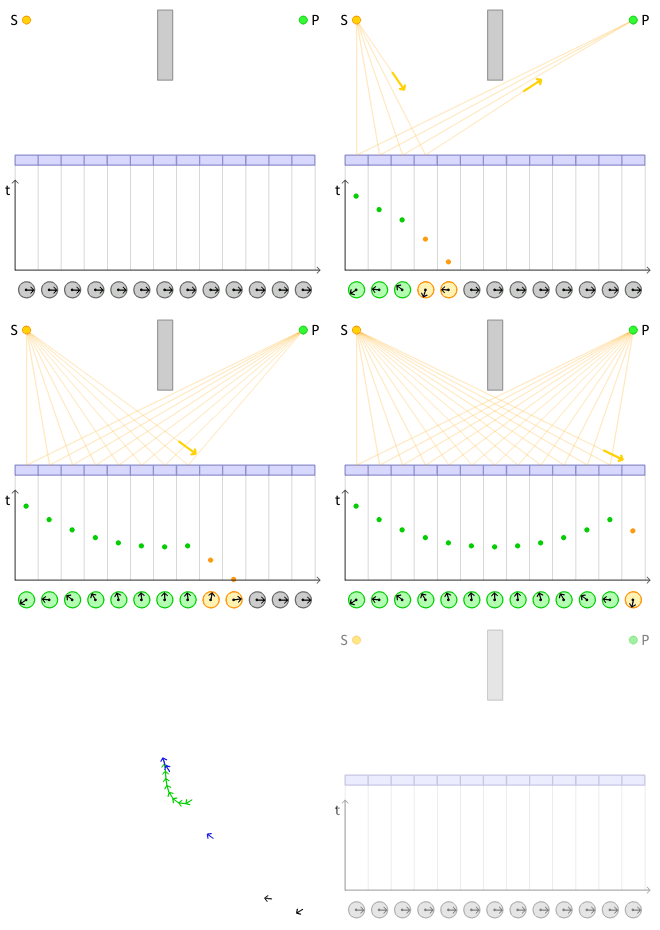
So, I'm trying to do the Feynman path thing.

The arrow on the clock is the wavelength, right.

Since the light is changing wavelength half way through, which did you use for the clock length?
 
You say that like I haven't posted the relationship like a hundred times.

And yet, you don't know when and how to incorporate it into your understanding.

Relevance?

That a speed change is the same as a wavelength change, so analyzing Snell's law in terms of speed or in terms of wavelength will produce the same results. So this idea you have that QED can somehow produce a loophole out of obeying Snell's law is a false hope. It cannot.
 
So, I'm trying to do the Feynman path thing.
You can't. You haven't got the mathematical ability. How is your calculus of variations?

The arrow on the clock is the wavelength, right.
Wrong.
Since the light is changing wavelength half way through, which did you use for the clock length?
You do know that diagram is a cartoon version of the integral over paths to illustrate the principle that the probability amplitude (complex number by the way) for each photon is maximum for the classical path and rapidly approaches zero for other paths. It is not the way the analysis is actually done. And the cartoon arrow length does not represent the wavelength in the cartoon.
 
You can't. You haven't got the mathematical ability. How is your calculus of variations?

Ok.

Well, this is what needs to be done:

Feynmans_QED_probability_amplitudes.gif


If you say this is cartoonish and can't work, we'll find out.

The question I'm having is what wavelength do you use when there are two photons with different wavelengths?

I'll use what you used, and we'll see how our answers compare.
 
The question I'm having is what wavelength do you use when there are two photons with different wavelengths?
If the wavelength after reflection is twice the incident wavelength (which was the specific example we were looking at when we were doing the geometric construction) then you should use lamda for the wavelength before reflection and 2*lamda after reflection.
 
If the wavelength after reflection is twice the incident wavelength (which was the specific example we were looking at when we were doing the geometric construction) then you should use lamda for the wavelength before reflection and 2*lamda after reflection.

Thanks. Sounds about right.

Let's say I implement that gif, and use a standard speed of light.

Let's say I have two clocks for each photon, one before the reflection and one after, and at the end, I add up all the clocks (2*photon_count).

Should we be expecting that result to be equal to the result of the standard method with one clock?

I'll find out, just curious what the expectation is.

If that works out as equivalent, then using two different wave lengths should be calculable that way. And that would work out to what you said. Do I have that right?

 
Thanks. Sounds about right.

Let's say I implement that gif, and use a standard speed of light.

Let's say I have two clocks for each photon, one before the reflection and one after, and at the end, I add up all the clocks (2*photon_count).

Should we be expecting that result to be equal to the result of the standard method with one clock?

I'll find out, just curious what the expectation is.

If that works out as equivalent, then using two different wave lengths should be calculable that way. And that would work out to what you said. Do I have that right?
I have no idea what you are planning to do, so I have no prediction.
 
Yet, that is the hypothesis. The photon loses frequency (observed) and speed (conjectured). Wavelength stays the same....
Repeating the error that light is a wave in a medium that we have known to be wrong since 1887, Mike Helland!
The Mickelson-Morley experiment was performed in 1887 and showed that light was not carried by a medium (the luminiferous aether). Thus a change in frequency is not caused by a change in speed.

4 March 2021: Mike Helland still cannot understand Wavespeed = frequency * wavelength is for waves in a medium.
 
Status
Not open for further replies.

Back
Top Bottom