
Clue me in: what is the group think here?
That we all believe we are people typing these posts.
It’s pretty insidious.

Clue me in: what is the group think here?

Aha. On the internet nobody knows you're a P-zombie.That we all believe we are people typing these posts.
It’s pretty insidious.

It’s a waste of time and bandwidth to go against the group think here . . . fatalism

Aha. On the internet nobody knows you're a P-zombie.

I think if realities fundamentally mental there’s no reason to parcellate more than one subject. If everything is mind then there is mind, mind is the subject. Objects are imaginations within minds which are observed from several different points of view of mind. From that perspective there is only one subject, and you are that subject, and I am that subject too.
He has definitely considered more of the issues than other idealists I have encountered but as I see it his argument is still largely subjective and his parsimony ends up requiring far more complexity than it saves. I may have misunderstood some points as this is a transcript and he's obviously talking off the cuff.. I mean it was not my intent to be that dismissive – all my answers are tentative. I approach them from the perspectives about someone who has looked at it and has chosen what I think is the simplest explanation with the most explanatory power
As I recall, from my reading of his book some years ago, most of his effort was to dismantle materialism more than building an argument for Idealism. Specifically, dismantling the need to postulate / abstract a non-mind physical world. For him, postulating a physical world created more problems than it solved.

Nihilism: There is no stuff
Solipsism: There's just my stuff

Nihilism is about moral truth, not physical existence.
And I think solipsism reduces to one of the other ontologies. "I think, therefore I am" is solipsistic enough, but doesn't tell you whether your thoughts are physically material or physically ideal.

That's why I chose Gorgias instead. He could be considered an ideal blend of nihilism and solipsism, a metaphysical solipsist who actually (we're told) said that nothing exists, and if you did you couldn't know it, and if you could you couldn't describe it. Of course he couldn't have believed that, since a teacher and philosopher can hardly really believe that you can't teach and philosophize, but he seems to have succeeded in making a rock he couldn't lift, as Hume did much later.Nihilism is about moral truth, not physical existence.
And I think solipsism reduces to one of the other ontologies. "I think, therefore I am" is solipsistic enough, but doesn't tell you whether your thoughts are physically material or physically ideal.
Sorry. You're absolutely right. It was a good joke and I apologize for stepping on it.Can we let just one joke slide, sometime?
; )

My best argument for Materialism is that it works.
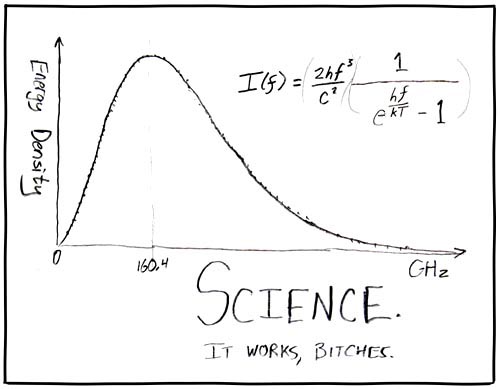
This thread has been going on so long that I don't know whether this has been posted yet, but from the "There's an XKCD for everything" files:
[qimg]https://imgs.xkcd.com/comics/science.jpg[/qimg]
Dave
Sorry. You're absolutely right. It was a good joke and I apologize for stepping on it.

