• Security incident: ISF was recently accessed by intruders. Please change your password, and change it anywhere else you used it. Read more

120 V or 240 V Mains - which voltage is better?

That's why here in Belgium ALL outlets need mandatory 20 A wiring (2.5mm2) and fuses. Lights can on 16A (1.5mm2) wiring. It's allowed to mix lights and outlets, but then all wiring must be rated for 20A. No mix ups possible that way.

Then there is britian where outlets are frequently on a 32 amp ring circuit. Hence why all plugs have fuses.
 
Are they 120V outlets or 240V? I understand that washing machines and airconditioning in particular operate on 240V.

My old house had a 240V 15A outlet wired on its own separate fuse for the air conditioner. It had a larger than normal earth pin. You could still plug ordinary devices into them but you couldn't plug the air conditioner into an ordinary outlet.

This still doesn't address the question of kettles and portable heaters. These are typically rated at in excess of 2000W here. You couldn't plug a 120V appliance like that in an ordinary US socket without overloading it.
In the US, the variety of different plugs and outlets is pretty confusing, but generally it's made so you can't plug the wrong voltages in. But it's pretty crazy. There are two different 30 amp outlets for dryers (age dependent) and at least two 50 amp outlets for ranges. Rarely seen in houses, there are numerous others seen in garages and shops and the like. In my shop I have four-prong 50 for a welder, a 3 prong 50 for a welder, and two different 20 amp 240 volt outlets for tools.

HERE is a fairly complete list of the different ones we have, although I don't see any of the twist-lock outlets here. Twist lock plugs and outlets are used for generators and some other outdoor applications, as well as for theatrical lighting, and there are three and four wire, 20 and 30 amp variants of those too, in both 120 and 240 volt.

e.t.a. if you go back a page in the link above, you'll find added charts for the twist locks and waterproof ones, and whatnot. (if you care)
 
Last edited:
If you touch a live AC circuit, how much current flows through your body generally doesn't depend upon how much current the circuit is capable of providing. (In extreme exceptions, where you draw enough current to "dim the lights," you're toast anyhow.) It depends instead on the impedance of the current path through your body, and on the voltage of the circuit. (The impedance depends on the contact area and pressure, what part of your body, whether or not you're grounded, and a lot of other things.) All other things being equal, a 240VAC circuit will put twice the current through you as a 120VAC one.

That arguably makes 120VAC circuits safer, but it's not as big a difference as it might seem, because most electrical shocks are either much less than or much more than a lethal current, so a factor of 2 will only rarely make the difference. The downside to the lower voltage is, as others have pointed out, you get only half the max safe power load for a given gauge of wiring at 120 than at 240.

Most small portable appliances max out at about 1200W in the U.S. Some hair dryers go to about 1800 but I'm sure there are many homes where you couldn't use them, or you would have to be careful about which outlet you plugged it into and what else was on at the time. Electric kettles use less wattage, and heat up less quickly, than in the U.K. That might be part of the reason why they're less popular in the U.S., the other reason being that most heating of water in small batches is performed by coffee makers instead, which heat the water a little at a time on purpose. I use a small "Hot Shot" water heater for tea and cocoa, which is 1000W and takes less than a minute to bring one cup (300 ml) to a boil.

New major appliances other than stoves, ovens, and the largest window AC units usually now plug into a standard 120V outlet. They're more efficient (and in some cases, more underpowered) than they used to be so they rarely exceed 12 amps, and most of them are usually also on their own dedicated circuits so you don't have to worry about e.g. the fridge cycling on while the washer and dryer are running. Window AC units with 120V plugs are an exception, and that can cause problems (e.g. if one of those hair dryers is running in the same circuit).

Having too many lights on used to be an issue when running other appliances, back when a simple floor lamp could draw 300 Watts. Now lighting is all but negligible. A home entertainment center today with 15 things plugged in (TV, cable box, blu-ray player, smart devices, game systems, and so forth) might use about the same power that just a color CRT TV used to.)
 
That arguably makes 120VAC circuits safer, but it's not as big a difference as it might seem, because most electrical shocks are either much less than or much more than a lethal current, so a factor of 2 will only rarely make the difference.

I can testify to the fact that, given appropriate conditions (though I would prefer not to try to replicate them), 240V AC from a UK mains socket across the arms for several seconds (my impression was about 30, but subjectivity can impose a very large error bar) is survivable. However, it seemed to be passing through two very small areas on my right thumb, which probably presented sufficient impedance to keep the current below lethal levels.

And, as my physics teacher used to say, it's the volts that jolts, but the mils that kills.

Dave
 
I wired light circuits on 14g and outlets on 12g wires. All on a 110 feed . It fits code here and has been reliable.

Most of our electric things are rated to 90 to 240 vac input ( international markets items ) and don't seem to be affected by brownouts or power spikes like older stuff was.

In Mexico if you get a 220 feed and split it to two 110 circuits instead of one 110 feed the bill is halved monthly. It somehow keeps you usage at the meter much lower.

The science behind that eludes me but I know of two friends that are doing it, and it works.
 
In Mexico if you get a 220 feed and split it to two 110 circuits instead of one 110 feed the bill is halved monthly. It somehow keeps you usage at the meter much lower.

That's normal wiring in the USA but I don't know why the bill would be lower. The meter is on the 220 feed anyhow.

Just for fun I went to look at the panel to see if we actually had any 15A breakers. There are three or four, a couple of which are dedicated, like for the garbage disposal. Or was it the dishwasher, I forget.

Off topic: What is it with washing machines tripping GFCI breakers? Ours does it at random times, but never when it's actually running. This is a new house and washing machine.
 
Not entirely sure about the washing machine, but I'd double check to be sure the earth ground is done right, and that all other circuits are connected to it in the breaker box, including any outlets shared with that of the washing machine if there are any. It sounds a bit as if some appliance other than the washing machine might be seeking ground through the circuit or through the plumbing, because its own ground is not correct.
 
In the US, the variety of different plugs and outlets is pretty confusing, but generally it's made so you can't plug the wrong voltages in.

. . . . . . . . . . .

HERE is a fairly complete list of the different ones we have, although I don't see any of the twist-lock outlets here.
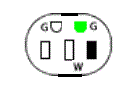
I'm surprised that you don't have a universal 120-0-120 outlet like the one shown below:

The outer two pins have a voltage difference of 240 V for the appliances rated as such but you would need a special plug with 5 pins to use it. You could still use the standard 120V plug (earthed or not) without the risk of accidentally connecting it across 240V.
 
I'm surprised that you don't have a universal 120-0-120 outlet like the one shown below:
[qimg]http://www.internationalskeptics.com/forums/imagehosting/436715dfaf25873dba.gif[/qimg]
The outer two pins have a voltage difference of 240 V for the appliances rated as such but you would need a special plug with 5 pins to use it. You could still use the standard 120V plug (earthed or not) without the risk of accidentally connecting it across 240V.

Continue, then, to be surprised. The US is not only large, but its electrification came fairly early, and in local areas before there was a grid, and I think the result has been a hodgepodge of different connections and systems. Both my parents were born in the 1920's. When my dad was a kid in rural Vermont, they had a generator putting out 32 volt DC. When they wintered in Brooklyn, it was 110 (AC I think,but not sure). When my mother lived for a while in Manhattan in the 1940's her apartment was still wired for 110 DC. She had to have an AC/DC radio and phonograph (no transformers, all the tube filaments in series, and high voltage limited to the line voltage, with a polarized two prong plug). The motor in her phonograph was not synchronous, and had a +/- lever for speed adjustment. Although it ended up used only for lights and elevators and the like in older buildings, the last DC power supplied in New York was not ended until 2007!

For those not familiar with some odd American electrical customs, you might notice that in all but a very few outlets and extension cords, one of the two parallel prongs is larger than the other. The long one is the neutral, the short the hot. In 120 volt systems, the supply is usually 240 volts, plus a ground. But in the house, the current is divided, so that there is 120 between either of the two hot wires and the ground. Thus, even though the neutral wire is at ground potential and shares a ground connection in the breaker box, it carries full current between the appliance and the box. DC requires correct polarity to work at all. AC/DC equipment (including some AC-only TVs) was often made with the entire chassis, including the shafts of controls and even including metal cases in some TV's, serving as common ground in a two wire system, so if such a device was connected the wrong way around, it would deliver a potentially lethal shock to anyone touching it while grounded. Back in the day, you could even get a shock if the setscrews in the knobs were too long! Many lamps are still provided with polarized plugs, because even though the whole lamp is not a common ground, the standard socket has the "hot" wire at the center of the bulb base, and the neutral on the outer threaded portion, and it's pretty easy either to get a ground fault, or just touch the wrong thing when changing bulbs.

Sometimes I find it surprising that we're not all fried to a crisp!

 
Last edited:
Continue, then, to be surprised. The US is not only large, but its electrification came fairly early, and in local areas before there was a grid, and I think the result has been a hodgepodge of different connections and systems. Both my parents were born in the 1920's. When my dad was a kid in rural Vermont, they had a generator putting out 32 volt DC. When they wintered in Brooklyn, it was 110 (AC I think,but not sure). When my mother lived for a while in Manhattan in the 1940's her apartment was still wired for 110 DC. She had to have an AC/DC radio and phonograph (no transformers, all the tube filaments in series, and high voltage limited to the line voltage, with a polarized two prong plug). The motor in her phonograph was not synchronous, and had a +/- lever for speed adjustment. Although it ended up used only for lights and elevators and the like in older buildings, the last DC power supplied in New York was not ended until 2007!
I don't know what any of that has to do with the post you quoted. Australia had a similar hodge-podge of electrical supplies including 240V DC in some country towns. That's ancient history.

For those not familiar with some odd American electrical customs, you might notice that in all but a very few outlets and extension cords, one of the two parallel prongs is larger than the other. The long one is the neutral, the short the hot. In 120 volt systems, the supply is usually 240 volts, plus a ground. But in the house, the current is divided, so that there is 120 between either of the two hot wires and the ground. Thus, even though the neutral wire is at ground potential and shares a ground connection in the breaker box, it carries full current between the appliance and the box. DC requires correct polarity to work at all. AC/DC equipment (including some AC-only TVs) was often made with the entire chassis, including the shafts of controls and even including metal cases in some TV's, serving as common ground in a two wire system, so if such a device was connected the wrong way around, it would deliver a potentially lethal shock to anyone touching it while grounded. Back in the day, you could even get a shock if the setscrews in the knobs were too long! Many lamps are still provided with polarized plugs, because even though the whole lamp is not a common ground, the standard socket has the "hot" wire at the center of the bulb base, and the neutral on the outer threaded portion, and it's pretty easy either to get a ground fault, or just touch the wrong thing when changing bulbs.

Sometimes I find it surprising that we're not all fried to a crisp!
Again, failing to explain why a universal power socket of the type I described can't be used.
 
In the USA the 15 & 20 Amp current ratings are for a continuous current for over 3 hours. The only likely items that might draw full current for that long are room heaters and lighting systems.
 
Again, failing to explain why a universal power socket of the type I described can't be used.


Why should it be used? It would be very expensive to retro-fit and more expensive even in new construction. What large problem does it solve that makes it worth that expense?
 
I don't know what any of that has to do with the post you quoted. Australia had a similar hodge-podge of electrical supplies including 240V DC in some country towns. That's ancient history.


Again, failing to explain why a universal power socket of the type I described can't be used.
I never said it couldn't, just that it isn't.
 
Why should it be used?
It would power appliances that draw too much current than a standard 120V outlet is rated for. Electric radiators for example would consume at least 2000W requiring a special outlet anyway. Similarly, electric kettles must necessarily be lower powered (and slower to boil) due to the limitations of a standard outlet.

It would be very expensive to retro-fit and more expensive even in new construction.
You already have a gazillion different types of plugs and sockets already. Adding one more to the mix isn't going to make any difference.

You can't replace a standard outlet with a dual outlet because you would require 2 live wires but that is a trivial expense when wiring in a new outlet from the meter box.
 
Last edited:
It would power appliances that draw too much current than a standard 120V outlet is rated for. Electric radiators for example would consume at least 2000W requiring a special outlet anyway. Similarly, electric kettles must necessarily be lower powered (and slower to boil) due to the limitations of a standard outlet.


You already have a gazillion different types of plugs and sockets already. Adding one more to the mix isn't going to make any difference.

You can't replace a standard outlet with a dual outlet because you would require 2 live wires but that is a trivial expense when wiring in a new outlet from the meter box.


If it's just one more choice added onto the list for wiring a new circuit, then it's not really much different. It has the advantage of being able to change your mind later about whether you're using the new outlet(s) for 120 or 240 VAC equipment. But unless those 240 VAC appliances come wired with those 5-prong plugs, it's also a drawback. (I'd consider it if wiring a new workshop, but first I'd have to research whether tools equipped with those plugs are available. Also, whether the electrical code allows them.)

There are many many available standards that are objectively superior to the ones currently in use, but there's no economical path from the status quo to the superior standard. Imperial units in U.S. fittings, fasteners, machinery, and tools. "Positive" and "negative" in electronic notation. Probably too many to count in IT and digital communications.
 

ISF - Join now!

Every member here is approved by hand. No bots, no spam, just people who care about evidence and honest debate.

Membership is free!

Create your free account

Back
Top Bottom