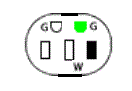
For those not familiar with some odd American electrical customs, you might notice that in all but a very few outlets and extension cords, one of the two parallel prongs is larger than the other. The long one is the neutral, the short the hot. In 120 volt systems, the supply is usually 240 volts, plus a ground. But in the house, the current is divided, so that there is 120 between either of the two hot wires and the ground. Thus, even though the neutral wire is at ground potential and shares a ground connection in the breaker box, it carries full current between the appliance and the box. DC requires correct polarity to work at all. AC/DC equipment (including some AC-only TVs) was often made with the entire chassis, including the shafts of controls and even including metal cases in some TV's, serving as common ground in a two wire system, so if such a device was connected the wrong way around, it would deliver a potentially lethal shock to anyone touching it while grounded. Back in the day, you could even get a shock if the setscrews in the knobs were too long! Many lamps are still provided with polarized plugs, because even though the whole lamp is not a common ground, the standard socket has the "hot" wire at the center of the bulb base, and the neutral on the outer threaded portion, and it's pretty easy either to get a ground fault, or just touch the wrong thing when changing bulbs.
Sometimes I find it surprising that we're not all fried to a crisp!