
• Quick note - the problem with Youtube videos not embedding on the forum appears to have been fixed, thanks to ZiprHead. If you do still see problems let me know.

Is the narrow impeachment a tactical mistake by Democrats?

The issue is not yet "in court". If the House sends articles of impeachment up the Senate will sit as a court. In treating this as similar to a conventional court case, the Intelligence committee can be seen as the police investigator who finds and develops evidence, the Judiciary Committee as the DA who frames the case and decides if it can be prosecuted, and the House as the Grand Jury who decides whether to send the charges to trial.

As theprestige just explained, the Judiciary decides disputes between the other two branches. The Intelligence Committee could have gone to court to enforce their subpoenas, but decided not to. One can speculate why they so decided, I suspect a significant reason is the time constraint of wanting to get this out before the end of the year.

I DON'T see why the House of Representatives needs to ask the courts what is or isn't a proper impeachment article.

I think it would set a horrible precedent to allow the Executive Branch to drag out informing Congress about the deliberate delay of authorized military aid.

Prestige's argument makes Congress into a potted impotent plant. I'm unconvinced that is what he wants.
 
I agree.

My position has always been that impeachment is a political process, that depends only and entirely on the political will of the Legislature to remove the President from office. They could impeach him for allegedly eating a ham sandwich, without subpoenaing a single witness, without presenting a single shred of evidence, if that's what they wanted to do.

They could impeach him for not complying with a subpoena, if that's what they wanted to do.

But that doesn't mean that the president is legally or constitutionally required to comply with Congressional subpoenas.

It does if he wants not to be charged with an article of impeachment. This isn't about what is legal or illegal. Impeachment is not a criminal process. The question is about the process and power of the different branches of government.

By stonewalling Congress the President has said he can do what he wants. Not only that, President Trump has said that Article 2 of the Constitution says he can do whatever he wants.

Do you think the President can do "whatever he wants"? And you do understand that by allowing the President to do whatever he wants you've created a precedent that future Presidents can follow?

Is this government you want? One without oversight? One where the President can ignore Congress entirely? Seriously? You should consider what this means. Making a deal with devil is a dangerous game.
 
Here's why the obstruction charge should be there, regardless of legal issues:

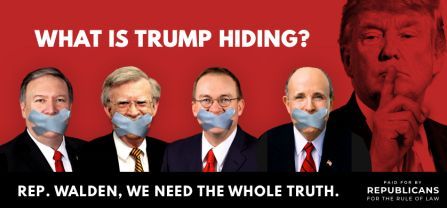
A conservative group is targeting House Republicans with a digital billboard campaign that is heavily critical of President Donald Trump.

In the new ads, Republicans for the Rule of Law calls out Trump for prohibiting key witnesses in the Ukraine scandal from testifying in the House impeachment inquiry against him.
5df22656210000500734fc62.jpg


https://news.yahoo.com/republicans-for-the-rule-of-law-billboards-trump-135139335.html

Trump said it himself about people who plead the 5th Amendment: it makes you look guilty.
 
If Bolton drops his objection and agrees to be deposed should the House ignore him?

If any of the other principals is ordered by a court to testify, should the House decline to interview them?

Is there already a possibility that Trump admin officials might be ordered to present documents and/or testify?
 
I DON'T see why the House of Representatives needs to ask the courts what is or isn't a proper impeachment article.
They don't.

The only reason for a House impeachment inquiry to involve the courts is if they think they need to sell the public on a legal argument to remove the president, and they think a court decision will help with that.

Prestige's argument makes Congress into a potted impotent plant. I'm unconvinced that is what he wants.

Congress has broad powers, including the power to straight up remove the president from office if they don't like the cut of his jib. That's very far from potted plant territory.

But there limits to the power Congress has over the Executive. They can remove him from office, but they can't necessarily dictate how he conducts the work of the Executive branch. You know this. You understand this. You believe this is a good thing. You're just convinced that subpoenas fall on the Congressional authority side of the line. I think that's still an open question.

Your argument that subpoena authority necessarily follows from impeachment authority does not convince me.
 
What makes you think that a Congressional obstruction charge needs to be pressed in court?

I don't think it needs to be, but it is the usual way for challenged subpoenas to be enforced. The Democrats not doing so in this case makes their position much weaker than if they had. I understand the reasons for not doing so - this case is time-sensitive, and the Supreme Court is stacked in Trump's favour - but that doesn't mean that it isn't a valid counter-argument.

I said this in the main impeachment thread, but a law-focused podcast (which I can't remember the name of now) apparently suggested that the Democrats' tactic might be to get the judge presiding over this trial to rule on the subpoenas, which would then have the authority of the Supreme Court. I didn't hear the actual argument made myself and I don't know enough myself about the law to know how likely or possible that actually is, but it's an interesting idea.
 
They don't.

The only reason for a House impeachment inquiry to involve the courts is if they think they need to sell the public on a legal argument to remove the president, and they think a court decision will help with that.


Congress has broad powers, including the power to straight up remove the president from office if they don't like the cut of his jib. That's very far from potted plant territory.

But there limits to the power Congress has over the Executive. They can remove him from office, but they can't necessarily dictate how he conducts the work of the Executive branch. You know this. You understand this. You believe this is a good thing. You're just convinced that subpoenas fall on the Congressional authority side of the line. I think that's still an open question.

Your argument that subpoena authority necessarily follows from impeachment authority does not convince me.

Subpoena power has been a right of Congress for 230 years. Any limits applied to that right have been minor. A blanket refusal by the Executive branch has never been claimed before.

Should be noted by you that the courts previously ruled unanimously in both cases, that the President must comply to subpoenas.

These cases forced the President to testify in a deposition where he was asked about a consensual sexual relationship and in another where recordings of conversations in the Oval Office were presented.

Do you really believe that asking the DOD and the State Department about foreign policy and the release of military aid is improper? Do you really believe the Executive should be able to prevent Congress from this information? Or does the House oversight committee have to operate in the dark and be dependent on whatever the President wants them to know? Is that the government you want?
 
Is it possible that Bolton or others could be ordered to honor the subpoenas under judicial proceedings already in progress?
 
Exactly. What the electors did and the voters did in 2016 were two different things.

That is only true if there were enough faithless electors to change the results of the popular vote. If the electors conformed to the will of the voters in their area, then what the electors and voters did was the same.

ETA; https://en.wikipedia.org/wiki/Faithless_electors_in_the_2016_United_States_presidential_election
As a result of the seven successfully cast faithless votes, the Democratic Party nominee, Hillary Clinton, lost five of her pledged electors while the Republican Party nominee and then president-elect, Donald Trump, lost two. Three of the faithless electors voted for Colin Powell while John Kasich, Ron Paul, Bernie Sanders, and Faith Spotted Eagle each received one vote.[8] The defections fell well short of the number needed to change the result of the election; only 2 of the 7 defected from the winner, when 35 were needed to defect in order to force a contingent election in Congress (a tally of less than 270).

Ranb
 
Last edited:
Subpoena power has been a right of Congress for 230 years. Any limits applied to that right have been minor. A blanket refusal by the Executive branch has never been claimed before.

It again serves to show how fragile the political system is, and how much it relies on tradition.

For instance: if SCOTUS orders something from Trump and he still refuses, then what?
 
It again serves to show how fragile the political system is, and how much it relies on tradition.

For instance: if SCOTUS orders something from Trump and he still refuses, then what?

That's easy:

1. Congress impeaches him and removes him from office.

2. Upon the vote to remove, the new President orders the Secret Service to evict the trespasser from the White House.
 
That's easy:

1. Congress impeaches him and removes him from office.

2. Upon the vote to remove, the new President orders the Secret Service to evict the trespasser from the White House.

And what if 34 Senators vote aginst impeachment? Do you really believe that simple oversight of the administration should require a majority in the SC, a majority in the House and a 2/3rds majority of the Senate?

Why not just make him King?
 
Last edited:

Back
Top Bottom