• Security incident: ISF was recently accessed by intruders. Please change your password, and change it anywhere else you used it. Read more

Luke Mitchell and the murder of Jodi Jones

an inverse relationship

"Throughout this all, Jodi’s family have continued to conduct themselves with quiet dignity." Daily Record I have no particular wish to criticize the Jones family, but this is not true, any more than it was strictly true that the Kercher family maintained a dignified silence (or words to that effect). With respect to teenage behavior Luke smoked marijuana and had sex when he was fourteen. One may argue that his mother should have had not permitted these things to occur (I don't take any position on questions of this sort). Yet exactly the same criticism could be said about Jodi's parents, in that Jodi also used marijuana and had sex at the same age. My point is that the press and public sometimes treat the victim and his or her family by a different set of standards versus the accused and his or her family. For example, Amanda Knox and Meredith Kercher were similar in their behaviors concerning sex and marijuana. BTW, this Daily Record article discussed a knife found about 300 yards from the crime scene long after the crime. It may bear no relationship to the murder whatsoever.

One other point I would like to make is that the murder of Jodi Jones was a high profile case and can be interpreted through the experiences of the Knox/Sollecito and Duke lacrosse cases (I once compared those two cases on my blog). I have sometimes thought that the weaker the case, the more the prosecution will attempt to blacken the name of the accused person or persons. This can produce a conviction despite little evidence assuming some fraction of the mud is seen by the jury. Another aspect of high-profile cases is that the police probably feel pressure to solve the case quickly so that the public is put at ease. This partially explains (but by no means excuses) the remarkable level of confirmation bias shown by the investigators in this instance. And of course no high-profile case would be complete without Statement AnalysisR. I don't recall ever seeing the Statement AnalysisR blog find for innocence, but I have not looked exhaustively.
 
Last edited:
DNA and a drop of blood

"The reports also show, the new defence team says, that a blood sample found on her produced a full DNA match with a named individual and a second full DNA profile, for an unknown male, was retrieved from a condom found near the body.

The latter individual was identified three years later when he committed a crime and provided a match on the DNA database." Guardian.

I acknowledge that this report may be in error. However if we take it as a given, one explanation is that Janine's boyfriend Stephen bled at the scene. Caveat: As I have said before, the association of a DNA profile with a fluid or tissue is not implicit, and there are other explanations.
 
Last edited:
more on the limitations of differential extraction

On p. 38 of her book Introduction to Forensic DNA Evidence for Criminal Justice Professionals, Jane Taupin wrote, "Sometimes this [differential] extraction is incomplete or unsuccessful, and female cellular material is found in the seminal (sperm) fraction and/or lysed spermatozoa are found in the cellular (nonsperm) fraction."

On p. 107 she wrote, "Differential extraction of these [low copy number or old and fragile] samples may yield no profile from a male donor due to a combination of premature lysis of the cellular constituents of the sperm into the nonsperm fraction and sperm loss during the physical manipulations required for the isolation process." She made similar comments on p. 140 of her book Using Forensic DNA Evidence at Trial.

These passages address Sandra Lean's concerns about certain paradoxical DNA results that I mentioned in comment #62.
 
Last edited:
I just wanted to check in and say that I do have a fair bit to say about this but I'm staying with friends and I only have my phone and I can't really type long or detailed posts at the moment.
 
How familiar this all sounds - the arrest of the slightly off-the-rails gothy, metal-heady "he's a wrong 'un alright" suspect who fits everyone's (not least the not-very-bright cops) idea of a sicko and killer. Which is gathered not from any real world knowledge or insight but from movies and teevee. In fact, it's become almost a cliche in and of itself.
 
How familiar this all sounds - the arrest of the slightly off-the-rails gothy, metal-heady "he's a wrong 'un alright" suspect who fits everyone's (not least the not-very-bright cops) idea of a sicko and killer. Which is gathered not from any real world knowledge or insight but from movies and teevee. In fact, it's become almost a cliche in and of itself.

It is worse than that, even brighter, university educated cops end up thinking that way, such is the culture, particularly in CID, to get a detection, no matter what.
 
How familiar this all sounds - the arrest of the slightly off-the-rails gothy, metal-heady "he's a wrong 'un alright" suspect who fits everyone's (not least the not-very-bright cops) idea of a sicko and killer. Which is gathered not from any real world knowledge or insight but from movies and teevee. In fact, it's become almost a cliche in and of itself.


The thing is, he doesn't seem to have been a gothy, metal-heady potential wrong 'un at all. And even if he had been, the police acted against him before they'd had a chance to find that out. They assumed he'd done it right from the moment they answered the 999 calls to the scene of the crime, before they had any idea who he was (or indeed whether he had an alibi).

He was only 14. He wasn't a goth or "gothy". I don't know much about that sort of music but he said his favourite band was Eminem, which I don't think is heavy metal. He was a good pupil at school, he'd been in the army cadets until the previous year, and the family was very into outdoor pursuits. He had a horse. He was learning to handle his dog which was being trained as a tracker.

He was smoking pot and messing around with his girlfriend while they were both underage, but I'm not persuaded that's especially "off the rails" for the culture he was part of. While I'm not saying his home life was a model of middle-class perfection I think the interpretation of "bad family versus good family" (Mitchells bad, Joneses good) had it the wrong way round.

The whole narrative about Luke being out of control and "obsessed with Marilyn Manson" and so on was added later by the media, aided and abetted by the cops.
 
Last edited:
Good afternoon, I was made aware of this discussion a few days ago, but it's taken until now to gain access to the forum!

Firstly, thanks to the posters who have clarified the possible (probable?) explanation about the DNA results reporting that sperm and semen samples appeared female in origin. That's very helpful to know - it's been something that's baffled me (as a non-expert) for a very long time.

Secondly, I'm happy to answer questions or clarify points - there has been a massive amount of information and misinformation in the public domain about this case for many years. I'll start with some of the questions already raised, if that's ok?

The semen on the bra/t-shirt? DNA from Jodi's sister's boyfriend's DNA was found in the middle front of the t-shirt, where samples labelled "semen" were found and also sperm heads. Confusion arose because the sample identifying the sister’s boyfriend’s DNA was initially labelled “blood.” (Explanations already posted her have clarified that somewhat, I think). Further semen deposits and spermheads were found on the upper left and right front of the t-shirt, the inside of the left sleeve of the t-shirt and also on the outside and inside cups of the bra. All of these returned either "no reportable results" or partial profiles and so remain unidentified to this day.

The prosecution claim was that semen from the t-shirt may have "migrated" to the bra due to rainwater diffusion. However, the bra and t-shirt pieces (it had been cut and ripped into two pieces) were found several feet away from each other, so, if rainwater diffusion was the culprit, Jodi had to be still wearing both items of clothing and being rained on when the semen was deposited, which doesn't fit with the prosecution case. At the claimed time of death (5.15pm) it wasn't raining (it was bright sunshine) - the rain didn't start until almost two hours later.

There is one other possible explanation and that is that when the police gathered up items of clothing from the scene (before the forensics officers arrived) they put the bra and the t-shirt together, thereby transferring forensic evidence from one to the other. I've no idea how likely it would be that the deposits would land up where they did on the items if this was the explanation.

The time Luke waited at the end of his street? When he left home just after 5.30pm, he tried to call Jodi’s house (5.32) but the call didn’t connect. He tried again at 5.40pm and was told Jodi had “just left” (it was later claimed he was told Jodi had left “to meet him,” although none of the initial statements said so). If he believed Jodi had just left at 5.40pm, he wouldn’t be expecting her in Newbattle much before 6.05 – 6.10pm, so, for the first half hour, he was just whiling away time. After that, he walked a little way up the Newbattle Road to a bend at Barondale Cottages “a couple of times” to see if he could see Jodi approaching. He was seen by a witness at around 6.15pm at the cottages. Around 6.30pm, he says he went into the grounds of Newbattle Abbey and smoked a joint and then called a male friend to see if he was going to be out and about – this was a friend Luke, Jodi and another friend regularly hung out with. The call was made at 6.50pm, Luke calling his mum at 7pm to tell her, if Jodi turned up at the house, to send her over to the Abbey where the others would be.

"Throughout this all, Jodi’s family have continued to conduct themselves with quiet dignity." That is not strictly true. Jodi’s mother went into Corinne Mitchell’s workplace just after the appeal hearing in 2008, drunk, and attacked Corinne, breaking her glasses and pulling out clumps of her hair. In 2010, after the launch of the Luke Mitchell website, Jodi’s brother came to my house and threatened me – amid a barrage of cursing, he told me “that website goes or you do – I know where you are now.” Jodi’s mother later posted on a forum that I was lying about her son’s threats, firstly claiming the incident never happened (as she did following the incident with Corinne) and then admitting her son had “visited” me because he was “upset.”

Where did Andrina Bryson live (and which supermarket did she visit)? Mrs Bryson lived in an area known as “The Bryans.” After she passed the Easthouses end of the path, she would continue driving southward on the Easthouses road onto Morris Road– when she reached the end of that, the houses directly opposite the junction with the B6482 belong to The Bryans area.


The supermarket was in Gorebridge - EH23 4TX - if you check with Google maps, you can see the direct route between the store and either the Easthouses Road or the Bryans area (I can't post links yet because this is my first post, sorry!)


However, if you zoom in on the Gorebridge map, the prosecution claim was that one of the routes taken by Mrs Bryson, instead of simply returning by the route she’d taken to get there, headed in the opposite direction (turning left out of the supermarket, on the B 704 along Hunterfield Road to Station Road, turning left onto Lady Brae and following this road to Barleyknowe Road and then looping back around to Stobhill Road again. When you look at the direct route between her home and the supermarket, this alternative seems ludicrous.

The other suggested route isn’t much better – instead of cutting along past Mayfield Industrial Estate, the suggestion was that Mrs Bryson took the B704 (back the way she came) but turned onto the A7, down through Newtongrange Main Street and up Bryans Road before turning into Morris Road.

The only explanation for introducing either of those routes as possibilities can be that the time needed for either journey had to be at least double the actual time the most direct route would have taken (around 6 – 7 minutes) in order to “fit” the required timing for the “sighting.”

(Apologies if this isn't the best way to demonstrate what I'm trying to show here - I've no idea how to upload screenshots of the actual maps, sorry!)
 
Sandra Lean,
Welcome to the forum.
It seems there is copious data precluding the notion Luke could be the perpetrator, so let's hope this thread can in some way assist.
 
Oh, hi Sandra. I'm @DrMoragKerr (my real name) on Twitter. You probably recognise the avatar. I'm currently in the huff there because Twitter have designated a couple of innocuous posts of mine (the usual, men cannot actually turn into women) as "hate speech" and won't give me access to my account until I delete them. I'll get round to it but I'm in no hurry.

This is a much better forum to discuss the case as we're not limited to 280 characters, and I'm glad you decided to join. It's also a lot harder to get suspended or banned from here.

I'm not sure about this explanation for the semen DNA being reported as female. It seems to me from what Chris posted that this explanation is in the context of semen being recovered from the vagina of a rape victim, when there would of course be female cells present as well. The semen in this case, as you noted, was recovered from a t-shirt. I was going to post about this once I was back on my computer. I still don't understand it and to a certain extent I'm still in "so somebody please explain to me why Steven Kelly isn't the murderer?" mode with that one. It would certainly have been a lot easier to fit him up than to fit Luke Mitchell up as far as I can see, and yet the police appear to have been falling over themselves to dream up exculpatory explanations for the evidence against him.

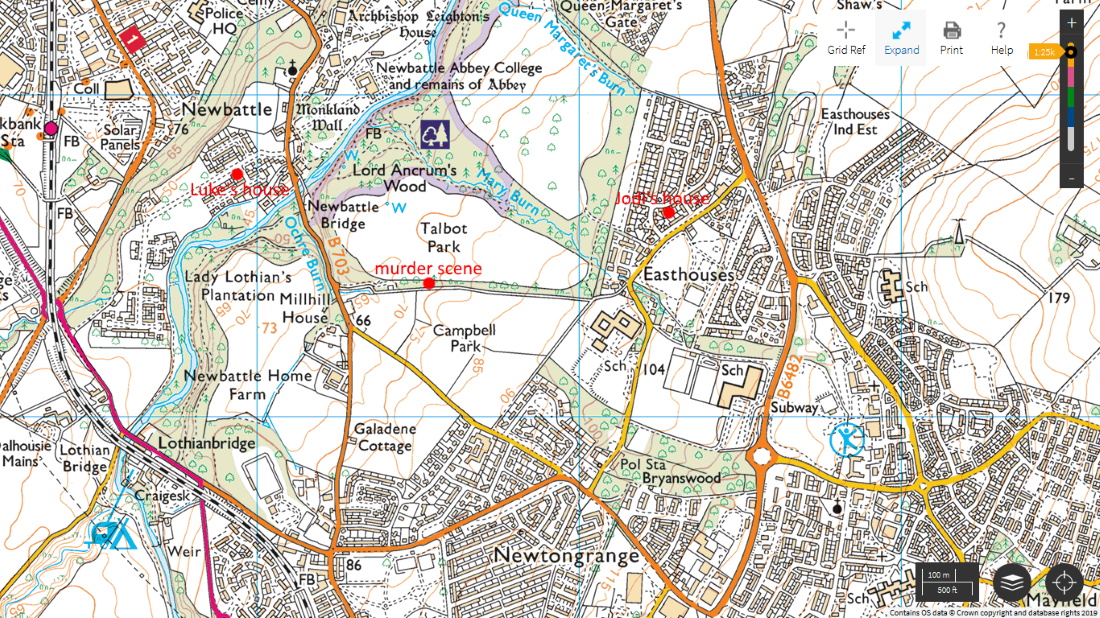
I've already posted a map of the general area, and here it is again. It doesn't go as far out as The Bryans or Gorebridge but I can put up a smaller scale one of a larger area if necessary. I think the OS map is a lot clearer and makes it a lot easier to see where things are than Google.

map1.jpg


The three points showing the two houses and the crime scene are a bit approximate, from your own descriptions. I think they're OK as illustrations, but if you have more precise details I can change the file.
 
Last edited:
Sandra, can I post some things I'm confused about so you can put me right?

First, Andrina Bryson. Her itinerary for the late afternoon was, put the kids in the car and go to the Co-op for the messages. (I'm a bit unclear as to why she went all the way to Gorebridge when there's another Scotmid branch a lot nearer but that doesn't matter, I assume the identity of the supermarket is not in doubt.) It's very clear that this journey, direct both ways, wouldn't have taken her anywhere near Easthouses Road, as Gorebridge is in the opposite direction.

However, she went into Easthouses to look at a house she'd seen there which was for sale. (Do we know the address of that house?) She must have done that after she did the messages, because of the time on the checkout slip. Leaving her actual route aside for the moment, this sequence of events would take her first north into Easthouses from Gorebridge, then south from Easthouses back home. Going from Gorebridge to Easthouses one might drive north up Easthouses Road, but on the other hand one might not, one might take the B6482 instead. Going from Easthouses to The Bryans on the other hand, the absolute no-brainer would be to drive south down Easthouses Road.

It is impossible to see what she said she saw from a car travelling north on Easthouses Road. It is perfectly possible to see what she said she saw from a car travelling south (although one might marvel somewhat at her having retained so much detail about two perfectly unremarkable pedestrians seen for only a handful of seconds when she apparently couldn't even remember which route she'd taken to Easthouses).

It would be natural to assume she saw these two people on her way home, as the natural route back to The Bryans from Easthouses is south down Easthouses Road, however if that was the case then the time was about 5.40, which is no use at all to the prosecution. The prosecution needs that sighting to have been shortly before five o'clock, and the time we're expected to believe it happened is approximately 4.50, certainly before 4.55.

Mrs Bryson left the supermarket at 4.50, according to the checkout slip time, or 4.37 according to the bank statement time (in both cases allowing five minutes to get the groceries and the kids into the car and drive off). The former time is too tight for her to have got to the end of the path even driving straight there, so the police had to use the latter time (even though this leaves an improbably short time to get the shopping done).

At this point a detour becomes necessary, not simply to use up some of that extra 13 minutes we've suddenly acquired by using the earlier checkout time, but to get her car pointing south. Neither of the routes you describe gets Mrs Bryson going south on Easthouses Road at 4.50 to 4.55. In order to do that she would either have had to drive north up Morris Road and then Easthouses Road, past the end of the path, then turn herself around and retrace her route back south towards The Bryans, or she would have had to get to the north end of Easthouses Road via the B6482 and then drive south.

Neither of these manoeuvres makes any sense if she was looking for a house in Easthouses, because the end of the path is to the south of Easthouses, and a driver going south is leaving Easthouses behind at that point. In order to be driving south on Easthouses Road before she had looked at the house she was interested in, she would have had to have become quite seriously lost. At this point her route from Gorebridge towards Easthouses becomes fairly irrelevant, as the time required to place the sighting at 4.50/4.55 given a leaving time of 4.37 is easily explained by this circumstance. The interesting part is how she came to be in Easthouses itself (north of the end of the path) and then to have driven south back out of Easthouses before she actually found the house she was looking for. (If she lived in The Bryans she can't have been as unfamiliar with Easthouses as all that, it's barely half a mile.)

I have to say this is quite baffling to me, and the attempted explanations are making it even more baffling. How do we place Mrs Bryans on Easthouses Road driving towards Morris Road at 4.50 to 4.55. That's the important point, not the route she took when leaving Gorebridge.

(As an aside, I find this whole story very hard to swallow when considering what Andrina Bryson was doing at that point. She was driving her car with two small children in it. She was looking for a house she wanted to take a look at. SHE WAS LOST, AND HEADING AWAY FROM THE PLACE SHE WANTED TO BE. Had she yet realised she was going the wrong way? Since she was less than half a mile from her own house, it would seem likely. She was approaching a blind left-hand bend. And yet we're supposed to believe she remembered, in detail, what two unremarkable pedestrians she happened to pass on her right were doing, and wearing, to the point where she was able to pick one of them out of a photospread some weeks later? Really?)
 
Second, the timeline of the Mitchell family between about five and five-thirty.

It seems that Luke started to heat up these pies around 4.30 or a little later, but we have to give him time to burn the things. Or did he not start doing that until after the exchange of texts with Jodi? If he didn't put them in the oven until about 4.40, after the texts and the point when Shane returned home, I'm not sure they'd have been burned unless he had the oven way too high. Did he also prepare Corinne's meal, or would she have done that herself?

It also seems likely that Shane logged off his computer at 5.06 to go and have his tea. If he left the house before 5.30 this is pretty much inevitable. So, he ate a burned pie. Presumably Luke also ate a burned pie, and again since we know he also left the house at 5.30 he must have eaten at that time too. Did they eat together? It seems unlikely they ate separately, alone in their rooms or something. (If Shane ate a burned pie, who burned it, if not Luke?)

I note that Corinne's usual time of returning home was 5.15. Did she get home at that time on 30th June? Did she see Luke (+/- Shane) at that time? What did she eat and when? Did all three eat together before 5.30?

I can appreciate that anyone might not immediately remember exactly what they did on what was then an unremarkable evening, but once it becomes clear (as it soon did) that the evening was anything but unremarkable and it's necessary to remember, it's not that hard to recall the details if not much time has passed (as was the case here). I know the police said Shane was lying about having seen Luke in the house when he got in from work, but what was it the police said Shane and Corinne were lying about as regards the period from about 5.10 until 5.30? Corinne was apparently in the house from about 5.15 but there's nothing in your book about whether she saw Luke or not, or indeed who ate at what time and with whom.
 
Last edited:
Third, Stocky Man.

You said he'd been identified at a later stage, after all the confusion about the person one witness thought it was turning out not to have been near the place. I can't see any clear statement of who he was identified as, but I have it in my mind it was either Steven Kelly or Joseph Jones. Can you clarify?
 
Last edited:
Andrina Bryson - the claim is she drove into Easthouses via Morris Road (i.e. driving north), found the house she was looking for, after a bit of to-and-froing, stopped outside the house, which was in a cul-de-sac, did a three point turn taking her back out onto the Easthouses Road and headed south, towards Morris Road, on her way home.

Findlay, himself, seemed confused (or perhaps he was trying to point out the anomaly of her car facing in the wrong direction for the sighting) - he put it to her that she passed a particular road sign which is just before the beginning of Easthouses when coming from the south. She agreed that was the way she'd come into Easthouses, but then Findlay moved onto her sighting without making any more of it.

As I've said so many times, the 4.49 - 4.54 window can only be fitted to the time Bryson was arriving in Easthouses (according to the prosecution case), from the south and therefore, the path (and anyone on it) were on her left hand side, hidden from view until she passed the entrance - she could only have seen someone on the path in those circumstances by looking backwards as she drove around what would then be a tight, right hand bend.

But her own testimony was that she spotted the couple when she was driving home, after viewing the house for sale.

She spoke to the police on the late afternoon of July 1st - just 24 hours after her shopping trip, and again on July 2nd. Both times, she was pretty clear about her times (she even took the phone log with the call from her husband pinpointing the time she'd estimated the previous day). They didn't ask her, in those two statements, what route she took from the store to Easthouses.
 
Times for the Mitchell family.

Luke put the pies in the over after he'd spoken to his mum around 4.25pm to ask what he should cook for dinner. Corinne was a few minutes later home because she stopped at the local store to buy cigarettes on her way home, but it didn't make a huge difference - she was home by 5.10 - 5.15pm every night and that particular day (June 30th) she arrived at 5.15pm. There is CCTV footage of her leaving work at a few minutes after five and in the shop buying cigarettes around 5.09pm (I'd have to dig out the paperwork to get the exact times) - she would have needed about 5 minutes to drive from the shop to her home.

Shane turned off the computer and went downstairs at the time he was expecting tea to be almost ready (as it was every other evening).

Corinne saw Luke and Shane when she came in (sorry I didn't specify this in the book - it was a mind fry to write). They didn't eat together (teenage boys!) Shane took his dinner upstairs to his room, Corinne sat out in the garden, as she often did after being in the office all day, and Luke ate his dinner in the livingroom. He and Corinne were talking in the kitchen - after both taking their plates there when they finished eating - when Shane left.

Corinne had prawns instead of pie.
 
some call it an axiom of DNA profiling

"There is no information inherent in the DNA profile that provides information about ‘how’ or ‘when’ the profile was transferred."
DNA commission of the International Society of Forensic Genetics: Recommendations on the evaluation of STR typing results that may include drop-out and/or drop-in using probabilistic methods, Forensic Sci Int Genet. 2012 Dec; 6(6): 679–688.
P. Gill, L. Gusmão, H. Haned, W.R. Mayr, N. Morling, W. Parson, L. Prieto, M. Prinz, H. Schneider, P.M. Schneider, and B.S. Weir. Link to abstract.

This is an important principle in DNA profiling, that I have mentioned previously with respect to the Knox/Sollecito case. I have even heard it referred to as an axiom by someone who was working in the field at the time. With respect to this or any other case, it cuts both ways. The prosecution can make up any story this wish about how DNA came to be on Jodi Jones' clothing, but their assertions do not make it true. Nor is any assertion necessarily false--more evidence might support one hypothesis over another. BTW in other cases the prosecution is usually the side arguing against transfer; therefore, this case is...unusual.

Presumptive then confirmatory testing of body fluids is important to establish a source for the DNA, and this may suggest one scenario for how the DNA arrived on an object. Suzanna Ryan's clearly written blog touches upon this point here. Caveat: The association between a test for a body fluid and a test for DNA is not "implicit," as pointed out in Professor Peter Gill's book.
 
Last edited:
Sperm cells and presumptive testing for semen

Suzanna Ryan discussed the presence of a small number of sperm cells here. In part she wrote:

"What does it mean, however, if an item is negative for AP and/or P30, yet a few sperm cells are found on the evidence item? In this case, there is support for the fact that either the area being tested is a semen stain that has been laundered, or the area being tested is not a semen stain at all. AP is an enzyme that is water soluble and research has shown that when a semen stain is put through a normal washing machine wash cycle, the AP activity will be lost (Kafarowski, Farmen). In addition, P30 activity will typically be lost during a hot water wash cycle (Farmen and Hulme).

Negative AP and P30 results are significant in light of the fact that the AP test can detect semen diluted up to 1:2000 and the P30 test can detect semen in dilutions up to a million-fold (Hochmeister et al) and can retain activity for many years in a dried stain. Therefore the absence of these seminal constituents indicates that the tested area is either not a semen stain, or at the very least the area is not a fresh semen stain that has not gone through the wash."

The acid phosphatase (AP) test is a presumptive test for semen. As Suzanna Ryan mentions, the story surrounding P30 (PSA) is a little more complex, but (without double-checking the literature) I seem to recall that it, too, is presumptive in that it can be found in lower concentrations in other fluids.
EDT
With respect to this case, I would say that finding a small number of sperm heads (hypothetically coupled with a negative AP or PSA test) might support the prosecution's hypothesis. However, it is my understanding that Jodi did live in the same household as her sister; therefore, the washing machine transfer scenario has certain hoops it would have to jump through in order to be plausible.
 
Last edited:
correction to earlier message today

With respect to this case, I would say that finding a small number of sperm heads (hypothetically coupled with a negative AP or PSA test) might support the prosecution's hypothesis. However, it is my understanding that Jodi did live in the same household as her sister; therefore, the washing machine transfer scenario has certain hoops it would have to jump through in order to be plausible.
I meant to write "...Jodi did not live..." I may be mistaken factually.
 
Last edited:
Hi there. Just before I start posting any considerations I might have, is this a continuation from an existing thread or are these 3 pages all there is at the moment? I can't find much else.

Hoots
 
That's all there is.

What you see all there is here; this is not a continuation thread, although a few comments were made in another thread. There are threads at other boards, including the Injustice Anywhere Forum.
 

ISF - Join now!

Every member here is approved by hand. No bots, no spam, just people who care about evidence and honest debate.

Membership is free!

Create your free account

Back
Top Bottom