• Security incident: ISF was recently accessed by intruders. Please change your password, and change it anywhere else you used it. Read more

Fully Automated Luxury Communism

The satisfaction derived is the same between the un-drawn lottery ticket and how good it is going to be for my heirs when they get my stuff. Both can only be enjoyed prior to the actual "drawing" in that they are both fantasies that can only be enjoyed before the fact.
Actually, one could say that it is at least possible that one will see the realization of the lottery fantasy.
Actions taken to try to achieve a result after death can only be enjoyed or appreciated as fantasy, even if they actually do turn out exactly as hoped, since the one doing the hoping will no longer exist after the action takes effect.

Oh, and I disagree with your word choice of "fantasy". Just because something is in the future doesn't imply it's "fantasy". It's often said there's no guarantee the sun will rise tomorrow, but it's quite a stretch to call it "fantasy", for example.

The chance of winning the lottery is so low that it is indeed a fantasy. Leaving an inheritance behind to your descendants is something you will not experience first hand, but it for damn sure isn't a "fantasy".
 
The ability to do what, though? Seems like the answer is that "meritocracy" allocates wealth and power to those with the ability to accrue wealth and power. A bit circular, no?

I have been in sales for a number of years, working for people of varying levels of integrity.
My job is to motivate people to pay more than they "should" for things. Of late I have questioned why being "stupid" is considered such a character flaw that our culture approves of the "smart" preying on them.
Is it illegal, or immoral, to be less smart than I am?
Why am I-and those that I work for- rewarded for being able to outsmart someone else in a particular transaction to their detriment? Is that truly "merit"?

That must be a soul-crushing job. (There are aspects of the value to society of my own job that I question too.)

Anyway, this post made me think about all the wasteful things we do in our economy.

Just to cite one example: light bulbs. Did you know that over 100 years ago they could make light bulbs that would last over 100 years? The manufacturers of light bulbs formed a cartel organization whose purpose was to intentionally make light bulbs worse so that they would burn out after about 1000 hours or so, so that people would have to buy new light bulbs regularly. They tested light bulbs from each company to make sure that none of them lasted too long. If a company's light bulb lasted too long, they had to pay a fine.

Think of all the waste of resources and money because of this.
 
I don't see the US as a meritocracy. It's the great American myth. The US is an oligarchy.

IMO, merit is a factor in the US, but not the only factor. Another factor is greed. Among two equally "meritorious" people, usually the one who is more greedy will be rewarded more for his contribution. And of course, there are other factors as well, such as leverage, preexisting advantages, biases, luck and so on.
 
In the US, the game of merits is played at different levels: depending on your background, there is a definitely lower and upper ceiling within which your merits make a difference.
 
Someone posted this link in a different thread, but I think it's more on-topic in this one.
It's a little old, but it still holds up.

5 Reasons The Future Will Be Ruled By B.S. (David Wong, Cracked)
To keep all that stuff up and running, the publisher is resorting to what experts call FARTS--Forced ARTificial Scarcity. Or they would call it that, if they were as awesome at naming things as I am.
Fun fact: David Wong is a member of this forum, although he hasn't been active since 2014)

The light bulb conspiracy I mentioned earlier is an example of FARTS (or planned obsolescence to be more precise). How we make things that are designed to fail within a few years so that people will need to buy replacements on a regular basis.
 
Milton Friedman

... was wrong.

Do you think the problem with socialism is, that socialism does not produce greater productivity than is produced in Capitalism?

No.

I would maintain that Capitalism, through it's greater productivity, helps more people than even a properly integrated Marxist civilization, simply because there is not enough product generated to help everyone.

And this is wrong. It helps those who have to have more and those who have nothing to remain that way.
 
You have to ask if we're truly living in a meritocracy to begin with.

I am a believer in private property and that people should be able to pass most of their wealth to their heirs. But for the very wealthy at least, I also think it's fair for the government to take a haircut, above say, 5 million.

I agree.
 
It always amuses me when somebody makes this argument. The notion seems related to the old euphemism of the stork bringing babies to the proud parents. Baby #15 goes to the grinding poverty family, while baby #16 is deposited on the doorstep of the Gottbux mansion. And if you think about it like that, yes, it does seem super-unfair that #16 got so many advantages compared to the unfortunate infant who came off the assembly line just before him.

Of course, basic biology sort of blows that notion out of the water. Baby #15 could not just as easily have been born to the Gottbux clan. There was no luck or unfairness involved.

Then of course a life time of grinding poverty vs opulence is fair because baby 16 is genetically superior? What makes it fair and not based on luck?
 
Milton Friedman

Do you think the problem with socialism is, that socialism does not produce greater productivity than is produced in Capitalism?

I would maintain that Capitalism, through it's greater productivity, helps more people than even a properly integrated Marxist civilization, simply because there is not enough product generated to help everyone.

Only true if you stick to a strict definition of Socialism, but that rarely happens. Actual Socialism is rare, and most of what gets called “Socialism” these days is really Social Democracy which is more productive than either Socialism or pure Laissez faire capitalism.

The real questions have nothing to do with the isms, but how to tune social Democracy to be as efficient and productive possible.
 
You have to ask if we're truly living in a meritocracy to begin with.

I am a believer in private property and that people should be able to pass most of their wealth to their heirs. But for the very wealthy at least, I also think it's fair for the government to take a haircut, above say, 5 million.

Seems reasonable.

One question, though: On what principle of fairness is the "haircut" based? Does the principle provide us with tools to derive the appropriate dollar amount? Or is any arbitrary amount enough to satisfy the principle? Or does the amount have to be non-arbitrary, but the principle doesn't help us calculate it?

Sorry, I guess that was... four questions. One point of discussion, though.
 
Last edited:
A version for a Wealth Tax is necessary to maintain social cohesion. It has nothing to do with fairness and everything to do with preventing social unrest.
Capitalism, by necessity, leads to the accumulation of comparative wealth in the hands of fewer people as time goes on. Only through a constant effort of redistribution can the system be kept going.
Otherwise, it will be pitchfork time sooner rather than later.
 
Seems reasonable.

One question, though: On what principle of fairness is the "haircut" based? Does the principle provide us with tools to derive the appropriate dollar amount? Or is any arbitrary amount enough to satisfy the principle? Or does the amount have to be non-arbitrary, but the principle doesn't help us calculate it?

Sorry, I guess that was... four questions. One point of discussion, though.

Hmm, well, I'll give it a try.

If we all accept that we need a government as a practical matter, and that the government needs to be funded, also as a practical matter, and therefore taxes must be collected, the question then becomes, "OK, so what do we tax". We have to tax something or someone after all. In the universe of things that could conceivably be taxed, (such as income, sales (transactions), wealth and so on), I see no reason why taxing wealth is any less fair than the others. Also, it's probably more fair to tax various things, not just income. Now, as far as wealth taxes go, you could conceivably do it every year, or just once, at the end of life.

Does that answer your first question?

The other questions: I'll call it the goldilocks principle. The amount of the tax should be neither too large nor too small. Too small, and there's really no point in bothering at all, is there? Because if it's only a rounding error or tiny insignificant fraction of the government's total revenue, then it's hardly worth the trouble, is it? Too large a haircut, and it becomes confiscatory and punitive and people probably won't accept that either.

Any arbitrary amount? No, I think think the amount should be determined by considering the needs of the government, balance with other forms of tax (sales taxes, property taxes, income taxes) and the benefits to society of lower, rather than higher taxes. Philosophically I am a utilitarian. The most ideal level of overall taxation is hard to determine from pure theory. Let's be empiricists, and observe different societies which have different levels of taxation and government services and see which ones achieve the best overall well-being for the most citizens.
 
We could think of it this way, perhaps. At least in the economies that can afford something like this, we could go for UBI at subsistence levels, and inheritence capped at luxe subsistence levels. That might suggest a fair cap for haircuts as far as inheritence.
 
A version for a Wealth Tax is necessary to maintain social cohesion. It has nothing to do with fairness and everything to do with preventing social unrest.
Capitalism, by necessity, leads to the accumulation of comparative wealth in the hands of fewer people as time goes on. Only through a constant effort of redistribution can the system be kept going.
Otherwise, it will be pitchfork time sooner rather than later.

Capitalism leads to the creation of wealth. It does not concentrate wealth as there is no wealth without an economic system. In the absence of an economic system, everyone is in total poverty.
 

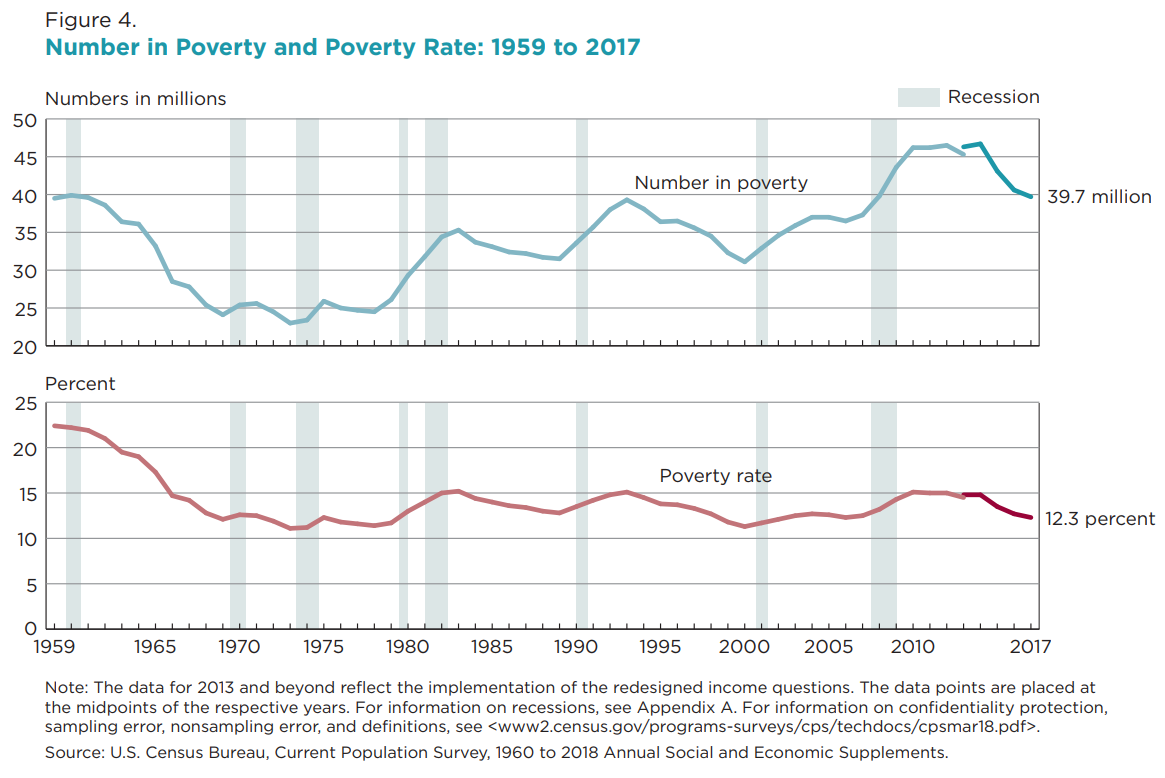
Poverty is not increasing in the US
Number_in_Poverty_and_Poverty_Rate%2C_1959_to_2017.png

https://en.wikipedia.org/wiki/Pover...in_Poverty_and_Poverty_Rate,_1959_to_2017.png

Poverty was once a state that all of humanity existed in: no stored reserves of food or water or extra clothing or shelter. 100% of humanity lived in poverty and now it is declining nearly universally. Nearly all of us have electricity and indoor plumbing and are not food insecure. Poverty declines, even with the worst of governments and economic policies, for a variety of reasons.
 
Hmm, well, I'll give it a try.

If we all accept that we need a government as a practical matter, and that the government needs to be funded, also as a practical matter, and therefore taxes must be collected, the question then becomes, "OK, so what do we tax". We have to tax something or someone after all. In the universe of things that could conceivably be taxed, (such as income, sales (transactions), wealth and so on), I see no reason why taxing wealth is any less fair than the others. Also, it's probably more fair to tax various things, not just income. Now, as far as wealth taxes go, you could conceivably do it every year, or just once, at the end of life.

Does that answer your first question?

The other questions: I'll call it the goldilocks principle. The amount of the tax should be neither too large nor too small. Too small, and there's really no point in bothering at all, is there? Because if it's only a rounding error or tiny insignificant fraction of the government's total revenue, then it's hardly worth the trouble, is it? Too large a haircut, and it becomes confiscatory and punitive and people probably won't accept that either.

Any arbitrary amount? No, I think think the amount should be determined by considering the needs of the government, balance with other forms of tax (sales taxes, property taxes, income taxes) and the benefits to society of lower, rather than higher taxes. Philosophically I am a utilitarian. The most ideal level of overall taxation is hard to determine from pure theory. Let's be empiricists, and observe different societies which have different levels of taxation and government services and see which ones achieve the best overall well-being for the most citizens.

I think that's a pretty good answer (thepretige may come an argue otherwise of course). But I do think that the "meritocracy" side has some valid concerns that are also worthy of consideration. If wealth is passed on it can accumulate in families and that wealth can be used to monopolise power (and wealth creation) to those few families. If that is a valid concern then preventing it is a valid goal, an inheritance tax can be a tool to do so. The amount then is determined in part by how much is necessary to prevent the development of such dynasties of wealth and power, and specifically from preventing them reaching the stage of inequality that allows them to prevent the less well off from finding opportunities both economically and politically.

This is only a statement that such issues potentially exist and can be seen to meaningfully be in conflict with property rights. As to the degree to which they exist I'll leave that to the experts. I think it's clear that this was a very real problem thoughout history, but it's conceivable to me that modern institutions and the rule of law are already doing a good job of preventing the exercise of that power even without preventing the accumulation of wealth and as such inheritance taxes may not be necessary for this goal (I sort of doubt it, though).
 
Capitalism leads to the creation of wealth. It does not concentrate wealth as there is no wealth without an economic system. In the absence of an economic system, everyone is in total poverty.

The highlighted sentence needs more support. Creating wealth isn't mutually exclusive from concentrating wealth.
 

ISF - Join now!

Every member here is approved by hand. No bots, no spam, just people who care about evidence and honest debate.

Membership is free!

Create your free account

Back
Top Bottom