Trebuchet
Penultimate Amazing

I've a vague recollection of driving through Seattle many years ago and seeing a Sea Dart being hoisted over a fence to the Museum of Flight, then in development and not open yet. It probably wasn't.


Anyone know what this one is?
[qimg]https://www.dropbox.com/s/4qdfa43hrorq1kl/2019-06-01%2016.00.28.jpg?raw=1[/qimg]
I caught a glimpse of this on a History Channel programme about the Battle of Britain. I don't recall seeing anything looking like this in that battle.

IIRC, the Avro Shackleton was the end of the design line that started with the Avro Manchester, then the Lancaster, then the Lincoln.Don't forget the Shackleton, some of those had contra rotating props but like the Gannet they are turboprop, not piston engines.


You have only to ask. This is the Red Baron Mustang. A modified P-51D with the Rolls Royce Griffon and contra-rotating props.

Most of the British WW2 bombers I've seen tend to be boxy (and I know the American B-24 was too). Even had boxy noses and windscreens. Isn't this the opposite of streamlining and didn't it take away from speed and range? What was the main advantage? Ease of construction? I though perhaps it enhanced interior space but I believe a cylinder has the max internal volume per surface area (being a pulled out sphere).
They certainly were successful.
Most of the British WW2 bombers I've seen tend to be boxy (and I know the American B-24 was too). Even had boxy noses and windscreens. Isn't this the opposite of streamlining and didn't it take away from speed and range? What was the main advantage? Ease of construction? I though perhaps it enhanced interior space but I believe a cylinder has the max internal volume per surface area (being a pulled out sphere).
They certainly were successful.
It allows a bigger bomb bay and proper nose and tail turrets.

OK, here is one. While it says "Danish Experimental" on this one, the general type was built in several places. The idea was the common man's aircraft. A single seater with an engine of about 30hp, it was not aimed for the higher parts of the sky. It was meant to be easy to fly, having only three controls:
- Rudder
- The angle of the main wing
- Throttle
They could fly, but as already the Brothers Wright found out, you really cannot do without ailerons: There are simply too many situations you cannot get yourself out of, and indeed several of these things crashed. Now they sit in museums here and there.
Hans

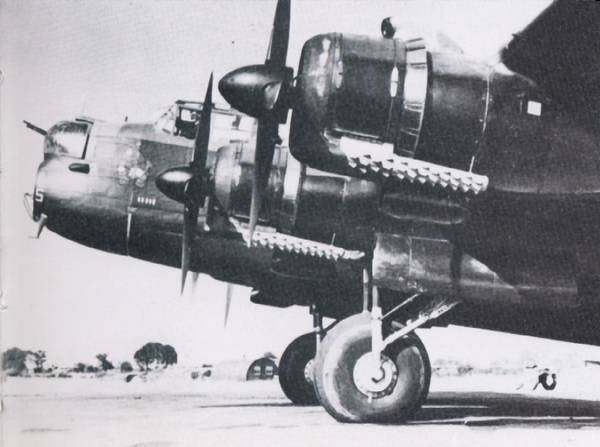

See if you can tell why this was a rare kite: Avro Lancaster B.II.
[qimg]https://cdn-live.warthunder.com/uploads/10/47fea43ad550151eba7d6140a459ba806420fe_mq/92ba616fa6a7d678b10f366b6460fc88.jpg[/qimg]
I saw something similar to this on the Smithsonian channel , It was a home built with a snowmobile engine
It allows a bigger bomb bay and proper nose and tail turrets.
Lancaster
Max speed 282 mph at 13,000 ft
Cruise speed: 200 mph Range: 2,530 mi
Bomb load 14,000 lb or a single 22,000 lb Grand Slam with modifications to bomb bay
Flying Fortress
Max speed 287 mph at 13,000 ft
Cruise speed: 182 mph
Range: 2,000 mi with 6,000 lb
Bomb load 8,000 lb or 4,500 on a long range mission
The design aims were simple: Maximise bomb load and range per aircraft. Speed and altitude were not major factors. Tonnage delivered was the goal. So they were very basic freighters.Most of the British WW2 bombers I've seen tend to be boxy (and I know the American B-24 was too). Even had boxy noses and windscreens. Isn't this the opposite of streamlining and didn't it take away from speed and range? What was the main advantage? Ease of construction? I though perhaps it enhanced interior space but I believe a cylinder has the max internal volume per surface area (being a pulled out sphere).
They certainly were successful.
One reason for the seemingly inferior performance of the B17 was its far heavier defensive armament, up to 13 cal 50 machine-guns. The Lanc had far less and relied on operating at night.
Hans

Any chance of uploading the image to ISF? For complicated reasons completely unconnected with goofing off at work I can't view Dropbox links.
Dave

That's definitely a Fulmar; the section of fuselage skin between the front and rear cockpits means it's not a Battle or the P4/34, that's a Merlin not a Griffon so it isn't a Firefly, and the chin radiator is pretty distinctive too.
Dave
I agree on the Fulmar, but I'm curious: How can you discern a Merlin from a Griffon on such a fuzzy shot? I know the Griffon is larger, still ...

