• Quick note - the problem with Youtube videos not embedding on the forum appears to have been fixed, thanks to ZiprHead. If you do still see problems let me know.

Magic Audiophile Gear

Time to fess up... :)

When I was in my teens I was seriously into high-end audio systems. I couldn't afford a Linn Sondek turntable but I got the next best thing, a Rega Planar 3. Belt driven, glass platter, all black, all manual (just a power switch). I loved it.

I built my own amps and preamps. The only controls on the preamp were source selector and volume.

I built my own speaker enclosures using software I wrote myself to calculate box volume and port specifications from the Thiele/Small parameters.

There were people I knew that tried to sell me fancy cables and things all those years ago, but even as a gullible and naive 16 year old I didn't fall for it. Maybe I was sceptical because I had a much greater understanding of what really makes a difference to the quality of sound reproduction.

Nothing beats learning enough about the theory (Thiele/Small, etc), and the engineering (slew rate limiting, negative feedback, long-tailed differential pairs, etc etc) to know that the stupid volume knob is not worth fussing over.


I go back a little further, back, in fact, to monaural! Did you know that the KT88 tubes in a Dynaco Mark III can be used not only to listen to music, but to roast chestnuts at the same time?
 
I go back a little further, back, in fact, to monaural! Did you know that the KT88 tubes in a Dynaco Mark III can be used not only to listen to music, but to roast chestnuts at the same time?
Ahh that's what I like about guitar amps. :)
 
[
$30,000 for speaker cables....

Nearly 7 grand for a volume knob that improves with a $485 wooden knob...

Don't these people know that all you need to do is to quantumly activate your DNA's frequencies and you'll then be able to hear the music on your CDs energistically? Geeze, some people....
Smokin mother lovin dead alien angel psychic frisbees! Ain't nothing like audiophiles. How many "cases" would Carla Barton have to "solve" to bring in that kind of dough? High end ignorance the way to go. Forget about raising the voices of the dead, just raise the voices of the Grateful Dead an indiscernible notch and collect 30 times the cash. :(
 
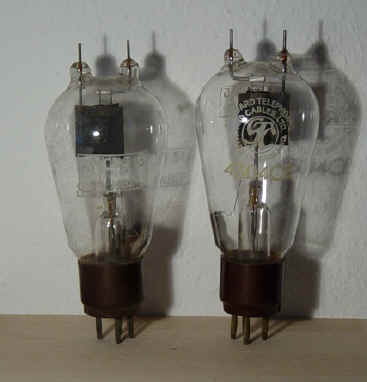
Mmmm, I wonder if I could sell these to one of them tube amplifier buffs:

cv315.jpg


Direct heated triodes. Good for about 30 Watts. Doesn't get more basic than that :rolleyes:. Unfortunately, I only have two.

Hans
 
A Question

Something in this thread triggered a memory of a question that bugged me a while ago.

A friend who was working in an audio shop (a respectable one at that) was talking about a stereo system he was going to buy. Since I have almost no knowledge of these things and he worked in an audio shop, I took his word for most of the stuff being up to his high standards until he mentioned buying a power cable for 200 quid.

I thought something was fishy about this and so I asked him about it. He swears blind that he can tell the difference between a stereo with a regular power cable and this super-duper power cable, says it makes the sound cleaner etc. My question is, is this possible, or is it just a big pile of c**p? I am talking about the cable that plugs between the wall socket and the main stereo unit thing.

My knowledge of power cables is based almost entirely on computer cables where one acts much like the next. I googled around, but the only references I could find looked very woo-like.
 
My question is, is this possible, or is it just a big pile of c**p? I am talking about the cable that plugs between the wall socket and the main stereo unit thing.

My knowledge of power cables is based almost entirely on computer cables where one acts much like the next. I googled around, but the only references I could find looked very woo-like.
Textbook audio woo.
 
I have this sick fantasy of getting together a bunch of these 'golden eared' audiophiles for some listening tests and then giving them actual hearing tests.

"So you say that your super ultra mega sweeter tweeters with hyper cables make all the difference? Funny because our tests show that you can't hear squat past 8khz."

$30k for speaker wire ... might as well just hire the band!!
 
Something in this thread triggered a memory of a question that bugged me a while ago.

A friend who was working in an audio shop (a respectable one at that) was talking about a stereo system he was going to buy. Since I have almost no knowledge of these things and he worked in an audio shop, I took his word for most of the stuff being up to his high standards until he mentioned buying a power cable for 200 quid.

I thought something was fishy about this and so I asked him about it. He swears blind that he can tell the difference between a stereo with a regular power cable and this super-duper power cable, says it makes the sound cleaner etc. My question is, is this possible, or is it just a big pile of c**p? I am talking about the cable that plugs between the wall socket and the main stereo unit thing.

My knowledge of power cables is based almost entirely on computer cables where one acts much like the next. I googled around, but the only references I could find looked very woo-like.


You might suggest to your friend that he could make some cash by demonstrating that ability to the JREF.
 
Something in this thread triggered a memory of a question that bugged me a while ago.

A friend who was working in an audio shop (a respectable one at that) was talking about a stereo system he was going to buy. Since I have almost no knowledge of these things and he worked in an audio shop, I took his word for most of the stuff being up to his high standards until he mentioned buying a power cable for 200 quid.

I thought something was fishy about this and so I asked him about it. He swears blind that he can tell the difference between a stereo with a regular power cable and this super-duper power cable, says it makes the sound cleaner etc. My question is, is this possible, or is it just a big pile of c**p? I am talking about the cable that plugs between the wall socket and the main stereo unit thing.

My knowledge of power cables is based almost entirely on computer cables where one acts much like the next. I googled around, but the only references I could find looked very woo-like.

If the original cables are, like most power cables, covered by safety standards that ensure that they can handle the current, then there is nothing to be gained by changing them. There is no signal passing through them, and the frequencies involved are entirely within the capability of any kind of wire. In American systems, it is actually remotely possible that there is something to be gained by replacing either the plug or the outlet if there is wear. Most American-made plugs use a folded-over prong that has some spring to it, but Japanese plugs are solid. When outlets wear, the Japanese plugs, especially, can become loose and cause voltage drop or intermittent loss of power, even. But this is a malfunction, and all you need to do is fix the bad outlet, or in the case of an American plug, stick a screwdriver into the prong and expand it a bit.

But it is at least theoretically possible for sound to suffer from inadequate power cables. It's actually a pretty common problem when powerful car audio systems are wired into standard radio harnesses. It's extremely unlikely in a home system, where safety standards ensure adequate current handling capacity.
 
But it is at least theoretically possible for sound to suffer from inadequate power cables.
Can you explain how? In what ways does the sound suffer. The only experience that I've had like this is batteries in a cassette tape walkman. Once the batteries get near to empty, they are giving out some power but not enough to turn the wheels at full speed so the tape slows down and things start sounding funny. I’ve never noticed any difference brand new batteries and batteries that have been used for several hours, and I wouldn’t expect any difference because they both have the power to turn the wheels at the expected rates.

So how would it be ‘theoretically possible’ for sound to suffer from ‘inadequate power cables’? It seems the power cable would have to be so inadequate that they could not fully move the mechanical parts of the sound system. Perhaps I’m missing something? :con2:
 
If the power cable is not able to handle the current needed for the equipment, then the supply voltage would be unstable, and the sound quality might suffer (and the cable would get hot). However, unless you are working with kilowatt amplifiers, even the cheapest mains cable can easily carry sufficient current.

As Bruto mentions, the problem can occur wit hsystems that run on low-voltage DC, like car systems, but that is another matter.
 
Can you explain how? In what ways does the sound suffer. The only experience that I've had like this is batteries in a cassette tape walkman. Once the batteries get near to empty, they are giving out some power but not enough to turn the wheels at full speed so the tape slows down and things start sounding funny. I’ve never noticed any difference brand new batteries and batteries that have been used for several hours, and I wouldn’t expect any difference because they both have the power to turn the wheels at the expected rates.

So how would it be ‘theoretically possible’ for sound to suffer from ‘inadequate power cables’? It seems the power cable would have to be so inadequate that they could not fully move the mechanical parts of the sound system. Perhaps I’m missing something? :con2:

What Hans says, above. There are no moving parts in an audio amplifier but performance depends on cdertain voltage levels being maintained. It's highly unlikely that power cords will be a factor in a 115 or 220 volt audio system unless there's a malfunction such as a defective cord or plug that heats up. Even the most powerful stereo receivers made use less current than a two-slice toaster. On the other hand, I've seen even modestly powered car stereos installed in factory wiring harnesses of cars, whose dial lights dimmed on hard bass notes, owing to voltage drop in the thin wiring. A medium powered car stereo could easily draw more amperes through its supply wires than even the most powerful home receiver.

(Ohm's law: volts times amperes equals watts. So 50 watts at 12 volts requires wiring good for 4.16 amps. 50 watts at 220 volts pulls less than a quarter of an ampere.)
 
This site did not list the latest product from Machina Dynamica called the Clever Little Clock. Endorsed by none other then M. Anda of Intelligent Chip fame. He'll be back next year to claim the million as apparently this clock improves his system even more than the chip does. Another scientific breakthrough reserved only for the gullable audiophile.
 
If the power cable is not able to handle the current needed for the equipment, then the supply voltage would be unstable, and the sound quality might suffer (and the cable would get hot). However, unless you are working with kilowatt amplifiers, even the cheapest mains cable can easily carry sufficient current.

As Bruto mentions, the problem can occur wit hsystems that run on low-voltage DC, like car systems, but that is another matter.


I actually posted a thread on a website dedicated to a famous BBC speaker decrying the trend towards very expensive speaker wire and offering to fund a Double Blind Test of wires, stipulating only that wires with broadly similar resistance and capacitance should be used. I also expressed myself reasonably forcefully on the subject of power cables, pointing out the negligible effect such devices could have compared with the many metres installed by the local Bob the Builder. I also suggested that an application to JREF was obviously the next step for the golden eared in the forum.
For this I was declared 'IGNOARANT' (sic) and so abused that I have stopped subscribing to the afore mentioned forum. I think some audiophiles are not willing to listen either to the facts or, indeed, their ears.
 
On top of all that has been said already about power cables...

Any decent audio equipment is going to have very good voltage regulation, which will compensate for quite a bit of voltage drop from the mains power.
 
On top of all that has been said already about power cables...

Any decent audio equipment is going to have very good voltage regulation, which will compensate for quite a bit of voltage drop from the mains power.

A good point, in the era of transistorized equipment. Once upon a time, that might not have been true, as few tube sets were actively regulated, but I think now if you look at most equipment you'll see that a rather wide voltage range is specified as normal.

On the subject of speaker wire, the DCM speakers I own, which were once considered pretty exotic (and which sound awfully good, too), came with instructions to use good quality zip cord.
 
This site did not list the latest product from Machina Dynamica called the Clever Little Clock. Endorsed by none other then M. Anda of Intelligent Chip fame. He'll be back next year to claim the million as apparently this clock improves his system even more than the chip does. Another scientific breakthrough reserved only for the gullable audiophile.
You mean this? Good grief, I can't believe that this isn't satire. Hell, they say in the product description itself that this thing does nothing!
Machina Dynamica said:
The Clever Little Clock does not plug into the wall and has no direct influence on the audio signal -- not on house wiring, audio components, cables, interconnects, power cords or acoustic waves. Yet the Clock has a real and profound affect on the sound.
Must be magic, I guess. And only $149 -- but if you buy more, the non-existant effects are cumulative! :oldroll:
 

Back
Top Bottom