3point14
Pi
- Joined
- Nov 4, 2005
- Messages
- 23,107
(I'm not saying they're not fiction, the older religions. They are. At least, that is my opinion. But I don't think they're quite as obviously fictional as, say, cargo cults or Hogwarts.
Why?
(I'm not saying they're not fiction, the older religions. They are. At least, that is my opinion. But I don't think they're quite as obviously fictional as, say, cargo cults or Hogwarts.
Yes, of course.
No.
No, not really.
Yes. (I'm not really into telling law enforcement what to do, but if the question had been, 'Did the chemist cause the woman's death?', my answer would have been yes.
By the way, I don't agree with the objection to Kohlberg that his stories were hypothetical. It's not difficult to find similar stories in real life: May Martin Shkreli (Wikipedia) rot in the hell that I don't believe in, and let him be joined by everybody who is trying to abolish health care for poor people.)
Why?
Because they are pre-science cosmologies. They are as good as they were able to understand the universe at that time.
That is the difference!
And not, why? Why is not a science question, how is!!!
E.g. how do you explain the difference between modern and non-modern religions?
I'm afraid I find the hard atheist's stance just as iffy as the theist's.
More than one poster, presumably hard atheists all, has brought up Harry Potter and cargo cults in this thread.
Think of a time, in the future, when somehow the details of who wrote these books is lost. All you have are these volumes, attributed to someone called J K Rowling, who might, for all we know, be fictional herself. And you have -- let's say -- large numbers of people who seem to believe the contents of these books are based on fact.
In such a scenario, surely a research into the provenance of these books would be a valid exercise? And surely soft a-Potterism, hard a-Potterism, and plain agnosticism would each be valid stances to adopt?
Further: might the goings-on in these books be actually based on some kind of occult practices and rituals practiced by these ancients of the 21st century? Surely that too would not be at all certain, and a valid subject for serious 'research'?
That Hogwarts and cargo cults and Scientology are very easily dismissed as fiction today have little to do with our dismissing the older, more complex religions as fiction.
(I'm not saying they're not fiction, the older religions. They are. At least, that is my opinion. But I don't think they're quite as obviously fictional as, say, cargo cults or Hogwarts. If that is the reasoning that leads us to our atheism, then I'm afraid we're being as irrational as the theist.)

Because people were more credulous then we can't dismiss their writings as fiction because they really believed it? - is that actually the argument? We're bowing to the greater knowledge of mescalined up stone age mystics?
That sounds like, not to be to frank about it, utter tosh.
I don't need to. Delusional people are delusional in any age. Of course, many centuries ago there was every excuse for deluded ignorance and wishful thinking. Since then we've had an enlightenment which you may have read of.
So the 85-90% of all adults have not reflected about ethics. That is no different than saying religious have not reflected about religion.
And it means it also applies to non-religious people, because non-religious also hold moral views, so it is likely that a majority of non-religious people have not reflected about ethical principles.
So it matters, that there are delusional people, i.e. it matters or you brought it for no reason at all.
So I will go with that it matters. The problem is "that it matters" is not science nor a fact like gravity. It is your first person subjective belief. It means you hold a non-factual belief.
Google: Delusion: an idiosyncratic belief or impression maintained despite being contradicted by reality or rational argument, typically as a symptom of mental disorder.
Now if you accept that it is belief, you are off the hook for now. If you claim it is a scientific fact "that it matters", you are delusional.
The scientific method can't be used to do first person subjective beliefs. It can explain how they are natural, but can't do first person subjective beliefs.
Now if you admit, "that it matters" is a belief, you admit that science can't do everything.
Well, at least I hope that the people of your imaginary future won't think that Voldemort is the hero of tales of Harry Potter - the way that some Bible thumpers seem to think that the guy in the Old Testament spreading death, disease and terror and demanding unconditional submission is!![]()
The number you quote is based on a sloppy study done on 10-16 year old boys. Why would you think the conclusions apply to adults?
The study made no distinction between theist and atheist so how can you say that conclusions reached apply equally to each. The 10-15% quoted could actually line up along those lines in that there were roughly <15% who claimed to be atheists and theists tend to get their morality from their religious indoctrination while atheists tend to get it through rational thought.
So the 85-90% of all adults have not reflected about ethics. That is no different than saying religious have not reflected about religion.
And it means it also applies to non-religious people, because non-religious also hold moral views, so it is likely that a majority of non-religious people have not reflected about ethical principles.
No, read more.
So an atheist communist or fascist or Ayn Rand objectivist or racist are all rational?
Most people get their morality from culture. It doesn't follow that atheists just because they are atheists apply rationality on morality.
Of one the two, strong versus soft atheist, is irrational.
That most scientists are atheists doesn't tell us, if they are strong or soft.
I'm afraid I find the hard atheist's stance just as iffy as the theist's.
Why?
...
Got a citation for either of those?
https://en.wikipedia.org/wiki/List_of_atheists_in_science_and_technologyThis is a list of atheists in science and technology. Per wikipedia policy WP:BLPCAT, persons in this list are people (living or not) who have publicly identified themselves as atheists or have been historically known to be atheists and whose atheism is relevant to their notable activities or public life. A mere statement by a person that he or she does not believe in God does not meet the criteria for inclusion on this list. Their atheism must be relevant to their notable activities or public life in order to be included on this list.
...Actually, it does? The culture of an atheist is far more rational than that of a religiously indoctrinated, delusional theist.
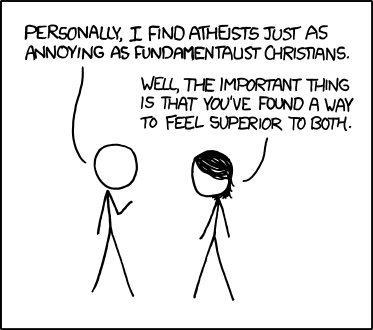
Heh, nice! I enjoyed that joke.
Except -- if I may be inappropriately solemn and serious in analyzing that joke -- it conflates atheism with hard atheism (either out of ignorance, or else deliberately and disingenuously); and also misrepresents both the intent and the sentiments of the soft atheist.
ETA : It's a nice joke, funny enough, but falls flat if seen as an actual argument. I hope you did not present it other than just for the laughs?
For instance, I am open to changing my mind, if given good reason to. Also : I am more accommodative of subjective beliefs of theists (and of hard atheists), as long as they realize the subjectivity of their stance, and provided they do not attempt to proselytize those personal subjective opinions and beliefs.
...
Actually, it does? The culture of an atheist is far more rational than that of a religiously indoctrinated, delusional theist.
...
Heh, nice! I enjoyed that joke.
Except -- if I may be inappropriately solemn and serious in analyzing that joke -- it conflates atheism with hard atheism (either out of ignorance, or else deliberately and disingenuously); and also misrepresents both the intent and the sentiments of the soft atheist.
ETA : It's a nice joke, funny enough, but falls flat if seen as an actual argument. I hope you did not present it other than just for the laughs?