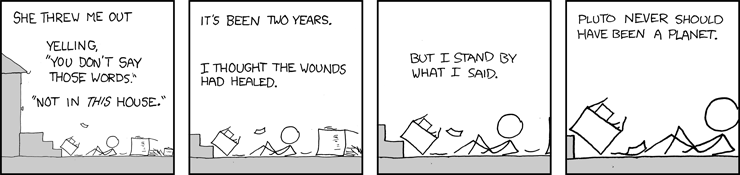
Pluto is was and always will be a planet

While this might be regarded as a fun thread, scientific input would be appreciated. I thought the relegation was a disgrace at the time, but New Horizon laid proof like an EGG.

Sorry, skipped most of the thread. Pluto is what it is. It always was and it always will be. Us humans may, however, change our definition of the word 'planet' quite arbitrarily.

This will not affect Pluto in the slightest.

Hans
 
What if the number is 10,000? Just asking.

I think it’s literally unimportant how many there are. As mentioned before, we don’t have to know all the names but are likely to remember plenty of the most obvious ones as we do with mountains, rivers, animal species, dinosaurs, bacteria, and almost any other class of objects and we are still likely to say something like “there are major planets such as the four terrestrial planets within the asteroid belt, four Jovian planets (or gas or ice giants) and then there are the Kuiper Belt planets such as Pluto, Eris, Makemake, etc...a few prominent asteroids and of course the billions of planets outside the solar system which vary in considerable ways...”
 
Subcategories for ease of study focus. Naming only the ones that need naming, and leaving the rest to their serial numbers.

Ok that's the solution, but what's the problem?

Similarly, Astronomers didn't look at the Andromeda Galaxy and the Magellanic Clouds, and say, "we'd better narrow the definition of 'galaxy' otherwise we'll have to name trillions of the things." No, they just stopped naming every new galaxy they found.

Again you seem to be misunderstanding what I was saying about names.
 
I think it's a major part of the reason, yes. It may not be the whole story.


No. Make your case.


Sorry, that's the definition now. I think you have the burden to argue against it. Hell, I don't even agree with the definition. At least explain why.

I did explain why. I was trying to be polite by saying "maybe I'm wrong, if so I'll listen to what you have to say".

But sure, I'll try one more time. We have categories that differentiates between different kinds of objects. We choose that choose those categories because there are differences between different kinds of objects that we want to be able to understand. It turns out that one of those categories has many members in it. That can't affect the fact that the initial differences between those categories exists, nor does it change the fact that the similarities across objects within those categories exist.

If all planets were literally exact copies of each other, but there happened to be 10,000 of them in our solar system, the fact that there are 10,000 couldn't justify not calling them all planets. Some other criterion is necessary.
 
So you don't agree that a problem exists, then. I wanted to check.

The problem is that there are too many objects in a set to know each individually. Giving each a name is an example of that. The solution is to study individually only those members of the set that merit individual study.

The solution is clearly not to change the category so as to exclude most of it's members: those objects will still exist and to what extent we wish to understand their nature, we will still want to understand their nature after that division, so their exclusion from the category solves no problems. At most it makes our categories less useful (by basing their characteristics on something other than that nature of the category). The similarities that they share with objects that we continue to call planets will continue to be shared, but the redefinition makes that slightly less obvious.
 
If all planets were literally exact copies of each other, but there happened to be 10,000 of them in our solar system, the fact that there are 10,000 couldn't justify not calling them all planets. Some other criterion is necessary.

I believe I've already agreed to that.

The solution is to study individually only those members of the set that merit individual study.

That sounds reasonable.

Question: how would you define "planet"?
 
So you don't agree that a problem exists, then. I wanted to check.
Rule of So. I agree that the problem was already solved by methods commonplace in science generally and astronomy particularly. The question, of whether a problem that has already been solved still exists, is a philosophical one. It's also irrelevant.

Do you agree that the problem had already been solved? Do you agree that reclassifiying the planets was unnecessary, since astronomers already had solutions ready to hand?
 
Rule of So. I agree that the problem was already solved by methods commonplace in science generally and astronomy particularly. The question, of whether a problem that has already been solved still exists, is a philosophical one. It's also irrelevant.

Well now I'm confused. Do you think there was a problem to be solved or not? You seemed to indicate ("apparently") that you didn't in your last post. Would it be too much to ask for you to make it clear?

Do you agree that the problem had already been solved?

The problem of "too many planets"? How was it solved because they proposed a solution? You're all over the place.
 
still_raw.png


This work is licensed under a Creative Commons Attribution-NonCommercial 2.5 License.
 
Well now I'm confused. Do you think there was a problem to be solved or not? You seemed to indicate ("apparently") that you didn't in your last post. Would it be too much to ask for you to make it clear?
I really don't understand this line of inquiry at all.

You're the one saying there's a problem with too many planets, necessitating a solution of some sort.

I'm asking that if too many planets is a problem, why not solve it with subcategories, the same way astronomers have done with stars?

But this conversation is starting to get very one-sided. I've been answering your questions, but you keep truncating my posts and ignoring mine. If you're not going to answer my questions, Belz..., why should I keep answering yours?

The problem of "too many planets"? How was it solved because they proposed a solution? You're all over the place.

It was solved because a solution already existed, in the form of subcategorization. In fact, the subcategorization of stars is a well-known and widely-accepted solution among astronomers, to the problem of having lots of stars.

Thus another solution - reclassification - was unnecessary. Why, then, was it proposed? Why was it adopted?
 
I think that Neil DeGrasse Tyson's argument mainly came down to "One of these things is not like the others"

And that Pluto is essentially a Kuiper object held by Neptune's gravity. Now the new suggested Planet Nine, that will cause some more controversy, it will be very hard to tell if it cleared out its orbit.
:)
 
Gentlemen,

In my hand I have a Plum. What if I take this Plum (and only this Plum!) and put it on the table? I take the Plum and put it back on the table, like so.

The Plum is now back on the table. And we just ... just walk away. Just like that! Cuz' it's only a Plum ... sitting on a table.

There's no losers here. Only winners! Cuz' it's only a Plum ... sitting on a table.
 
Rule of So. I agree that the problem was already solved by methods commonplace in science generally and astronomy particularly. The question, of whether a problem that has already been solved still exists, is a philosophical one. It's also irrelevant.

Do you agree that the problem had already been solved? Do you agree that reclassifiying the planets was unnecessary, since astronomers already had solutions ready to hand?

Not a problem. Rather, a question of refining taxonomies and assigned classifications based on advancing knowledge about that region of space and bodies such as Pluto and Charon. This is simply what happens when data informs and consistent treatment thereof begs... consistency.

Or, yes a problem: emotion.
 
Not a problem. Rather, a question of refining taxonomies and assigned classifications based on advancing knowledge about that region of space and bodies such as Pluto and Charon. This is simply what happens when data informs and consistent treatment thereof begs... consistency.

Or, yes a problem: emotion.

Emotion isn't the problem. NGT passing off a subjective opinion as consistent treatment of data might be a problem.
 

Back
Top Bottom