Cont: Proof of Immortality VIII

Big image. Much woke. Wow.

[IMGw=640]https://i.imgur.com/FlgdrBs.png[/IMGw]
 
Last edited by a moderator:

js,
- Yeah, that's what I mean -- but, the fact that P(Heads) = P(Tails) [two priors] = .05 doesn't say anything about the posterior probability of the nickle being fair.
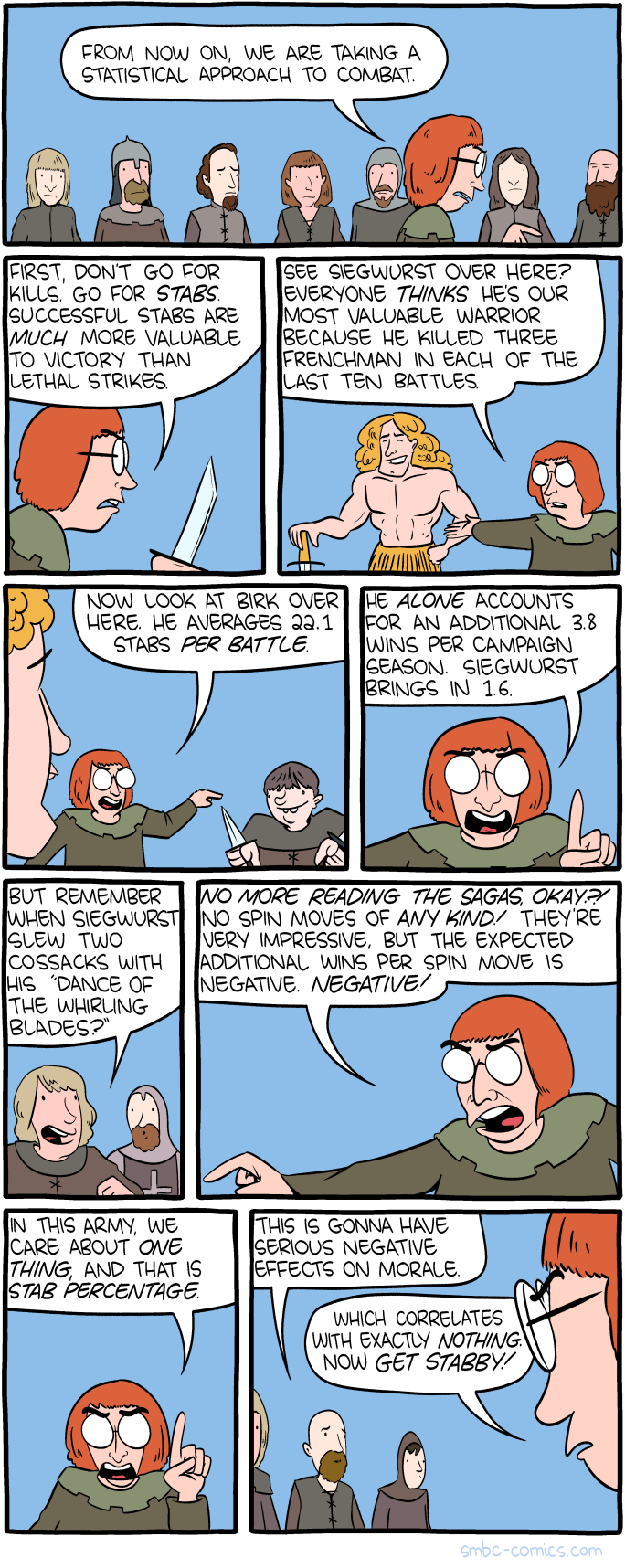
That's it. I'm convinced the author of "Saturday morning Breakfast Cereal" is reading this thread.

https://www.smbc-comics.com/comic/moneybattle

(Click the link to see the mouse-over text and bonus panel.)

1523283220-20180409.png
 
jabba,
The interesting part of this little exercise is not that you have finally reached an operational definition for "fair", but the trouble you had reaching it. Do remember that this was a simple example that you put forward (because you thought you could relate to your immortality proof). It is a simple example, too, but you have stumbled at every step.

Now that you've settled on the interval, (0.499, 0.501), you'll need a probability distribution function and a bit of Calculus to come up with P(F), your prior probability for the fairness of your nickel. It is likely you have no idea what to make of the former and have no proficiency with the latter.

The only thing you have is an inference formula and a firm belief that if you plug in the right numbers you'll establish the "truth" of your immortality. You are way over your head. Your knowledge of statistics is minimal, and you simply do not know what you do not know.
I think you need some ice for that burn Jabba.
 
Last edited:
Jabba,

Suppose you toss a coin ten times, and it comes up heads every time. However, you have previously examined the coin, tested it carefully, and determined unambiguously that it is completely unbiased. What is the probability, given that all ten tosses were heads, that the coin is fair?

Now, suppose you toss a coin that you know to be double-headed ten times, and it comes up heads every time. What now is the probability, given that all ten tosses were heads, that the coin is fair?

In the first case, the prior probability that the coin is fair is 1. In the second, the prior probability is zero. In the first case, therefore, the likelihood that the coin is fair is 1; it cannot be less. And in the second case, the likelihood is 0; it cannot be more.

Now, suppose you toss a third coin ten times, and it comes up heads every time. What is the probability, based on this knowledge alone, that the coin is fair? The only possible answer is that you cannot know that probability; you do not know a prior probability that the coin is fair, so you have insufficient data.

Dave
Dave,
- Good questions!
- I'll be back. I've got to talk to js first.
 
Now that you've settled on the interval, (0.499, 0.501),
His first instinct - first! - is to pull numbers out of his ass. Hey, why not take an interval of plus or minus one-thousandth. Not - hey let's build a coin-flipper and measure an actual bunch of flips, not - hey, let's google for data that someone else has surely compiled on flipping nickels, not - hey, I wonder if the way that you flip the coin affects the outcome. Etc.

No - he just ********s his way to plus or minus one thousandth from one half. Make of that what you will.
 
jabba,
The interesting part of this little exercise is not that you have finally reached an operational definition for "fair", but the trouble you had reaching it. Do remember that this was a simple example that you put forward (because you thought you could relate to your immortality proof). It is a simple example, too, but you have stumbled at every step.

Now that you've settled on the interval, (0.499, 0.501), you'll need a probability distribution function and a bit of Calculus to come up with P(F), your prior probability for the fairness of your nickel. It is likely you have no idea what to make of the former and have no proficiency with the latter.

The only thing you have is an inference formula and a firm belief that if you plug in the right numbers you'll establish the "truth" of your immortality. You are way over your head. Your knowledge of statistics is minimal, and you simply do not know what you do not know.
- But, I'm trying to find out.
js,
- Just to let you know -- despite beginning to realize how little of the nuances re Bayes I understand, I still think I'm right about the big picture...
- I think that I have a major question to ask, but I need some time to figure out the wording.
- I'll be back.
 
- But, I'm trying to find out.

"Trying to find out" implies that you're open to solutions and answers you didn't want or expect.

The only answer you want is that you're immortal. As such you are, in fact, NOT trying to find out. You are ignoring every solution you dislike.

- Just to let you know -- despite beginning to realize how little of the nuances re Bayes I understand, I still think I'm right about the big picture...

You're wrong about every single pixel that composes that picture. You're talking nonsense. Now stop wasting our time and respond to Jay's ENTIRE list as asked.

- I think that I have a major question to ask, but I need some time to figure out the wording.

Somehow I predict that wording won't be the issue.
 
- But, I'm trying to find out.
js,
- Just to let you know -- despite beginning to realize how little of the nuances re Bayes I understand, I still think I'm right about the big picture...

That is because you don't know what you don't know.

And they are not nuances, nor are they limited to just Bayes inference. Likelihood is not a nuance; prior is not a nuance; continuous vs. discrete functions is not a nuance; P(A) = P(A|B)P(B) + P(A|~B)P(~B) is not a nuance. The Texas Sharpshooter Fallacy is not a nuance. And, with respect to your made-up numbers, GIGO is not a nuance.
 
- But, I'm trying to find out.
js,
- Just to let you know -- despite beginning to realize how little of the nuances re Bayes I understand, I still think I'm right about the big picture...
- I think that I have a major question to ask, but I need some time to figure out the wording.
- I'll be back.
- Re the case of the fair nickle, the difficult part to fill in is P(E).
- Given that P(E) is the same as P(E|H)P(H) + P(E|~H)P(~H) when dealing with complementary hypotheses, I'm going to try to calculate P(~H) in the case of the nickle. Not easy.
- I need to sum the prior probabilities of the different possibilities.
- That seems pretty tricky.
- Could be that both sides are heads, both sides are tails or the nickle is somehow "loaded" one way or another. Say that I had a pocket full of "fair" (as far as I know) change, I take out a nickle and begin flipping.
- I just know that each of those possibilities is extremely unlikely, so I'll try .001 for each.
- Then, I calculate the probability of getting 10 heads with each of the possibilities. Heads on both sides gives me 1. Tails on both sides gives me 0. Loaded includes an infinity of possible versions, but say .10.
- Then, I multiply .001 times 1, times 0 and .10. Or, .001, 0 and .0001
- I add those up and get .0011.

- Grimacing -- does this make sense so far?
 
...I still think I'm right about the big picture.

No. You don't understand statistics fundamentals. Back when you were trying to count the centuries in all of time, I and several others tried to explain the notion of probability density to you. You had no clue what we were talking about, and still don't. You still don't seem to understand the notion of probability as a continuous function, or what a complement is. These are elementary concepts in statistics. Further, you don't understand basic propositional logic such as avoiding false dilemmas and circular reasoning. No, you don't have a good big-picture understanding of what you're trying to do. Or a working low-level understanding. As others have noted, your thinking is broken in some way at every level.

It's also especially insulting for you to tell us that today you want to rest on your big picture, when all day yesterday you were whining about having to have the discussion at that level. For nine months I've been trying to get you to address your big-picture errors in a way that emphasizes that they are big-picture problems. Standing back and looking at the "big picture," I see a dozen or so problems at that scope that doom your proof. And three times now you've taken up the gauntlet to discuss your "big picture" problems. But every single time, you insist that we have to drive the discuss back down to sub-sub-sub-issues.

I need some time to figure out the wording.

I'm not holding my breath. When you "figure out the wording," more often than not this means you trying to come up with some mealy-mouthed wordplay to hide logical and mathematical errors. The fact that you know you need to hide them means the deception is intended. You want to fool people into thinking you're an unsung genius who has beaten those godless atheists at their own game. Only it's harder to do that with math than with archaeology. Math has fixed rules that make it work. They don't work for you, so you try to rewrite logic and math to create the illusion of success, just like you try to cheat and rewrite my rules for big-picture analysis. You want all the applause, but you aren't willing to do any of the work.

Your argument is just one long ongoing shell game. If you get backed into a corner, you just rearrange the shells and play again. Can't figure out the Texas sharpshooter fallacy? Yikes, better leave that alone and talk about the nature of the self. Can't get past the accusations of question-begging? Ooh, better bring up the lottery example again. Now today you're having to deal with your ignorance of the nuts and bolts of statistical analysis. Ooh, better back away from the details and push the "big picture." Except that that was yesterday's shell -- you couldn't cope with the "big picture" so you pressed on with the details of a simple statistics example.

And it's sad that you can't seem to believe all your critics can see that this is what you're doing. I don't know if your "effective debate" fiasco has ever worked on anyone before, but if it has then you must have been in some pretty foggy company. Your argument is nothing but flim-flammery, Jabba. You are just trying to con someone into believing you are who you say you are.
 
Given that P(E) is the same as P(E|H)P(H) + P(E|~H)P(~H) when dealing with complementary hypotheses...

You're not dealing with complementary hypotheses. You're dealing with continuous probability.

I need to sum the prior probabilities of the different possibilities.
That seems pretty tricky.

You can't enumerate all the different possibilities in the complement. That's why we call it the complement. It has a probability distribution associated with it, but it's not a useful distribution because the complement is not itself a singular hypothesis.

I just know that each of those possibilities is extremely unlikely, so I'll try .001 for each.

No. As usual you're just drawing numbers out of your orifice. This is not how statistics works.

...does this make sense so far?

It makes perfect sense, but not in the way you had hoped. What makes sense is that you simply don't know how statistical reasoning works at any level. At. Any. Level. You've apparently taken a part of some elementary statistics course, and you're trying to buttress that with stuff you hastily Google (and a whole lot of gaslighting). But you really don't know what you're talking about.
 
If you get backed into a corner, you just rearrange the shells and play again.

He's never not in the corner, because he can't find a way to get out. Then he goes for sub-issues and gets corned in those as well. He's backed into the corner's corner's corner. It's fractal cornering.
 
-
- Just to let you know -- despite beginning to realize how little of the nuances re Bayes I understand, I still think I'm right about the big picture...
- I think that I have a major question to ask, but I need some time to figure out

:dl:
 

Back
Top Bottom