halleyscomet
Penultimate Amazing

- Joined
- Dec 7, 2012
- Messages
- 10,259
Big image. Much woke. Wow.
[IMGw=640]https://i.imgur.com/FlgdrBs.png[/IMGw]
Last edited by a moderator:

js,
- Yeah, that's what I mean -- but, the fact that P(Heads) = P(Tails) [two priors] = .05 doesn't say anything about the posterior probability of the nickle being fair.

I think you need some ice for that burn Jabba.jabba,
The interesting part of this little exercise is not that you have finally reached an operational definition for "fair", but the trouble you had reaching it. Do remember that this was a simple example that you put forward (because you thought you could relate to your immortality proof). It is a simple example, too, but you have stumbled at every step.
Now that you've settled on the interval, (0.499, 0.501), you'll need a probability distribution function and a bit of Calculus to come up with P(F), your prior probability for the fairness of your nickel. It is likely you have no idea what to make of the former and have no proficiency with the latter.
The only thing you have is an inference formula and a firm belief that if you plug in the right numbers you'll establish the "truth" of your immortality. You are way over your head. Your knowledge of statistics is minimal, and you simply do not know what you do not know.
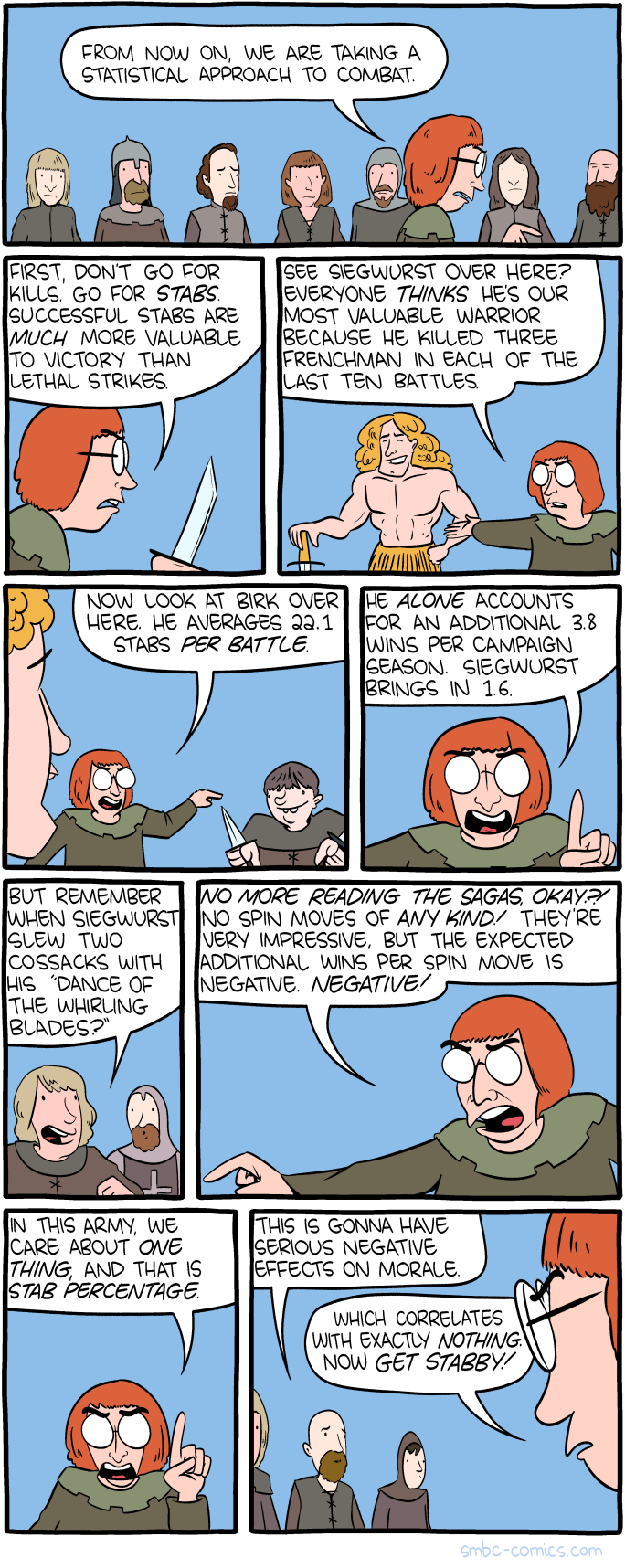
That's it. I'm convinced the author of "Saturday morning Breakfast Cereal" is reading this thread.

Dave,Jabba,
Suppose you toss a coin ten times, and it comes up heads every time. However, you have previously examined the coin, tested it carefully, and determined unambiguously that it is completely unbiased. What is the probability, given that all ten tosses were heads, that the coin is fair?
Now, suppose you toss a coin that you know to be double-headed ten times, and it comes up heads every time. What now is the probability, given that all ten tosses were heads, that the coin is fair?
In the first case, the prior probability that the coin is fair is 1. In the second, the prior probability is zero. In the first case, therefore, the likelihood that the coin is fair is 1; it cannot be less. And in the second case, the likelihood is 0; it cannot be more.
Now, suppose you toss a third coin ten times, and it comes up heads every time. What is the probability, based on this knowledge alone, that the coin is fair? The only possible answer is that you cannot know that probability; you do not know a prior probability that the coin is fair, so you have insufficient data.
Dave
His first instinct - first! - is to pull numbers out of his ass. Hey, why not take an interval of plus or minus one-thousandth. Not - hey let's build a coin-flipper and measure an actual bunch of flips, not - hey, let's google for data that someone else has surely compiled on flipping nickels, not - hey, I wonder if the way that you flip the coin affects the outcome. Etc.Now that you've settled on the interval, (0.499, 0.501),

I've got to talk to js first.

It is not! That's
JABBARISH!
Now you apologize to Mr. Savage. Go on.
We're waiting.
- But, I'm trying to find out.jabba,
The interesting part of this little exercise is not that you have finally reached an operational definition for "fair", but the trouble you had reaching it. Do remember that this was a simple example that you put forward (because you thought you could relate to your immortality proof). It is a simple example, too, but you have stumbled at every step.
Now that you've settled on the interval, (0.499, 0.501), you'll need a probability distribution function and a bit of Calculus to come up with P(F), your prior probability for the fairness of your nickel. It is likely you have no idea what to make of the former and have no proficiency with the latter.
The only thing you have is an inference formula and a firm belief that if you plug in the right numbers you'll establish the "truth" of your immortality. You are way over your head. Your knowledge of statistics is minimal, and you simply do not know what you do not know.
- But, I'm trying to find out.
- Just to let you know -- despite beginning to realize how little of the nuances re Bayes I understand, I still think I'm right about the big picture...
- I think that I have a major question to ask, but I need some time to figure out the wording.

- But, I'm trying to find out.
js,
- Just to let you know -- despite beginning to realize how little of the nuances re Bayes I understand, I still think I'm right about the big picture...

That's it. I'm convinced the author of "Saturday morning Breakfast Cereal" is reading this thread.
https://www.smbc-comics.com/comic/moneybattle
- Re the case of the fair nickle, the difficult part to fill in is P(E).- But, I'm trying to find out.
js,
- Just to let you know -- despite beginning to realize how little of the nuances re Bayes I understand, I still think I'm right about the big picture...
- I think that I have a major question to ask, but I need some time to figure out the wording.
- I'll be back.

...I still think I'm right about the big picture.
I need some time to figure out the wording.
Given that P(E) is the same as P(E|H)P(H) + P(E|~H)P(~H) when dealing with complementary hypotheses...
I need to sum the prior probabilities of the different possibilities.
That seems pretty tricky.
I just know that each of those possibilities is extremely unlikely, so I'll try .001 for each.
...does this make sense so far?
- Grimacing -- does this make sense so far?
If you get backed into a corner, you just rearrange the shells and play again.
- I just know that each of those possibilities is extremely unlikely
so I'll try .001 for each.

-
- Just to let you know -- despite beginning to realize how little of the nuances re Bayes I understand, I still think I'm right about the big picture...
- I think that I have a major question to ask, but I need some time to figure out

does this make sense so far?
