Skeptics and nuclear power

Skeptic and Suport nuclear power

  • Skeptic and support nuclear power

    Votes: 94 90.4%
  • Skeptic and against nuclear power

    Votes: 6 5.8%
  • Not a skeptic and support nuclear power

    Votes: 0 0.0%
  • Not a skeptic and against nuclear power

    Votes: 0 0.0%
  • I don't want to answer

    Votes: 4 3.8%

  • Total voters
    104
It is also complicated by the reality of exposure to radiation from many other sources from bananas to frequent flyer, dentists to cancer survivors like me who are treated with potentially lethal levels of radiation to cure ..not kill.

This should be required understanding

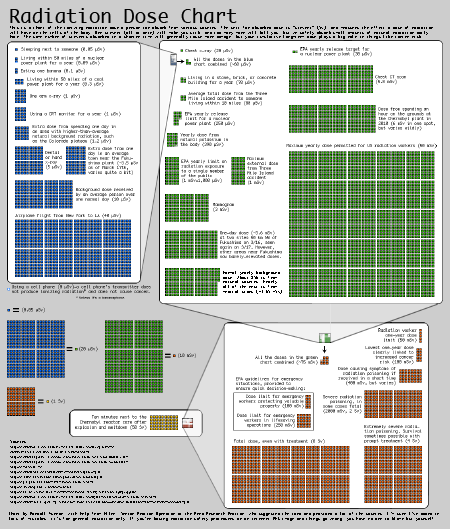
radiation_450.png


larger https://xkcd.com/radiation/

For instance a chest scan and spending an hour on the grounds of Chernobyl are similar...the chest scan is higher.

People are seriously stupid about radiation risk.
 
Last edited:
Switzerland, Norway and many other countries have used hydroelectric with no significant issues for decades. Even the recent failure in the US, admittedly caused by poor maintenance, did not cause serious harm.

That's a good point.

Similarly Chernobyl happened in the USSR, but nuclear power has a very good record in France, Canada, the US, etc.
 
Why stop there, why not include all the Uranium in the asteroid belt? Commercial availability is about the same at this point.

Do you deny that it has been demonstrated that the uranium in the oceans can be recovered economically?

http://large.stanford.edu/courses/2012/ph241/ferguson2/

Is seawater extraction economically viable? Japanese research suggests the lowest possible cost to extract uranium is 25,000 Yen per kilogram of uranium. [4] At the current exchange rate (March 2012, 1USD ~ 81 JPY), that equates to about 300 USD per kilogram of uranium. This is about 3 times more than the current price of uranium, and it is expected that the actual recovery price would be about 10 times the current price of uranium. [2]

If you think that price of uranium is a major factor in the price of nuclear power, or that a 10 times increase would effect the viability of nuclear power, then you are certainly mistaken. This is not in any way comparable to asteroid mining.
 
Given the amount of effort that has been put into developing fusion and the continuing lack of usable results, I have to wonder if it isn't an intractable problem, i.e. the reason we haven't found a way to effectively use fusion for power generation is that there just isn't any way to do it.
This is one of my nerd triggers. The reason we haven't found a way to effectively use fusion for power generation is because no one is funding research into it, and hasn't since the late 70s. Fusion isn't twenty years away, fusion is $80 billion away, and possibly always will be.

Anyway, nuclear (fission) power is safe, scalable, expensive as hell and a complete non-starter because of the NIMBY problem. Solar (and requisite storage) may or may not be cheaper than fossil fuels right now, but it's cheap enough to take over if and when fuel prices start rising, and that's enough.
 
Uranium is expensive because mining and processing it is a health and security risk.
And we don't actually know how much it costs to safety close a mine since US companies refuse to do so to delay the costs.
 
Haven't read the whole thread so hopefully I'm not being redundant.

I'm not so sure. Uranium is spontaneously radioactive on its own. It needs a reactor to sustain the chain reaction. The reactor exploded.

No, a reactor is not required to sustain the chain reaction and there are in fact natural reactors (see Oklo). There have also been run away reactions due to simple mishandling of uranium or plutonium (lookup "tickling the dragon's tail").

Fission is happening spontaneously in all uranium. Chain reactions happen naturally whenever you have enough uranium atoms close to each other. Sustained chain reactions happen when you have a particular amount of uranium in one place.

Fission and chain reactions are certainly happening at Chernobyl. I don't know how to estimate the level of risk, but there is some level of risk of a sustained chain reaction at the remains of Chernobyl. A bomb like reaction isn't at all likely since that configuration would likely destroy itself before achieving the right density but other sustained scenarios are possible.
 
No, a reactor is not required to sustain the chain reaction and there are in fact natural reactors (see Oklo). There have also been run away reactions due to simple mishandling of uranium or plutonium (lookup "tickling the dragon's tail").

I understand your point, and accept the correction, though I'd like to point out that it's funny that you say that reactors are not required, while then offering natural reactors as a counter-example. :D

Fission and chain reactions are certainly happening at Chernobyl.

Certainly? Can you support the latter?
 
Certainly? Can you support the latter?
How could you stop it? Spontaneous fission happens in uranium isotopes that are used in reactors. That's guaranteed. Some of the neutrons from those spontaneous events have to hit other uranium atoms. What rate that happens at depends on how spread out the uranium is and how well separated from potential moderators it is. But there is really no way that reactor fell apart so precisely that it separated uranium and moderators to completely prevent that.
 
How could you stop it? Spontaneous fission happens in uranium isotopes that are used in reactors. That's guaranteed.

I asked you to support your claim that chain reactions occur. Beyond the normal rate, I assumed you meant. As to how to stop it, blowing up the reactor usually does it since you need a concentration of mass in order to get it going in the first place. Fuel rods don't do that on their own.
 
Do you deny that it has been demonstrated that the uranium in the oceans can be recovered economically?

http://large.stanford.edu/courses/2012/ph241/ferguson2/

This is simply a callback to previous project that extracted a small amount of uranium under laboratory conditions. This was 15 years ago and it’s no closer to commercial scale extraction. The cost estimate is at best thumb in the air speculation as neither they nor anyone else have proposed anything that even remotely resembles a commercial design.
 
I asked you to support your claim that chain reactions occur. Beyond the normal rate, I assumed you meant. As to how to stop it, blowing up the reactor usually does it since you need a concentration of mass in order to get it going in the first place. Fuel rods don't do that on their own.
Uh, yes they do. What magic do you think prevents it? The capture cross section for uncooled neutrons is low but it isn't zero.

You keep saying "blew up" and I'm wondering if you think the contents of the reactor were completely spread across the country side. They weren't. The reactor contents are still present in that sarcophagus.
 
Uh, yes they do. What magic do you think prevents it? The capture cross section for uncooled neutrons is low but it isn't zero.

Ooh, magic! Because I can't possibly have already addressed background reactions. Oh, wait... I did!

You keep saying "blew up"

That is generally how explosions work.

I'm wondering if you think the contents of the reactor were completely spread across the country side. They weren't. The reactor contents are still present in that sarcophagus.

They're not exactly in their working configuration, are they? Otherwise they should pump electricity from the thing again, while it's just sitting there.
 
Haven't read the whole thread so hopefully I'm not being redundant.


No, a reactor is not required to sustain the chain reaction and there are in fact natural reactors (see Oklo). There have also been run away reactions due to simple mishandling of uranium or plutonium (lookup "tickling the dragon's tail").

Fission is happening spontaneously in all uranium. Chain reactions happen naturally whenever you have enough uranium atoms close to each other. Sustained chain reactions happen when you have a particular amount of uranium in one place.

Fission and chain reactions are certainly happening at Chernobyl. I don't know how to estimate the level of risk, but there is some level of risk of a sustained chain reaction at the remains of Chernobyl. A bomb like reaction isn't at all likely since that configuration would likely destroy itself before achieving the right density but other sustained scenarios are possible.
Thanks. That’s a much better description of what I was trying to say. I doubt they can even get close enough to the core to determine to what extent this is occurring which is why I was trying to avoid debate on the subject. The real issue is how to cut the remnants of the core apart and safely move it someplace it can be safely stored.
I asked you to support your claim that chain reactions occur. Beyond the normal rate, I assumed you meant
I’m not sure what normal rate means in this context. All rates are “normal” for a particular fuel density and configuration. There is a more fuel in a small area than you would ever regularly see in nature, so by definition there are more chain reactions than any configuration regularly found in nature. I’d guess they can’t get close enough to the core to determine exactly how much more.
As to how to stop it, blowing up the reactor usually does it since you need a concentration of mass in order to get it going in the first place. Fuel rods don't do that on their own.

Chernobyl didn’t blow up, the fuel melted. Once melted it drained haphazardly. It’s conceivable it could have blown up had all the fuel drained into a single concentrated pool, or maybe it boils away to metallic steam before that happens I don’t really know. Regardless, it didn’t blow and the fuel is now apparently solid.

The real issue remains that the site will require a containment facility until a way can be found to cut up the melted remnants of the core, extract them and move them someplace where they can be stored safely. Before that can even be attempted the original containment faculty needs to be dismantled. The new building does have extensive robotics designed to dismantle the original building remotely, but even with taking apart a concrete building remotely and without it collapsing is not going to be an easy task.

The point here is that Chernobyl isn’t just something that happened 30 years ago. It’s not done, it’s an ongoing problem that has merely been contained temporarily with the hope that will be long enough implement a permanent solution.
 
I’m not sure what normal rate means in this context. All rates are “normal” for a particular fuel density and configuration. There is a more fuel in a small area than you would ever regularly see in nature, so by definition there are more chain reactions than any configuration regularly found in nature. I’d guess they can’t get close enough to the core to determine exactly how much more.

What I mean is that for a nuclear reaction to function and heat up sufficiently to drive a turbine it needs a precisely controlled set of conditions. Under those conditions you have a rate of chain reactions. Absent those conditions they are negligible.

Chernobyl didn’t blow up, the fuel melted. Once melted it drained haphazardly. It’s conceivable it could have blown up had all the fuel drained into a single concentrated pool, or maybe it boils away to metallic steam before that happens I don’t really know. Regardless, it didn’t blow and the fuel is now apparently solid.

Didn't blow up? How do you call a steam explosion, then? That's what happened at Chernobyl, in two stages. The reactor didn't have time to melt before the explosions took place, taking good chunks of it all across the countryside.

Correct me if I'm wrong.
 
Last edited:
Chernobyl didn’t blow up, the fuel melted. Once melted it drained haphazardly. It’s conceivable it could have blown up had all the fuel drained into a single concentrated pool, or maybe it boils away to metallic steam before that happens I don’t really know. Regardless, it didn’t blow and the fuel is now apparently solid.

Perhaps this is semantics - There was no nuclear explosion but Chernobyl certainly experienced explosions, and much of the core was ejected in those explosions:

Wiki:
Then, according to some estimations, the reactor jumped to around 30,000 MW thermal, ten times the normal operational output. The last reading on the control panel was 33,000 MW. It was not possible to reconstruct the precise sequence of the processes that led to the destruction of the reactor and the power unit building, but a steam explosion, like the explosion of a steam boiler from excess vapour pressure, appears to have been the next event. There is a general understanding that it was explosive steam pressure from the damaged fuel channels escaping into the reactor's exterior cooling structure that caused the detonation that destroyed the reactor casing, tearing off and blasting the 2000-ton upper plate, to which the entire reactor assembly is fastened, through the roof of the reactor building. This is believed to be the first explosion that many heard.[58]:366 This explosion ruptured further fuel channels, as well as severing most of the coolant lines feeding the reactor chamber, and as a result the remaining coolant flashed to steam and escaped the reactor core. The total water loss in combination with a high positive void coefficient further increased the reactor's thermal power.

A second, more powerful explosion occurred about two or three seconds after the first; this explosion dispersed the damaged core and effectively terminated the nuclear chain reaction. This explosion also compromised more of the reactor containment vessel and ejected hot lumps of graphite moderator. The ejected graphite and the demolished channels still in the remains of the reactor vessel caught fire on exposure to air, greatly contributing to the spread of radioactive fallout and the contamination of outlying areas.[46]

According to observers outside Unit 4, burning lumps of material and sparks shot into the air above the reactor. Some of them fell onto the roof of the machine hall and started a fire. About 25 percent of the red-hot graphite blocks and overheated material from the fuel channels was ejected. Parts of the graphite blocks and fuel channels were out of the reactor building. As a result of the damage to the building an airflow through the core was established by the high temperature of the core. The air ignited the hot graphite and started a graphite fire.[39]:32[better source needed]

The remaining core melted, some of it flowed down into a basement level and formed the "elephant's foot".
 
Last edited:
They're not exactly in their working configuration, are they?

You think the uranium atoms broke? Fission and chain reactions are natural events for uranium. And there is no doubt that there is a very high concentration of uranium there and further that uranium is enriched in the isotopes that support chain reactions. There is also no doubt that some, possibly most, of the original moderator is still present (some of it burned away).
 
Perhaps this is semantics - There was no nuclear explosion but Chernobyl certainly experienced explosions, and much of the core was ejected in those explosions:

Wiki:

The remaining core melted, some of it flowed down into a basement level and formed the "elephant's foot".
While what you posted is accurate and there is no doubt a lot of nasty stuff was blasted out of the building, you'll note that that same article under the section "radioactive release" notes that "only" 3% of the fuel escaped in to the environment.
 
You think the uranium atoms broke?

Is that supposed to be a serious question? Where in any of my posts have I said or implied this? I'm talking about the core components, principally the fuel rods, which have to be arranged around a source of neutrons, remember?

Fission and chain reactions are natural events for uranium.

Already addressed.
 

Back
Top Bottom