• Quick note - the problem with Youtube videos not embedding on the forum appears to have been fixed, thanks to ZiprHead. If you do still see problems let me know.

JFK Conspiracy Theories IV: The One With The Whales

Status
Not open for further replies.
The average human brain weighs 3 pounds, 1,500 grams is 3.3 pounds. Even with the stuff that ended up on the back seat this is still within the margin of error.

The photo you've posts has been cropped - intentionally - to confuse scale and depth.

All everyone sees is what one would expect, except you. :thumbsup:
 
Micha, I think we are past the point that you will find anybody showing interest in your questions about photographs. It is clear we will never be able to answer why any marking or feature has any significance to you, nor will you be satisfied with answers that are painfully obvious to the rest of us.

What we seem to have is a divergence of purpose. Micah uses this forum as an outlet for recording his latest enthusiasms and discoveries, whereas many of the seasoned participants want to test more fully articulated claims and theories by the tools of logical economy and persuasive evidence. It's hard to respond to Micah when it's not clear that he actually owns any of the ideas he brings up or is willing to develop or defend them with logical and evidentiary rigor. He seems to feel passion for this subject, but it is a diffuse, emotional, and undigested passion. I think he is in search of the kind of forum where likeminded enthusiasts will play his game. I just think he won't find, and hasn't found, many such persons here.
 
Last edited:
What we seem to have is a divergence of purpose. Micah uses this forum as an outlet for recording his latest enthusiasms and discoveries, whereas many of the seasoned participants want to test more fully articulated claims and theories by the tools of logical economy and persuasive evidence. It's hard to respond to Micah when it's not clear that he actually owns any of the ideas he brings up or is willing to develop or defend them with logical and evidentiary rigor. He seems to feel passion for this subject, but it is a diffuse, emotional, and undigested passion. I think he is in search of the kind of forum where likeminded enthusiasts will play his game. I just think he won't find, and hasn't found, many such persons here.

What does that mean? My main point is that the cowlick entry idea makes no sense. Everything points to the original lower EOP location. The cowlick entry idea appears to be a complete waste of time which sabotaged our understanding of the forensic evidence for decades.
 
What does that mean? My main point is that the cowlick entry idea makes no sense. Everything points to the original lower EOP location. The cowlick entry idea appears to be a complete waste of time which sabotaged our understanding of the forensic evidence for decades.

That's where we diverge. You call it a "cowlick entry" and want to rule it out, but you never responded to one of the first points made in response about why you even call it that:

I see no possible wound location anywhere on the back of the head except for the one you keep calling the "cowlick red spot". You remember, the one which is:

(a) in focus
(b) in the relative center of the photo
(c) has the hair parted around it to apparently show it better
(d) has a ruler next to it

That one, the one that couldn't possibly be a wound entry location (according to you).


Only a fool knows in his heart that the red dot on the BOH photos is the entry wound.
Only the fools on the HSCA pathology panel. And fools who like to follow the actual evidence and real experts, instead of 'missing evidence' and non-experts like Dr. Burkley. Fools like that.

You assume it's a natural parting of the hair, putting it at the top of the head in the cowlick area. You have NEVER shown how you knew it wasn't a parting of the hair made by the autopsists to better show the wound. Calling it the "cowlick wound" is just you begging the question.

And now we get the conspiracy reset ... MicahJava has stayed away from this point for awhile, has never responded to the points made in rebuttal, and all the citations to the expert testimony and no doubt now intends to go through all that all over again from the beginning and rehash all his arguments while ignoring all of ours.

You'd think we have never seen this song-and-dance routine before.

Hank
 
Last edited:
That's where we diverge. You call it a "cowlick entry" and want to rule it out, but you never responded to one of the first points made in response about why you even call it that:

Humes said the ruler was there to establish scale, when asked if it could be measuring something he said "no way, no way".


You assume it's a natural parting of the hair, putting it at the top of the head in the cowlick area. You have NEVER shown how you knew it wasn't a parting of the hair made by the autopsists to better show the wound. Calling it the "cowlick wound" is just you begging the question.

And now we get the conspiracy reset ... MicahJava has stayed away from this point for awhile, has never responded to the points made in rebuttal, and all the citations to the expert testimony and no doubt now intends to go through all that all over again from the beginning and rehash all his arguments while ignoring all of ours.

You'd think we have never seen this song-and-dance routine before.

Hank

Well, that red spot isn't the same shape, size, location or appearance of the small head wound mentioned in the autopsy records or doctors statements. It does not have raised edges characteristic of an entry wound. But I guess we have spend a few more moments entertaining the theory that red spot on the photo could be the entry wound.

The autopsy doctors never remembered parting the hear to reveal the small head wound. Dr. Humes also said that he remembered a close-up photo of the small head wound being taken, and such a photograph is not present in the official collection, as is tradition. I've already brought up some of the phantom photographs that autopsy witnesses remember.

The back wound photograph also features a patch of parted hair, but the patch appears to be somewhat different from the one on the BOH photos. The red mark is not easily apparent on that cowlick, or if it is, the hair isn't situated the same way.

Dr. Boswell, contrary to Humes, Finck and Stirnger who said they thought the red spot was probably blood, did say that he remembered that red spot as a blemish related to the large head wound. If that is true, then the red spot may have been significant enough to photograph.

If the skull photograph depict the occipital-parietal area, the red spot could correlate to an exit from a small fragment which may have had to be sanitized from the record as far as Humes et. al were concerned (even if that could happen with a shot from the rear). Again, the full extent of what the autopsy recorded seems to have been sanitized to keep everything as vague as possible so the official story may be malleable.

Lastly, there isn't even any proof that the red spot on the scalp correlates to the depressed cowlick fracture The red spot on the BOH photographs is situated lower, between the EOP and cowlick fracture areas. So if that red spot correlated to the mark on the X-ray, the doctors would have to be pulling down the scalp. Why would they do that and potentially confuse anybody looking at the photographs?
 
Last edited:
... Mulberry bush, mulberry bush, here we go 'round ... (Children's nursery rhyme)


Humes said [in what year?] the ruler was there to establish scale, when asked if it could be measuring something he said "no way, no way".

So you just need to establish that Humes recollection was correct. Good luck. You can start by telling us how many years elapsed between his autopsy and his recollection, and then cite the studies that establish that people are normally great at recalling things from that many years after the event.


Well, that red spot isn't the same shape, size, location or appearance of the small head wound mentioned in the autopsy records or doctors statements.

According to what expert authority? If you're telling us your layman's opinion, we've been through all that. We don't care to hear it. It's worthless. You needn't bother to treat us to your opinions any more, because they have no value.


It does not have raised edges characteristic of an entry wound.

According to what expert authority? If you're telling us your layman's opinion, we've been through all that. We don't care to hear it. It's worthless. It's worthless. You needn't bother to treat us to your opinions any more, because they have no value.


But I guess we have spend a few more moments entertaining the theory that red spot on the photo could be the entry wound.

The "theory" (as you call it) is the one entertained by all the qualified forensic pathologists who ever examined the extant autopsy materials, is it not?


The autopsy doctors never remembered parting the hear [hair] to reveal the small head wound.

They were asked this specific question? Where and when? Can you cite their answer? Or are you just supposing they didn't do this based on their failure to mention it? Why would you think parting the hair around the wound to better expose the wound for photography's sake is not the proper approach?


Dr. Humes also said [in what year?] that he remembered a close-up photo of the small head wound being taken, and such a photograph is not present in the official collection, as is tradition.

And this helps your argument exactly how? He remembers seeing something there is no record of. Does this call into question the photographic record, or his recollection? Justify your answer.


I've already brought up some of the phantom photographs that autopsy witnesses remember.

Yes, and you still have yet to establish they were ever real photographs, and not just false memories. We're still awaiting your evidence, rather than your assumptions about which choice is the correct answer.


The back wound photograph also features a patch of parted hair, but the patch appears to be somewhat different from the one on the BOH photos. The red mark is not easily apparent on that cowlick, or if it is, the hair isn't situated the same way.

This "patch appears ... different" according to what authority on photo interpretation? And you bring it up why exactly? What point are you trying to make?


Dr. Boswell, contrary to Humes, Finck and Stirnger who said [in what year?] they thought the red spot was probably blood, did say [in what year?] that he remembered that red spot as a blemish related to the large head wound. If that is true, then the red spot may have been significant enough to photograph.

It was photographed. With the hair parted. In the center of the photo. In focus. And with a ruler next to it. Remember? What more could you want to establish it was photographed? If the photo with all the above supporting it isn't sufficient to justify concluding it was photographed, what would it take for you to conclude it was photographed?

And if you're arguing that the red spot was only significant enough to photograph as a 'blemish', how much more significant would it be to photograph the actual entry wound?

And the fact that they differ on what the red spot is (a blemish vs. blood) apparently doesn't cause you to doubt their recollections at all, does it?


If the skull photograph depict the occipital-parietal area, the red spot could correlate to an exit from a small fragment which may have had to be sanitized from the record as far as Humes et. al were concerned (even if that could happen with a shot from the rear). Again, the full extent of what the autopsy recorded seems to have been sanitized to keep everything as vague as possible so the official story may be malleable.

This is just more of your supposition masquerading as evidence, is it not? Why should we give it any credence?


Lastly, there isn't even any proof that the red spot on the scalp correlates to the depressed cowlick fracture

Sigh. What proof did all the qualified forensic pathologists who examined the extant autopsy materials conclude was lacking? Can you tell us that? Otherwise, this is nothing more than the thinly disguised logical fallacy of an argument from incredulity.


The red spot on the BOH photographs is situated lower, between the EOP and cowlick fracture areas. So if that red spot correlated to the mark on the X-ray, the doctors would have to be pulling down the scalp.

According to what expert authority? If you're telling us your layman's opinion, we've been through all that. We don't care to hear it. It's worthless.


Why would they do that and potentially confuse anybody looking at the photographs?

Begging the question. You haven't established what you're questioning.


If I may summarize your arguments, they stem from two apparent sources -- decades later recollections combined liberally with your own opinions of what you see and think.

There is no actual evidence there.


Hank

 
Last edited:
But I guess we have spend a few more moments entertaining the theory that red spot on the photo could be the entry wound.

And this is my point.
We can see it is an entry wound. Even if we ignore that it matches the xrays and the description, just looking at the photograph I don't think we can discuss why it does not look like an entry wound, or why it is suspicious to you, because I simply do not understand how can you can look at it, and not see a wound.
 
Humes said the ruler was there to establish scale, when asked if it could be measuring something he said "no way, no way".


Well, that red spot isn't the same shape, size, location or appearance of the small head wound mentioned in the autopsy records or doctors statements. It does not have raised edges characteristic of an entry wound. But I guess we have spend a few more moments entertaining the theory that red spot on the photo could be the entry wound.

...
For the record would anyone post a link to this image? All I have found was an unedited B/W image with no "red spot"
 
For the record would anyone post a link to this image? All I have found was an unedited B/W image with no "red spot"

JFK_Autopsy_Photo_BOH.jpg


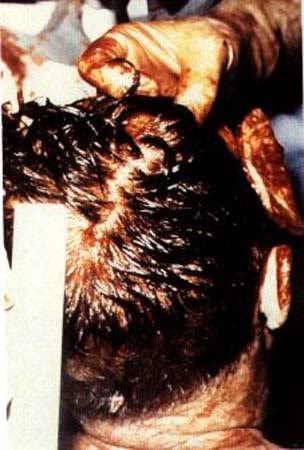
Towards the bottom is a white blob which the forensic pathology panel thought was a piece of human tissue or fat. Near the center of the photo, at the level of the top of the ear in the photo, right next to the ruler, and in focus, and with the hair parted around it apparently to better expose it for the photographer, is the red spot that the same panel thought was an entry wound.

MicahJava has his own opinion of what all this is, and he's welcome to it. Apparently no one else here has been willing to put the same emphasis on contradictory recollections from 15 or 33 years after the fact that MicahJava does (I pointed out one above - the red spot was described well after the fact as either a 'blemish' or blood, and this contradiction bothers MicahJava apparently not at all, nor does it cause him to question the validity of using recollections from decades after the fact).

And therein lies the logical disconnect between MicahJava and the others here.

Hank
 
Last edited:
[qimg]http://3.bp.blogspot.com/-lLWqbNL8Zgo/UYraEfUOHfI/AAAAAAAAuis/RtjG5B8TugM/s1600/JFK_Autopsy_Photo_BOH.jpg[/qimg]

Towards the bottom is a white blob which the forensic pathology panel thought was a piece of human tissue or fat. Near the center of the photo, at the level of the top of the ear in the photo, right next to the ruler, and in focus, and with the hair parted around it apparently to better expose it for the photographer, is the red spot that the same panel thought was an entry wound.

MicahJava has his own opinion of what all this is, and he's welcome to it. Apparently no one else here has been willing to put the same emphasis on contradictory recollections from 15 or 33 years after the fact that MicahJava does (I pointed out one above - the red spot was described well after the fact as either a 'blemish' or blood, and this contradiction bothers MicahJava apparently not at all, nor does it cause him to question the validity of using recollections from decades after the fact).

And therein lies the logical disconnect between MicahJava and the others here.

Hank

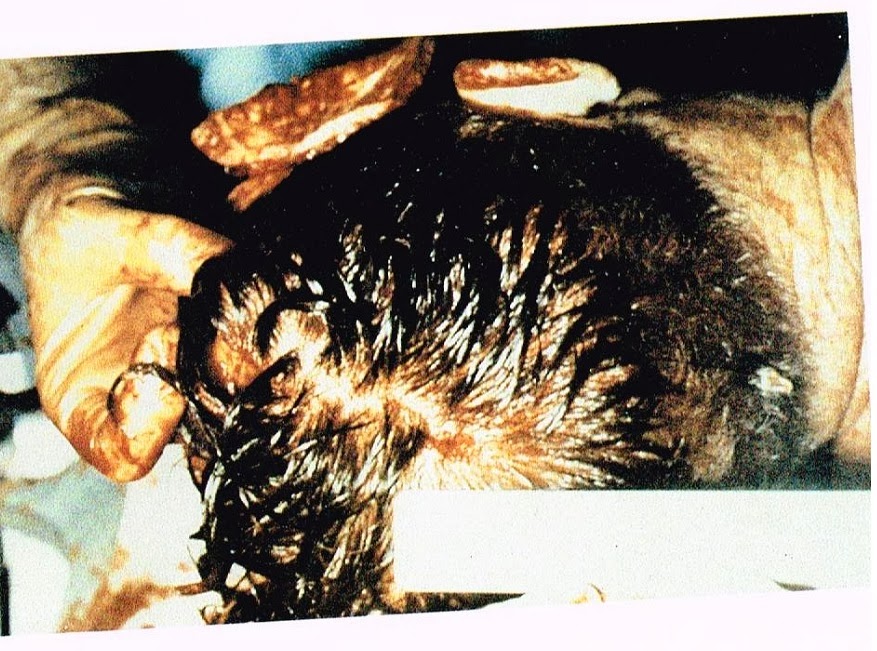
Here are two higher quality versions of the cowlick photo:

JFKcolor_boh_autopsy_photo.jpg


jfk4+001.jpg


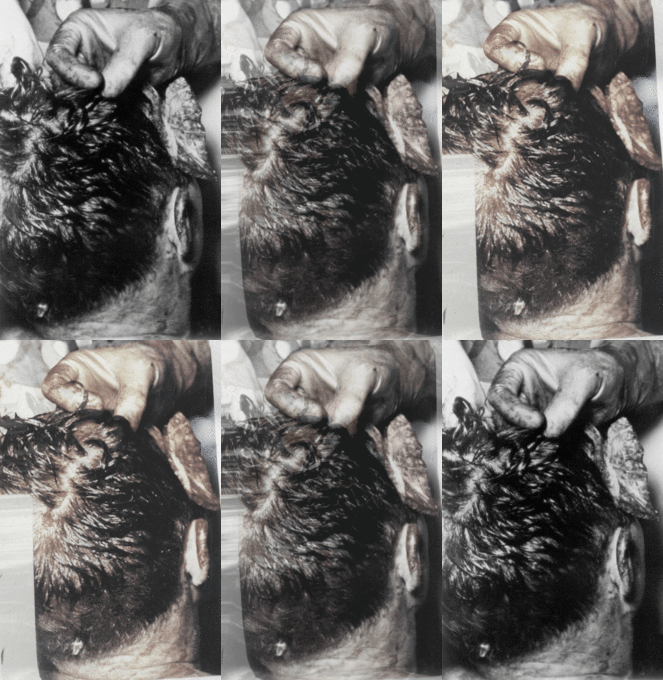
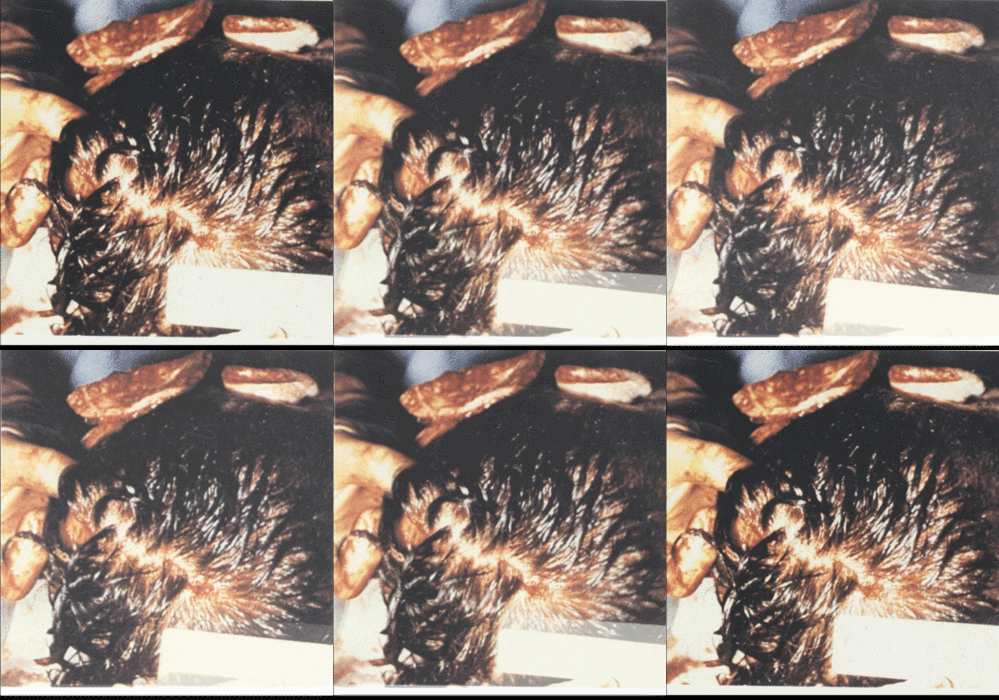
Two morphing head gifs to simulate a stereoscopic view:

JFK-Autopsy-Photos-GIF.gif


BOHEntrancea_zps1aef7673.gif


The red spot looks two-dimensional, not like a hole. If you want to say the red spot is a hole that correlates to the depressed cowlick fracture, then you could always say that the apparent depth of the hole was lost when the scalp was being pulled back. All the more reason to question why they would pull the scalp back if they were trying to photograph an accurate representation of an entry wound.

And, of course, there's no raised edges like an entry wound has. Why do you think Ida Dox was coerced into drawing her sketch with raised edges around the red spot? Oh whatever, you'll never give a real answer lol
 
To my uneducated in forensics viewpoint nothing in that image looks like an entry hole.

So what's the next step?

I would consult the HSCA forensic panel conclusions and determine what they thought, based on their viewing of all the extant autopsy materials (not limited to the autopsy photos and x-rays leaked to the public). Once I saw what they thought based on their training, education, and experience, I would weigh it against my own meager understanding of what wounds to the skull look like, based on my own lack of training, education, and experience.

I would then conclude, rightly, I think, that they knew more than me about this, and they reached the right conclusion (barring overwhelming evidence to the contrary).

This is called an appeal to legitimate authority. Too many people confuse an appeal to legitimate authority with an appeal to illegitimate authority, or don't accept any appeals to authority whatsoever (they think all such appeals are logical fallacies -- but they are not).

This site does a great job of differentiating between illegitimate appeals to authority and legitimate appeals to authority: http://www.nizkor.org/features/fallacies/appeal-to-authority.html

MicahJava takes a different approach apparently, and after concluding that the red spot doesn't look like an entry wound, starts looking for evidence it's not an entry wound. He dismisses everything the HSCA forensic panel concluded, and based on his own conclusion it's not an entry wound, searches the testimony -- some of it given a third of a century after the autopsy -- for anything that appears to support his conclusion. In other words, what he appears to be doing is reaching a conclusion based on his own meager understanding of what wounds should look like, then tries to justify that conclusion by searching for evidence that supports his conclusion.

Ultimately, of course, given how much this case has been investigated, he finds some statements that support his viewpoint and takes great pride in pointing them out to us. It apparently doesn't matter to MicahJava how many decades elapsed until the testimony was given, or even if the witness he is quoting gave contradictory testimony before or since. All that apparently matters to MicahJava is that he can be seen to support his conclusion with statements by some of the principals.

I think that's the wrong approach, as you shouldn't reach the conclusion and then find reasons to support it. You should examine the evidence and let the evidence direct you to the conclusion.

Evidence first, conclusion second. Not the other way around.

Hank
 
Last edited:
Here are two higher quality versions of the cowlick photo:

[qimg]https://i318.photobucket.com/albums/mm433/JFKAUTOPSYPHOTOS/JFKcolor_boh_autopsy_photo.jpg[/qimg]


[qimg]https://2.bp.blogspot.com/-qvdPOiTR_9M/UnaawlhCNBI/AAAAAAAABaA/TkHJToQgAfg/s1600/jfk4+001.jpg[/qimg]


Two morphing head gifs to simulate a stereoscopic view:

[qimg]https://3.bp.blogspot.com/-mt8ebUPjtAM/UYm45Enz7SI/AAAAAAAAuiY/52WQQlmaQaY/s1600/JFK-Autopsy-Photos-GIF.gif[/qimg]


[qimg]https://i1110.photobucket.com/albums/h441/johniscool5/BOHEntrancea_zps1aef7673.gif[/qimg]


The red spot looks two-dimensional, not like a hole. If you want to say the red spot is a hole that correlates to the depressed cowlick fracture, then you could always say that the apparent depth of the hole was lost when the scalp was being pulled back. All the more reason to question why they would pull the scalp back if they were trying to photograph an accurate representation of an entry wound.

And, of course, there's no raised edges like an entry wound has. Why do you think Ida Dox was coerced into drawing her sketch with raised edges around the red spot? Oh whatever, you'll never give a real answer lol

You didn't answer any of my questions, nor clear up when the statements you cited were made. Do try again. Ignoring my points and simply posting more of your opinion is not the appropriate way to convince me of the error of my ways.

My questions and points remain: http://www.internationalskeptics.com/forums/showpost.php?p=11829706&postcount=3326

And as I noted above:

If I may summarize your arguments, they stem from two apparent sources -- decades later recollections combined liberally with your own opinions of what you see and think.

There is no actual evidence there.


Hank
 
Last edited:
The red spot looks two-dimensional, not like a hole.

What did the HSCA forensic panel conclude? To whom does it look two-dimensional? You never provide any evidence, just your own uneducated opinion. We're not interested in that.


If you want to say the red spot is a hole that correlates to the depressed cowlick fracture, then you could always say that the apparent depth of the hole was lost when the scalp was being pulled back.

I don't need or want to say anything. I don't have to disprove your contentions, you need to prove them. Asking me for my explanation of your assertion is simply shifting the burden of proof.


All the more reason to question why they would pull the scalp back if they were trying to photograph an accurate representation of an entry wound.

Again, this is your unproven supposition, based on your own interpretation of the evidence, and not supported by any expert testimony.


And, of course, there's no raised edges like an entry wound has.

Asked you to document this. You have yet to do so.


Why do you think Ida Dox was coerced into drawing her sketch with raised edges around the red spot?

Asking me to disprove your assumed assertion is not going to fly very far. That's two logical fallacies in one question -- shifting the burden of proof and begging the question.


Oh whatever, you'll never give a real answer lol

I don't have to give any answer. It's not incumbent on me to explain away your contentions. I just need to ask you for your evidence, which you have yet to provide. Not your opinion, your evidence.

Got any?

As I noted above:

If I may summarize your arguments, they stem from two apparent sources -- decades later recollections combined liberally with your own opinions of what you see and think.

There is no actual evidence there.


Hank
 
Last edited:
You didn't answer any of my questions, nor clear up when the statements you cited were made. Do try again. Ignoring my points and simply posting more of your opinion is not the appropriate way to convince me of the error of my ways.

Hank

"Hurr durr you're not an expert" and crap we've already been through. Such pressing questions.

Meanwhile, Roy Kellerman was one of many to describe the the small head wound in relation to Kennedy's hair. Here's some of his 3/9/1964 WC Testimony:

Mr. KELLERMAN. Entry into this man's head was right below that wound, right here.

Mr. SPECTER. Indicating the bottom of the hairline immediately to the right of the ear about the lower third of the ear?

Mr. KELLERMAN. Right. But it was in the hairline, sir.

Mr. SPECTER. In his hairline?

Mr. KELLERMAN. Yes, sir.

Mr. SPECTER. Near the end of his hairline?

Mr. KELLERMAN. Yes, sir.

Mr. SPECTER. What was the size of that aperture?

Mr. KELLERMAN. The little finger.

Mr. SPECTER. Indicating the diameter of the little finger.

Mr. KELLERMAN. Right.


Short, sweet, straight to the point.
 
Last edited:
The red spot looks two-dimensional, not like a hole.

Based on what?

How many GSW victims have you personally dealt with? 1, 4, 50? I'm guessing zero. I've shot animals, not people, that's an entry wound.

Your knowledge of ballistics and pathology has actually retarded since you began posting here. Case in point:

And, of course, there's no raised edges like an entry wound has. Why do you think Ida Dox was coerced into drawing her sketch with raised edges around the red spot? Oh whatever, you'll never give a real answer lol

1. The scalp is CLEARLY BEING PULLED TIGHT, compressing the wound for the photo.

2. It's a head shot, the skin on the cranium it tighter than other parts of the body.

3. Raised edges are found at the exit wound (most of the time).

The bullet struck right were everyone says it did. You are doing the same trick every hack ghost-hunter does by pointing to artifacts in photos and claiming proof.:thumbsup:
 
"Hurr durr you're not an expert" and crap we've already been through. Such pressing questions.

Meanwhile, Roy Kellerman was one of many to describe the the small head wound in relation to Kennedy's hair. Here's some of his 3/9/1964 WC Testimony:

Mr. KELLERMAN. Entry into this man's head was right below that wound, right here.

Mr. SPECTER. Indicating the bottom of the hairline immediately to the right of the ear about the lower third of the ear?

Mr. KELLERMAN. Right. But it was in the hairline, sir.

Mr. SPECTER. In his hairline?

Mr. KELLERMAN. Yes, sir.

Mr. SPECTER. Near the end of his hairline?

Mr. KELLERMAN. Yes, sir.

Mr. SPECTER. What was the size of that aperture?

Mr. KELLERMAN. The little finger.

Mr. SPECTER. Indicating the diameter of the little finger.

Mr. KELLERMAN. Right.


Short, sweet, straight to the point.

Why do CTists never understand the reason autopsy photographs and other materials are taken is to be more precise than human memory?

We can check how accurate that is, by looking at the photograph. Where we can see an obvious entry wound. I am sorry, I really don't get why you think it looks two dimensional, or fake, or whatever.
 
"Hurr durr you're not an expert" and crap we've already been through. Such pressing questions.

A reminder that you're the one that started recycling your arguments from six months ago. If there is any "crap we've already been through", this is your doing.

After getting thoroughly hammered on the rifle and the paper sack arguments you tried to advance (read from the top of the prior page) you then jumped right back to the head wound you had been discussing six months ago: http://www.internationalskeptics.com/forums/showpost.php?p=11828354&postcount=3318

You dismissed my points (or just ignored them) then, just as you do now.

We're supposed to not notice you just avoided answering any of the questions and dismissed the point that your opinions have no value?

They don't have value and failing to answer the questions your arguments raise is not the best way to support your arguments.


"Meanwhile, Roy Kellerman was one of many to describe the the small head wound in relation to Kennedy's hair. Here's some of his 3/9/1964 WC Testimony:

Mr. KELLERMAN. Entry into this man's head was right below that [exit] wound, right here.
Mr. SPECTER. Indicating the bottom of the hairline immediately to the right of the ear about the lower third of the ear?
Mr. KELLERMAN. Right. But it was in the hairline, sir.
Mr. SPECTER. In his hairline?
Mr. KELLERMAN. Yes, sir.
Mr. SPECTER. Near the end of his hairline?
Mr. KELLERMAN. Yes, sir.
Mr. SPECTER. What was the size of that aperture?
Mr. KELLERMAN. The little finger.
Mr. SPECTER. Indicating the diameter of the little finger.
Mr. KELLERMAN. Right.


Short, sweet, straight to the point.

So you think the white spot (which the HSCA forensic pathologists -- all of them eminently qualified to render an opinion and they concluded it was a piece of human tissue or fat) is in fact the entry wound?

Why should we give your opinion any credence and ignore their opinion?

If I may summarize your arguments, they stem from two apparent sources -- decades later recollections combined liberally with your own opinions of what you see and think.

There is no actual evidence there.


And are you basing your opinion on Kellerman's testimony? You will avoid answering this, but isn't Kellerman putting the entry wound "right below" the exit wound, as we can see in the HSCA illustration here?

idadox.jpg


Or do you think the exit wound looked like this, and the entry wound was below that?

head2.gif


If the latter, can you reconcile that image (often mistakenly called the 'McClelland drawing') with the back of head photos already posted here (in color and black and white)?

Hank
 
Last edited:
Why do you think Kellerman was talking about the white spot? He said he saw a hole, not a nodule of fat.

And "right below" is nowhere near as accurate as pointing to "the bottom of the hairline immediately to the right of the ear about the lower third of the ear", "near the end of his hairline".
 
Why do CTists never understand the reason autopsy photographs and other materials are taken is to be more precise than human memory?

We can check how accurate that is, by looking at the photograph. Where we can see an obvious entry wound. I am sorry, I really don't get why you think it looks two dimensional, or fake, or whatever.

Dr. Pierre Finck was a gunshot wound expert and said the red spot looks like it could even be something as simple as dried blood. And he was there examining Kennedy's body. So if we want to say it's a wound, it could be any of a variety of different kinds of wounds before we start considering entry wound. Deal?
 
Status
Not open for further replies.

Back
Top Bottom