Utopia and Time Travel

Whatever changes this future time traveler makes would just be undone by his fellow time travellers. The same thing happens every time some n00b kills Hitler.

Or it becomes a series of increasingly desperate attempts by the time traveler to undo the increasingly ugly unanticipated consequences of their prior fixes until the movie fades out
 
What if future time travelers have already traveled back in time not to try to kill Hitler before he gained power, but to prevent him from being killed in the untinkered time line, because for their future world it is essential all the horrors of WW 2 had happened? What would they care of the millions dead in 1930s to 1940s if the sanctity of their own utopia was at stake? What would they care about our lives? We are the long dead to them.

There is also a scifi story where there was no Hitler and the German High Command manged to conquer the world, so in the future they send someone to mess it up, who was Adolph Schicklgruber.
 
Looking across larger distances the effect can be noticable and quite large, on the scale of the solar system an observer on one planet could even observe events occurring in a different order from what an observer on another planet would see. Every observer has their own unique now no matter how small or large the distances between them.

Ok, I'll try.
Say you're looking through your really powerful telescope at a martian and it's looking back at you. At one point you sneeze, then a few seconds later you look back through your telescope only to see the martian spilling it's martian coffee but it continues to look through it's telescope. From the martians point of view it spilled it's coffee first then saw you sneeze some time later.
So there was a now for you where you'd sneezed but the martian hadn't yet spilled it's coffee, and there was a now for the martian where it'd spilled it's coffee but you hadn't yet sneezed.

okay. thanks

It is what i was saying about the stars we see NOW. The actual positions of the stars NOW are different from how we see them NOW.
 
okay. thanks

It is what i was saying about the stars we see NOW. The actual positions of the stars NOW are different from how we see them NOW.

There is no Universal "NOW", only various points (or frames) of reference. The distance between you and the stars means that your "now" is different to theirs. Hop in a spaceship and travel there at the speed of light and your "nows" will coincide, but only because you took your "now" with you. Anyone you left behind on Earth will be experiencing an entirely different "now" because they are light years away from you. You can never make them meet...
 
The Universal Now

There is no Universal "NOW",only various points (or frames) of reference.

I have to question that rational. There is a universal NOW.

The distance between you and the stars means that your "now" is different to theirs.

All the different things happening in that moment, and the distance between those things has no bearing on the moment - the universal now.

The now is still the now.


Hop in a spaceship and travel there at the speed of light and your "nows" will coincide, but only because you took your "now" with you. Anyone you left behind on Earth will be experiencing an entirely different "now" because they are light years away from you. You can never make them meet...

It isn't about making them meet.
They are one thing, and distance makes no difference to the universal now.

I think there is a universal moment of now, and the addition of a SoL spaceship into the mix doesn't change that. You are speaking about a 'now' that you take with you. That is another way of saying, 'your subjective experience', which of course is only one thing happening in the universal NOW.

I am speaking about now in relation to a universal concept, but even one this planet, if you are one one side experiencing a night and I was on the other side experiencing a day, we still experience the same moment, only the subjective experience is different. We are still on the same planet in the same universe.

So, ust because you left people who used to be in your subjective now experience, and moved away from them at the SoL, and they are experiencing an entirely different now than you immediately, does not mean anything other than you are moving through those points of universal now moments at a different speed to them.

If we agree (for arguments sake) that a 'universal now' moment = 60 seconds at the speed of Earth before the next one starts, once you travel at light speed, your now moment has changed speed...it is = 60 seconds at the SoL.

This means that the more distance you travel, the more universal now moments you go through, so all that is happening is that you are acquiring more now moments due to your speed.

Going back to what I said about the stars, the now moment in relation the ours in relation to the universal now moment places their real position in the universal now moment, somewhere else.

So what I am saying is that in REALITY (the universal now moment) those stars are not where we think they are.

(perhaps there are maps on the net which would show a better approximation of where they actually were?)

But anyway, you are arguing that there is no such thing as a universal now. You related that to subjective observation rather than objective reality.

At least that is how I understand it.

 
General Relativity states otherwise.

It appears that GR is concerned with subjective reality in relation to its equations, 'tis all.

Does GR state that there is no Universal Now, or is it simply pointing out how subjectively the concept of 'now' can be taken?
Does Albert Einstein's theory say that I am incorrect regarding the positions of those stars in the Universal Now?
 
Last edited:
I have to question that rational. There is a universal NOW.


All the different things happening in that moment, and the distance between those things has no bearing on the moment - the universal now.

The now is still the now.


It isn't about making them meet.
They are one thing, and distance makes no difference to the universal now.

I think there is a universal moment of now, and the addition of a SoL spaceship into the mix doesn't change that. You are speaking about a 'now' that you take with you. That is another way of saying, 'your subjective experience', which of course is only one thing happening in the universal NOW.

I am speaking about now in relation to a universal concept, but even one this planet, if you are one one side experiencing a night and I was on the other side experiencing a day, we still experience the same moment, only the subjective experience is different. We are still on the same planet in the same universe.

So, ust because you left people who used to be in your subjective now experience, and moved away from them at the SoL, and they are experiencing an entirely different now than you immediately, does not mean anything other than you are moving through those points of universal now moments at a different speed to them.

If we agree (for arguments sake) that a 'universal now' moment = 60 seconds at the speed of Earth before the next one starts, once you travel at light speed, your now moment has changed speed...it is = 60 seconds at the SoL.

This means that the more distance you travel, the more universal now moments you go through, so all that is happening is that you are acquiring more now moments due to your speed.

Going back to what I said about the stars, the now moment in relation the ours in relation to the universal now moment places their real position in the universal now moment, somewhere else.

So what I am saying is that in REALITY (the universal now moment) those stars are not where we think they are.

(perhaps there are maps on the net which would show a better approximation of where they actually were?)

But anyway, you are arguing that there is no such thing as a universal now. You related that to subjective observation rather than objective reality.

At least that is how I understand it.

But weren't you the one saying that reality requires an observer? Our observations are limited by the speed of light. "Now" is when the photons from something hit the back of my eyeballs. If my eyeballs are closer to that something than your eyeballs, our "Nows" are different.

For a Universal "Now" to exist there would have to be something observing everything all at once, but the speed of light means that such a thing does not exist. By the time the light from distant objects reaches the "Universal Observer" things have already moved on... Unless you're talking about an Omnipresent god.... Are you?
 
But weren't you the one saying that reality requires an observer?

In order to be seen to be real, yes.


Our observations are limited by the speed of light. "Now" is when the photons from something hit the back of my eyeballs. If my eyeballs are closer to that something than your eyeballs, our "Nows" are different.

Of course our nows are different. That does not mean that a universal now is not an objective truth.

For a Universal "Now" to exist there would have to be something observing everything all at once, but the speed of light means that such a thing does not exist. By the time the light from distant objects reaches the "Universal Observer" things have already moved on... Unless you're talking about an Omnipresent god.... Are you?

No. I am talking about a universal now as an objective reality. Not a universal ability to observe everything all at once.

What I am saying is that the huge rockfall on that planet on the other side of this universe which is happening now, is happening in the same moment as I write this reply and that you are presently doing what you are doing in the same moment that I am doing what I am doing, while the pink unicorn is in a galaxy somewhere in this same universe, having a dump right at this same moment and that no matter how distant we are from each other, there is a universal now.

Stuff like that.

In other words...Everything that is happening in the universe right at this moment is happening NOW.
 
Last edited:
I write spec fiction and science fiction. The concept of time travel came out of fiction (thank you, H.G. Wells). While the concepts of altering space-time to go backwards are loads of fun, and make for great books, TV, and movies the fact is that going back in time will require command of a whole class of physics that doesn't exist, and likely will never exist.

Going forward in time? No problem, just figure out lightspeed propulsion, which again requires huge evolutionary changes to physics and engineering.

I'm not a scientist, but I fairly sure I'm solid on this.

So to address the OP, here's your problem:

Someone who has traveled back in time is going to come from a society so far advanced that they will not be able to relate to you on an individual level, any more than a biologist can relate to Marine Iguanas on Galapagos. They are not going to talk to you, and they're not going to be talked into some kind of temporal game. If they were to take you back to their future you'd end up in a lab cage, or a zoo.

Something else to consider is that a civilization advanced enough to time-travel will not risk using such technology for the same reasons we just don't solve conflicts with nuclear weapons. If such technology existed the warning label on the machine would look like the London phone book. I suspect that when the day comes that such technology exists it would be used as a lifeboat to escape some cataclysm, and not for science or recreation.
 
In order to be seen to be real, yes.


Of course our nows are different. That does not mean that a universal now is not an objective truth.


No. I am talking about a universal now as an objective reality. Not a universal ability to observe everything all at once.

What I am saying is that the huge rockfall on that planet on the other side of this universe which is happening now, is happening in the same moment as I write this reply and that you are presently doing what you are doing in the same moment that I am doing what I am doing, while the pink unicorn is in a galaxy somewhere in this same universe, having a dump right at this same moment and that no matter how distant we are from each other, there is a universal now.

Stuff like that.

OK, but in that case, the universal "now" is unknowable. Unless you can receive information faster than light.

Have you read "The Light Of Other Days" by Arthur C Clarke and Stephen Baxter? It is interesting.
 
OK, but in that case, the universal "now" is unknowable. Unless you can receive information faster than light.

The important thing is to get the gist. ;) Also, it allows for the existence of pink unicorns even that we don't 'know' - it allows for a lot of stuff really. :)

But it definitely allows for the notion that there is a fricken lot of things all happening at the same time, everywhere therein.

Have you read "The Light Of Other Days" by Arthur C Clarke and Stephen Baxter? It is interesting.

No I haven't. I don't have a lot of time for reading books, what with the internet and all. :) I like the book in my head anyway...
 
It appears that GR is concerned with subjective reality in relation to its equations, 'tis all.

Does GR state that there is no Universal Now, or is it simply pointing out how subjectively the concept of 'now' can be taken?
Does Albert Einstein's theory say that I am incorrect regarding the positions of those stars in the Universal Now?

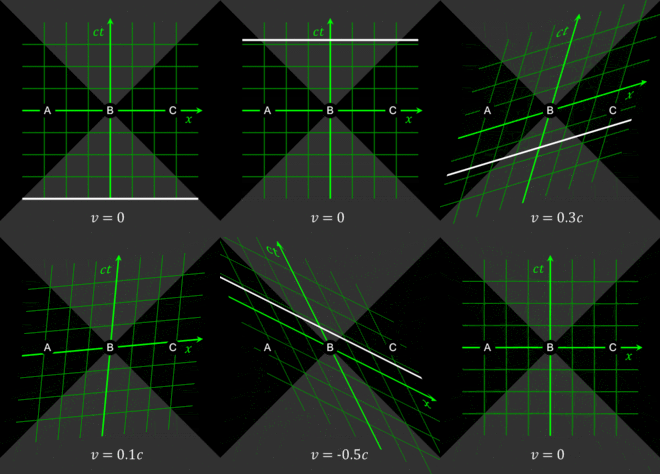
Yes, even SR specifically rejects and disproves the concept of simultaneity. The concept of two events separated by some distance happening at the same time is not something you can declare with SR. One observer might measure the two events happening at the same time, but another observer will see A happen before B, and another B before A.

https://en.wikipedia.org/wiki/Relativity_of_simultaneity

220px-Relativity_of_Simultaneity_Animation.gif
 
Yes, even SR specifically rejects and disproves the concept of simultaneity. The concept of two events separated by some distance happening at the same time is not something you can declare with SR. One observer might measure the two events happening at the same time, but another observer will see A happen before B, and another B before A.

https://en.wikipedia.org/wiki/Relativity_of_simultaneity

[qimg]https://upload.wikimedia.org/wikipedia/commons/thumb/7/78/Relativity_of_Simultaneity_Animation.gif/220px-Relativity_of_Simultaneity_Animation.gif[/qimg]

Be that as it may, there is a universal now. Oops, there was one...oh no, here comes another...

But seriously, the universe is happening now. :) The argument isn't about who sees what when and where.
 
Be that as it may, there is a universal now. Oops, there was one...oh no, here comes another...
No - there isn't. There is only a subjective now. And your subjective now might be different from my subjective now.

This is 100-year old science. It may seem strange, but it's true.
 
No - there isn't. There is only a subjective now. And your subjective now might be different from my subjective now.

This is 100-year old science. It may seem strange, but it's true.

Are you sure it's subjective? I thought I could always calculate your now objectively through observation of our relative states of motion (under SR).
 
Are you sure it's subjective? I thought I could always calculate your now objectively through observation of our relative states of motion (under SR).
I'm not an expert, so you may be technically right. However, your now may be different from my now. That's what I meant by it being subjective. We know for sure that our perceptions of time can be different. What you measure as an hour may be longer than what I measure as an hour, depending on our relative states of motion. This has been empirically demonstrated using atomic clocks.
 
I'm not an expert, so you may be technically right. However, your now may be different from my now. That's what I meant by it being subjective. We know for sure that our perceptions of time can be different. What you measure as an hour may be longer than what I measure as an hour, depending on our relative states of motion. This has been empirically demonstrated using atomic clocks.

Which leads to an odd question. Do you suppose that our nows can have different durations?
 

Back
Top Bottom