• Quick note - the problem with Youtube videos not embedding on the forum appears to have been fixed, thanks to ZiprHead. If you do still see problems let me know.

JFK Conspiracy Theories IV: The One With The Whales

Status
Not open for further replies.
Oswald's thinking, such as it was, may be somewhat easy to deduce if we allow that his motivation was not so much to shoot JFK (who, I seem to recall Oswald liked and/or admired) as to commit a great deed.

"I shot the president! Look what I can do!"
 
Yup, this is my feeling exactly.

The one explanation that I've heard that got my interest was that Oswald might have shot Kennedy as a means to immigrate into Cuba. The theory is that some of his shady Cuban contacts might have represented (truthfully or not) that they had Castro's ear, and once Oswald knew he might have a shot at taking out Kennedy, he offered to snuff him in exchange for asylum there. Oswald carried out the actual deed alone.

That's close to what I've been arguing for decades, but with a slight twist.

Instead of Kennedy being the enticement to get into Cuban, think right-wing General Walker, who argued that one army division would be all it would take to overthrow Castro.

Then all his summer in New Orleans activities make sense, he's deliberately picking a fight with anti-Castro Cubans to get arrested for his cause, he's starting an illegal chapter of the Fair Play for Cuba Committee, he's handing out leaflets in a variety of places for the FPCC, he's going on the radio and tv, he's offering his skills to the WORKER and MILITANT newspapers - all to build a resume.

Before going back to Dallas, he tries to wedge the door open further by going to Mexico City and applying for a visa to visit Cuba on a purported trip back to the Soviet Union. That's his escape hatch after he kills Walker. But the Cubans tell him he'd have to get approval from the Soviet Union, and Oswald gets angry, and tells them they are petty bureaucrats getting in the way of the revolution.

This is too early for him to be talking about assassinating Kennedy, as the trip wasn't finalized yet, and there was no way of knowing whether there'd even be a motorcade, as some of the logistics still needed to be worked out. And of course, Oswald didn't have a job at the Depository yet, and the motorcade route hadn't been decided... from the point of his Mexico City venture until mid-November, Oswald's plans involve assassinating Walker, not Kennedy.

It wasn't until the weekend of 11/16 - 11/17 that the newspapers start carrying preliminary reports about the motorcade route, and Oswald could begin to contemplate shifting his sights to Kennedy AND Walker. Kennedy was a target of opportunity. Walker was a long-time target who Oswald once compared to Hitler, and he said the world would be better off without Walker, as it would have been without Hitler.

Walker and Kennedy's politics intersected at one point and one point only, both were in favor of removing Castro from Cuba. Oswald's stongest influences was what he read, like THE WORKER and THE MILITANT (rather than any people he knew), neither of which painted Kennedy in a kind light. And Oswald once told Michael Paine, that if you read between the lines, you'd know what they wanted you to do.

Mr. LIEBELER - Did you know that Oswald received mail at your house from Irving, Tex?
Mr. PAINE - Yes.
Mr. LIEBELER - Do you know what kind of mail he received?
Mr. PAINE - I suppose he used it as the mailing address for most of his mail until he would receive, get a permanent address, so he received the Daily Worker there, or The Worker, and also, I didn't see it come, I don't generally see the mail that arrives there. Most of my mail would arrive at that address even though I was living somewhere else because I also didn't feel permanent in my other addresses, so Ruth would collect the mail and separated mine into a separate pile. I didn't see the Militant arrive. I did see various Russian magazines, Agitateur, maybe a very large one. A very large one and the Daily Worker, The Worker.
Mr. LIEBELER - Did you ever discuss these publications with Oswald?
Mr. PAINE - Yes, we talked with regard to the Daily Worker. He said that, he told me, that you could tell what they wanted you to do, they, a word I dislike, what they wanted you to do by reading between the lines, reading the thing and doing a little reading between the lines. He then gave me an issue to look and see. I wanted to see if I could read between the lines and see what they wanted you to do.
Mr. LIEBELER - Did you read the particular issue that he referred to?
Mr. PAINE - I tried to. I don't think I had very much patience to go through it.
Mr. LIEBELER - Do you remember what particular issue it was?
Mr. PAINE - No, I didn't notice.
Mr. LIEBELER - Can you set the date of this discussion that you had with Oswald?
Mr. PAINE - That was fairly soon after his coming back. So let's say the middle of October.
Mr. LIEBELER - Did he discuss with you, your ability or inability to determine what they wanted you to do by reading between the lines after you had read the publication?
Mr. PAINE - No, I just handed it back to him.
Mr. LIEBELER - Was there anything else said between you at that time on that subject?
Mr. PAINE - He asked me how did I like it.
Mr. LIEBELER - What did you say?
Mr. PAINE - And I tried to be polite. I said it was awful extreme, I thought.
Mr. LIEBELER - Did he respond to that?
Mr. PAINE - I think that was the end of it.


Here's some of THE MILITANT, as republished in the Warren Commission volumes of evidence: http://www.history-matters.com/archive/jfk/wc/wcvols/wh22/html/WH_Vol22_0295b.htm (next ten pages or so).

And a few pages of THE WORKER: http://www.history-matters.com/archive/jfk/wc/wcvols/wh22/html/WH_Vol22_0305b.htm

Hank

EDIT: Found this online (THE MILITANT Back issues for all of 1963): https://www.marxists.org/history/etol/newspape/themilitant/1963/

 
Last edited:
I'm back. Got the skull now.

A rough draft: https://imgur.com/a/2uEgw

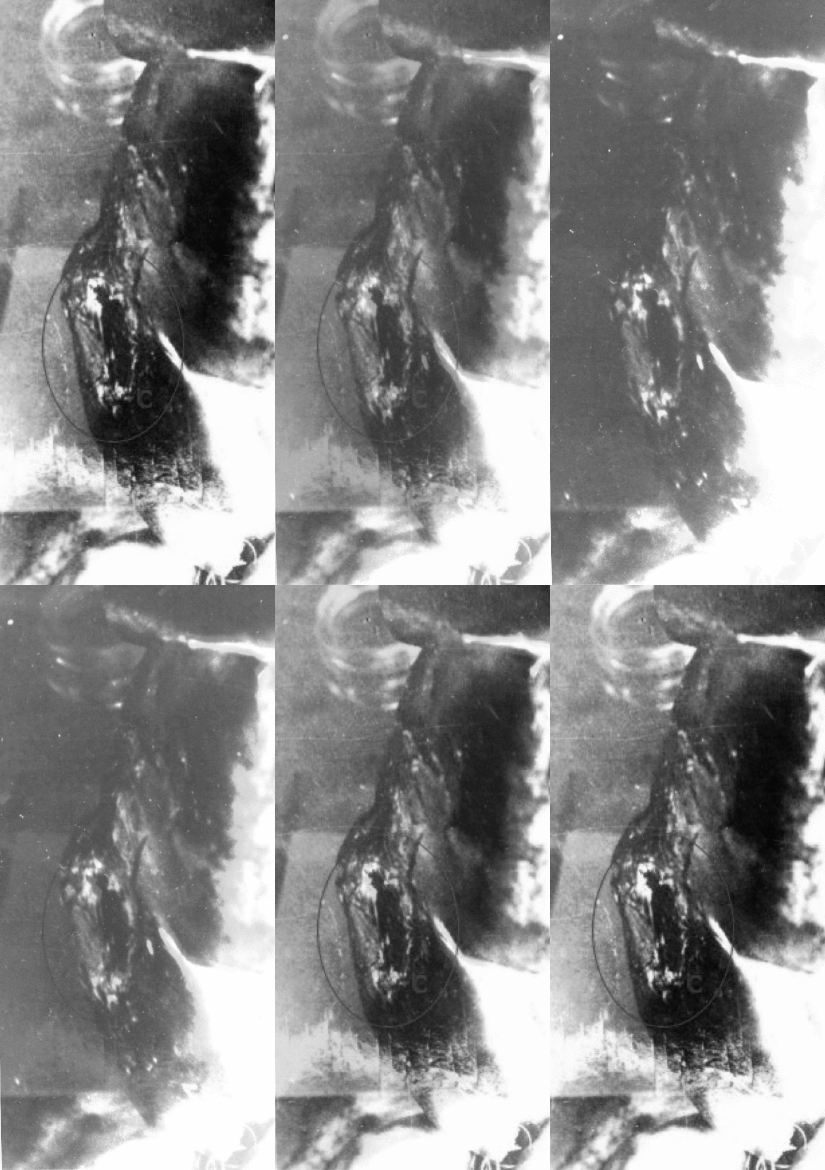
At the very least, this confirms that the elliptical 15x6mm wound described in the autopsy report matches very well with a 15x6mm piece of tape placed at an approximate location on the dummy skull.

If I could get the display of a digital camera hooked up to a computer screen, I wonder if I can somehow transparently overlay the open-cranium photo, so it could be as easy to replicate as using tracing paper.

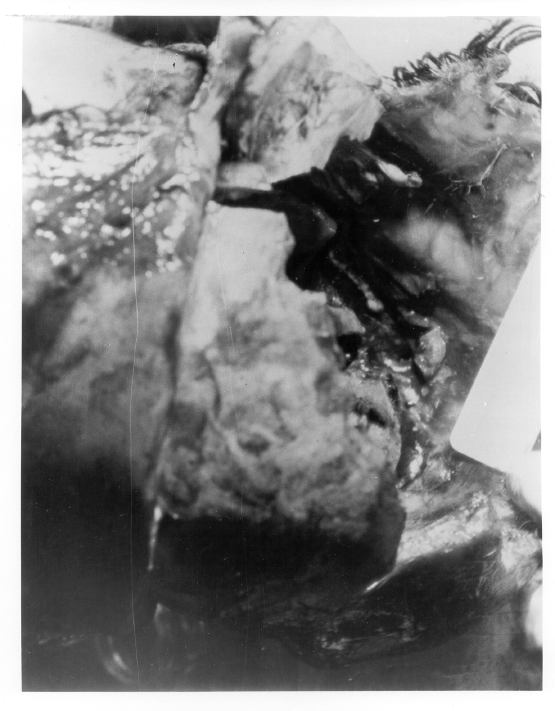
Open-cranium photograph:
BE7_HI.JPG


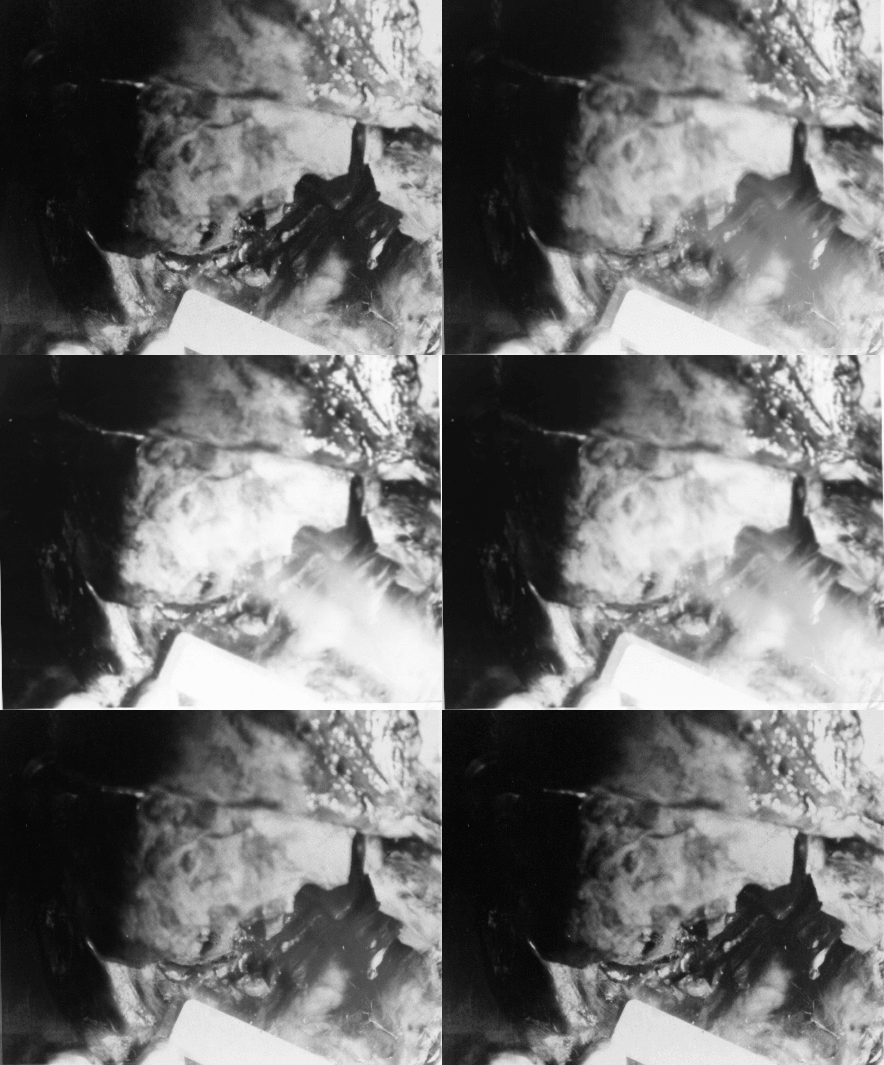
Lightened morph of both photographs:
https://imgur.com/a/ZZNFe


Darker morph of both photographs:
F8-JFK-Autopsy-Photo-Pat-Speer.gif


Close-up morph of suspected EOP wound:
Autopsy-Photos-Cropped-Via-PatSpeer.com.gif


EDIT: I may have found a way to replicate the photo almost perfectly by overlaying it on my screen. I'll try that soon.
 
Last edited:
Sorry. That makes no sense.

I asked why it is "crackpot" to consider the wound we have evidence for. You may claim it is a blood smear, or some other marking. But I can see and identify an open wound. Your only counter argument is your own misunderstanding of testimony, your own disorientation looking at a cropped and enlarged photo (despite being gently reminded that context would help you) and an insistence that the entry wound is elsewhere but hidden.

Sorry. But disagreeing with you does not make somebody a crackpot, when you post evidence that clearly, and obviously, proves you wrong.

Put your preconceptions aside for a moment. Consider what you are showing us. A photograph of the back of JFKs head. It is centred, on a wound. The rule is place by the wound for scale. The hair is parted to expose the wound. The focal point of the image is the wound.

And you are not only telling us the wound is not a wound, and of no consequence, you are unable to identify an alternative, used a scatter gun approach, then settled on a mark that does not match the blemish on another photograph that you think is an entry wound.

I claim no expertise in the medical analysis required to interpret xrays, or autopsies. I fully sympathise with your confusion. It took me a long time to get to grips with it. But frankly your squinting and telling me what does, or does not, look like what you imagine a wound to look like is not going to convince me.

Your experiments with a plastic skull will not convince me, because I have no confidence you are orientating the wounds and interpreting the photos correctly, and I am fairly confident you may impose the wounds you think you see, rather than the wounds described in the photograph. If on the other hand, you could get a pathologist to perform the experiment, recreating the wounds both described in the autopsy and those in the photographs, I would be interested.

But I do not believe they will find a significant discrepency.

MicahJava's reference to the wound in the autopsy photos as a "cowlick" or "red spot" is reminiscent of a 9-11 no-planer who used to post here (his user name escapes me) who used to refer to the plane in videos where it struck the tower as the "shadow thingy".

If he calls it something other than what it clearly is, he seems to think he can negate the evidence.
 
MicahJava's reference to the wound in the autopsy photos as a "cowlick" or "red spot" is reminiscent of a 9-11 no-planer who used to post here (his user name escapes me) who used to refer to the plane in videos where it struck the tower as the "shadow thingy".

If he calls it something other than what it clearly is, he seems to think he can negate the evidence.

A.K.A. "who are you going to believe, me, or your lyin' eyes?"
 
MicahJava's reference to the wound in the autopsy photos as a "cowlick" or "red spot" is reminiscent of a 9-11 no-planer who used to post here (his user name escapes me) who used to refer to the plane in videos where it struck the tower as the "shadow thingy".

If he calls it something other than what it clearly is, he seems to think he can negate the evidence.

I have evidence to spare, dude. What do the cowlickers have? a picture that looks like a bit of blood or a minor scrape on the skin, and a spot on an x-ray that looks like a regular fracture with no bullet fragments on the outside of it?

Oops, accidentally dropped a 1978 sketch made by Francis X. O'Neill. Where is it? Oh here, I found it.

KTAsvYn.png


Got any people who actually saw the body and say the red spot is a bullet hole?
 
I have evidence to spare, dude. What do the cowlickers have? a picture that looks like a bit of blood or a minor scrape on the skin, and a spot on an x-ray that looks like a regular fracture with no bullet fragments on the outside of it?

Well, that's actually hard evidence for experts like the forensic panel of the HSCA!

ETA:

By the way, there is an X-Ray of Kennedy's skull, showing the distribution of the bullet fragments in his head. This X-Ray is in agreement with a "cowlick entrance wound" as you call it and in total disagreement with an EOP entrance wound!
 
Last edited:
Well, that's actually hard evidence for experts like the forensic panel of the HSCA!

ETA:

By the way, there is an X-Ray of Kennedy's skull, showing the distribution of the bullet fragments in his head. This X-Ray is in agreement with a "cowlick entrance wound" as you call it and in total disagreement with an EOP entrance wound!

Have anything you can point to or specific points to argue or is it just "these experts say different"? My experts actually saw and handled the body, and at least four of them specifically said that the cowlick red spot is not the small head wound.
 
I have evidence to spare, dude. What do the cowlickers have? a picture that looks like a bit of blood or a minor scrape on the skin, and a spot on an x-ray that looks like a regular fracture with no bullet fragments on the outside of it?

Oops, accidentally dropped a 1978 sketch made by Francis X. O'Neill. Where is it? Oh here, I found it.

[qimg]https://i.imgur.com/KTAsvYn.png[/qimg]

Got any people who actually saw the body and say the red spot is a bullet hole?

I'm sorry, was that sketch made with the body in front of O'Neill?

No, correct?

It's a 15-year after-the-fact recollection by a FBI agent.

Right?

I thought the FBI was part of the frame-up of Oswald.

Did O'Neill not get that memo?

Hank
 
Have anything you can point to or specific points to argue or is it just "these experts say different"? My experts actually saw and handled the body, and at least four of them specifically said that the cowlick red spot is not the small head wound.

What four experts?

I count three autopsy surgeons - Finck, Humes and Boswell.

So even if you want to count all three (which is questionable, because some of those three gave differing testimony) you still can't get to four experts.

Who's the fourth qualified expert?

Hank
 
What four experts?

I count three autopsy surgeons - Finck, Humes and Boswell.

So even if you want to count all three (which is questionable, because some of those three gave differing testimony) you still can't get to four experts.

Who's the fourth qualified expert?

Hank

John T. Stringer, the photographer, in his testimony to the ARRB, 1996:

Q: And you're certain that that's where the doctors identified the entrance wound as being; is that correct?

A: Yeah. Yeah, I would think so. That's what I remember.

Q: I'd like to point out the spot that appears somewhat red that is near the end of the ruler, and ask you whether that was an entrance wound, or whether the doctors during the night of the autopsy identified that as an entrance wound?

A: I don't think so, no.

Q: Do you know what that red spot is that appears to be, in layman's terms, near the cowlick?

A: It looks like blood. I would say it was. There was blood all over the place. But I don't think it was anything out of the ordinary. I don't think there was a hole there for the bullet wound. You would have seen the hole.
 
MicahJava said:
What four experts?

I count three autopsy surgeons - Finck, Humes and Boswell.

So even if you want to count all three (which is questionable, because some of those three gave differing testimony) you still can't get to four experts.

Who's the fourth qualified expert?

Hank

John T. Stringer, the photographer, in his testimony to the ARRB, 1996:

In other words, no other medical expert. OK, he's surely a professional, so some sort of "expert," in his job as medical photographer. But his qualifications pertained to capturing information on film, not analyzing it.

And again, you're relying on memories long after the fact.
 
In other words, no other medical expert. OK, he's surely a professional, so some sort of "expert," in his job as medical photographer. But his qualifications pertained to capturing information on film, not analyzing it.

And again, you're relying on memories long after the fact.

Apparently the official autopsy report isn't good enough for you, so I'm just throwing endless confirmations that the report was indeed correct about the placement of the small head wound.
 
Apparently the official autopsy report isn't good enough for you, so I'm just throwing endless confirmations that the report was indeed correct about the placement of the small head wound.
You need to read the actual reports, not just the cherry picked bits you're cribbing from.
 
John T. Stringer, the photographer, in his testimony to the ARRB, 1996:

Q: And you're certain that that's where the doctors identified the entrance wound as being; is that correct?

A: Yeah. Yeah, I would think so. That's what I remember.

Q: I'd like to point out the spot that appears somewhat red that is near the end of the ruler, and ask you whether that was an entrance wound, or whether the doctors during the night of the autopsy identified that as an entrance wound?

A: I don't think so, no.

Q: Do you know what that red spot is that appears to be, in layman's terms, near the cowlick?

A: It looks like blood. I would say it was. There was blood all over the place. But I don't think it was anything out of the ordinary. I don't think there was a hole there for the bullet wound. You would have seen the hole.

Can I quote the executive director and general counsel of the ARRB on that?
In a speech at Stanford University, Jeremy Gunn said:

The last thing I wanted to mention, just in terms of how we understand the evidence and how we deal with what we have is what I will call is the profound underscore profound unreliability of eyewitness testimony. You just cannot believe it. And I can tell you something else that is even worse than eyewitness testimony and that is 35 year old eyewitness testimony.
I have taken the depositions of several people who were involved in phases of the Kennedy assassination, all the doctors who performed the autopsy of President Kennedy and people who witnessed various things and they are profoundly unreliable.


And the ARRB Final Report says:

The deposition transcripts and other medical evidence that were released by the Review Board should be evaluated cautiously by the public. Often the witnesses contradict not only each other, but sometimes themselves. For events that transpired almost 35 years ago, all persons are likely to have failures of memory. It would be more prudent to weigh all of the evidence, with due concern for human error, rather than take single statements as "proof" for one theory or another.


But here you are, citing recollections 33 years after the fact as if they are meaningful. They are not.

Hank
 
Apparently the official autopsy report isn't good enough for you, so I'm just throwing endless confirmations that the report was indeed correct about the placement of the small head wound.

You're the one who seems to have a problem with the conclusions of the original autopsy report.
 
You're the one who seems to have a problem with the conclusions of the original autopsy report.

Other researchers have shown that the autopsy professionals were not as sure of the official conclusions as you're implying, and it is known that they were susceptible to some coercion.

Since we have established that the small, elliptical wound near the EOP existed, can you use medical evidence to explain how all of the head damage is consistent with anything Oswald could have done?
 
Last edited:
Status
Not open for further replies.

Back
Top Bottom