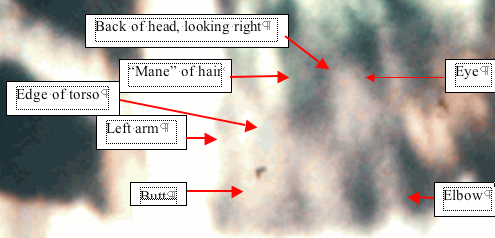
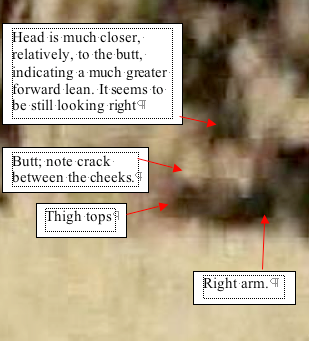
Here’s one of the images I posted earlier, but doubled in size for easier examination, and annotated with text boxes and arrows. I should have done this in the first place. It shows Patty leaning, with her butt and thigh-tops in view:
The left butt has a spot on it—some sort of imperfection in the film, I suppose. Both butt cheeks are white—this is what identifies them as a landmark in the subsequent “tiny cropped images.” In
this image, their identity is validated by the butt crack between them.
The right arm is distinct, to the right of the right butt cheek—it’s hanging down from the shoulder,perhaps on its forward swing, with a substantial, black gap between it and the torso. I’ve pointed out the elbow.
Because the left arm is not dangling as much (perhaps it was on its backswing), its back is visible alongside the torso. The top of the right arm is the top of the shoulder-line. The shoulder-line slants upward —as it does in other images.
The head sits atop it, a light-colored blob, turned sideways to the right. An eye is where it should be, given that the "mane" of hair is on the left, indicating the head is turned to the right. Below it, the jaw projects forward, as it does on Patty. (This is something that is not well known, because the standard 35-degree forward lean of her neck has the effect of making the jaw less salient.)
An apparent long “mane” or pony tail of hair emerges from the back of the head and trails down to about the top of the armpit level. This puzzling apparent mane appears on most images of Patty.
There appears to be a pronounced forward lean to the torso—at least 45 degrees.
There is a large relative distance between the head and the butt—much larger than in the brown-tined image below. That smaller gap is indicative of a greater forward lean to the torso—maybe 75 degrees or more. But Parcher says:
If you look at the first and largest image you see that the sand berm increases in height towards the right side of the frame. Patty is walking in that direction. She is actually walking both away from the camera and to the right. In that first image her legs are obscured from view by that berm. With each subsequent frame more of her lower body gets concealed.
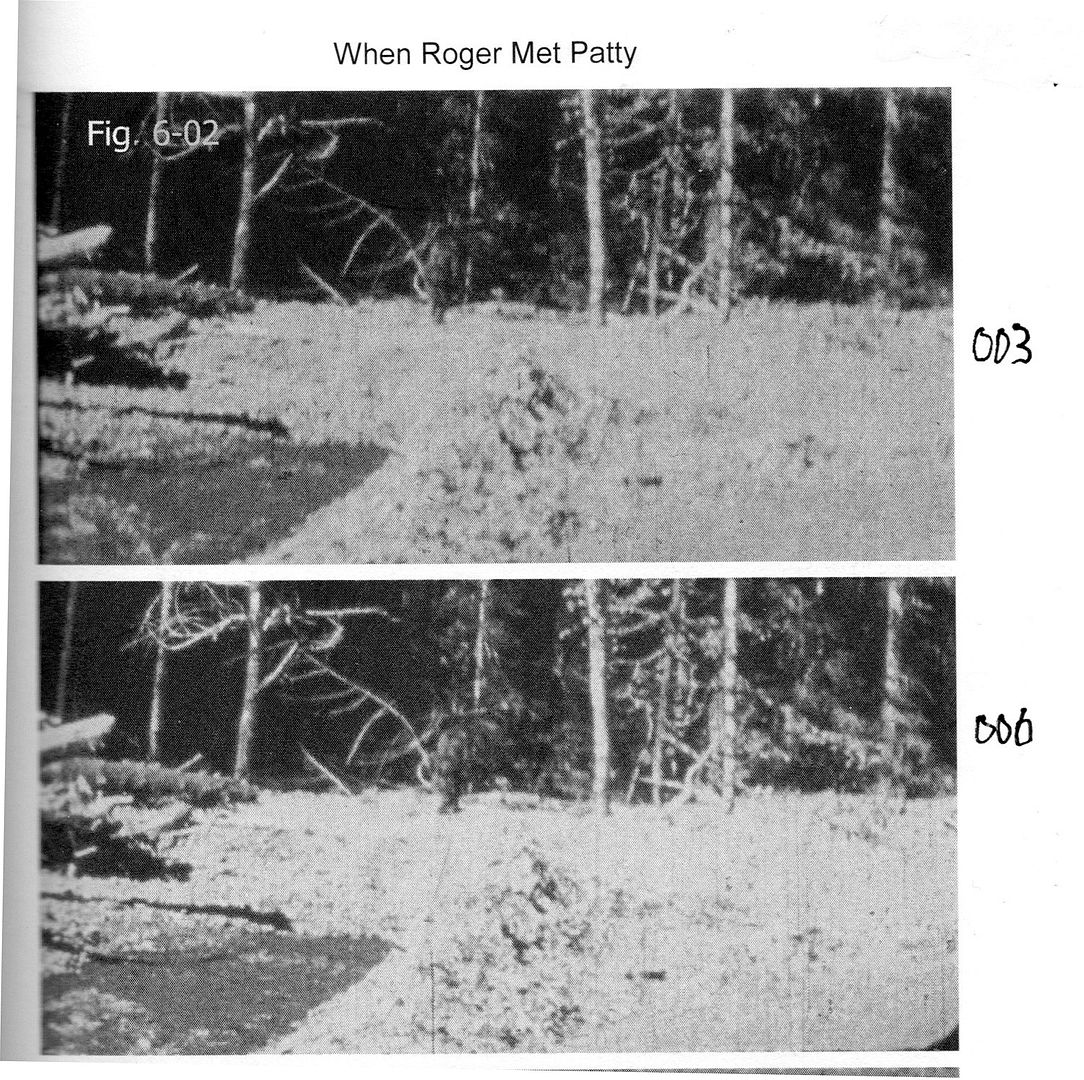
Wrong. Here are very early frames shot before Patterson got down into the creekbed. There is no berm in view. In the upper image, the substantial height of the embankment above the water can be seen.
Parcher’s “berm” (and Vortigern99’s “log”) is actually the upper edge of the three-foot-high embankment of the creek. Patterson apparently knelt against it to steady his camera, putting its lens slightly below the top of the embankment. In the brown-tinted “final” image the edge of the embankment levels out—actually it turns slightly downward.
Eventually her butt becomes concealed behind the berm. At that point all that is visible is the back and the head. This is what we see in the tiny cropped images. Patty hasn't bent over or fallen down. She's still walking upright but much of her body is hidden behind the sand berm. More gets hidden with each step she takes.
Wishful thinking. Take a look below:
Without the context of preceding frames, and the tree on the left, anchoring the creature to the preceding frames, this would be a blobsquatch. However, they exist, so this frame is a continuation of what was seen before. The white-tinted butt, shining in the sun from being stretched even more than in the first image, is a landmark that anchors the rest of the body to what is seen in the first image in this comment.
Patterson probably realized that she was soon to be completely hidden so he stopped and shifted position.
Correct. Patterson next ran out of the creek, swinging his camera in one hand, with the trigger apparently in its locked-down position, to close the distance to his target.
Hmm . . . OTOH, if it was a hoax, Patterson might have realized, as soon as the first image above, that Heironimus had tripped in his clown feet, so he intentionally blurred all the succeeding frames except, by accident, this one (above), and took his finger off the trigger. He thereby hoped the tripping would not be noticed. If there had been a trip, he’d have had strong words with the mime afterwards about his stumble—something Heironimus didn’t report, indicating he wasn’t there, and the mime was someone else.
Davis may have done these tiny croppings so that you cannot properly see the rising berm. He intentionally created an optical illusion where one should not really exist.
The berm premise is off the table, so the conclusion doesn’t follow.
Here’s a link to “The [MK] Davis Report” site, which contains lots of interesting stuff, I assume. Due to my absence from the Bigfoot scene for five hears, I haven’t yet gotten into it.
https://thedavisreport.wordpress.com/