• Quick note - the problem with Youtube videos not embedding on the forum appears to have been fixed, thanks to ZiprHead. If you do still see problems let me know.

Merged Apollo "hoax" discussion - continuation thread

Supposedly this poorly staged sixties piece of crap went to the moon ...

You think the assembly tooling went to the Moon? You don't even have the faintest clue what you're looking at.

... NASA posing wearing the "scientific" version of tin foil caps: white caps.
Talk about tin foil hat theories.

Non sequitur. In any case it's clear your knowledge of the field can't possibly rise above ignorant mockery. So I'll wait with my associates here for your next demonstration of abject ignorance.

Anyway, if brainwashing has been so successful that so many people still want to believe this crap, then about ANY PaintShop work will do the job for Mars.

Those "brainwashed" people who believe in this constitute tens of thousands of highly trained modern aerospace engineers and the entire scientific community. A multibillion dollar worldwide industry in commercial spacefaring (i.e., having nothing to do with NASA) is built upon those principles. That's a pretty great accomplishment for being nothing more than "brainwashing" and image editing.
 
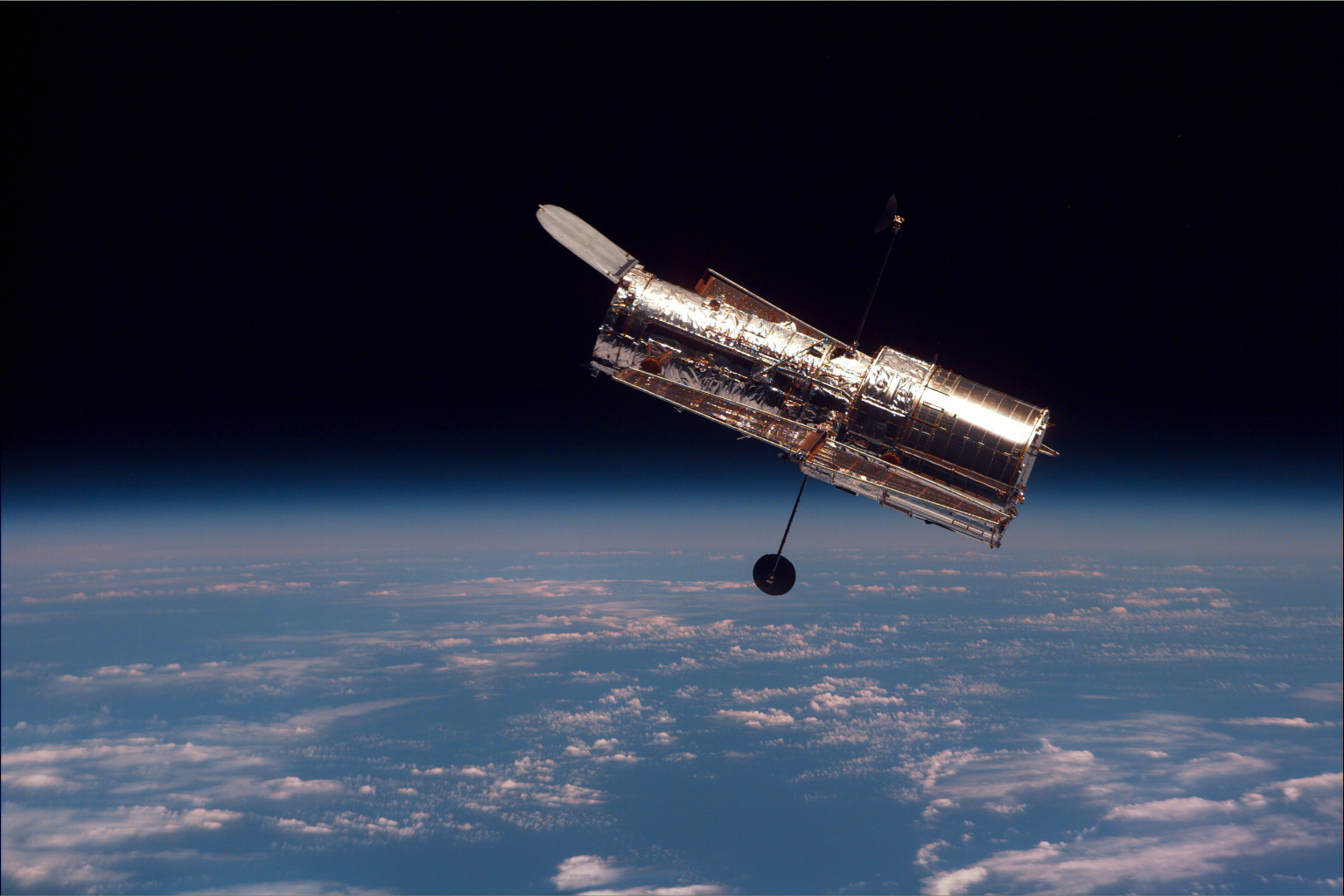
Hubble is also fake! Look at all that tinfoil! IMPOSSIBLE!! (its actually Mylar, if I am not mistaken)
Hubble_01.jpg
 
It was inside the biggest rocket ever built, which was the responsible for accelerating this to orbit. [...]

Have you seen other spacecraft and such? No need for aerodynamics in space.

Hubble is also fake! Look at all that tinfoil!

Indeed it's always ironic to see these ignoramuses tell us that the lunar module can't be a "real" spaceship because of its purportedly flimsy construction. The vast majority of spacecraft we've flown since then us the same sorts of structure and skinning techniques, including the "foil" coverings.

its actually Mylar, if I am not mistaken

Aluminized films, generally polymers like polyester, polyamides, or many other poly-somethings. Mylar and Kapton are common trademarked formulations, but the Apollo lunar module employed many such coated films. You get all the thermal properties of aluminum with without the weight because it behaves mechanically like plastic film. It's actually very much like the aluminized films that potato chip/crisp bags are made from. Also, an early form of this material is almost certainly what Jesse Marcel recovered from the Roswell crash site -- a "metal" that could be crumpled up, yet unfolded on its own.
 
NASA, the real conspiracy theorists selling that "lunar module".

That's only half the lunar module -- the descent stage -- surrounded by its assembly fixtures. It's not as if there aren't plenty of photographs available of the whole ship, in various stages of assembly, checkout, and flight. And it's not as if there aren't several surviving examples, available for inspection by any knowledgeable expert.

At least two of us active in this thread are full-time professional aerospace engineers. And I happen to be a rather oft-consulted expert on Apollo engineering and history. So I find it very amusing that amidst all your scoffing, you can't seem to explain at all why the Apollo lunar module, or any other part of the Apollo program, wouldn't work as advertised. You seem smugly to think it's self-evident.

So let's see how smart you really are. Are you so confident in your beliefs regarding this allegedly faked space program that you can defend it before a panel of experts? Tell us in your own words and in as much detail as you can muster why the Apollo lunar module must be fake.
 
. Also, an early form of this material is almost certainly what Jesse Marcel recovered from the Roswell crash site -- a "metal" that could be crumpled up, yet unfolded on its own.

Wow, Aliens invented crisp packets?
I knew there was more to the KP Foods factory up the road than met the eye.
 
Make room in the sub-basement of the pit of ignorance.
There is hope... he might not find the thread, even with a link.

{brought to you buy the alliance for moving insane claims to the upper CT forum...}

You just had to go and do that, didn't you?

[qimg]http://science.ksc.nasa.gov/history/apollo/images/670800.GIF[/qimg]

Supposedly this poorly staged sixties piece of crap went to the moon ...
... NASA posing wearing the "scientific" version of tin foil caps: white caps.
Talk about tin foil hat theories.

Anyway, if brainwashing has been so successful that so many people still want to believe this crap, then about ANY PaintShop work will do the job for Mars.

NASA, the real conspiracy theorists selling that "lunar module".
 
If he bothered to look there are plenty of pictures of the actual hull without the insulation. It's construction is quite elegant.

And robust, despite the descriptions of its thin skin. If you go to Kansas you can see a lunar module without its clothes on. The chem-milling techniques used to make the integrated skins and stringers were considered fairly advanced back in the 1960s.

The descent stage structure is made from four aluminum panels built like beams, with appropriate stiffeners, arranged as a tic-tac-toe board. Everything is bolted to one of those panels. The skin -- blankets of the aforementioned films laid up in thicknesses of 20 or so layers -- is simply wrapped around it and only has to support its own mass. The landing legs attach to the ends of the beam panels, such that when it's sitting on the lunar surface there is a pair of beams spanning each pair of two diametrically opposite legs. The legs are tubular aluminum, the same method used to construct secondary structures of airframes.

This is the same method we use today to build spacecraft chassis. More often than not a spacecraft chassis is an interlocked or interleaved set of bulkheads made from honeycomb plate or similar high-strength, low-mass materials. The exact arrangement depends on mission requirements for structural stiffness and strength. But if you were to remove the insulation blankets from a modern spacecraft chassis and the Apollo lunar module, you would clearly see the design lineage.

The ascent stage structure is a cylinder laying on its side. The fore and aft bulkheads are milled from solid plates of aluminum, several inches thick. The forward bulkhead is actually the passage from the overhead hatch and ascent engine area into the cockpit, which is secondary structure. The rear bulkhead also mounts the aft equipment panels. This method of bulkhead milling is the same as, for example, the structure around an airliner's pressure doors. By milling away all the material except for the load paths, you get a structure that's as strong as several inches worth of aluminum plating without the weight.

At about knee level, to either side, are two robust ventral beams made from aluminum sheets, the same technique used to make airliner wing and keel spars. These connect the foreward and aft bulkheads.

Overhead is the docking hatch and associated structure, which is a thick aluminum tube welded and gussetted to another milled bulkhead. This completes the connection between the two bulkheads and transfers docked maneuvering loads. This produces a very robust structure, stronger even than portions of some airliners.

Secondary structure is built out in the front to form the cockpit and to each side to mount the ascent propellant tanks. Standard aerospace-type beams are used, as well as aluminum tubing struts.

The pressure hull is the most talked about feature. Visually it resembles standard skin-and-stringer construction that you would see in any airplane built from the 1930s to the 1990s. The same skin-stiffening methods were used in the Saturn V body and similar to SpaceX's Falcon 9 (the stringers are on the inside). Except in Grumman's case, the stringers were not attached to the skin but instead milled together with the skin to the precise shape required for each body panel. These were then welded to the secondary structure to form what was essentially an aluminum balloon. The skin portion of the pressure vessel was about the same thickness as two or three aluminum pie plates, which gives rise to the famous and true claim that you could poke a hole in it with a well-placed stab of a screwdriver. But its primary role was only to contain air pressure. It had a structural role only in partially stiffening the secondary structures such as the cockpit walls.

On the interior were a variety of composite interior panels that prevented anything on the inside of the cabin or cockpit from contacting or damaging the skin.

The exterior panels of the ascent stage were sheet aluminum (roughly the same thickness as HVAC ducting) over insulation and micrometeoroid shield blankets. These blankets employed the same hard-soft layer alternation that would be used in the M-1 Abrams tank's laminated armor.

Much has been made of the use of tape in attaching the blankets and various other elements of the LM. This is entirely proper. Tape works much better in many cases than piercing fasteners for attaching films and sheets. And this isn't "masking tape" as so many ignorant critics have supposed. This is industrial tape with pressure-sensitive adhesives that are stronger than bonds achieved by many off-the-shelf glues. I can literally take this tape (which uses Mylar as its substrate), attached a piece to an overhead beam in a building, and literally hang my full weight from no more than half a square inch of bonding area.

In more common aerospace, "speed tape" would be a suitable analogue. And speed tape's properties are within the experience of even the lowliest rampie. It's not magic, or exotic.

 
Why don't they send every single CTer into outer space? Problem solved. :thumbsup:

in a "tinfoil" craft. Towards the Sun.


anyway, CTs are so full of themselves, but they are hardly more intelligent than these people in the video below, who are TRUE ignorant people (wouldn´t qualify them as CTs)


it's a report from a TV from the poorest brazilian state (Maranhão). They are interviewing rural people from a town located right next to the Alcantara Rocket Launch base, about the Moon Landings (it was filmed in the 40th anniversary of the first moon landing)

Man @0:50: how will you enter in a moon, if it's round? It doesn't have a door!

Woman @1:20: Saint Jorge lives there... with his sword... but men going? Never will! (it says she was 7 years old in 1969... that's what real poverty does to people, she looks like she was some 30 years old AT LEAST in 1969)

Man @1:40: and why didn't men went to the Sun?

Woman @1:50: if men went to the Moon, it's because there was not so much sin as there is now. Now men cannot go because there is too much sin.
 
Last edited:
Indeed it's always ironic to see these ignoramuses tell us that the lunar module can't be a "real" spaceship because of its purportedly flimsy construction. The vast majority of spacecraft we've flown since then us the same sorts of structure and skinning techniques, including the "foil" coverings.


Aluminized films, generally polymers like polyester, polyamides, or many other poly-somethings. Mylar and Kapton are common trademarked formulations, but the Apollo lunar module employed many such coated films. You get all the thermal properties of aluminum with without the weight because it behaves mechanically like plastic film. It's actually very much like the aluminized films that potato chip/crisp bags are made from. Also, an early form of this material is almost certainly what Jesse Marcel recovered from the Roswell crash site -- a "metal" that could be crumpled up, yet unfolded on its own.

And they actually crumpled it up by hand before applying the layers to minimize the amount of surface contact between each layer, thus minimizing the thermal conduction from one sheet to the next. Hoax-nuts rarely ever delve deeper than their most superficial perceptions of the subject they are addressing. They see layers of shiny metal "foil" on the outside, and it's wrinkly. They think that this is supposed to be self-evidently ridiculous because if they designed a spacecraft it sure as hell wouldn't be made of wrinkly foil. But when you really start to peel back the layers (pun intended), you discover that even something as seemingly irrelevant as the insulating material being wrinkled had a damned good thermodynamic justification.
 
Oh, it's worse than that. Just think about a B-52! 8 engines, all controlled constantly throughout the entire flight. More movable control surfaces than I can count, plus navigation systems, radar, weapons control - it would take vastly more computing power to manage a B-52 than an Apollo, and yet supposedly the first B-52 flight was 17 years before the moon landing!

So we can only conclude that the B-52 was a hoax, too.
And supposedly the ancient nuke hardened tube radios are only just now being replaced.
 
And the thinnest parts of an airliner's pressurized airframe aren't much thicker than the thinnest parts of the LM's pressure hull. And the airliner's skin isn't integral with the stringers like on the LMs, it's just riveted.
 
[qimg]http://science.ksc.nasa.gov/history/apollo/images/670800.GIF[/qimg]

Supposedly this poorly staged sixties piece of crap went to the moon ...
... NASA posing wearing the "scientific" version of tin foil caps: white caps.
Talk about tin foil hat theories.

Anyway, if brainwashing has been so successful that so many people still want to believe this crap, then about ANY PaintShop work will do the job for Mars.

Of all the obviously uninformed Arguments From Ignorance I've seen deployed against the Apollo program this is certainly one of them.
 
Good luck actually convincing them they're in space. :)

Ranb

depressurize the craft. Their last thoughts (They cant speak anymore because it's a vacuum) will be "ha, this is clearly a vacuum chamber with 3D projections of the Earth and Moon against some distant wall of this airplane simulating zero g"
 
And the thinnest parts of an airliner's pressurized airframe aren't much thicker than the thinnest parts of the LM's pressure hull.

E.g., the aft pressure dome.

And the airliner's skin isn't integral with the stringers like on the LMs, it's just riveted.

Riveted, glued, or welded, depending on manufacturer and age. But fastened nonetheless, instead of integrated. This is what made Grumman's chem-milling technique such a valuable commodity. The same team that build the LM went on to build the F-14 Tomcat.
 

Back
Top Bottom