
• Security incident: ISF was recently accessed by intruders. Please change your password, and change it anywhere else you used it. Read more

Cont: Deeper than primes - Continuation 2

Status
Not open for further replies.
s isn't a natural number according to the notion that there is a complete set of natural numbers, exactly because such notion is based on the Archimedean property, which according to it there is no infinitely large number like 1,000,000,000,...

Your s isn't a natural number because it is an infinite sequence of 0s and 1s, as are all the si terms, too.

Cantor's diagonal proof by contradiction can't be used under non-Archimedean number system.

Why not? It seems to have worked fine with cardinal numbers.
 
I do not reject the existence of infinitely large numbers, as you do.

Where did I do that? And what has this to do with your rejection of the Axiom of Infinity?

Moreover, with the Axiom of Infinity laid to reset, what additional axiom are you proposing to admit infinite sets into set theory?
 
Your s isn't a natural number because it is an infinite sequence of 0s and 1s, as are all the si terms, too.
Come on jsfisher, we are talking about the completeness of the set of infinitely many finite indexes of s.


Why not? It seems to have worked fine with cardinal numbers.
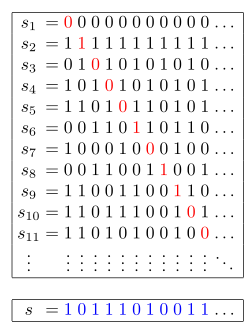
Because it is based on the notion that there is a complete set of natural numbers, that has one and only one size.
 
Where did I do that? And what has this to do with your rejection of the Axiom of Infinity?
I do not reject it, I simply disagree with the notion that an inductive set is a complete set (which means that finitely or infinitely many members can be added to it).
 
Your s isn't a natural number because it is an infinite sequence of 0s and 1s, as are all the si terms, too.
Come on jsfisher, we are talking about the completeness of the set of infinitely many finite indexes of s.

If that were the case, then somewhere in your posts you would have used the word, index.

Be that as it may, as you continue to backpedal, perhaps you could indicate which natural number would be being added for s, since s doesn't have an index.

Why not? It seems to have worked fine with cardinal numbers.
Because it is based on the notion that there is a complete set of natural numbers, that has one and only one size.

The "why not?" was in reference to your alleged Archimedean Property requirement. Are you claiming that an algebraic structure based on the cardinal numbers would be Archimedean? You seem to have a different understanding of cardinal numbers than the rest of the world.
 
By rejecting the existence of a number that is represented by infinitely many place values at the left side of the radix point.

I rejected your nonsensical notation. I am perfectly happy accepting number systems that just happen to include various forms of infinity.
 
If that were the case, then somewhere in your posts you would have used the word, index.
In http://www.internationalskeptics.com/forums/showpost.php?p=11243802&postcount=1040 it can be shown that I use s in order to represent the natural numbers, it is done by the index that follows each s, and this is how I use s in this example all along my posts.

Be that as it may, as you continue to backpedal, perhaps you could indicate which natural number would be being added for s, since s doesn't have an index.
s is a general notation for some natural number that is not added a set of infinitely many natural numbers.


The "why not?" was in reference to your alleged Archimedean Property requirement. Are you claiming that an algebraic structure based on the cardinal numbers would be Archimedean?
Yes, because 1/aleph0 is not defined (it can't be used in order to represent a number like 1/1,000,000,000,... that is an infinitesimal number that does not satisfy the Archimedean property).
 
Last edited:
I rejected your nonsensical notation. I am perfectly happy accepting number systems that just happen to include various forms of infinity.
The various forms of infinity of your number systems are partial cases of my suggested number system.
 
If that were the case, then somewhere in your posts you would have used the word, index.
In http://www.internationalskeptics.com/forums/showpost.php?p=11243802&postcount=1040...

...you didn't use the word index. Just as I said.

And no, you didn't use s (with or without a subscript) to represent the natural numbers. It and the all the si terms were used to represent infinite sequences of 0s and 1s.

Be that as it may, as you continue to backpedal, perhaps you could indicate which natural number would be being added for s, since s doesn't have an index.
s is a general notation for some natural number that is not added a set of infinitely many natural numbers.

Repeating a lie does not change its truth value. Each s (with or without a subscript) stands for a unique infinite sequence of 0s and 1s, not a natural number.

The "why not?" was in reference to your alleged Archimedean Property requirement. Are you claiming that an algebraic structure based on the cardinal numbers would be Archimedean?
Yes, because 1/aleph0 is not defined (it can't be used in order to represent a number like 1/1,000,000,000,... that is an infinitesimal number that does not satisfy the Archimedean property).

Whether aleph0 has a reciprocal would depend on the particular algebraic structure, but even so, that is not a necessary condition for the structure to be non-Archimedean. The group formed from the cardinal numbers and the natural extension to addition is sufficient. In this case aleph0 is infinite with respect to 1 and 1 is infinitesimal with respect to aleph0.

Your are again wrong. This group is non-Archimedean.
 
Last edited:
The various forms of infinity of your number systems are partial cases of my suggested number system.

Bold statement considering I haven't described the number systems I had in mind (and you haven't defined you alleged system, either).
 
...you didn't use the word index. Just as I said.
It was vary clear how I use the s symbols in http://www.internationalskeptics.com/forums/showpost.php?p=11243802&postcount=1040 even without using the word index.


Whether aleph0 has a reciprocal would depend on the particular algebraic structure, but even so, that is not a necessary condition for the structure to be non-Archimedean. The group formed from the cardinal numbers and the natural extension to addition is sufficient. In this case aleph0 is infinite with respect to 1 and 1 is infinitesimal with respect to aleph0.

Your are again wrong. This group is non-Archimedean.
Please show me where in the mathematical literature 1/aleph0 is used as an infinitesimal number, such that it is smaller than any 1/n AND greater than 0.
 
Last edited:
It was vary clear how I use the s symbols in http://www.internationalskeptics.com/forums/showpost.php?p=11243802&postcount=1040 even without using the word index.

Having subscripts appear in the notation in no way indicates you intend to add missing natural numbers to a set of natural numbers.

But none of that matters since that is not what you were doing at all.

You had a set of infinite sequences of 0s and 1s, not natural numbers, and from the elements of that set of infinite sequences of 0s and 1s, not natural numbers, you identified another infinite sequence of 0s and 1s, not a natural number, that wasn't in that set of of infinite sequences of 0s and 1s, not natural numbers, you started with.

At the point, the proof is complete, but for some reason you ramble on about adding something you didn't identify to a set you never introduced into the proof in the first place.

Please show me where in the mathematical literature 1/aleph0 is used as an infinitesimal number, such that it is smaller than any 1/n AND greater than 0.

You are the one focused on the reciprocal of aleph0, not I.
 
Also please show me (by using the traditional notion of transfinite cardinality) what is the index of some s in the set of all natural numbers for aleph0 - 1 in the following set of s indexes? (and again I am talking about the infinite set of indexes and not about the value of some s):

250px-Diagonal_argument_01_svg.svg.png
 
Last edited:
Also please show me (by using the traditional notion of transfinite cardinality) what is the index of some s in the set of all natural numbers for aleph0 - 1 in the following set of s indexes?

The si objects you show are not natural numbers, and so they do not form a set of natural numbers.

Even if they did, aleph0-1, not being a natural number, would not appear in that set.


(and again I am talking about the infinite set of indexes and not about the value of some s)

If that were true, than you would not have said "some s in the set of all natural numbers."
 
The si objects you show are not natural numbers, and so they do not form a set of natural numbers.
I am talking about the set of i members, and not about the value of any given si.

So, once again, please try to answer to my question.
 
But none of that matters since that is not what you were doing at all.

You had a set of infinite sequences of 0s and 1s I.

Not at all, you simply ignore this part in post http://www.internationalskeptics.com/forums/showpost.php?p=11243802&postcount=1040 :

doronshadmi said:
Even without adding s to the list of all s numbers, that may represent the natural numbers, we already assume that all natural numbers exist in that list, otherwise we can't conclude that there are more real numbers than natural numbers.

that clearly show how I actually use the following diagonalization:

250px-Diagonal_argument_01_svg.svg.png


which is as follows:

At the left side of the equations I was focused only on the set of i members, and at the right side of the equations I was focused on the base-2 representation of real numbers.
 
Last edited:
doronshadmi said:
Even without adding s to the list of all s numbers, that may represent the natural numbers, we already assume that all natural numbers exist in that list, otherwise we can't conclude that there are more real numbers than natural numbers.

What you have is a set of infinite sequences of 0s and 1s. If you expect them to represent the natural numbers, then you need to show how.

How does each member of your set of infinite sequences of 0s and 1s represent a natural number?

How do you establish that all the natural numbers are represented?
 
Last edited:
Status
Not open for further replies.

ISF - Join now!

Every member here is approved by hand. No bots, no spam, just people who care about evidence and honest debate.

Membership is free!

Create your free account

Back
Top Bottom