• Security incident: ISF was recently accessed by intruders. Please change your password, and change it anywhere else you used it. Read more

Continuation Part 20: Amanda Knox/Raffaele Sollecito

Status
Not open for further replies.
One person was restrained. Read Massei.
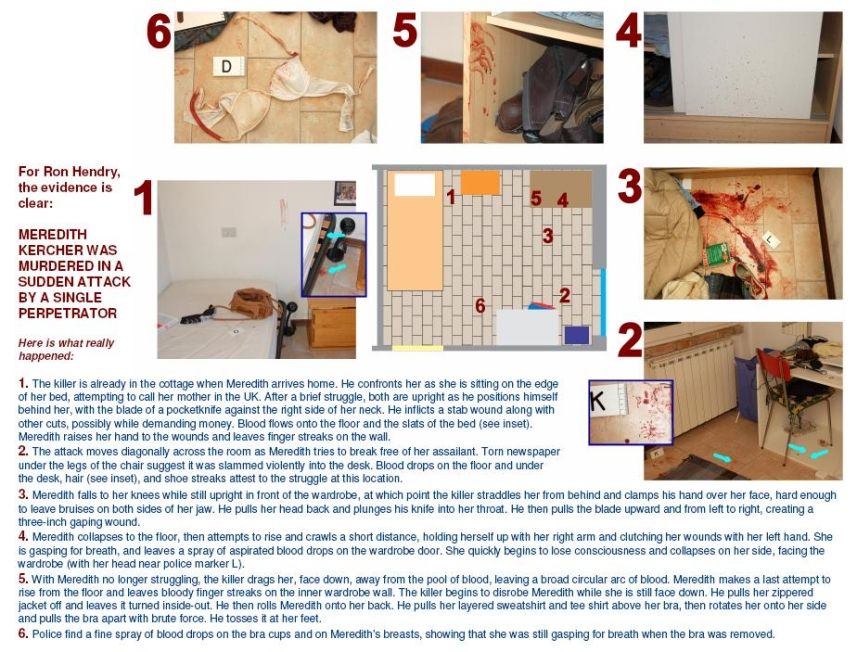
1291490984.jpg


The room seems to be 3 x 4 meters or `12 sq m or about 100 sq ft.

 
He knew from blood spatter analysis and crime reconstruction from forensics.

Read the article and learn how forensic science works.

This from the most scientific illiterate person I know.

Still think your 7 year old or you beat an International Master at chess?:rolleyes:
 
I didn't see reference to this in the trial, strange.

Perhaps in backward old Italy computers come with "Devilman" as the default.

I'd ask for a cite but I sense a tidal-wave coming.

A trial is edited to those issues considered relevant.

I don't think the tattoo came up, but I have it on good authority Rudy coincidentally had the same password.
 

Attachments

  • rs manga tattoo.jpg
    rs manga tattoo.jpg
    8.2 KB · Views: 9
[qimg]http://www.salem-news.com/gphotos/1291490984.jpg[/qimg]

The room seems to be 3 x 4 meters or `12 sq m or about 100 sq ft.

So how come Rudy then staged a burglary? We know paper was randomly scattered over Filomena's room after the murder, as (1) bits of paper were similar scattered over the duvet covering the body and (2) there was a shard of glass from the broken window in the murder room, and (3) Rudy's shoeprints show he directly left the cottage after leaving Mez' room.
 

Attachments

  • duvet.png
    duvet.png
    12.3 KB · Views: 38
Last edited:
A trial is edited to those issues considered relevant.

I don't think the tattoo came up, but I have it on good authority Rudy coincidentally had the same password.

Good authority? 8 out of 10 things you post here is wrong. Who is this "Good authority" ? Is it the guilter crazy in chief who says he's God or maybe you are referencing Richard Owens of the London TImes again?
 
So how come Rudy then staged a burglary? We know paper was randomly scattered over Filomena's room after the murder, as (1) bits of paper were similar scattered over the duvet covering the body and (2) there was a shard of glass from the broken window in the murder room, and (3) Rudy's shoeprints show he directly left the cottage after leaving Mez' room.

Nobody staged anything.
 
I guess police corruption is not a myth.


Ex-Los Angeles top cop Lee Baca faces six months in prison for lying to investigators

Baca, 73, falsely told investigators he had no idea his deputies planned to approach and threaten an FBI agent in 2011 because she was probing allegations of corruption and civil rights violations inside his former lockups, the U.S. attorney's office said.

The plea deal calls for a maximum of six months behind bars, but the actual sentence will be determined by a federal judge, according to court filings obtained by the Daily News.

Baca now admits he secretly directed deputies to "isolate" an inmate suspected of being an FBI informant and "do everything but put handcuffs" on the FBI agent sniffing around his jails.

As a result, two deputies approached the agent outside her home on September 26, 2011, and threatened her with arrest, prosecutors said.


http://www.nydailynews.com/news/nat...ed-officials-faces-6-months-article-1.2527311
 
Once again you spout off at half-cock. The Lutheran church (that is, virtually the whole of Scandinavia and Germany) marks 31st October as Martin Luther
Commemoration Day (the C16 priest, not his US C20 assassinated namesake). On the nearest Sunday, candles are lit in memory of departed loved ones. So, whilst Catholics may well eschew the celebration of quasi-witches abroad, and Raff declined to party, they do associate that time of the year with All Souls/Day of the Dead. 31st October is the eve. As per Jewish custom, on which many Christian customs are based, a religious festival starts on the eve of the day before.

From wiki:

According to one account, Luther nailed his Ninety-Five Theses to the door of All Saints' Church in Wittenberg on 31 October 1517, sparking the Reformation. The Latin inscription above informs the reader that the original door was destroyed by a fire, and that in 1857, King Frederick William IV of Prussia ordered the replacement be made. Luther's theses were engraved into today's bronze gate (pictured).

BTW Scandinavian protestants love the old pagan idea of witches, and traditionally little children dress up in witches outfits, wielding brooms.


Oh wait, I know somebody who celebrated his grandfather's birthday on 31st October every year! I'll use that as some sort of equivalent to the very specific HALLOWEEN FESTIVAL of celebrating evil spirits, since it happens to fall on the same day.

HAHAHAHAHAHAHAHAHAHAHAHA!

(Only hang on, no I won't - because the two are ENTIRELY DIFFERENT THINGS commemorating TOTALLY DIFFERENT EVENTS that happen to fall on the same date of the year. And because I know how to argue with intellectual honesty......)


ETA: to others tuning into this narrowcast, Halloween is very relevant to the Knox/Sollecito trials, since the prosecutors (and one of the convicting judges) made efforts to tie the murder to some form of Halloween-related ritual (while rationalising away the inconvenient truth that the murder happened the night AFTER Halloween through some nonsense related to the idea that they'd have "liked" to commit the crime the night before but just didn't get the right opportunity etc etc). And a not-insignificant amount of the "rationale", in both the courts and the rabid media, in 2007-2009 in particular, invoked the notion of Halloween to some degree.

It's therefore also extremely relevant to note that the Catholic Church - which is the established church of Italy, and of which IIRC Mignini (and probably many establishment figures in Italy) is a keen follower - is fervently opposed to the notion and practice of Halloween. Indeed, the Catholic Church in Italy has denounced Halloween "celebrations" as a corruption of youth. I would strongly contend that this dynamic almost certainly played a factor in the way Mignini (the chief prosecutor in the first trials) viewed the case, and why it would have been far more of a "hot potato" in Italy than it ever probably would have been in a country such as the US or UK (where Halloween is predominantly viewed as a bit of harmless fun with no anti-Christian undertones or notes of disreputable or corrupt behaviour).

And that, of course, it what makes it even more important and relevant to correct the risible notion that Halloween "is an important day for Christians" (and note the perfectly obvious specification of "Halloween" as opposed to the date 31st October - but I's sure that would be clear to all reasonable, logical observers anyhow...)
 
Last edited:
to clear, as of an accusation; free from guilt or blame; exculpate: He was exonerated from the accusation of cheating.

1. If the fact does not exist, if the accused has not committed, if the offense is not or is not required by law as a crime or if the offense was committed by a person not responsible [85 scp] or not punishable for a ' other reason, the court ruling of acquittal on their cause in the device [254 trans.].
2. The judge pronounces acquittal even when there is insufficient or contradictory evidence that the thing certain, that the accused committed it, that constitutes a criminal offense or the offense was committed by the person responsible.

You have simply repeated what I provided, but with a somewhat different translation, for CPP Article 530.1 and 530.2. You haven't shown what the alleged LEGAL difference is for the two allegedly different types of acquittal.

In my source (Mitja Giuluz et al., The Italian Code of Criminal Procedure: Critical essays and English translation), the text is slightly different, as I quoted earlier. CPP Article 530.2 reads "The judge shall deliver a judgment of acquittal also in case of insufficient, contradictory or lacking proof that the criminal act occurred, the accused committed it, the act is deemed an offense by law, the offence was committed by a person with mental capacity".

In other words, CPP Art. 530.2 states, among other reasons for acquittal, that if there is no proof (which to convict must be beyond a reasonable doubt, according to CPP Art. 533) that the accused committed the crime, the judge must acquit. This is no different than the grounds for acquittal in a US court.

Anyone in the US legal system, who was convicted, and then later found by an appeal court or retrial, to have not been guilty beyond a reasonable doubt, would be acquitted and thus exonerated.

Thus, Knox and Sollecito by US standards as well as by the laws of Italy are fully acquitted.

You have not shown any legal difference in terms of the consequences or effects of their CPP Article 530.2 acquittal compared to an Article 530.1 acquittal. Point out any specific legal difference in consequences or effects, or acknowledge that the difference is only one of perception among some.

I have previously posted a quote from Gialuz pointing out how this Italian procedural law semantic confusion in Article 530 was passed down from the pre-1988 inquisitorial justice system, and is now clarified by conviction only based on proof of guilt BARD, as required by CPP Article 533.1. I repost that quote here:

"With regard to the final decision, the CPP instead has solely eliminated the acquittal for insufficient evidence, which was inherited from the inquisitorial system based on the presumption of guilt. The Code only established that "the judge shall deliver a judgment of acquittal also in case of insufficient, contradictory or lacking proof that the criminal act occurred, the accused committed it...." It was not clear, however, which was the required standard to convict a person and therefore Article 530 was considered one of the least successful provisions of the 1988 reform."

{The CSC in the 1990's began to reference a BARD standard for certain evidentiary situations; in Joint Chambers (United Chambers) in 2002, the BARD standard was declared to be the fundamental standard of proof for conviction.}

"In 2006, Law no. 46 embodied this evolution and changed Article 533, par. 1, by introducing a norm whereby the "judge shall deliver a judgment of conviction if the accused is proven to be guilty of the alleged offence beyond a reasonable doubt". This step has represented a step towards completion, from an accusatorial viewpoint, of the Italian criminal justice system."

Source: Gialuz et al., p. 37-38
 
Last edited:
A trial is edited to those issues considered relevant.

I don't think the tattoo came up, but I have it on good authority Rudy coincidentally had the same password.

How on earth can you tell what that tattoo is? Is it like how you guys "know" the bloody footprint is Raffaele's? It's consistent with a Devilman manga tattoo and compatible = a match?
 
You have simply repeated what I provided, but with a somewhat different translation, for CPP Article 530.1 and 530.2. You haven't shown what the alleged LEGAL difference is for the two allegedly different types of acquittal.

No I provided the law as requested.

"With regard to the final decision, the CPP instead has solely eliminated the acquittal for insufficient evidence, which was inherited from the inquisitorial system based on the presumption of guilt. The Code only established that "the judge shall deliver a judgment of acquittal also in case of insufficient, contradictory or lacking proof that the criminal act occurred, the accused committed it...." It was not clear, however, which was the required standard to convict a person and therefore Article 530 was considered one of the least successful provisions of the 1988 reform."

So it wasn't an oversight but rather part of the reform. The problem doesn't seem to be with acquittal but rather with conviction.

You and others will not convince me that the people of Italy don't perceive a difference between the paragraphs.
 
Mignini was pointing out that to a gullible person in a fantasy world, the time of year could have been a trigger for acting out fantasy. Raff had vampire slaying fantasies, Rudy made a video in which he jeered, "I am a vampire and I'll drink your blood."

Amanda was all dressed up on Halloween with nowhere to go.

In her email to the world she made a point of mentioning Mez' vampire makeup running down her chin, and Raff mentioned it in police statements, too, so was obviously something they focused on.

Raff has a massive tattoo on his shoulder of a dark figure known in manga as 'Devilman', which was also the same password Rudy used on his computer.

Why wouldn't Mignini make a note of this?

Hmm. An interesting hypothesis. So you are saying Mignini made a note about vampire slaying fantasies, Halloween, implied that Raffaele lived in this vampire slaying fantasy world, brought up a religious holiday related to paganism, said that that time of year (Halloween) could be a trigger for these vampire slaying fantasies, and he has a tattoo of a Devil(man) on his shoulder. But he totally didn't mean these pagan vampire slaying fantasies were related to a pagan erotic murder game with satan devil tattoos ............ After all Wiccans are fancy tree huggers in tune with nature! Raffaele and Amanda were just playing dress-up don't you see! Trick or treat!

I like how you think Vixen.
 
A trial is edited to those issues considered relevant.

I don't think the tattoo came up, but I have it on good authority Rudy coincidentally had the same password.

Not to be difficult but it is beyond credulity to believe the prosecution wouldn't point out this connection.

Perhaps while Mignini was attending Masonic meetings, Rudi and Raf were at secret Manga tattoo meetings.
 
Wait, I think I can see it now when I run that picture through photoshop. It says "I KILLED MEREDITH WITH FOXY KNOXY" at the bottom and when I translate the rest of the words through my guilter codex I believe it says "pagan murder orgies 4lyfe"

Mystery solved!! Can you believe Raffaele had that tattooed on his SHOULDER the whole time?!
 
No I provided the law as requested.


So it wasn't an oversight but rather part of the reform. The problem doesn't seem to be with acquittal but rather with conviction.

You and others will not convince me that the people of Italy don't perceive a difference between the paragraphs.

Where you fall down is assuming that paragraph two is somehow not a full acquittal. I don't believe such a concept can be in any Western democracy, but then again your mileage varies....
 
Where you fall down is assuming that paragraph two is somehow not a full acquittal. I don't believe such a concept can be in any Western democracy, but then again your mileage varies....


It's also important and relevant to note that 530.2 is in no way equivalent to something like the "not proven" verdict that still exists in Scottish criminal justice (though I believe there are moves underway to abolish it, and rightly so).

I suspect that many lazy and/or invested-in-guilt commentators will incorrectly interpret the 530.2 acquittals of Knox and Sollecito on the murder charges as somehow akin to "they might well have done it (and there's plenty of evidence to suggest that) but we just don't have enough evidence to prove their guilt beyond a reasonable doubt, so we're going to have to acquit".

Lastly, of course Cheli is correct to say that a 530.1 acquittal would have been a total, unequivocal declaration of innocence in a much stronger way than a 530.2 acquittal. But IMO there was (and forever will be) zero possibility of 530.1 acquittals in this case, since no court can ever satisfy itself that Knox or Sollecito absolutely did not participate in the murder*. And a 530.2 acquittal covers every case where the court cannot say for CERTAIN that the accused did not (and cannot have) committed the crime - ranging all the way from zero evidence of guilt up to evidence falling just short of the BARD standard. In the case of Knox and Sollecito, their 530.2 acquittals, as evidenced by the motivations report, were right down at the former end of that scale.

And of course it's also important to note that all acquittals in Italy (as in E&W and US) carry with them the legal and ethical presumption of innocence. Not "partial" innocence. Total innocence.


* Just as, to go back to my trusty hypothetical, if I was tried for a murder which occurred at 4am half a mile from my apartment (which factually I had nothing do do with, and I was asleep alone in bed at the time), and if there was nothing (e.g. CCTV covering the entrance to my apartment block) which could actively PROVE my innocence, there's no way an acquitting court could/would ever use 530.1 to acquit. It'd be 530.2.
 
Where you fall down is assuming that paragraph two is somehow not a full acquittal. I don't believe such a concept can be in any Western democracy, but then again your mileage varies....

Since the acquittal is based on paragraph 2 of article 530 of the Italian Code of Criminal Procedure, which provides for a judge to pronounce a verdict of acquittal “when evidence is lacking, insufficient or contradictory”, it was to be expected that it would not have been a clearcut, one-sided proclamation of innocence.​

I never have said it wasn't a full acquittal. What I said was that they didn't declare her innocent as per paragraph 1. While we don't have the distinction I think most people would agree OJ would have been given a para 2.

Scotland used to have a not proven similar to para 2.

Not quite sure what being Western or democracy had to do with it.
 
No I provided the law as requested.


So it wasn't an oversight but rather part of the reform. The problem doesn't seem to be with acquittal but rather with conviction.

You and others will not convince me that the people of Italy don't perceive a difference between the paragraphs.

Does it matter what you think? Or me? Or Vixen? Or the people of Italy? They are exonerated. Cleared of the murder charges.
 
Since the acquittal is based on paragraph 2 of article 530 of the Italian Code of Criminal Procedure, which provides for a judge to pronounce a verdict of acquittal “when evidence is lacking, insufficient or contradictory”, it was to be expected that it would not have been a clearcut, one-sided proclamation of innocence.​

I never have said it wasn't a full acquittal.
At the very least you implied such above.

What I said was that they didn't declare her innocent as per paragraph 1. While we don't have the distinction I think most people would agree OJ would have been given a para 2.

Scotland used to have a not proven similar to para 2.

Not quite sure what being Western or democracy had to do with it.
That's what's troubling.
 
Does it matter what you think? Or me? Or Vixen? Or the people of Italy? They are exonerated. Cleared of the murder charges.

Just imagine that someone was found not guilty but under the Scottish "not proven" would that leave a different impression than innocent or not guilty?

ETA - Historically, the two verdicts available to Scots juries were that the case had been "proven" or "not proven". However, in a dramatic case in 1728 the jury asserted "its ancient right" to bring in a "not guilty" verdict even when the facts of the case were proven (see jury nullification). As the "not guilty" verdict gained wide acceptance amongst Scots juries, Scots began to use "not guilty" in cases where the jury felt the "not proven" verdict did not adequately express the innocence of the person on trial.
 
Last edited:
Status
Not open for further replies.

ISF - Join now!

Every member here is approved by hand. No bots, no spam, just people who care about evidence and honest debate.

Membership is free!

Create your free account

Back
Top Bottom