A hypothesis for gamma ray bursts: photon cohesion

I don't know for what kind of "quantum mechanical waves" your statement may be true.

All of them.

In the case of Einstein's photon concept however, a difference between shifting frequency and shifting phase exists. Photons of the same frequency emitted later can be in-phase or out-of-phase with previously emitted photons. A continuous drift in phase without frequency-change is therefore at least logically possible.

No.

You seem to imagine that photons emitted at discrete times can have a single frequency. But this is not the case. In order for a photon to be emitted within a specified time window, its spatial extent must also be finite, which means (ala Heisenberg) that its momentum will have a minimum uncertainty as well, which in turn means an energy (and frequency) uncertainty.

You can consider a monochromatic beam of light to be a superposition of lots of individual photons, each of which is has some spread in momentum and frequency and hence is spatially localized. But that superposition, in order to form a monochromatic beam, will end up cancelling components of each photon that vary from the frequency of the beam itself.

If you construct your monochromatic beam where the phase shifts for each successive photon you're building your beam from, then the non-cancelled frequency will be shifted. Your continuous phase shift will still be the same thing as a frequency shift.

You deny the existence of coherent photon groups separated by phase jumps only because I use it as evidence for a gamma-ray-burst hypothesis not (yet) existing in textbooks or peer-reviewed articles.

No. What you mean by "phase jump" doesn't correspond to what the authors of your source mean by "phase jump".

There is a lot of further evidence suggesting the existence of coherent photon groups, e.g. Astrophysical maser, or Random Laser:

Sure, but they all still involve conditions under which stimulated emission dominates spontaneous emission, as it does in a man-made laser. None of it is applicable to your theory.
 
Do you have some evidence that phase jumps do not occur?
It is your imaginary "gaps, fissures, jumps or even dancing the fandango" that do not exist, wogoga:
No wogoga: You have a laser beam that shifts frequency and that is that. There are no imaginary gaps, fissures, jumps or even dancing the fandango in the frequency :p.
It is your assertion that "phase jumps" exist so you need to cite the relevant scientific literature on these "phase jumps". :eek:!

The seeming idiocy of Googling for "phase jump" and picking irrelevant links is not good. There is phase noise which is not your "phase jumps", wogoga.

Lying about Wikipedia articles is worse. Astrophysical maser, and Random Laser have no "coherent photon groups". These are coherent sources.
 
Last edited:
In the case of Einstein's photon concept however, a difference between shifting frequency and shifting phase exists.

You seem to imagine that photons emitted at discrete times can have a single frequency. But this is not the case. In order for a photon to be emitted within a specified time window, its spatial extent must also be finite, which means (ala Heisenberg) that its momentum will have a minimum uncertainty as well, which in turn means an energy (and frequency) uncertainty.


Heisenberg's Uncertainty Relations (1927) have been invented just in order to defend the principles of classical wave mechanics and to fight Einstein's photon concept of 1917 (with directed, i.e. particle-like emission and absorption). This happened after experiments had delivered evidence in favor of Einstein and against Bohr-Kramers-Slater.

We very probably will never agree on this point. We have already discussed it here (see also).


It is your assertion that "phase jumps" exist so you need to cite the relevant scientific literature on these "phase jumps". :eek:!

The seeming idiocy of Googling for "phase jump" and picking irrelevant links is not good. There is phase noise which is not your "phase jumps", wogoga.


Once again my quote from 'phase noise':

Phase noise may occur in the form of a continuous frequency drift, or as sudden phase jumps, or as a combination of both.​
Lying about Wikipedia articles is worse. Astrophysical maser, and Random Laser have no "coherent photon groups". These are coherent sources.


Three quotes from Astrophysical Maser:

The emission from an astrophysical maser is due to a single pass through the gain medium and therefore generally lacks the spatial coherence and mode purity expected from a laboratory maser.

The amplification or gain of radiation passing through a maser cloud is exponential.

The exponential growth in intensity of radiation passing through a maser cloud continues as long as pumping processes can maintain the population inversion against the growing losses by stimulated emission.

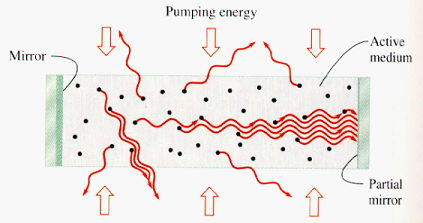
A good example of what I mean by coherent photon groups can be found in the following diagram (showing the case of a laser just switched on):

laser_just_switched_on.png


That the author uses this picture in "The Bad Diagram" only shows that he adheres to the pseudo-revolutionary (yet essentially dogmatic) Bohr-Heisenberg wave mechanics.

Cheers, Wolfgang
 
Heisenberg's Uncertainty Relations (1927) have been invented just in order to defend the principles of classical wave mechanics and to fight Einstein's photon concept of 1917 (with directed, i.e. particle-like emission and absorption).

No.

The Heisenberg uncertainty relationship (and in fact the far more general uncertainty relationship for any pair of incompatible observables) is mathematically provable from Schrodinger's equation. That proof is a standard part of undergraduate quantum mechanics courses. You can't get rid of it without getting rid of basically all of quantum mechanics. But why would you do that? Quantum mechanics works. There is no experimental evidence to contradict it, and no viable alternative to it.

There is no model under which a photon with a confined position/emission time has an exact frequency. None. And you can't build a model where that happens either.
 
Once again
Once again you are lying about those quotes, wogoga,
The seeming idiocy of Googling for "phase jump" and picking irrelevant links is not good. There is phase noise which still is not your "phase jumps", wogoga.

Lying about Wikipedia articles remains worse. Astrophysical maser, and Random Laser have no "coherent photon groups". These are coherent sources

Adding another lie is not good since Lasers: WTF is Coherent Light? has no "coherent photon groups". This a random quite bad physics web site, not the scientific literature :p! For a start the author seems to think that light is either waves or particles when it is that light acts as waves or particles depending on the measurement being done. The author thinks that coherent light only comes from pinhole sources. Obviously they have never seen a real laser and do not know that stars are not lasers (their example of a pinhole source)!
 
"Each atom in the light source is working away independently and so photons arrive at the slit with every possible phase. How does the slit put them in phase?"


The slit doesn't put them in phase. What it does is make the phase difference at the slit the only relevant phase difference, because the waves are blocked everywhere else. In contrast, if you have two spatially separated sources with nothing blocking them, then the phase difference will change from location to location.

Once you've selected that single spatial phase difference at the slit, it will not change as the superimposed waves propagate outward from the slit. This is the sense in which the slit becomes a coherent source. But if the waves are completely out of phase at the slit, then nothing will get through at all. So the slit doesn't make them get in phase. It can't.


Let us imagine a big slit and two radio antennas next to each other. Having the same distance from the slit, both antennas send a signal of the same frequency and intensity to the slit. Let us assume a phase shift (resp. difference) of Pi/2 (i.e. wavelength/4) between the two radio signals: S1 with phase 0 and S2 with phase Pi/2. The superposed signal S then gets phase Pi/4 at the slit.

Now let us divide the united signal S behind the slit into Sa and Sb, and reunite these two signals again at a given point P after a path length difference of half a wave length. If "the only relevant phase" is the superposed phase Pi/4 of S, then we get 100% destructive interference, as a phase-shift of Pi of the two otherwise identical signals Sa and Sb reduces their joint intensity to zero.

However, if we assume that the original signals S1 and S2 of the combined signal S do not interact in any way when passing the slit, then we get four different sub-signals behind the slit:

S1 becoming Sa1 with phase 0
S2 becoming Sa2 with phase Pi/2

S1 becoming Sb1 with phase 0 + Pi
S2 becoming Sb2 with phase Pi/2 + Pi

This obviously cannot result in 100% destructive interference between Sa and Sb as in the already abovementioned case, where "the phase difference at the slit" is "the only relevant phase difference":

S1 becoming Sa1 with phase Pi/4
S2 becoming Sa2 with phase Pi/4

S1 becoming Sb1 with phase Pi/4 + Pi
S2 becoming Sb2 with phase Pi/4 + Pi
In the case of sun light passing a slit, it is or may be understandable that two photons (of same or similar frequency) cannot pass together if they have a phase shift of exactly Pi, resulting in destructive interference at the slit. In all other cases however, there is a certain probability that photons with different phases can pass together through the slit. Therefore: Fully coherent light (photon groups) is only possible if photons passing the slit (within coherence length) adjust their phase-shifts, or if they already have been coherent before passing the slit.

Cheers, Wolfgang
 
Let us imagine a big slit and two radio antennas next to each other. Having the same distance from the slit, both antennas send a signal of the same frequency and intensity to the slit. Let us assume a phase shift (resp. difference) of Pi/2 (i.e. wavelength/4) between the two radio signals: S1 with phase 0 and S2 with phase Pi/2. The superposed signal S then gets phase Pi/4 at the slit.

Now let us divide the united signal S behind the slit into Sa and Sb, and reunite these two signals again at a given point P after a path length difference of half a wave length. If "the only relevant phase" is the superposed phase Pi/4 of S, then we get 100% destructive interference, as a phase-shift of Pi of the two otherwise identical signals Sa and Sb reduces their joint intensity to zero.

OK, so you took what's effectively now a single source, split it into two paths of different length, and then combined the two paths after to destructively interfere.

However, if we assume that the original signals S1 and S2 of the combined signal S do not interact in any way when passing the slit, then we get four different sub-signals behind the slit:

S1 becoming Sa1 with phase 0
S2 becoming Sa2 with phase Pi/2

S1 becoming Sb1 with phase 0 + Pi
S2 becoming Sb2 with phase Pi/2 + Pi

This obviously cannot result in 100% destructive interference between Sa and Sb as in the already abovementioned case, where "the phase difference at the slit" is "the only relevant phase difference":

Actually, this situation DOES result in 100% destructive interference. Sa1 cancels Sb1, Sa2 cancels Sb2. It's right there in your numbers. Treating the components separately doesn't change the end result.

Therefore: Fully coherent light (photon groups) is only possible if photons passing the slit (within coherence length) adjust their phase-shifts, or if they already have been coherent before passing the slit.


The mistake that you are making is in thinking that this "adjustment" consists of anything other than BLOCKING the component of the waves which are not already in phase at the slit. The component of the waves which is out of phase doesn't get changed to be in phases, it just interacts with the screen with the slit rather than what's beyond the screen.

But there is no slit in our astronomical case. The components which are not in phase don't get blocked, they aren't absorbed anywhere, they aren't reflected away. There is nothing which makes that light become coherent the way you are envisioning it.
 
However, if we assume that the original signals S1 and S2 of the combined signal S do not interact in any way when passing the slit, then we get four different sub-signals behind the slit:

S1 becoming Sa1 with phase 0
S2 becoming Sa2 with phase Pi/2

S1 becoming Sb1 with phase 0 + Pi
S2 becoming Sb2 with phase Pi/2 + Pi

This obviously cannot result in 100% destructive interference between Sa and Sb as in the already abovementioned case, where "the phase difference at the slit" is "the only relevant phase difference":

Actually, this situation DOES result in 100% destructive interference. Sa1 cancels Sb1, Sa2 cancels Sb2. It's right there in your numbers. Treating the components separately doesn't change the end result.

The mistake that you are making is in thinking that this "adjustment" consists of anything other than BLOCKING the component of the waves which are not already in phase at the slit.


Ok. My reasoning with two phase-shifted radio signals (each divided into two sub-signals) is analogous to the 'one photon takes all paths' hypothesis, and this (in my opinion untenable) hypothesis can indeed explain (at least lateral) coherence.

Nevertheless, your statement that a slit makes the superposed phase of photons (passing at the same time) "the only relevant phase" isn't true either. Your conclusion "the slit becomes a coherent source" (#39) logically depends primarily on the 'one photon takes all paths' hypothesis, and not on blocking photons which are not in phase.

Two photons passing a slit can only be fully blocked if they have exactly opposite phase (e.g. one photon with phase 0 and the other with Pi). In the case of a phase shift between two photons of phi = Pi/2, the probability of passing the slit is Cos[phi/2]2 = 50% for each photon. So there is a 25% chance of both photons passing the slit. Because of their phase shift of Pi/2, the two photons cannot interfere in the same way, as two coherent photons with phase shift 0 would do. Therefore the slit cannot cause incoherence to completely disappear.

By the way, no interference takes place between orthogonally polarized photons. From Wikipedia: "Temporal (or longitudinal) coherence implies a polarized wave at a single frequency whose phase is correlated over a relatively great distance (the coherence length) along the beam."

So, for explaining that "the slit becomes a coherent source", you need apart from "the superposed phase becomes the only relevant phase" also something like "the superposed polarization becomes the only relevant polarization".

Cheers, Wolfgang
 
Last edited:
Ok. My reasoning with two phase-shifted radio signals (each divided into two sub-signals) is analogous to the 'one photon takes all paths' hypothesis, and this (in my opinion untenable) hypothesis can indeed explain (at least lateral) coherence.

Nevertheless, your statement that a slit makes the superposed phase of photons (passing at the same time) "the only relevant phase" isn't true either. Your conclusion "the slit becomes a coherent source" (#39) logically depends primarily on the 'one photon takes all paths' hypothesis, and not on blocking photons which are not in phase.

First, photons DO take all paths. This isn't "untenable", it's the only explanation which makes sense. There is no other explanation for single-photon interference. Second, you seem to be confused by the mathematics of linear superposition. More below. Third, don't confuse single-slit with double-slit.

Two photons passing a slit can only be fully blocked if they have exactly opposite phase (e.g. one photon with phase 0 and the other with Pi).

And?

Regardless of the relative phase of the two photons, we can ALWAYS treat each photon as a superposition of components which are out of phase and equal in magnitude at the slit plus components which are in phase at the slit. The slit blocks the components which are out of phase at the slit. This is basic linear superposition.

In the case of a phase shift between two photons of phi = Pi/2, the probability of passing the slit is Cos[phi/2]2 = 50% for each photon. So there is a 25% chance of both photons passing the slit. Because of their phase shift of Pi/2, the two photons cannot interfere in the same way, as two coherent photons with phase shift 0 would do. Therefore the slit cannot cause incoherence to completely disappear.

Your analysis is wrong. The mechanism for blocking photons at the slit via interference means that photons which travel through the slit have their phase changed. This is mathematically equivalent to the transmission of polarized photons through a polarizer rotated at 45 degrees. Half the photons make it through and half get blocked, but the half that do make it through have a different phase than the original photons.

By the way, no interference takes place between orthogonally polarized photons.

It does if you pass them through a polarizer at an angle half way between them.
 
Sunlight should indeed be incoherent, because sunlight emerges from thermal radiation, and thermal radiation is considered spontaneous emission. So the phase of one photon should be independent from all other photons.

However photons, as social particles, tend to emerge and travel in coherent groups. And the longer they travel next to one another, the more they become coherent, by exchanging momentum and energy.

Did you see what was said? The hypothesis that photons interact, or are "social" as you put them, to any great degree has been falsified. They are, for the most part, loners. If they emerged in coherent groups all the time, LASERs would not be necessary to get coherent light beams.
 
Last edited:
First, photons DO take all paths. This isn't "untenable", it's the only explanation which makes sense.


Here you follow Bohr, Heisenberg, Feynman and so on, according to whom photons are rather theological objects with properties attributed to angels (and saints): they can be everywhere at the same time. I follow Einstein, according to whom photons are individual physical objects, with concrete distribution of mass/energy and momentum over a limited space. The amount of space over which energy and momentum of a photon of a given frequency is distributed may depend on factors such as photon densities in the neighborhood. (See again #43).


There is no other explanation for single-photon interference.


We must not confuse "single-photon interference" as predicted by QM with inference of real photons. According to common sense (as advocated by Einstein), it is impossible to split one single photon by a beam-splitter into taking two different paths. The energy E of the photon can be found either in path 1 or in path 2. If the paths consist of a refractive medium such as glass, then the mass of either path 1 or of path 2 is increased by E/c2.

The belief that either the photon somehow knows the future (i.e. where it will be absorbed), or that at absorption time in path 2, half of the energy and momentum is transferred instantaneously from a far-away location in path 1, is so incredibly absurd that Einstein gave up further discussing with Bohr.

Unfortunately, Einstein's unwillingness to continue the discussion was interpreted by others as a victory of Bohr.

That single-photon interference is possible in case of a double-slit is easy to understand. Also an individual flock of birds can use two slits in a wall without losing its unity, if the slits are not too far apart.


Regardless of the relative phase of the two photons, we can ALWAYS treat each photon as a superposition of components which are out of phase and equal in magnitude at the slit plus components which are in phase at the slit. The slit blocks the components which are out of phase at the slit.


Two pieces of matter, one with 9 kg and the other with 11 kg exchange matter so that each piece will have 10 kg. Now your superposition principle means that both pieces already have 10 kg before mass-homogenization. The 9 kg of piece 1 are a superposition 10 kg and -1 kg, and the 11 kg of piece 2 a superposition of 10 kg and +1 kg.


Because of their phase shift of Pi/2, the two photons cannot interfere in the same way, as two coherent photons with phase shift 0 would do. Therefore the slit cannot cause incoherence to completely disappear.

Your analysis is wrong.


My analysis is based on your premises.


The mechanism for blocking photons at the slit via interference means that photons which travel through the slit have their phase changed.


Finally you admit what I've been advocating throughout this discussion: Photons with (very) similar properties coming close together can become coherent, i.e. they adapt their phase (and other properties) to each other.

Two photons with very similar properties coming from the left and the right side of the sun to a point on Earth at the same time do not become coherent, as their propagation directions are too different. However, if they succeed in passing through a small slit, then they will adjust their phases to each other.

Cheers, Wolfgang
 
Last edited:
Here you follow Bohr, Heisenberg, Feynman and so on, according to whom photons are rather theological objects with properties attributed to angels (and saints): they can be everywhere at the same time. I follow Einstein, according to whom photons are individual physical objects, with concrete distribution of mass/energy and momentum over a limited space.

I don't care who you follow. You have failed to offer an explanation for single-photon interference. This does not surprise, since there IS no explanation which doesn't involve the photon taking both paths.

We must not confuse "single-photon interference" as predicted by QM with inference of real photons. According to common sense (as advocated by Einstein), it is impossible to split one single photon by a beam-splitter into taking two different paths.

Single-photon interference as predicted by QM is very much interference of real photons. The experiments have been done.

The belief that either the photon somehow knows the future (i.e. where it will be absorbed), or that at absorption time in path 2, half of the energy and momentum is transferred instantaneously from a far-away location in path 1, is so incredibly absurd that Einstein gave up further discussing with Bohr.

And?

You're just using argument from authority at this point, but it won't work. The experiments don't conform to Einstein's views. Bell's inequality (and experimental tests of it) proved that conclusively.

That single-photon interference is possible in case of a double-slit is easy to understand.

Yes, it is easy to understand: the photon takes both paths.

You claim that this is not correct, but can offer no alternative.

Two pieces of matter, one with 9 kg and the other with 11 kg exchange matter so that each piece will have 10 kg. Now your superposition principle means that both pieces already have 10 kg before mass-homogenization.

It means nothing of the sort. You really don't understand quantum mechanics. "Linear superposition" has a mathematical definition, and that definition simply doesn't apply to your hypothetical.

My analysis is based on your premises.

So? You still got it wrong. Basing an analysis on something correct doesn't guarantee that you won't make any mistakes.

Finally you admit what I've been advocating throughout this discussion: Photons with (very) similar properties coming close together can become coherent, i.e. they adapt their phase (and other properties) to each other.

Yes, they can. But it requires something external (such as a narrow slit or a polarizer) to make it happen.

No such mechanism is available in the gamma ray burst problem.
 
Here you follow Bohr, Heisenberg, Feynman and so on, according to whom photons are rather theological objects with properties attributed to angels (and saints): they can be everywhere at the same time. I follow Einstein, according to whom photons are individual physical objects, ..
Sorry, wogoga, but fantasies about how Bohr, Heisenberg, Feynman, Einstein and so on treated photons is not science :p,

Bohr, Heisenberg, Feynman, Einstein and so on were not stupid. They treated photons as photons presented themselves in theory and experiments.
* Photons travel every possible path - photons are never "everywhere at the same time".
That is a point of the single photon double slit experiments where a photon acts as if it goes through both slits.
* Photons are waves (sometimes).
* Photons are particles (sometimes).
* Photons follow the Heisenberg Uncertainly Principle.
etc.

We must not ignore the actual experimental observation of a photon acting as if it goes through both slits in a single photon double slit experiment and that this is predicted by QM. That is denial of science, wogoga!

We must not ignore that many things in QM contradict commonsense as Einstein knew, wogoga - you really think that Einstein did not know about wave/particle duality :eek: ?

The rest of your post just exposes more ignorance about QM.
 
Last edited:
Very high-energy gamma rays

Quote from Teraelectronvolt pulsed emission from the Crab Pulsar detected by MAGIC:

"We investigate the extension of the very high-energy spectral tail of the Crab Pulsar at energies above 400 GeV."

"Using data from the MAGIC telescopes we measured the most energetic pulsed photons from a pulsar to date. Such TeV pulsed photons require a parent population of electrons with a Lorentz factor of at least 5×10⁶."

"The MAGIC results require a revision of the state-of-the-art models proposed to explain how and where gamma-ray pulsed emission from 100MeV to 1.5 TeV are produced."

The crab pulsar is not an obscure source such as a remote quasar, but an object at a distance of only around 7000 light years from us. It is the remnant of a supernova explosion around 8000 years ago, which became visible on Earth in the year 1054.

From experience we know that for a high-speed particle, the probability of slowing down is much higher than of further speeding up. How could an electron reach a speed so close to light-speed c that its mass-energy is increased by a factor of 5 million? How is this energy-equivalent of millions of electron-masses transferred to one electron? According to Maxwell and standard physics, the transferred energy itself can only move at c!

The problem of incredibly huge photon energies stems only from the hypothesis that photon-densities always get more and more diluted with time. Under the premise of cohesive forces between gamma photons (post #1) we simply explain such a gamma pulse of 1.5 x 10¹² eV by e.g. a flock of 3 x 10⁶ photons with each 5OO keV instead of one single photon with 1.5 TeV.

As the wavelength of a 500 keV photon is only around 2.5 pm = 2.5 x 10⁻¹² m, such a flock consisting of three million individual photons can theoretically be localized in an extremely small region. Insofar as we can neither determine directly wavelength nor frequency of high-energy photons, it is currently impossible to discriminate between one single photon of 1012 eV and a compact group of 105 photons with each 107 eV.

Cheers, Wolfgang
www.pandualism.com
 
Last edited:
The problem of incredibly huge photon energies stems only from the hypothesis that photon-densities always get more and more diluted with time. Under the premise of cohesive forces between gamma photons (post #1) we simply explain such a gamma pulse of 1.5 x 10¹² eV by e.g. a flock of 3 x 10⁶ photons with each 5OO keV instead of one single photon with 1.5 TeV.

No. Photons do not do that. We've known that they don't do that ever since Einstein's seminal photoelectric effect paper. Multiple low-energy photons cannot and do not act like one high-energy photon.
 
The problem of incredibly huge photon energies stems only from the hypothesis that photon-densities always get more and more diluted with time.
The problem really is an abysmal ignorance of geometry, wogoga:
The density of photons travelling away from a point source decreases because there is more volume for them. It is not a hypothesis. It is simple geometry - the surface that they travel through increases in area with time :eek:.

A delusion about photons magically grouping together does not change this basic geometry.
 
The solution of the mystery of terrestrial gamma glows and flashes

Under the premises of 1) induced emission of "droplets" of gamma photons and 2) cohesive forces between the photons of such droplets, terrestrial gamma flashes (TGF) and gamma glows from thunder-clouds become much less mysterious.

Different from the case of ultra-high-energy gamma flashes, cohesive forces may not be necessary in the terrestrial case, as the photon-droplets could emerge as very narrow beams, and distance from source to detector (leading to beam-width expansion) is relatively small.

For better understanding here some quotes from Positron clouds within thunderstorms of 2015:

Lightning leaders have been observed to emit bright sub-microsecond pulses of x-rays with energies typically in the few hundred keV range.

Long laboratory sparks have been shown to produce similar x-ray emissions.

Thunderstorms produce bright sub-millisecond bursts of gamma rays, called terrestrial gamma ray flashes (TGFs), with energies reaching several tens of MeV.

For both the lightning/laboratory spark emissions and TGFs, the x-rays and gamma rays are produced by bremsstrahlung interactions of energetic electrons with air. However, it is a theoretical challenge to explain how so many high-energy electrons are generated in our atmosphere on such short time scales.

Another kind of emission from thunderclouds is the gamma-ray glow. Gamma-ray glows appear as sub-second to minute long emissions of gamma rays. Like TGFs, the glows are produced by bremsstrahlung emissions from energetic electrons and in some cases have been found to have spectra similar to those of TGFs. However, glows last much longer than TGFs and have much lower fluxes. Gamma-ray glows have been observed by aircraft, balloon and on the ground.

… demonstrated that active thunderstorms produce gamma rays that last tens of seconds, with energies greater than 110 keV.

They found that the gamma-ray emissions were generally terminated, rather than caused, by lightning.

In a series of balloon flights, … flew scintillators and electric field sensors through and above active thunderstorms and measured gamma-ray glows of up to 120 keV in energy. They found that the gamma-ray emissions occurred at an altitude of 4 km where the electric field was highest.

The emission persisted while the balloon passed through the strong-electric-field region within the storm, except that it terminated and then restarted following two lightning flashes.

… measured gamma-ray enhancements of up to 70 times the local background level at the Monju nuclear reactor in Japan during a winter thunderstorm.

The currently prevailing explanation is Relativistic Runaway Electron Avalanche. RREA is an apriori highly unlikely explanation: Electrons are assumed to at first accelerate to relativistic speeds (i.e. with Lorentz-factors substantially higher than 1); then gamma photons (x-rays) are "produced by bremsstrahlung interactions of energetic electrons with air". Whereas normally losses due to friction resp. bremsstrahlung increase with electron speed, the hypothesis is based on substantially decreasing friction losses with increasing speed.

Two quotes from Lightning (Wikipedia):

A typical cloud to ground lightning flash culminates in the formation of an electrically conducting plasma channel through the air in excess of 5 kilometers tall, from within the cloud to the ground's surface. The actual discharge is the final stage of a very complex process.

The cause of the X-ray emissions is still a matter for research, as the temperature of lightning is too low to account for the X-rays observed.

Two quotes from Lightning strike:

Most of the early formative and propagation stages are much dimmer and not visible to the human eye.

The establishment of the ionic channel takes a comparatively long amount of time (hundreds of milliseconds) in comparison to resulting discharge which occurs within a few microseconds.

The explanation of terrestrial gamma glows and flashes by photon cohesion is very simple. The plasma channels of thunderclouds act like a gamma-laser ("gaser") gain medium; and a flash "particle" consists not of one single gamma quantum but of a compound of gamma photons. The energy of individual photons of such gamma droplets primarily stems from ionization energies in the plasma channels of the thunderclouds.

The longer a spontaneously emitted gamma quantum propagates within an ionic channel, the bigger a droplet can grow due to induced emission of coherent photons. A gamma flash with an "energy spectrum" of around 500 keV could therefore be composed not of one quantum but e.g. of around 10,000 quanta of each 50 eV. As the wavelength of a 50 eV photon is only around 2.5 x 10⁻⁸ m, and 40 x 40 x 40 = 64,000 cubes of edge length 2.5 x 10⁻⁸ m can form a cube with an edge length of 1 micrometer, such a composite gamma droplet can be very compact.

No sophisticated feedback mechanism is necessary to explain repetitive glows and flashed from the same thundercloud regions.

Another relevant quote from Wikipedia:

In a few situations it is possible to obtain lasing with only a single pass of EM radiation through the gain medium, and this produces a laser beam without any need for a resonant or reflective cavity (see for example nitrogen laser). Thus, reflection in a resonant cavity is usually required for a laser, but is not absolutely necessary.

At least in the case of "long laboratory sparks", a simple experiment should be able to refute the currently prevailing Relativistic Runaway Electron Avalanche hypothesis: The application of a magnetic field preventing the electrons by the Lorentz force from simply accelerating in the electrostatic field.

Cheers, Wolfgang
The solution of the mystery of terrestrial and extraterrestrial gamma glows and flashes: photon cohesion

 
Under the premises of 1) induced emission of "droplets" of gamma photons and 2) cohesive forces between the photons of such droplets

The premise is wrong, so the rest is irrelevant.
 

Back
Top Bottom