
moving right on to some climate science and the consequences of our warming the planet....
Except the sun and planet have other ideas

Stephen Wilde has a theory. Plug in your brain, and follow this chain of potential influence:
The Sun —-> UV or charged particles —- > ozone —-> polar jet streams —–> clouds —–> surface temperatures.
Summary of the Stephen Wilde Hypothesis
In essence: The Sun affects the ozone layer through changes in UV or charged particles. When the Sun is more active there is more ozone above the equator and less over the poles, and vice versa. An increase in ozone warms the stratosphere or mesosphere, which pushes the tropopause lower. There is thus a solar induced see-saw effect on the height of the tropopause, which causes the climate zones to shift towards then away from the equator, moving the jet streams and changing them from “zonal” jet streams to “meridonal” ones. When meridonal, the jet streams wander in loops further north and south, resulting in longer lines of air mass mixing at climate zone boundaries, which creates more clouds. Clouds reflect sunlight back out to space, determining how much the climate system is heated by the near-constant incoming solar radiation. Thus the Sun’s UV and charged particles modulate the solar heating of the Earth.
Good explanation of why this may be an enduring and increasingly dangerous pattern
Nope, the JET STREAM has been stuck over the UK for a few weeks now and it's for that reason the flooding has happened.
What controls the JET STREAM? It's our variable star of course

With an INACTIVE Sun (as we have now) Earth system losing energy, Jet Stream moves towards the equator, more clouds, high albedo
With an ACTIVE Sun (as we had last century) Earth system gaining energy, Jet Stream moves towards the poles, less clouds, low albedo
the collision zone
Under the Jet Stream
worth the read
Oh Yes !
Is the Sun driving ozone and changing the climate?
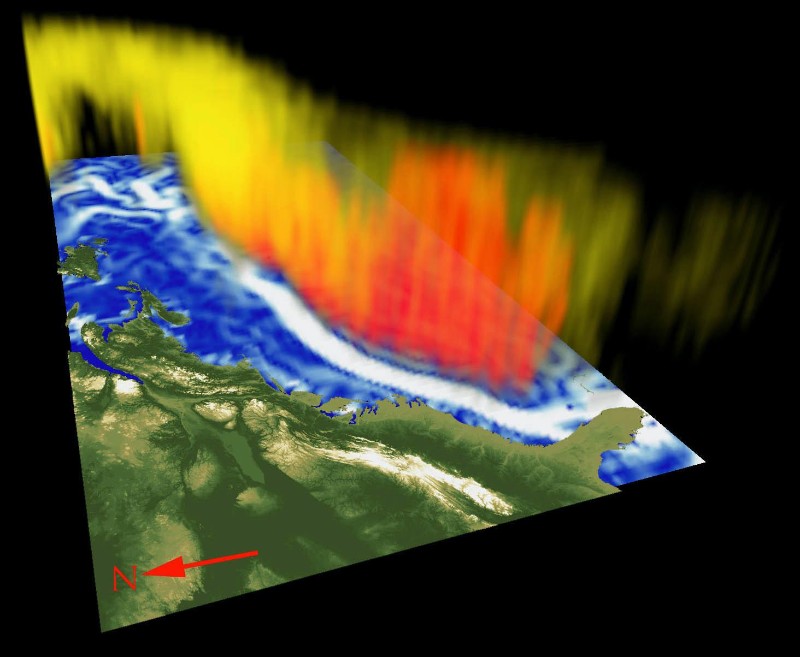
The new paper by Andersson et al builds on the hypothesis that ozone is influential and a potential mechanism to amplify solar factors. It adds energetic electron precipitation (EEP) to spectral changes in UV, which is a significant step forward.
Andersson et al describe it as having a short term regional effect, with no implications for global or long term climate change. But if the effect is significant between the peak and trough of a single solar cycle, then surely it is also going to be significant over the millennial cycle of solar variation — such as that observed from the Medieval Warm Period through the Little Ice Age and up to date.
Observations of climate changes across the last thousand years suggest that it must be so. In the Medieval Warm Period, Greenland had agriculture and the Western Isles of Scotland were prosperous with a much larger population than today—which implies more poleward climate zones and zonal jets at that time. In contrast, ships logs from the Little Ice Age show much greater Atlantic storminess and more equatorward mid latitude depression tracks at that time (depressions generally follow the tracks of the jet streams).
How The Sun Could Control Earth’s Temperature PDF
Note that the solar UV warming effect on ozone in the stratosphere becomes weaker as one approaches the poles whereas the solar proton destruction of ozone in the mesosphere becomes stronger as one approaches the poles. I suggest that within the polar vortex (poleward of the mid latitude jets) the solar proton effect becomes dominant and affects the height of the polar tropopause more than does the solar UV effect but due to the reversed sign of the solar proton effect (cooling) as compared to the UV effect (warming) both processes act on the jets the same way.
The temperature differential between surface and stratosphere will increase either if the surface warms or if the stratosphere cools so a higher tropopause (globally averaged – never mind the latitudinal variations) and a poleward shift of the jets is consistent either with AGW theory which proposes a warming of the troposphere from human CO2 or in accordance with my hypothesis which proposes a cooling of the stratosphere from some natural solar induced process when the sun is more active.
So which is it – natural or anthropogenic ?
The jets were more poleward during the Mediaeval Warm Period hence the reported Viking settlements in Greenland so the temperature differential from surface to stratosphere must have increased then too and at that time there was no significant warming in the troposphere from human emissions thus the cause of the poleward jets back then must have been a net cooling of the stratosphere from entirely natural causes at a time of (then as now) a more active sun.
On the basis of logic and observations and contrary to AGW theory it must be the case that the stratosphere cools naturally when the sun is more active and warms naturally when the sun is less active.
Maunder Minimum jets were well south of what we see today and we know that from ship's records. MWP jets were north of even what they were in the 1990's because the Vikings could settle Greenland back then.
Solar activity predicted to fall 60% in 2030s, to 'mini ice age' levels: Sun driven by double dynamo
A new model of the Sun's solar cycle is producing unprecedentedly accurate predictions of irregularities within the Sun's 11-year heartbeat. The model draws on dynamo effects in two layers of the Sun, one close to the surface and one deep within its convection zone. Predictions from the model suggest that solar activity will fall by 60 per cent during the 2030s to conditions last seen during the 'mini ice age' that began in 1645.
Irregular heartbeat of the Sun driven by double dynamo
Looking ahead to the next solar cycles, the model predicts that the pair of waves become increasingly offset during Cycle 25, which peaks in 2022. During Cycle 26, which covers the decade from 2030-2040, the two waves will become exactly out of synch and this will cause a significant reduction in solar activity.
“In cycle 26, the two waves exactly mirror each other – peaking at the same time but in opposite hemispheres of the Sun. Their interaction will be disruptive, or they will nearly cancel each other. We predict that this will lead to the properties of a ‘Maunder minimum’,” said Zharkova. “Effectively, when the waves are approximately in phase, they can show strong interaction, or resonance, and we have strong solar activity. When they are out of phase, we have solar minimums. When there is full phase separation, we have the conditions last seen during the Maunder minimum, 370 years ago.”

Also interesting ...
SUN EXPERIENCES SEASONAL CHANGES, NEW RESEARCH FINDS
In the new paper, the authors conclude that the migrating bands produce seasonal variations in solar activity that are as strong as the more familiar 11-year counterpart. These quasi-annual variations take place separately in both the northern and southern hemispheres.
“Much like Earth’s jet stream, whose warps and waves have had severe impact on our regional weather patterns in the past couple of winters, the bands on the Sun have very slow-moving waves that can expand and warp it too,” said co-author Robert Leamon, a scientist at Montana State University. “Sometimes this results in magnetic fields leaking from one band to the other. In other cases, the warp drags magnetic fields from deep in the solar interior, near the tachocline, and pushes them toward the surface.”
The surges of magnetic fuel from the Sun’s interior catastrophically destabilize the corona, the Sun’s outermost atmosphere. They are the driving force behind the most destructive solar storms.
“These surges or ‘whomps’ as we have dubbed them, are responsible for over 95 percent of the large flares and CMEs—the ones that are really devastating,” McIntosh said.
The quasi-annual variability can also help explain a cold-war era puzzle: why do powerful solar flares and CMEs often peak a year or more after the maximum number of sunspots? This lag is known as the Gnevyshev Gap, after the Soviet scientist who first reported it in the 1940s. The answer appears to be that seasonal changes may cause an upswing in solar disturbances long after the peak in the solar cycle.



 I posted just part of a cartoon that you thought couldn't happen


 ! The reason being that the organizers are the neo-